
A ‘Nazi gold train’ in Poland: Why does the search persist?


A ‘Nazi gold train’ in Poland: Why does the search persist?
Is there actually a treasure-filled train buried in a tunnel in southwestern Poland? Or do Nazi conspiracy theories, urban legends, and tourism continue to draw amateur treasure hunters to the region?
By Ben Rosen, The Christian Science Monitor, August 16, 2016
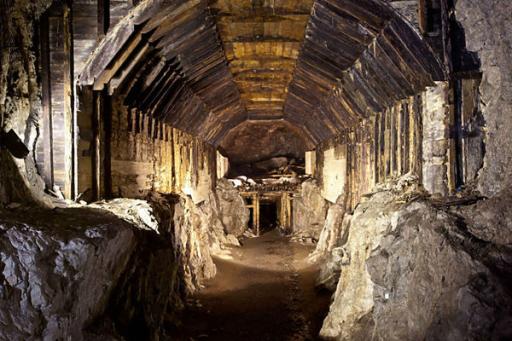
AP View Caption
Legend has it a Nazi train, filled with gold, gems, valuable art, and armaments, disappeared into a mysterious network of tunnels under the Owl Mountains, a mountain range in southwest Poland, during the Soviet advance to end World War II. According to Polish folklore, the train has remained sealed in a tunnel underneath the city of Walbrzych ever since.
Despite historians and geologists’ attempts to discredit the tale, amateur treasure hunters have continued to search for the "lost train." A team of 35 of these hobbyists resumed this pursuit Tuesday, excavating where two men a year ago said they had radar proof of the train's existence.
These explorers’ search is partly driven by a lust for gold and treasure. Yet, observers say the mystery is shrouded by a combination of factors: Nazi activity underneath the city, urban legend, and the defunct coal mines abandoned after the fall of Communism. With no clear answers, explorers continue in their a quest to uncover the supposed buried locomotive.
For 70 years, accounts have circulated around the Walbrzych and Lower Silesia region of Poland of a lost train. According to the legend, the train is in the network of tunnels the Nazis built through "Project Riese," the code name for a subterranean construction project of Nazi Germany in 1943. The secret operation left behind a system of tunnels and bunkers 164 feet in the ground, most of which remain inaccessible. Walbrzych residents told the Monitor in fall 2015 that the tunnels served as the perfect storehouse to hide billions of dollars in gold and jewels hidden from the fast-approaching Red Army.
Treasure hunters have searched for and gone spelunking in the tunnels in search of the train and other valuables. This pursuit turned into a frenzy about a year ago, when treasure hunters Piotr Koper of Poland and Andreas Richter and Germany said radar equipment revealed a train was buried in the ground.
Responding to Mr. Koper and Mr. Richter’s claims, a team of Polish geologists declared in December 2015 that the train did not exist. The team from the University of Science and Technology said geological tests of the area showed a tunnel could be buried underneath the ground, but no train
Nevertheless, the hunt has resumed. Why?
The Christian Science Monitor’s Monika Rębała and Sara Miller Llana wrote in September 2015 that the Nazi's mystery intentions for Project Riese have fed conspiracy theories.
Albert Speer, the German architect and Third Reich minister, wrote in his memoirs that if they had completed the project, 20,000 people could have lived here. “That's why we call it the city,” says Zdzisław Łazanowski, who governs the Underground City Osówka, which is one of the main bunkers of the Riese, located in the Sowie Mountains. “Probably it was a kind of underground city in case of a nuclear bomb attack,” he says. And the tunnels also could have served as a safehouse for gold and other treasures against the advancing Soviet army.
Zeitgeist about Nazi descendants returning to their homes has also played a part, wrote the New Yorker’s Jake Halpern in May. Polish Lower Silesia was part of the Third Reich, and many of the Polish homes there once belonged to Germans.
Joanna Lamparska, who has written several books about the treasure hunters of Lower Silesia, told me that the legend of the guards came from an enduring Zeitgeist: a sense, among older Poles, that the region is not really theirs. For decades after the war, many Poles lived out of suitcases, half expecting that the Germans whose homes they occupied would return and demand what was theirs. During the nineteen-seventies, as relations between Poland and West Germany warmed, many former German residents returned to visit their old homes. Lamparska said that there are countless stories of German tourists arriving with bags and retrieving possessions buried in the ground or hidden in walls.
The few ethnic Germans allowed to remain in Lower Silesia after the war allegedly stayed behind to look after caches.
Legends about the train has also turned the defunct mining city into a tourist destination.
"We have been hoping to become a tourist town since the mines closed in the 1990s and it happened over one month because of the train story," local historian Mateusz Mykytyszyn told NBC News, who describes the mystery as the region's Loch Ness monster, much talked about but never seen. "I've spoken with restaurant owners, taxi drivers, tour operators and they have seen a huge rise in interest. Definitely it is a different town."
This continued Tuesday, as the privately funded search was scheduled to be live streamed online.
Tags
Who is online
158 visitors
A great way to bring an abandoned town back to life again.
What an intriguing story; and, it's not even over!
Why does the search persist?
The lure of great riches? Perhaps a desire to solve a mystery? A desire for an adventure?
Actually there are a lot of stories like this. There've been rumours of various ships on American rivers in the South supposedly carrying YUGE amounts of gold to pay Union soldiers . . or Confederate soldiers. Some people are still looking for where various famous pirates supposedly buried their treasures. In fact, some adventurous divers try to find any historical shipwreck they can, in hopes of finding something of value.
Then there are legends about"the Lost Kingdom of the Incas" (or Aztcs . . . or Mayans) deep in the Jungle where lots of gold supposedly exists. And so much more. And that's just in the Western Hemisphere.
Very interesting story ! Thanks for posting.