


Editor’s Note: Our talk of cars tends to be related to a wide variety of topics like speed, looks, comfort and fuel mileage. Yet often overlooked — both by enthusiasts and everyday drivers — is one of the most important factors: safety. This week, we’re taking a deeper look at how modern vehicles are keeping you and your loved ones safe. We start here, with a review of how the National Highway Traffic Safety Administration tests cars’ performance in accidents — and how they’re getting it wrong.
ize matters in cars, and not just for carrying more passengers, extra fuel or having the space for a bigger engine. It’s both conventional wisdom and fact that heavier cars tend to be safer for their drivers and passengers during crashes. Yes, it’s a complex issue, and there are exceptions to the rule (a big, hulking SUV with a high center of gravity might be less safe than a well-designed sedan, for example) but generally, you want to be driving the Chevy Tahoe and not the Chevy Cruze if the two are destined to meet intimately on the road.
GREAT QUICK SPINS: Audi A3 | Volkswagen Golf GTI | Zero S Electric Motorcycle
And the stats prove the principle. Studies from the Insurance Institute for Highway Safety (IIHS) show that from 1994-1997, the death rate for occupants of sub-2,500 pound cars was 101 per million. The rate for 4,000 pound sedans was 85. 4,500 was 73. There’s clear strength in the numbers. This is true for a number of reasons, in both single car accidents and those involving multiple vehicles. Bigger cars give occupants more room to move — get into a wreck, and your body has the potential to get smacked around pretty hard by the interior of the car. The more interior space, the less likely you’ll be to smash your face against a hard A-pillar or a dash surface. Smaller, lighter cars also have smaller “crumple zones”, the areas of a car designed to absorb the force of an accident and diffuse it by “controlled deformation”.
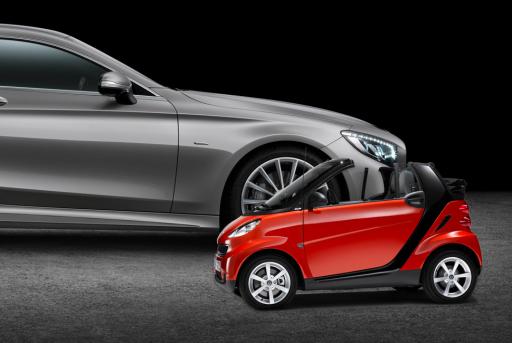
But when it comes to crash test ratings that are widely recognized in the automotive industry and consumers, weight is not brought into the equation with the heft it deserves. The NHTSA uses weight classes in their annual safety report, but they’re broad ones: 3,500 pounds and up goes into one class, under 3,500 are split up into groups every 500 pounds, while SUVs, vans and light-duty pickup trucks get stuck in their own category. But two cars in completely separate weight classes can get the same rating, based on their laboratory conducted crash testing. For example, the 2014 Chevy Spark (automatic) weighs in at a Richard Simmons-like 2,368 pounds and gets an acceptable crash rating, while the Toyota Highlander gets the same rating but weighs in at 4,134 pounds. That’s a 1,766 pound difference, or very close to the weight of a Smart ForTwo. Which car would you rather drive at the other one?
Simple physics is proof in the pudding: Newton’s Second Law of Motion states that Mass multiplied by Acceleration equals Force. This applies to two cars of different weight smashing into each other.
Simple physics is proof in the pudding. Newton’s Second Law of Motion states that Mass multiplied by Acceleration equals Force. The Aveo’s force looks like this: 1074 kg (2,368 lbs) multiplied by 17.8816 m/s2 (40 mph) equals approximately about 19,204 kg of force. The Highlander generates 33,528 kg of force at the same speed. Though both of them get high marks in crash testing against a stationary object, it’s clear that the bigger, heavier Highlander will fare better in an accident.
Then there’s the difference between the conditions in the lab where crash testing is conducted, against static objects, and the actual paved real world, with real cars moving in all directions and a wide variety of deadly roadside obstacles. A smaller sedan like the Hyundai Elantra might do quite well in laboratory crash testing, but that only involves collisions with static objects. On the road, if the Elantra were in an accident with something much larger than it — say, a Hummer — there’s a potential for the smaller car to be pushed into other cars and stationary objects. Imagine Dwayne “The Rock” Johnson chest-butting Woody Allen in a crowded room.
And that’s exactly where crash testing and laboratory results don’t help very much. Though the data isn’t completely useless, it is easily less than sufficient in providing an accurate picture of how a car (and its passengers) will bear the brunt of an accident with another car of varying weight. There should be a reworking of classifications according to weight to make weight ranges in each class narrower. Furthermore, the awards given by the NHTSA and the IIHSA should ascribe scores according to how cars perform in specific weight classes and in collision with other moving vehicles of varying weight.
Until this problem is solved, all we can rely on is the data that’s out there — including a potential new car’s curb weight. It’s vital for new car buyers to do their own research beyond just current crash test result and into the realm of car weight. You’ll have to consider that a heavier car tends to get worse gas mileage; but putting safety first may well be worth the extra dollars at the pump.
Big cars are safer it's not rocket science.
smaller cars could put you at greater risk
When experts evaluate safety, a car's size and weight factor into the testing criteria in addition to the structural strength and material. These are important contributors to what's known as a vehicle's crashworthiness (no matter how technologically advanced a vehicle is). We'll explain why.
Size matters for front ends and passenger protection
In a frontal collision, the front end is the part of the car that bears the most impact. A bigger front end gives a car more time to absorb the impact, slowing the car as the front end gets crushed. This reduces the force on the front-seat passengers and lessens the chance of intrusion into the passenger area. In general, the more distance between a car's front end and its passengers, the safer those passengers will be in the event of a front-end collision.
Smaller cars, with their smaller front ends, transfer more of a collision's impact to their passengers, which can increase the risk of injury.
Smaller cars tend to weigh less, and lighter cars fare worse in a crash
Lighter cars don't do as well against heavier cars in crashes.
A heavier car has greater momentum and requires more energy to slow down than a lighter car. In a crash, passengers in a lighter car will experience more of the collision's force than passengers in a heavier car, which can also increase the risk of injury.
So if a big, beefy Escalade (at over 5,000 pounds) crashes into a small car like a Ford Focus (under 3,000), the driver in the Escalade has a better chance of walking away unscathed thanks to the Escalade's bulk.
Smaller cars have higher fatality rates in car accidents
The Insurance Institute for Highway Safety (IIHS) explains that while cars of all types are much safer now than before, the smallest and lightest cars have fatality rates around twice as high as the biggest and heaviest cars. When you consider how car size and weight impact a vehicle's crashworthiness, it's easier to understand why small cars don't do as well at protecting their passengers.
crash tests haven’t always told the whole story
Just because your car performed well in a crash test doesn't necessarily mean you'll be well protected in an accident. In fact, testing how well a car protects you in a collision with a larger car is a relatively recent idea. Previous tests monitored how well a car performed in a crash against a car of similar size and weight.
In 2009, the IIHS conducted a car size and safety experiment. They crashed a Honda Fit (minicar) into a Honda Accord (midsize car); a Smart Fortwo (2-seat city car) into a Mercedes C class (compact); and a Toyota Yaris (subcompact) into a Toyota Camry (midsize car).
In each crash, the bigger car fared better.
Another tidbit worth mentioning is that each of the "losing" cars fared well in more traditional crash tests, which typically involve crashing into a barrier at 40 mph. But when they hit a bigger moving object, the results were less reassuring.
For many years I drove Volvos , 3 different ones consecutively, In particular when I had a young family, due to the safety record of that make. I would hate to be in a collision in a Smart car, even if they are a cinch to park.
I'm fairly safe in my Ford F250...
I'm fairly safe in my Ford F250..
In yours, yes; but remember that B. G. is an older vehicle. Ford and Dodge, as well as all of the imports, now make their pickup bodies out of fiberglass. The only one still making them out of steel is GM.
To carry the principle of heavier is better to an extreme, back in '96 I was driving a 26' dock high straight truck. I was rear ended at a stop light by a Dodge Caravan. The front of the Caravan was destroyed (luckily, neither the driver nor the six little old ladies in the rear were injured). I barely felt the bump and there was no visible damage to my vehicle at all.
Another case: My son drives a half ton Chevy Silverado ('05). That truck has hit 8 deer, 7 with my son driving and 1 with me driving. All were hit at highway speeds and, in one case, the deer was torn in half. Total damage: Some fur in the radiator, not even a dent. What did it take to damage this truck? Well, aside from the dent from a shopping cart the night he got it (which really pissed him off) it took a blown down tree on a dark night. He hit a large branch of the tree at about 50mph. Total damage: Large dent in the front of the hood which we had to straighten with a set of vice grips before the hood could be opened or closed, a crack in the plastic grill and he needed a new windshield. The truck is still driveable; in fact, I drove it just the other day.
Fiberglass bodies have some good points. The lighter weight improves gas mileage and cuts down on wear of both the suspension and the tires; but, when you hit something (or it hits you), there's nothing like steel, and fiberglass just isn't steel.
Mine is a 1996 F250 Turbo Diesel, extended cab with a 8 foot bed. It's all steel and damn heavy ttga.
I was sitting at a stop sign in Las Vegas and a Mercedes hit me..I have a Roll Away bumper on the back and had a trailer hitch on...The front of the MBZ was pretty well damaged and the trailer hitch went right through the grill...The lady driving wanted to back her car away. I warned her not to do it, but she did it anyhow...LOL, I had the grill and part of the front bumper hanging on the trailer hitch when she pulled away..She drove about a block and discovered that the radiator had a huge hole in it...
The LEO that showed up just stood there and shook his head when I told him what happened...I had a bit of chrome taken on the trailer hitch...
That's Big Green, right? '96 was before the change, when they were still making them from steel. With the extended cab and 8' bed, they have an enormous turning circle, but you can hit them with a wrecking ball and it might just shatter the ball. Only thing that would make me feel safer on the highway would be if I was in a tank.
Yup, that's Big Green, ttga.
I was a little kid when my father got a new 1947 Chrysler. What I remember is that you could hit the fender with a hammer and not make a dent. Actually there was one other thing I remember about that car that I've never seen since. At night, when the dashboard lights had to be on, the speedometer light was green up to 30 mph, then it turned yellow up to 50mph, and turned red over 50 mph - always fascinated me because it didn't flash from one colour to another abruptly, but sort of blended when it got close to the 30 and 50 numbers.
Buzz,
That sounds (in strength, not in light scheme) much like the '53 Ford that my dad got. Denting it was almost impossible. One of my first childhood memories is of a trip we made in 1953; using the brand new car, of course. The trip was up the East coast of Michigan from Bay City to Mackinaw City. We followed US 23 all the way and it took two days, stopping overnight at my grandparents' place in Tawas. I could take that same route now in about 10 hours. Of course, I wouldn't be stopping every half hour to polish the dust off the car. Now, as an adult, I can understand why my dad did that. It was the first new car he had gotten since before WWII and NOTHING was going to get it dusty. Six years later the glow had faded and he gladly traded it in. It was still undented, but had gone through three fuel pumps in six years (rural mail carriers are hard on vehicles). In 1959, my dad got a brand new Chevy Bel Aire. Good running car but no dust cleaning there. Two weeks after he bought it we went up to my grandparents' farm. There, my dad and grandpa opened beers and settled in to talk about the car. My dad then leaned on one of those honkin big tail fins that the '59 Chevy's had, and put an enormous dent into it. It seems that there is metal and then there is another kind of metal. One is more dentable than the other. My dad left the dent in the tail fin. He said it was to remind him to never again buy a vehicle based on looks.
By the way, that brings up how you get your car fixed around here. Step 1: Put car in driveway. Step 2: Open hood. Step 3: Open beer and set rest of 6 pack on fender. Step 4: Stand there with beer looking confused. Within ten minutes, you'll have at least four "experts" there to help you. Three of the "experts" are good at drinking beer. The fourth actually knows something about cars. Only halfway a joke; I've actually gotten two repairs done on my cars in this manner. The repairs were as good as any professional mechanic could have done it. Not surprising since a professional mechanic did do it. They like beer too.
LOL Ttga re car repairs. I had a 1959 car as well. I had just graduated from university and the '59s were just released and it was my father's gift for graduating. It was a Pontiac Parisienne convertible (the Parisienne was the Canadian designation for the Bonneville). It was a great car but the rear window was plastic, and got scratched up over the years so you couldn't see through it. As well, I discovered that convertibles may be desired by some people, but in Canadian winters it gets damned cold, and drafty, and noisy.