
Is property theft? ... by Bob Nelson


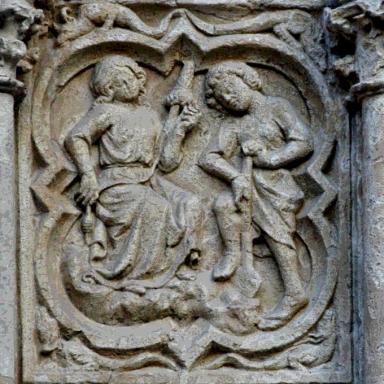
-- John Ball
The first man who, having enclosed a piece of ground, bethought himself of saying 'This is mine,' and found people simple enough to believe him, was the real founder of civil society. From how many crimes, wars, and murders, from how many horrors and misfortunes might not any one have saved mankind, by pulling up the stakes, or filling up the ditch, and crying to his fellows: Beware of listening to this impostor; you are undone if you once forget that the fruits of the earth belong to us all, and the earth itself to nobody.
-- Jean-Jacques Rousseau
Where there is no property there is no injustice.
-- John Locke
Labor is prior to, and independent of, capital. Capital is only the fruit of labor, and could never have existed if labor had not first existed. Labor is the superior of capital, and deserves much the higher consideration.
-- Abraham Lincoln
Property is theft!
-- Pierre-Joseph Proudhon
John Malone owns 2.2 million acres of land. The second largest landowner in the US, Ted Turner, owns 2.1 million acres. For reference, that's more than Rhode Island (a little under a million) or Delaware (1.5 million).
How is this possible? I mean the question quite literally. These men bought the land, of course... but what was the "right" of the previous owner. And so on, back to "The first man who, having enclosed a piece of ground, bethought himself of saying 'This is mine,' "
At some point, someone simply claimed the land, and then held onto it by force. Gradually, the notion that all that land "belongs" to John Malone has been accepted in our capitalist society... but another way of looking at it would be that Mr Malone is just the latest in a long line of fences -- buyers of stolen goods.
Knowingly buying stolen goods is a crime. A fence is an accessory after the fact in the theft.
Or, as Proudhon said, "Property is theft!"
-----------------------------------
RED RULES apply:
- Be polite . No insults whatsoever. No insults to particular people, to groups of people, to ideas, ... None!
- Be smart . Contribute substantive thought. Facts and/or reasoning. One-line zingers and bumper-sticker mantras are by definition off-topic.
-----------------------------------
The topic is in the title. Please stay very close to it.
Comments about various political / economic systems that did not exist when these quotes were spoken -- Lincoln and Proudhon being the last, in the mid 1800s -- would be anachronistic and off-topic.
Reacting to the quotations would be a good path.
Tags
Who is online
117 visitors
RED RULES apply:
- Be polite. No insults whatsoever. No insults to particular people, to groups of people, to ideas, ... None!
- Be smart. Contribute substantive thought. Facts and/or reasoning. One-line zingers and bumper-sticker mantras are by definition off-topic.
One of the few uses for government that libertarians find is the protection of private property.
This is a tacit admission that without government private property does not exist.
So they like government, they just like it under their terms.
John...
I specifically said that "Comments about various political / economic systems that did not exist when these quotes were spoken -- Lincoln and Proudhon being the last, in the mid 1800s -- would be anachronistic and off-topic." Any Comment about libertarianism is an anachronism, and off-topic.
That said... the relationship between government and property does indeed underlie the question, "Is property theft?" If property is theft, then is government an accessory to that theft? Is this necessarily the case? Can we imagine a government that does not recognize "property"?
Why don't you ask the Indian tribes? They'll be glad to give you an answer about what property is.
I'm sure they understood ownership as relates to control, ownership as relates to possession is a European interloper ideal, one they soon learned to despise.
And I'm sure they have opinions on it... (chuckle)
Probably some very valuable insights concerning the power of government over rights also...
The topic is in the title. Please stay very close to it.
I did.
I am done with your articles Bob, I cannot comment according to your narrow and unreasonable restrictions. Maybe you will find a couple people to play your game, but I will not.
Actually, John... I encouraged you to continue... on the relationship between government and property.
I don't want people talking about socialism and capitalism and all the other 21st century "isms". I want them to get past the labels, and think about "property".
Your post would have been fine if you didn't mention an "ism"... and there was no need.
... without government private property does not exist...
... is an idea totally worth discussion! No "ism" is needed; none is desirable. Citing an "ism" is just an invitation to derail from this idea, onto the "ism". Then we'd repeat the same bumper-sticker slogans that we always repeat. If we want to get a different conversation, then we have to change the process. Therefore... no "isms"...
But please! Continue with the idea you broached.
Where there is no property there is no injustice.
Well, I will say you deserve an award for taking a clause and using it in the most misleading way possible. It's like butchering a writing by Galileo to claim he was arguing for a geocentric universe.
Anyone who knows anything about Locke knows that property is the foundation stone upon which civilization exists. Without an understood right to property we exist in a state of nature/war where the strong has the right to take from the weak.
Locke's point, in context, is that the very concepts of justice and injustice only exist in civilization and not in the state of nature. The recognition of property is what separates us from the state of nature where the strong take whatever they want from the weak. That there is no justice without property is also true, according to Locke's argument. The whole concept of justice/injustice simply doesn't exist in a world without property, because rights don't exist, only strength by conquest.
The poor man who takes property by force is called a thief, but the creditor who can by legislation make a debtor pay a dollar twice as large as he borrowed is lauded as the friend of a sound currency. The man who wants the people to destroy the Government is an anarchist, but the man who wants the Government to destroy the people is a patriot.
William Jennings Bryant
Government is force, pure and simple. There's no way to sugar-coat that. And because government is force, it will attract the worst elements of society - people who want to use government to avoid having to earn their living and to avoid having to persuade others to accept their ideas voluntarily.
Harry Brown
Bob your misusing Lincolns quote in the article above... Completely taking it out of context...
Here is the quote in full context of the speech it was given.... (First Annual Message (to Congress), December 3, 1861)
In my present position I could scarcely be justified were I to omit raising a warning voice against this approach of returning despotism.
It is not needed nor fitting here that a general argument should be made in favor of popular institutions, but there is one point, with its connections, not so hackneyed as most others, to which I ask a brief attention. It is the effort to place capital on an equal footing with, if not above, labor in the structure of government. It is assumed that labor is available only in connection with capital; that nobody labors unless somebody else, owning capital, somehow by the use of it induces him to labor. This assumed, it is next considered whether it is best that capital shall hire laborers, and thus induce them to work by their own consent, or buy them and drive them to it without their consent. Having proceeded so far, it is naturally concluded that all laborers are either hired laborers or what we call slaves. And further, it is assumed that whoever is once a hired laborer is fixed in that condition for life.
Now there is no such relation between capital and labor as assumed, nor is there any such thing as a free man being fixed for life in the condition of a hired laborer. Both these assumptions are false, and all inferences from them are groundless.
Labor is prior to and independent of capital. Capital is only the fruit of labor, and could never have existed if labor had not first existed. Labor is the superior of capital, and deserves much the higher consideration. Capital has its rights, which are as worthy of protection as any other rights. Nor is it denied that there is, and probably always will be, a relation between labor and capital producing mutual benefits. The error is in assuming that the whole labor of community exists within that relation. A few men own capital, and that few avoid labor themselves, and with their capital hire or buy another few to labor for them. A large majority belong to neither class--neither work for others nor have others working for them. In most of the Southern States a majority of the whole people of all colors are neither slaves nor masters, while in the Northern a large majority are neither hirers nor hired. Men, with their families--wives, sons, and daughters--work for themselves on their farms, in their houses, and in their shops, taking the whole product to themselves, and asking no favors of capital on the one hand nor of hired laborers or slaves on the other. It is not forgotten that a considerable number of persons mingle their own labor with capital; that is, they labor with their own hands and also buy or hire others to labor for them; but this is only a mixed and not a distinct class. No principle stated is disturbed by the existence of this mixed class.
Again, as has already been said, there is not of necessity any such thing as the free hired laborer being fixed to that condition for life. Many independent men everywhere in these States a few years back in their lives were hired laborers. The prudent, penniless beginner in the world labors for wages awhile, saves a surplus with which to buy tools or land for himself, then labors on his own account another while, and at length hires another new beginner to help him. This is the just and generous and prosperous system which opens the way to all, gives hope to all, and consequent energy and progress and improvement of condition to all. No men living are more worthy to be trusted than those who toil up from poverty; none less inclined to take or touch aught which they have not honestly earned. Let them beware of surrendering a political power which they already possess, and which if surrendered will surely be used to close the door of advancement against such as they and to fix new disabilities and burdens upon them till all of liberty shall be lost.
He states that Labor is "Superior" to capital in the context that one must necessarily "Work" for their "Wealth" At the start of their adult lives, work for someone else, in the mature period of adult life, work for themselves, in the senior portion of adult life, pass it on to others.
There cannot be one without the other.... It is the despots who wish to make it otherwise, through political power.....
That was the point of Lincoln's message, I think necessarily contrary to the point you were trying to imbue it with...
NWM,
I wasn't trying to "imbue" anything. I was trying to kick-start some conversation on the topic of "property". I thought that a few quotations might do the job.
"Property" is an idea that most people never really think about. Property just "is". Most people never ask "why".
I don't want to argue the exegesis of the quotes I included, although I don't see that the Lincoln quote's context significantly alters its standalone meaning.
I'd prefer to bounce off John's post about government, which hooks nicely into your Bryant and Brown citations.
No quote is worth anything without a proper understanding of it's meaning. The only way to get it's meaning is to read it in the context it was stated.
Without said context, the meaning of the quote can be what anyone wants it to mean...
Lincoln was clearly saying with that quote that one must work for what is theirs or they claim as theirs, the work "labor" comes before the reward in whatever manner the reward is received "Capital".
Claiming a standalone meaning, is in my opinion acknowledging the intent to frame his meaning differently and for a different purpose. Essentially usurping the words to your own ends but leaving Lincoln's name attached to the words to give your usage more attention/consideration than they otherwise would. Seeing as your understanding intent is contrary to Lincoln's meaning. You admit such right here....
I don't see that the Lincoln quote's context significantly alters its standalone meaning.
If your willing to go that far to make an argument or impute meaning into something that isn't there,
What is the point of the discussion?
Your very well read, so well read in fact that you understand this implicitly. Others who are not so well read will take the Lincoln quote as something in support of your points, when in context it is the exact opposite.
And your knowledge of this fact is plain when....
"I don't want to argue the exegesis of the quotes I included"
You do not want to argue the actual point, your creating something that is not there the original point of the words you want ignored....
Your also educated and experienced enough to know that credibility of commentator is is of the highest order when using quotes of the type and in the manner your are choosing to use them.
By doing this your credibility as a commentator, possibly as a leader of an open discussion is gravely called into question.
Even worse, represents bias.....
I'm quite capable of having a serious discussion on pretty much any level of discourse Bob, but to do such honestly, one must have honest intent.
I find that lacking here.
I'm quite capable of having a serious discussion on pretty much any level of discourse Bob, but to do such honestly, one must have honest intent.
I find that lacking here.
Then I guess we should shut down. I had no secret agenda, in posting this article. I wasn't pushing anything. I thought it would be fun to talk about property.
I didn't know the contexts of any of the quotes I included. I found them online as they are. I wasn't trimming context because I didn't have it.
Sometimes there's nothing lurking in the shadows...
Well I appreciate that Bob, your intent is to have a serious discussion. I would love to do that, but keep the context if we are going to use quotes to state or support a position.
I couldn't find accreditation for the stated quote from John Locke either. (some say it is from his second treatise on government, but I can't find it in any copy I have access to)
GOOD topic to have a conversation over from a philosophical standpoint. But the basis has to be correct, the only way we can build understanding is to build upon those that came before......
As you noted I posted a couple of quotes that are right on point.
Now I agree with your ideal that we need to stay away from labels to have such a discussion some use labels to describe that which they do not wish to delve deeply into. Not good for this kind of discussion.
This is a discussion of natural rights, do they actually exist or not. More like Hobbesian than Lockeian philosophy.
The Abraham Lincoln quote and context is pure Hobbesian philosophy stated in a down home Illinois way as Lincoln was wont.
But we can have a good discussion if you want one. Just be sure of the points and quotes so we don't get into discussing something that is not.
Is property theft?
How much is land? What does it cost?
We have developed a system whereby we assign a numerical dollar value to nearly everything. Whatever we haven't yet assigned a value to yet, will eventually be valued similarly. We reduce the entire planet to an arbitrary value of our own invention , create supply and demand equations in an attempt to coral the dynamics of such a system, and, is conversely built upon the assumption that interest charged will come from somewhere (" growth "~~~ppppphhhhhttttttt). We harvest resources, many that are not replenishable, and think that pieces of paper traded for such reflect a true value,,,but that is an illusion we chose to believe, and is no more real than watching a volcano crater explode with lava on TV, and actually being there yards from it while it happens. The "price" of a gallon of gas for me to drive thirty-eight miles, does it include the true value of that resource? Does it take into consideration the real toil placed upon our world, in pollution, damage, oppression, aggression, slavery and death caused by the supply and demand for petrol alone? What do we do for diamonds? Water? Quinoa, beans, steel, rubber, cocaine, leather? What is our planet worth ?
As long as we continue to live under the spell that life and all relationships on the planet are to be manipulated rather than joined, we will continue taking rather than sharing and coexisting. Until such a time, no property is not theft, it is the course we now travel. We take things from the planet, and rather than using and sharing, we take and charge for. It is no different than microscopic creatures that live on our skin deciding to start charging each other for what was free. We are creatures that live on the skin of planet earth.
One day.....
One day
And there is a religious context to the question also. For god subjugated the world to man, I guess he created both and it was his right to place which ever one over the other.
This is the basis of natural rights that Hobbes discussed. Although Hobbes set about creating and defining the set of rules of what he called "Nature" (ie how man interacts in nature towards one another)
More of the first real statement of morality or effort to codify human morality into a code of life. Or, better stated living with each other. This code of life grows from the golden rule, attempting to put do unto other as you would have done to you into a set of guiding laws for mans behavior to his fellow man.
All morality codes stem from this understanding.
To me it is like taking the simple (the golden rule) and as man is wont to do complicating the hell out of it....
Someday we will go back to simple......
Someday
Property is worth virtually nothing without a means to travel outside of that property. The essential connectivity of parcels is a function of government (i.e. Infrastructure). If parcels should not be privately owned, then the whole system falls apart. No, property is not theft, it's an essential part of a free society. Is it subject to abuse? Absolutely.