
Top pilot who stole plane to escape WWII prison camp dies

October 25, 2016 11:05 PM EST
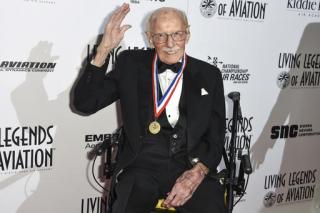
Hoover, who lived in Palos Verdes Estates, California, died early Tuesday, said Bill Fanning, a close family friend for many years and fellow pilot.
"He was every pilot's icon," Fanning said, recalling his friend as one of the premier test pilots of the 1950s and '60s. "Bob tested everything. He flew them all."
When the National Air and Space Museum conferred its highest honor on Hoover in 2007, the museum noted that Jimmy Doolittle, leader of the famed 1942 bomber raid on Japan, had once described Hoover as "the greatest stick-and-rudder man that ever lived."
"We lost an aviation pioneer today," Apollo 11 astronaut Buzz Aldrin, the second man on the moon, said in a Twitter post. "He could do magical things with an airplane. He was the best."
Hoover, who began flying in 1937 at Berry Field in Nashville, Tennessee, almost came to an early end. While serving in the Army's 52nd Fighter Group in Sicily during World War II, he flew more than 50 missions before being shot down. He survived and spent months in a prisoner-of-war camp before he escaped, stole a German fighter plane and flew to safety in The Netherlands.
Early U.S. jet-powered warplanes such as the P-80 and F-84 were tested by Hoover, who then became a backup pilot in the Bell X-1 program and flew the chase plane when Chuck Yeager became the first to break the sound barrier in 1947.
Hoover also tested the XFJ-2 Fury, which was developed for the Navy and Marine Corps, and the F-86 Sabre, an Air Force fighter, among more than 300 types of aircraft he flew in his career, according to the National Air and Space Museum.
He later brought his flying prowess to the public in aerobatic performances using such aircraft as North American Aviation's P-51 Mustang and Aero Commanders.
His Shrike Commander 500S, now ensconced in the Air and Space Museum, changed from an ordinary business-style propeller plane into an aerobatic star with Hoover at the controls during a so-called energy management routine. With both engines off he would do a loop, roll, 180-degree turn and land.
In the early 1990s, the Federal Aviation Administration pulled Hoover's medical certificate for failing a neurological exam that followed a performance at Aerospace America air show in Oklahoma City. Hoover fought the decision, and even went to court, and in 1995 he received a restricted medical certificate.
That year he returned to the skies and delivered his signature performance at Daytona Beach, Florida.
"It felt good to be performing in front of my countrymen again," he said at the time. "I'm just glad all that is behind me and that justice and fairness prevailed."
A recipient of numerous honors, Hoover was among the 100 heroes of aviation honored in 2003 at the First Flight Centennial celebration.
"It's fair to say that anyone who ever had the privilege of flying with Bob, saw him perform at an airshow, or who heard him speak, was affected tremendously by the experience," said Andrew Broom, executive director of the Citation Jets Pilots Association.
The association, in conjunction with the Bob Hoover Legacy Foundation, provides scholarships in Hoover's name to students attending Embry-Riddle Aeronautical University.
http://my.earthlink.net/article/us?guid=20161025/a0f9de3f-c04d-4625-a23c-53b806e16356
Tags
Who is online
107 visitors
Hoover, who began flying in 1937 at Berry Field in Nashville, Tennessee, almost came to an early end. While serving in the Army's 52nd Fighter Group in Sicily during World War II, he flew more than 50 missions before being shot down. He survived and spent months in a prisoner-of-war camp before he escaped, stole a German fighter plane and flew to safety in The Netherlands.
RIP to a true legend of aviation and the military. Just saying thank you for your service sounds so small when said about a real giant such as him.
Who today can compete with such men?
I agree. I mean 50 combat missions! No wonder they were called "The Greatest Generation". They earned that title.
Early U.S. jet-powered warplanes such as the P-80 and F-84 were tested by Hoover, who then became a backup pilot in the Bell X-1 program and flew the chase plane when Chuck Yeager became the first to break the sound barrier in 1947.
One of my childhood heroes was (and still as an adult) Chuck Yeager and pilots such as them of that era, who had a 1 in 4 chance of dying every time they took a new plane up. That takes a kind of courage few have.
His Shrike Commander 500S, now ensconced in the Air and Space Museum, changed from an ordinary business-style propeller plane into an aerobatic star with Hoover at the controls during a so-called energy management routine. With both engines off he would do a loop, roll, 180-degree turn and land.
And then doing something like that! Engines off! That doesn't just take courage, it takes the raw gall of someone like a deep brain surgeon to think that you really are good enough to do it and then to actually do it. Amazing!
And a pilot like Sully deserves the credit he got as well. (Hudson River landing)
What a legend....RIP Bob.