
Jeff Sessions Was Deemed Too Racist To Be A Federal Judge. He’ll Now Be Trump’s Attorney General.


He once joked that he only took issue with the KKK’s drug use and referred to civil rights groups as “un-American.”
WASHINGTON ― The man who President-elect Donald Trump will nominate as the 84th attorney general of the United States was once rejected as a federal judge over allegations he called a black attorney “boy,” suggested a white lawyer working for black clients was a race traitor, joked that the only issue he had with the Ku Klux Klan was their drug use, and referred to civil rights groups as “un-American” organizations trying to “force civil rights down the throats of people who were trying to put problems behind them.”
Sen. Jeff Sessions (R-Ala.), an early Trump supporter who has been playing a major role on the Trump transition team, met with the president-elect in New York on Thursday. A former aide to Sessions is managing the Justice Department transition. In a statement, the Trump team said the president-elect was “unbelievably impressed” with Sessions.
On Friday morning, several outlets reported that Trump had offered Sessions the attorney general position.
J. Gerald Hebert remembers Sessions’ time as the top federal prosecutor in Mobile, Alabama, well ― and is stunned that an Attorney General Jeff Sessions is a possibility. More than three decades ago, Hebert was in his 30s and working on voting rights cases for the Department of Justice’s Civil Rights Division. He was based in D.C. but spent time in Alabama working with Sessions, who was a U.S. attorney in Ronald Reagan’s administration.
“He was very affable, always wanting to have a conversation, a cup of coffee,” Hebert told The Huffington Post earlier this week. “Over the course of those months, I had a number of conversations with him, and in a number of those conversations he made remarks that were deeply concerning.”
After Sessions was nominated to be a federal judge in 1986, Hebert appeared before the Senate Judiciary Committee to testify about these remarks. It was unusual for a career DOJ lawyer to testify about a judicial nominee’s character, and Hebert said at the time that he did so with “very mixed feelings,” telling senators he considered Sessions “a friend.” Hebert told them Sessions had “a tendency to pop off” and that he was “not a very sensitive person when it comes to race relations.”
HuffPost reviewed a transcript of the Sessions’ 1986 confirmation hearings. In this selection, Hebert testified that he had once relayed comments about a white lawyer being described as a race traitor, and that Sessions had responded by saying “he probably is
That’s not exactly how Hebert recalled it:
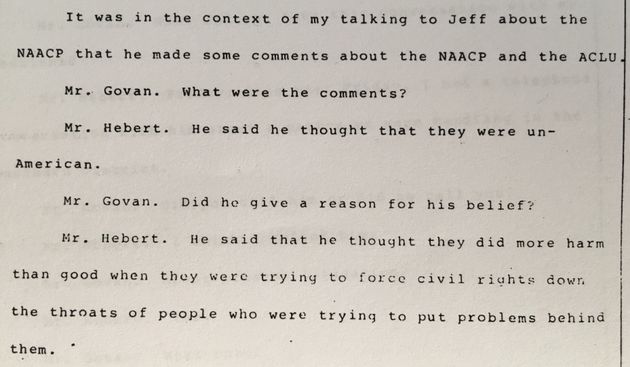
Sessions also called the American Civil Liberties Union and NAACP “communist-inspired,” Hebert testified.
Thomas Figures, a former assistant U.S. attorney, backed up Hebert’s testimony about Sessions’ views. He told Congress that Sessions said the NAACP, the Southern Christian Leadership Conference, Operation Push and the National Council of Churches “were all un-American organizations teaching anti-American values.”
“I recall saying that civil rights organizations, when they demand more than is legitimate, it hurts their position,” Sessions testified.
Figures, who died last year, also said that Sessions once warned him to “be careful what you say to white folks” after Figures told a white secretary that he found a comment she made offensive. Figures was the only black assistant U.S. attorney in the office.
“Had Mr. Sessions merely urged me to be careful what I say to ‘folks,’ that admonition would have been quite reasonable,” Figures said. “But that was not the language that he used. I realize, on the other hand, that Mr. Sessions’ remark may not have been premeditated. There was a period in our own lifetimes when blacks where regularly admonished to be particularly polite or deferential, and a remark of that sort may have just slipped out inadvertently.”
Figures also testified that Sessions and two others in the office referred to him as “boy.” Figures said he couldn’t say anything about it to Sessions because his position with him was “tentative.”
“I felt that if I had said anything or reacted in a manner in which thought appropriate, I thought I would be fired,” Figures said. “I had to guard my reaction to things, Senator, because I needed a job at the time... So I took a lot of things; I just kept it inside.”
Sessions “categorically” denied using the term “boy” to refer to Figures. “I have never used the word ‘boy’ to describe a black, nor would I tolerate it in my office,” Sessions testified.
Hebert said Figures’ testimony would be consistent with the views he believes Sessions holds.
“He demonstrated gross insensitivity to black people. So Tom Figures reporting that he had been called ‘boy’ by Jeff Sessions, that wouldn’t surprise me at all,” Hebert told HuffPost.
Figures also said that Sessions, during a “very spirited discussion” about one civil rights case, threw a file on the table and said, “I wish I could decline all of them.” Figures said it was clear the remark was made in anger, and noted that Sessions didn’t make him toss out all of the civil rights cases, even though he apparently wished that they’d disappear.
“Mr. Sessions did not make such a remark to me on any other occasion, and he did not direct me then, or at any other time, to in fact systematically decline all civil rights cases,” Figures testified.
Figures also said that Sessions would overrule him solely in criminal civil rights cases.
“In all fairness to Mr. Sessions, however, I should make clear that the problems which existed in the area of civil rights were not present in other aspects of my case assignments,” he said. “Except in criminal civil rights cases, Mr. Sessions deferred to my recommendations regarding whether to pursue cases, and never withdrew a case assignment because he disagreed with my recommendations.”
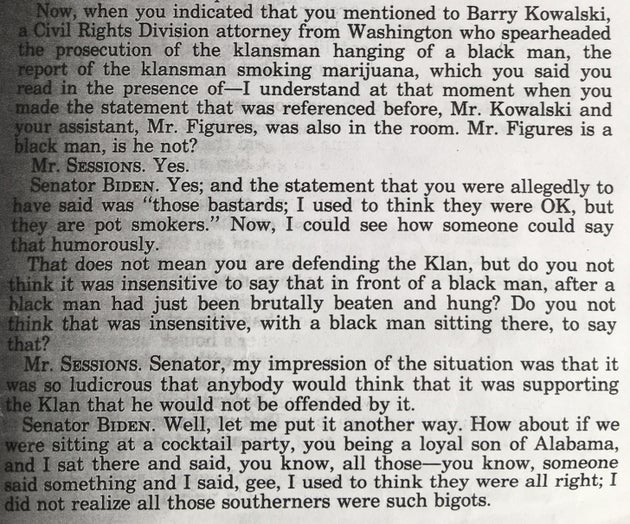
Sessions also remarked that he thought the KKK was OK until he found out they smoked marijuana, according to Figures. The statement was made in connection with the prosecution of a Klan member who had hanged a black man. From Figures’ testimony:

Questioned at the time by now-Vice President Joe Biden, Sessions admitted to the comments and said they were intended humorously.

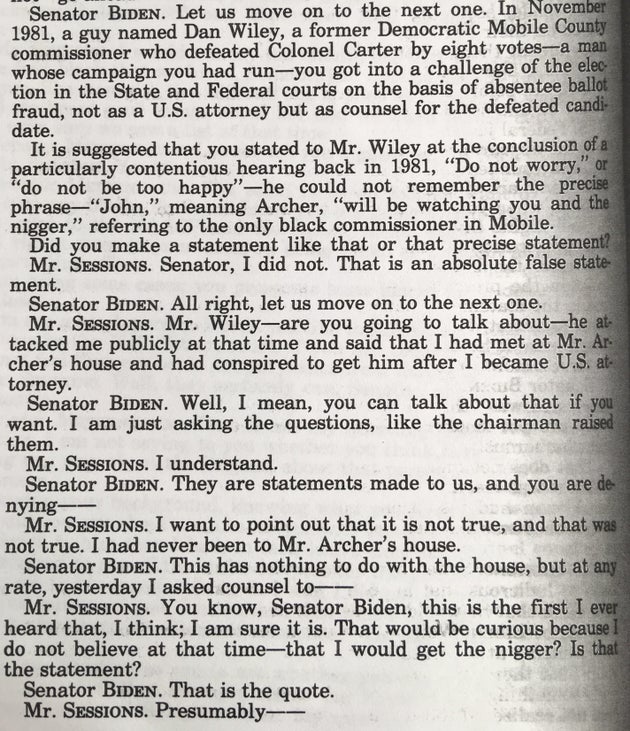
Biden also asked Sessions about the allegation that he had used a racial slur after a court hearing when he was in private practice. (The term appears uncensored in the transcript below. The U.S. Senate didn’t approve C-SPAN cameras until later that year.)
Sessions’ nomination was ultimately defeated in June 1986, making him the first Reagan nominee the Senate Judiciary Committee rejected.
Before his rejection, Sessions told senators he denied many of the claims made against him and that he felt he had been “caricatured.”
“All of us know that when the confidence of a private conversation is breached by a party with ulterior motives or one who simply misunderstands what the speaker says or means, he speaker can always be embarrassed,” Sessions said. “I enjoy repartee and frequently engage in devil’s advocacy. In short, when I talk to friends, I do not guard every word that I say because I think that I know they know that my commitment to equality and justice is real, and they would not twist my words or misinterpret what I am saying to them.”
“I deny as strongly as I can express it that I am insensitive to the concerns of blacks,” Sessions said.
Hebert, like many civil rights advocates , is deeply concerned about the future of the Civil Rights Division in a Trump administration. He referenced the politicization of the Civil Rights Division under former President George W. Bush, when political officials abandoned much of the division’s work.
“I fear we’ll see a repeat of that, or perhaps worse,” Hebert said. “I worry about those who are in the Civil Rights Division now, and what it will do to their careers. But more importantly, what it’s going to do to minority voters, minority citizens, across the country who need their basic fundamental human rights protected.”
“Just the thought of him overseeing the Justice Department’s Civil Rights Division is frightening,” Hebert said. “He’s a mean-spirited individual.”
Hebert said his friends in Alabama were disappointed that Sessions didn’t become a federal judge because it would have prevented him from acceding to his current position.
“He would have quietly disappeared into the history books instead of being a U.S. senator and being on the Judiciary Committee,” Hebert said. “They tongue-in-cheek say to me, ‘Thanks a lot, Gerry.’”
”: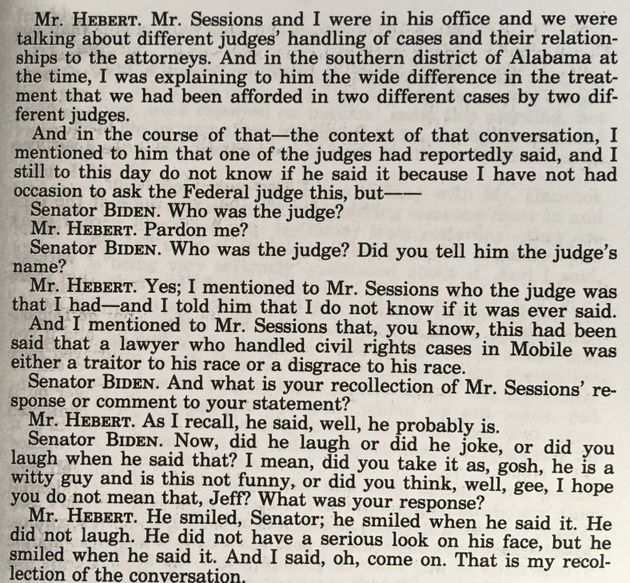
Sessions testified that he did not believe he had made such a remark, but his views changed as he reflected.
“The best I could recall was that I said, well, he is not that popular around town; I have heard him referred to as a disgrace to his race,” Sessions said. He said he did not personally believe that the white civil rights attorney was a race traitor, and that he had respect for him.
Sessions testified that he enjoyed the “free flow of ideas” and liked to stir it up with Hebert when he was in town. “I like to discuss things. I am open: I like to discuss with liberals better than I do with conservatives,” Sessions said.
In describing one conversation with Hebert on civil rights, Sessions articulated his view that things were pretty great for minorities in the 1980s and that civil rights organizations were asking for too much.
“I made the comment that the fundamental legal barriers to minorities had been knocked down, and that in many areas blacks dominate the political area, and that when the civil rights organizations or the ACLU participate in asking for things beyond what they are justified in asking, they do more harm than good,” Sessions testified.
That’s not exactly how Hebert recalled it:
Tags
Who is online
137 visitors
What we will hear in Sessions' defense is "let bygones be bygones" , "it was many years ago".
So was Clinton's "super-predator" comment, which the Republicans said disqualified her.
The new attorney general nominee is anti-marijuana and apparently there is some concern that he will want to do something about it.
Matthew Miller Retweeted Eric Lipton
Hadn't thought of this yet: Sessions could reverse Holder policy & threaten prison for people in states where pot is legal under state law.
Matthew Miller added,
Quite possibly. It's not really legal anywhere in the US.
Quote from Jeff Sessions.....'' good people don't smoke marijuana.”
LOL, half the country aren't good people...Look out folks here comes da judge.
When I was going to college in Ypsilanti Mi in 1978 they had a $5 pot law just like Ann Arbor did at the time. If the local town cops saw you smoking pot the most they would do is issue you a ticket for $5 and confiscate what they could see. Most of the time they just ignored you. I used to sit on the front porch of the house where my friend and I were renting the upstairs and study and kept a bong right next to my chair. It helped me come up with creative ways to use the BASIC programming I was writing. If a Ypsi cop drove by they'd just smile and wave. Ahhh, for the good old days!
I don't see Trump himself caring about this issue too much. Hopefully, he'll rein the AG in.
Scary thought!
Calling every republican for generations Hitler and/or a racist has robbed those words of all meaning. These are the same people who tried to turn mitt freaking Romney into genghis Kahn.
It's like liberals never picked up the lesson behind the childhood fable the boy who cried wolf.