
Dutch election: PM Rutte sees off anti-EU Wilders challenge


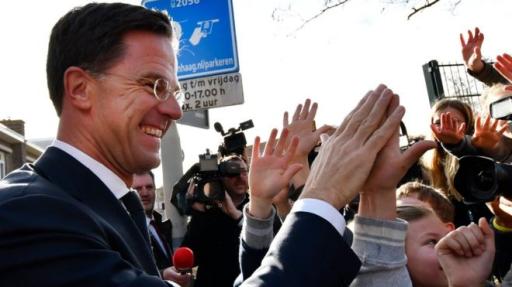
Analysts say a high turnout may have benefited pro-EU parties, including Mark Rutte's party
Dutch Prime Minister Mark Rutte's party has won the most seats in parliamentary elections, exit polls say.
Early results confirmed the exit polls, with his centre-right VVD Party on course for 31 out of 150 seats.
Three parties are projected to win 19 seats each: Geert Wilders' anti-immigration Freedom Party (PVV), the Christian Democrats and the D66 party.
Mr Wilders' party had been leading in opinion polls but support for the party appeared to slip in recent days.
With 10.9% of votes counted early on Thursday, the VVD had polled 17.8%.
Voter participation in the general election was high; the 81% turnout was the highest for 30 years.
Analysts say a high turnout may have benefited pro-EU and liberal parties.
"Today was a celebration of democracy," Mr Rutte said, adding that the Netherlands had said no to the "wrong kind of populism".
Although the VVD had lost several seats since the last election, many had expected the party to lose much more ground to the Freedom Party.
Many had been watching the vote in the Netherlands closely, as an indication for how populist parties may fare in other elections in EU countries.
France goes to the polls next month to elect a new president, while Germany is due to hold a general election in September.
German Chancellor Angela Merkel has called Mr Rutte to congratulate him, while Luxembourg Prime Minister Xavier Bettel has also tweeted his congratulations.
- Voting Dutch: Quirky polling stations
- Dutch vote turns spotlight on Moroccans
- Political pets - where the virtual life of a politician is in your hands
Martin Schulz, president of the European Parliament until earlier this year, said he was "relieved" Mr Wilders' party had lost.
"We must continue to fight for an open and free Europe!" he added on Twitter (in German) .
However, Mr Wilders warned that Mr Rutte "has not seen the last of me".
He previously said that the "patriotic revolution" would continue to take place, and "the genie will not go back into the bottle".
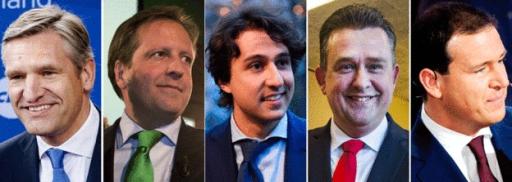
From L-R: Christian Democrat Sybrand Buma, D66 Alexander Pechtold, Green-Left Jesse Klaver, Socialist Emile Roemer, Labour Lodewijk Asscher
Champagne but no fizz: Anna Holligan, BBC News, the Hague
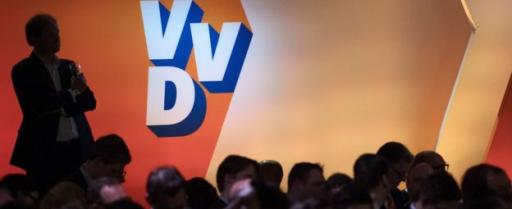
Pharrell Williams' song Happy pumped out across a conference hall converted to host the victorious VVD.
"Of course he'll still be prime minister," a loyal party member with black rimmed glasses told us. "He's the best man for the job."
Entry to the gathering was invitation only. Most of the foreign press were contained in a side room. The champagne was flowing but there wasn't much fizz. The mild-mannered, measured Mark Rutte appears to have been given a mandate.
He will say he stopped the "dominos of populism" from falling, but to do that he shifted himself to occupy the populists' territory, talking tough on immigration and integration.
As parliamentary seats are allocated in exact proportion to a party's vote share, the VVD party will need to go into coalition with other parties.
The VVD had ruled out a coalition with the Freedom Party - but not the other two runners-up, the Christian Democratic Appeal (CDA) party, and the Democrats 66 (D66) party, which are both pro-EU.
The CDA said it was delighted with its election result and looked forward to helping form a coalition.
The VVD will need at least three other parties before it can secure a majority.
Hence, the other smaller parties will be seen as potential power-brokers.
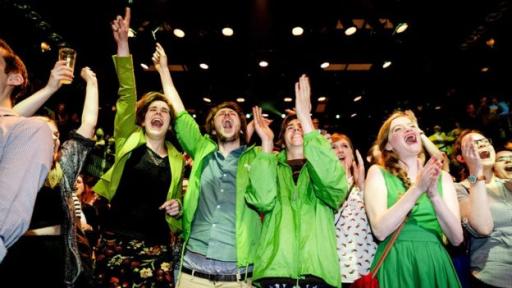
Also celebrating were the Green Left party, that gained several seats
Exit polls suggest the Green-Left party performed strongly, winning a total of 16 seats, compared to four in the last parliament.
Meanwhile, the Socialist Party took 14 seats, while the VVD's previous coalition partner, the Labour Party, saw its number of seats plunge from 38 to nine.
Analysts said it appeared to have been punished for its role in the coalition government, where it helped pass austerity measures.
Party leader Lodewijk Asscher called it "a bitter evening for labour - unbelievably disappointing".
"Rebuilding the party begins today," he said.
http://www.bbc.com/news/world-europe-39285803
Tags
Who is online
107 visitors
Looks like it was a rather bad day for hate, White Nationalism, bigotry and general assholishness. Poor Steve King. Poor Steve Bannon. Poor Steve Miller. Poor Donald Trump. More and more people are taking closer and closer looks at scum like you and they don't like what they see. You have maggots in your hearts.
''He previously said that the "patriotic revolution" would continue to take place, and "the genie will not go back into the bottle".''
Does the patriotic/patriot sound familiar...It's the same old same old from the far right wingers...Yet they can never answer what makes them more of a patriot than anyone else as can be seen on NT.
Is Trump Dragging Down the European Far-Right?
Donald Trump’s victory in the U.S. presidential election in November was heralded as the latest in a series of triumphs for the populist right: First there was Brexit, followed by a series of gains for right-wing, anti-immigration parties in Europe. When Italians voted against a referendum backed by Prime Minster Matteo Renzi in December, it looked like proof of the populist wave’s continued surge.
But a poorer-than-expected showing by Geert Wilders’s Dutch Freedom Party (PVV), with nearly 80 percent turnout, in elections on Wednesday complicates the picture. While Prime Minister Mark Rutte’s center-right People’s Party for Freedom and Democracy lost eight seats, it will be the biggest party in the 150-seat Dutch parliament. Wilders’s party won 20, short of the 30 it hoped to pick up.
It’s too soon to declare the populist wave dead, but with Wilders’s stumble, it’s worth at least raising the question of whether Trump’s victory may have been the high-water mark for the right-wing populist movement.
Rutte, who is expected to remain in power, is hardly a dove on immigration, but he’s not as hardline as Wilders. And unlike the platinum-pompadoured populist, he is favorable toward European integration. Wilders has been styled in the press as the Dutch Donald Trump, a comparison that he has at times courted—Wilders dropped by the 2016 Republican National Convention, where Trump was formally nominated, even as many top Republicans stayed away. He contributes to Breitbart , the court organ of the Trump administration. Even his campaign slogan was a variation on Trump’s.
But as the Dutch campaign ramped up, Wilders grew much more cautious about invoking the U.S. president . This was no coincidence: By mid-February, when the race in the Netherlands began, Trump had been in office for several weeks, and Dutch voters had gotten a chance to observe him as president. They didn’t like what they saw. “It’s a hard start for Wilders—he’s losing momentum, and this is partly because of Trump,” pollster Gijs Rademaker told The Wall Street Journal . Among poll respondents who had backed the PVV in December but no longer did by February, 60 percent thought Trump was doing a bad job.
Wilders’s caginess about Trump doesn’t seem to have saved him; although PVV gained seats on Wednesday, it fell short of expectations , as well as his own prediction of a surprisingly strong result.
And if Wilders is in fact a victim of Trump backlash in Europe, he might not be the last. While immediate reactions tend to be overly rash, Bloomberg’s Joe Weisenthal noted that immediately after preliminary results came in from the Netherlands, betting markets became much more bearish on the electoral chances of Marine Le Pen, the French presidential candidate who is aligned with Wilders, and who consciously tried to associate herself with Trump :
Le Pen's odds of winning the French election slip below 30% after the Dutch result