
APNewsBreak: About 4,000 more US troops to go to Afghanistan


June 16, 2017 12:32 AM EST
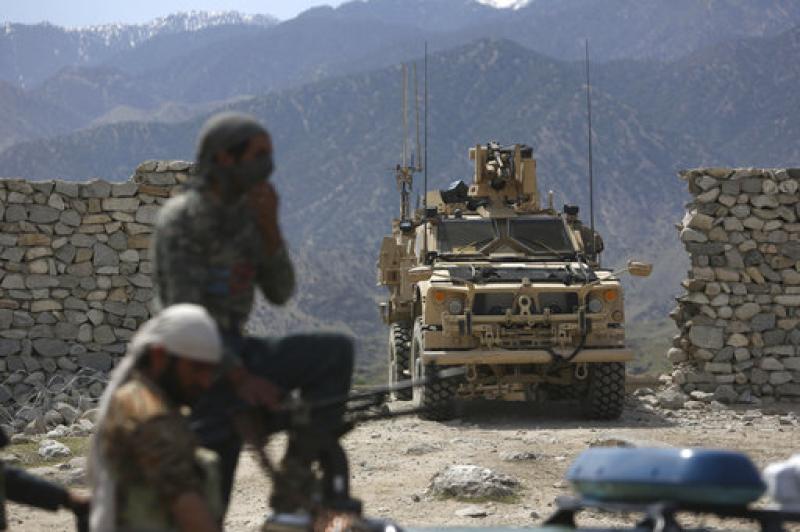
WASHINGTON (AP) — The Pentagon will send almost 4,000 additional American forces to Afghanistan, a Trump administration official said Thursday, hoping to break a stalemate in a war that has now passed to a third U.S. commander in chief. The deployment will be the largest of American manpower under Donald Trump's young presidency.
The decision by Defense Secretary Jim Mattis could be announced as early as next week, the official said. It follows Trump's move to give Mattis the authority to set troop levels and seeks to address assertions by the top U.S. commander in Afghanistan that he doesn't have enough forces to help Afghanistan's army against a resurgent Taliban insurgency. The rising threat posed by Islamic State extremists, evidenced in a rash of deadly attacks in the capital city of Kabul, has only fueled calls for a stronger U.S. presence, as have several recent American combat deaths.
The bulk of the additional troops will train and advise Afghan forces, according to the administration official, who wasn't authorized to discuss details of the decision publicly and spoke on condition of anonymity. A smaller number would be assigned to counterterror operations against the Taliban and IS, the official said.
Asked for comment, a Pentagon spokesman, Navy Capt. Jeff Davis, said, "No decisions have been made."
Daulat Waziri, a spokesman for Afghanistan's defense ministry, was reluctant to comment on specifics Friday but said the Afghan government supports the U.S. decision to send more troops.
"The United States knows we are in the fight against terrorism, " he said. "We want to finish this war in Afghanistan with the help of the NATO alliance."
There was no immediate report whether NATO allies would also increase their troop commitment to Afghanistan. The U.S. currently has 8,500 troops deployed in Afghanistan.
"We are the frontline in the war against international terrorism," Waziri said.
Although Trump has delegated authority for U.S. troop numbers in Afghanistan, the responsibility for America's wars and the men and women who fight in them rests on his shoulders. Trump has inherited America's longest conflict with no clear endpoint or a defined strategy for American success, though U.S. troop levels are far lower than they were under Presidents Barack Obama and George W. Bush. In 2009, Obama authorized a surge of 30,000 troops into Afghanistan, bringing the total there to more than 100,000, before drawing down over the rest of his presidency.
Trump has barely spoken about Afghanistan as a candidate or president, concentrating instead on crushing the Islamic State group in Syria and Iraq. His predecessors both had hoped to win the war. Bush scored a quick success, helping allied militant groups oust the Taliban shortly after the Sept. 11, 2001, attacks, before seeing the gains slip away as American focus shifted to the Iraq war. In refocusing attention on Afghanistan, Obama eliminated much of the country's al-Qaida network and authorized the mission that killed Osama bin Laden, but failed to snuff out the Taliban's rebellion.
Mattis' deployment of more troops will be far smaller than Obama's.
While military leaders have consistently said more forces are needed, a decision had been tied up in a lengthy, wider debate about America's long-term military, diplomatic and economic strategy for ending the war. Gen. John Nicholson, the top U.S. commander there, has said the troops are necessary to properly train and advise the Afghan military and perform work handled at greater cost by contractors. Afghan leaders endorse the idea of more U.S. troops, having lost significant ground to the Taliban in recent months.
But despite repeated questions from Congress this week, Mattis wouldn't reveal his thinking on a troop increase. He said that while counterterrorism efforts in Afghanistan are making progress in weakening al-Qaida and IS, "their defeat will come about only by giving our men and women on the ground the support and the authorities they need to win."
Obama set a cap a year ago of 8,400 troops in Afghanistan after slowing the pace of what he hoped would be a U.S. withdrawal.
Nevertheless, there are at least another 2,000 U.S. troops in Afghanistan not included in the official count. These include forces that are technically considered temporary even if they've been in the warzone for months.
Trump's decision Tuesday to give Mattis authority to set force levels in Afghanistan mirrored similar powers he handed over earlier this year for U.S. fights in Iraq and Syria. The change was made public hours after Sen. John McCain, the Senate Armed Services Committee's Republican chairman, blasted Mattis for the administration's failure to present an overarching strategy for Afghanistan. McCain said the U.S. is "not winning" in Afghanistan, and Mattis agreed.
The finality of the decision isn't entirely clear. While Trump has handed over the troop level decision-making, there is nothing preventing him from taking it back.
Mattis has repeatedly stressed that increasing the number of U.S. troops in Afghanistan would take place within a broader, long-term strategy for stabilizing Afghanistan. In congressional testimony this week, he said the strategy will take into account regional influences, such as Pakistan's role as a Taliban sanctuary. Regional powers Iran, India and China, which all have political stakes in the fate of Afghanistan, also must be considered.
While the new troops could raise fears of mission creep, Mattis told lawmakers this week he didn't envision returning to the force levels of 2010-11, when Obama thought he could pressure the Taliban into peace talks. Despite heavy losses, the Taliban fought on.
"Reconciliation" remains the goal, Mattis told a House Appropriations panel Thursday, along with reducing Afghan government corruption.
"We're not looking at a purely military strategy," he said. "All wars come to an end. Our job is to end it as quickly as possible without losing the very mission that we've recognized, through several administrations, that was worth putting those young Americans on the line for."
There have been almost 2,400 U.S. military deaths in Afghanistan since 2001. Three U.S. soldiers were killed and another was wounded in eastern Afghanistan this weekend in an attack claimed by the Taliban.
http://my.earthlink.net/article/top?guid=20170615/9638e910-2ea2-48b4-8578-9124fae116e6
Tags
Who is online
121 visitors
Not just no, but fuck no! Not 4,000 more! Not 400 more! Not 40 more! Not even 4 more! None! Don't add more targets and pull what's left of our troops there out! There is no more form of any kind of victory to be had there. It's time to stop this farce once and for all!
If Bush would have followed through in 2001/02 and not switched his focus to Iraq, there is a good probability this war would have ended back than. Instead we got thousands more of our troops killed in Iraq, which is still fighting a war and we lost Afghanistan.
16 years later and we are still fighting there and Iraq.
If only someone would have listened to Charlies Wilson, ''we fucked up the end game'' in Afghanistan. True words.
Enough is enough
If Bush would have followed through in 2001/02 and not switched his focus to Iraq, there is a good probability this war would have ended back than. Instead we got thousands more of our troops killed in Iraq, which is still fighting a war and we lost Afghanistan.
Exactly. Iraq was a a war of choice and stupidity, but more importantly it took needed assets away from Afghanistan and put that war in a holding pattern from which it never recovered. Right now it has devolved into Vietnam with sand and mountains, instead of rice paddies and jungles. There is nothing t be gained by staying there. As you said, enough is enough!
There comes a time in a situation like this where all the occupying force (us) is trying to do is save face rather than achieving a tangible and permanent good. Because U.S. casualties there are relatively light ( 40 U.S. service members have been killed there in the past three years) ( about 20,000 wounded in Afghanistan since 2001) there is an assumption the public won't make much stink about it.
Why are we there anymore? If Afghanistan was the world wide source of terrorism there would be a purpose there in stopping or hampering it, but that is not the case is it?
I think Bush initially made the fundamental mistake of equating the Taliban to al Qaeda and needlessly started an unwindable conflict. We basically sparked the mujahideen movement (that included the Taliban and al Qaeda) by funding a counterinsurgency that would expel the soviets from Afghanistan. The movement was composed of fundamentalist Islamic fighters who would never bend to soviet dogma or anything else. The movement expelled the Soviets, expanded, and then splintered (going separate ways).
The Taliban was parochial in its outlook, limiting its actions to basically turning back the clock in Afghanistan to the 7th century. Al Qaeda, under Osama, wanted to expel western influence from Saudi Arabia and then from other Islamic countries. Osama favored achieving his goals through terrorism. The Taliban is more of a popular movement against a corrupt Afghan government, warlords, and foreign occupation. The two groups sort of came back into contact when Osama sought refuge in Afghanistan and the Taliban gave it to him based more on his ties by marriage than any common ideology. The Taliban had nothing to do with 911 or international terrorism.
Bush could have easily pried the Taliban and al Qaeda apart and negotiated peace with the Taliban. Instead, he tried to stamp out the Taliban when the Taliban is not exactly the worse thing in Afghanistan. We're the ones who showed the Taliban how to cripple the Soviets and, because we showed them how to beat a superpower, we're finding it impossible to beat them ourselves.
This conflict cannot be won militarily no matter how many troops we send there. This is not like dealing with al Qaeda or ISIS and we really shouldn't be trying to drive these groups together by treating them all the same. The Taliban exist because people there like them as a counterbalance to the corrupt government, warlords, and foreign influence (that includes us, Russia, Iran, and India). We should help drive a wedge between the Taliban and groups like al Qaeda, negotiate a peace that includes the Taliban, stabilize the Afghan government as best we can, and withdraw.