
Secret’s Out: The Senate Health Care Bill Is An Assault On The Safety Net


Americans are finally getting a look at the much-anticipated, heretofore-secret Senate Republican health care bill. As expected, the bill released Thursday amounts to a massive rollback of the federal commitment to promote health care access and would instead pay for hundreds of billions of dollars in tax cuts for corporations and the wealthy.
The Congressional Budget Office isn’t expected to weigh in on the Senate bill, dubbed the Better Care Reconciliation Act , until next week. That means there’s no official accounting of what the legislation would do to the health care system, how many people stand to lose their coverage and how much the federal government would spend on health care programs. And the 142-page bill consists of complex legislative language that will require days for other analysts to fully digest.
But the plain truth already is clear: This legislation would result in millions of people losing their health benefits and would shrink the safety net over time. Wealthy people and health care companies would see their taxes go down. And although some consumers may pay less for insurance, an untold number of people wouldn’t have access to the coverage and medical services they have under the existing health care law.
Senate Majority Leader Mitch McConnell (R-Ky.) hasn’t locked down the 50 votes he needs to pass this bill. But GOP lawmakers have been promising Obamacare repeal for more than seven years, President Donald Trump is eager to fulfill his campaign promise to undo the law (if not his vow to replace it with ” something terrific ”) and the House has already advanced its own bill.
McConnell wants the Senate to vote on this bill next week, capping off a remarkably secretive and rapid process that has outraged Senate Democrats .
Although Trump, McConnell, House Speaker Paul Ryan (R-Wis.) and other GOP leaders always refer to their plans as a mission to repeal and “replace” the Affordable Care Act, the legislation unveiled Thursday is actually a fundamental, drastic overhaul of the Medicaid program that serves children, people living near or below the poverty level, pregnant women, people with disabilities and elderly nursing home residents.
The bill would also eradicate central components of the Affordable Care Act, such as its expansion to Medicaid to cover more poor, working-age adults, its requirement that most people either obtain health coverage or face a tax penalty and its rule that large employers must offer health benefits to workers.
What The Bill Means For Medicaid
Like the House, the Senate seeks to go far beyond unraveling President Barack Obama ’s landmark 2010 health care reform initiative by making draconian cuts to Medicaid.
The CBO determined that the House-passed American Health Care Act would mean 23 million fewer Americans having health coverage over the coming decade, while a small but very wealthy group of Americans would get a substantial tax cut.
Broadly speaking, the Senate bill looks a lot like that House bill . It calls for rolling back the Medicaid expansion and fundamentally changing the program going forward ― specifically, by ending the federal government’s open-ended commitment to funding the program at whatever levels it takes to cover everybody who becomes eligible. Instead, states would receive a lump sum per year or a lump sum per enrollee.
Projections have shown that the federal government would spend far less on Medicaid spending over time. This would almost certainly force states ― which jointly fund and operate Medicaid ― to make deep cuts to the program by taking actions like eliminating coverage and benefits and reducing already-low fees to doctors and other medical providers.
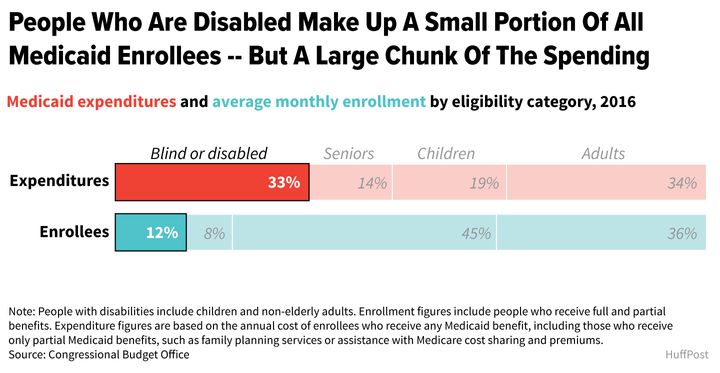
Republicans have said their reforms would protect the most vulnerable people in Medicaid, such as the elderly and disabled, because the formula for the new spending caps assume greater spending on these people. But experts who have analyzed the proposals have said states would still have a relatively free hand on how to spend that money once they get it from Washington. Because the elderly and disabled account for half of program spending, coverage for them would be ripe targets for cuts.
The CBO projected 14 million fewer people would receive Medicaid over the next 10 years under the House bill, and the Senate’s deeper cuts to the program could mean an even higher number losing this coverage.
What The Bill Means For Private Insurance
The Senate bill would also rejigger the Affordable Care Act ’s reforms of the private insurance market for people who buy coverage on their own.
People would still be eligible for financial assistance, in order to help offset the costs of premiums. But fewer middle-income people would get assistance. The assistance that people get would also be smaller, which means people would have to pay more to get the same kind of coverage they have now — or put up with policies that leave them exposed to higher out-of-pocket costs.
This is because the Senate bill redefines the “benchmark” plan that the federal government would use as its basis for calculating financial assistance. Instead of a plan that covers 70 percent of the average person’s medical expenses, the Senate bill would reduce that level to 58 percent of the average person’s medical expenses. Larry Levitt , an analyst with the Henry J. Kaiser Family Foundation, likened that change to a 15 percent, across-the-board reduction in subsidies for people buying coverage on their own.
The Senate bill makes a few other changes to the funding formula. As a result, some younger people would end up paying less for their coverage than they do today. But older consumers would just as surely pay more. In addition, low-income consumers would also face substantially higher copayments and deductibles, because the Senate bill would eliminate special subsidies that presently reduce out-of-pocket costs for people with incomes below 250 percent of the poverty line, or about $30,000 per year for an individual
Health insurance companies would be permitted to sell skimpier policies that cover a smaller share of patients’ medical bills, which likely would mean even higher deductibles and other costs than the plans available under the Affordable Care Act. They would also have more leeway to vary premiums by age . Under current law, insurers can only charge older consumers three times as much.
The Senate bill, like the House bill, would effectively eliminate the controversial individual mandate, under which people who decline to get health insurance pay a tax penalty. In addition, states would have the ability to waive some regulations on insurance, including requirements that all plans cover an “essential” set of benefits.
The bill retains the Affordable Care Act’s rule that insurers can’t reject applicants because of pre-existing conditions or charge them more than healthier people, but that promise could prove empty under the Senate bill.
Because states could revoke the current set of guaranteed benefits ― which includes things like hospitalizations, prescription drugs and maternity care ― insurers would be able to design policies that would leave out important treatments. For example, insurers couldn’t refuse to cover a patient with HIV/AIDS, diabetes or a history of cancer, but they could offer plans that don’t cover the treatments for those things.
At the same time, the Senate bill would eventually eliminate most of the Affordable Care Act’s taxes that fall on health care companies ― including health insurers, pharmaceutical companies and medical device makers ― and wealthy individuals.
The Senate bill sheds some of the harshest aspects of the House measure, such as letting states entirely cast aside the guarantee of coverage for people with pre-existing conditions and would offer relatively more generous tax credits for private insurance. But the appropriate comparison is to what currently exists, not the House bill, and the Senate legislation offers far less help than that.
Tags
Who is online
137 visitors
We should not be cutting taxes on the wealthy to fund benefit cuts to people's health care. Period.
Some of the worst effects of the GOP bill don't go into effect until after the 2020 election. So if the Dems can win the presidency and the Congress then they can legislate a lot of this crap away.
Health care in the US may be in permanent suspense until we get national health care.
Our politics are divided. They have been for a long time. And while I know that division makes it difficult to listen to Americans with whom we disagree, that’s what we need to do today.
I recognize that repealing and replacing the Affordable Care Act has become a core tenet of the Republican Party. Still, I hope that our Senators, many of whom I know well, step back and measure what’s really at stake, and consider that the rationale for action, on health care or any other issue, must be something more than simply undoing something that Democrats did.
We didn’t fight for the Affordable Care Act for more than a year in the public square for any personal or political gain – we fought for it because we knew it would save lives, prevent financial misery, and ultimately set this country we love on a better, healthier course.
Nor did we fight for it alone. Thousands upon thousands of Americans, including Republicans, threw themselves into that collective effort, not for political reasons, but for intensely personal ones – a sick child, a parent lost to cancer, the memory of medical bills that threatened to derail their dreams.
And you made a difference. For the first time, more than ninety percent of Americans know the security of health insurance. Health care costs, while still rising, have been rising at the slowest pace in fifty years. Women can’t be charged more for their insurance, young adults can stay on their parents’ plan until they turn 26, contraceptive care and preventive care are now free. Paying more, or being denied insurance altogether due to a preexisting condition – we made that a thing of the past.
We did these things together. So many of you made that change possible.
At the same time, I was careful to say again and again that while the Affordable Care Act represented a significant step forward for America, it was not perfect, nor could it be the end of our efforts – and that if Republicans could put together a plan that is demonstrably better than the improvements we made to our health care system, that covers as many people at less cost, I would gladly and publicly support it.
That remains true. So I still hope that there are enough Republicans in Congress who remember that public service is not about sport or notching a political win, that there’s a reason we all chose to serve in the first place, and that hopefully, it’s to make people’s lives better, not worse.
But right now, after eight years, the legislation rushed through the House and the Senate without public hearings or debate would do the opposite. It would raise costs, reduce coverage, roll back protections, and ruin Medicaid as we know it. That’s not my opinion, but rather the conclusion of all objective analyses, from the nonpartisan Congressional Budget Office, which found that 23 million Americans would lose insurance, to America’s doctors, nurses, and hospitals on the front lines of our health care system.
The Senate bill, unveiled today, is not a health care bill. It’s a massive transfer of wealth from middle-class and poor families to the richest people in America. It hands enormous tax cuts to the rich and to the drug and insurance industries, paid for by cutting health care for everybody else. Those with private insurance will experience higher premiums and higher deductibles, with lower tax credits to help working families cover the costs, even as their plans might no longer cover pregnancy, mental health care, or expensive prescriptions. Discrimination based on pre-existing conditions could become the norm again. Millions of families will lose coverage entirely.
Simply put, if there’s a chance you might get sick, get old, or start a family – this bill will do you harm. And small tweaks over the course of the next couple weeks, under the guise of making these bills easier to stomach, cannot change the fundamental meanness at the core of this legislation.
I hope our Senators ask themselves – what will happen to the Americans grappling with opioid addiction who suddenly lose their coverage? What will happen to pregnant mothers, children with disabilities, poor adults and seniors who need long-term care once they can no longer count on Medicaid? What will happen if you have a medical emergency when insurance companies are once again allowed to exclude the benefits you need, send you unlimited bills, or set unaffordable deductibles? What impossible choices will working parents be forced to make if their child’s cancer treatment costs them more than their life savings?
To put the American people through that pain – while giving billionaires and corporations a massive tax cut in return – that’s tough to fathom. But it’s what’s at stake right now. So it remains my fervent hope that we step back and try to deliver on what the American people need.
That might take some time and compromise between Democrats and Republicans. But I believe that’s what people want to see. I believe it would demonstrate the kind of leadership that appeals to Americans across party lines. And I believe that it’s possible – if you are willing to make a difference again. If you’re willing to call your members of Congress. If you are willing to visit their offices. If you are willing to speak out, let them and the country know, in very real terms, what this means for you and your family.
After all, this debate has always been about something bigger than politics. It’s about the character of our country – who we are, and who we aspire to be. And that’s always worth fighting for.
Trump couldn't write a coherent analysis (of anything) like that if he sat in front of a keyboard for a thousand years.