
North Korea ICBM launch: US and S Korea respond with drill


The US and South Korea have held a ballistic missile drill, after North Korea tested a long-range missile experts believe may reach Alaska.
Self-restraint was "all that separated armistice and war" and could be changed at any time, the two allies said.
It would be a "grave mistake" for the North to think otherwise, they said.
China and Russia have urged the North to suspend its weapons programme in exchange for a halt to US-South Korean military exercises.
The launch, the latest in a series of tests, was in defiance of a ban by the UN Security Council.
The US has asked for an urgent meeting of the UNSC to discuss the issue. A closed-door session of the 15-member body will take place later on Wednesday.
Pyongyang claimed on Tuesday to have successfully tested an intercontinental ballistic missile (ICBM).
However, most experts believe that the North does not yet have long-range nuclear weapon capabilities.
The two Koreas are technically still at war as the 1950-1953 Korean War ended in an armistice.
How have the US and South Korea responded?
The allies conducted a ballistic missile fire exercise in the Sea of Japan.
South Korean President Moon Jae-in said the allies needed to demonstrate their missile defence posture "with action, not just a statement", his office said.
- Is the new missile test a game-changer?
- Can the US defend itself against North Korea?
- Have North Korea's missile tests paid off?
- What can the outside world do?
Meanwhile in a joint statement Gen Vincent Brooks, commander of US forces Korea, and South Korean Joint Chiefs Chairman Gen Lee Sun-jin said the allies were maintaining patience and self-restraint, but this could change.
"We are able to change our choice when so ordered by our alliance's national leaders. It would be a grave mistake for anyone to believe anything to the contrary," it said.
Earlier, US Secretary of State Rex Tillerson called North Korea's move a "new escalation of the threat" and warned that Washington "will never accept a nuclear-armed North Korea".
Mr Tillerson said "global action is required to stop a global threat" and warned that any nation that provided economic or military benefits to the North, or failed to fully implement UN Security Council resolutions, was "aiding and abetting a dangerous regime".
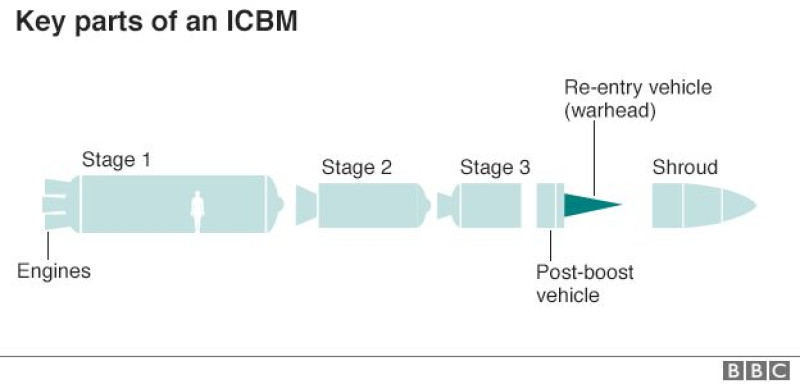
- A long-range missile usually designed to carry a nuclear warhead
- The minimum range is 5,500km (3,400 miles), although most fly about 10,000km or more
- Pyongyang has previously displayed two types of ICBMs: the KN-08, with a range of 11,500km, and the KN-14, with a range of 10,000km, but before 4 July had not claimed to have flight tested an ICBM. It is not clear what differentiates the Hwasong-14
North Korea's missile programme

What has North Korea said?
State news agency KCNA quoted leader Kim Jong-un as saying the test was a "gift" to the Americans on their independence day.
The report warned of the possibility of more tests, saying he ordered officials to "frequently send big and small 'gift packages' to the Yankees".
Pyongyang said earlier the Hwasong-14 intercontinental ballistic missile (ICBM) had reached an altitude of 2,802km (1,731 miles) and flew 933km for 39 minutes before hitting a target in the sea.
North Korea, it said, was now "a full-fledged nuclear power that has been possessed of the most powerful inter-continental ballistic rocket capable of hitting any part of the world".
Does North Korea really have a long-range weapon now?
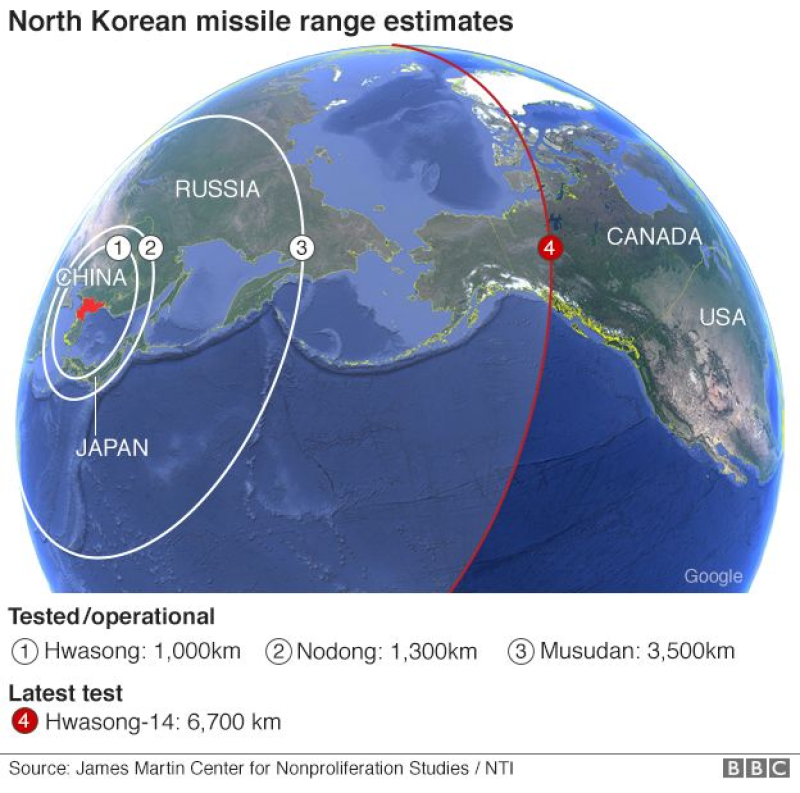
Some experts believe that Tuesday's test proves that it has a missile that could travel across the globe and reach Alaska.
Physicist David Wright said it could reach a maximum range of about 6,700km on a standard trajectory, while South Korea's defence ministry on Wednesday put the range between 7,000 and 8,000km.
But whether that missile could deliver a warhead is still a question.
Pyongyang claimed the rocket carried a "heavy warhead" and that it "accurately hit the targeted waters without any structural breakdown".
South Korea said there was no evidence proving the missile could withstand high temperatures and successfully re-enter the atmosphere, reported Yonhap news agency.
Experts believe Pyongyang does not yet have the capability to miniaturise a nuclear warhead, fit it onto a long-range missile, and ensure it is protected until delivery to the target.
They say many of North Korea's missiles cannot accurately hit targets.
But others believe that at the rate it is going, Pyongyang may overcome these challenges and develop a nuclear weapon that could strike the US within five to 10 years.
How advanced is North Korea's nuclear programme?
y bringing Alaska within range, the new missile test is an unambiguous game-changer in both symbolical and practical terms.
US territory (albeit separate from the contiguous continental US) is now finally within Pyongyang's cross-hairs.
For the first time a US president has to accept that the North poses a "real and present" danger not merely to north-east Asia and America's key allies - but to the US proper.
President Trump's weakness lies in having overplayed his hand too publicly and too loudly.
Read more from Dr Nilsson-Wright.
How is the rest of the world reacting?
Japan on Tuesday said "repeated provocations like this are absolutely unacceptable" and lodged a protest.
Meanwhile China - who is Pyongyang's main economic ally - and Russia have called on North Korea to suspend its ballistic missile programme in exchange for a halt on the large-scale military exercises by the US and South Korea.
Chinese President Xi Jinping and Russian counterpart Vladimir Putin, who met in Moscow on Tuesday, said "the opposing sides should start negotiations".
http://www.bbc.com/news/world-asia-40503558
Tags
Who is online
100 visitors
The United States and most likely the world, stands on one the most dangerous steps toward a nuclear conflict that it has been since the The Cuban Missile Crises. The number one difference between then and now and the by far scariest part is that, as much as one my have felt that Khrushchev was dangerous and that JFK was inexperienced, is that at least one was assured that both were reasonable persons to some extent. The same can not be said in this instance. Unless people in the U.S. Government in the Defense and Diplomatic Agencies step forward, such as SoS Tillerson and SoD Mattis and the Combined Joint Chiefs of Staffs, the world is faced with a confrontation where one world leader is just as unpredictable, just as mentally unstable and just as mad as the other. Neither is to be trusted to do what is in the worlds interest any more then the other as neither is as obviously mentally balanced as the other. They are both completely equal in this as far as decision making and leadership. The world can only hope that underlings and powerful advisers will stop these two obvious uncontrollable loose cannons and well, quite frankly, lunatics, from forcing a war, even a nuclear one, on the Korean Peninsula where 100's of thousands of innocent people will die needlessly and where such a war will be as much ones fault as the other's. The world must step between these two mad men to prevent tragedy.
I have one important question. Can Sarah Palin see the North Korean ICBM from her front porch? She could be America's (not very) early warning defence system. I can hear her phone call now: "You have 2 minutes to hide in your bomb shelters."