
This map shows why passing Graham-Cassidy could be a huge political problem for Republicans


(CNN)Senate Republicans continue to sound optimistic about their chances of passing their last, last-ditch attempt to repeal and replace Obamacare before their window to do so closes at the end of the month. ( I'm more skeptical. )
But even if Republicans do manage to squeak through the legislation being championed by Sens. Lindsey Graham of South Carolina and Bill Cassidy of Louisiana -- and it will be a squeaker -- it's possible they will create even more political problems for themselves on health care than they currently face.
New data from an Avalere Health analysis suggests that Graham-Cassidy -- if passed in its current form -- would cut federal money to states by $215 billion over the next decade. All told, 34 states would see cuts to the amount of federal dollars they are getting for health care under the Affordable Care Act, while 16 would see an increase.
This map -- created by CNN dataviz wiz Sam Petulla -- shows how much each state would stand to gain or lose in federal dollars if Graham-Cassidy passed:
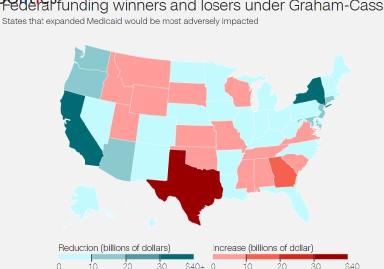
Big states are, not surprisingly, affected the most. Texas, which rejected Medicaid expansion under Obamacare, would see an increase of $35 billion in federal dollars headed its way. California and New York, two massive states whose governors accepted the Medicaid expansion, would see dips in funding of $78 billion and $45 billion, respectively.
Those are the extremes. It's the other 47 states -- or at least the 34 that would receive less federal dollars under Graham-Cassidy -- that should worry Republican politicians. Among the states that would lose billions in federal funding: Pennsylvania ($6 billion), Ohio ($9 billion), Colorado ($6 billion) and Michigan ($8 billion).
Those are all states Trump won in 2016 -- and states he would need to win again in 2020. There are also a slew of competitive House and Senate races in those states in 2018. If, for example, Republicans suffered major losses in their House ranks in Ohio, Pennsylvania and Michigan, their majority in the House could be at stake.
The Avalere analysis is not alone in concluding what the effect Graham-Cassidy would have on states. While the Graham-Cassidy legislation hasn't been scored by the Congressional Budget office, CNN's Tami Luhby expertly notes :
"(CBO's) analysis of an earlier Senate repeal bill showed that a similar restructuring of the traditional Medicaid program and the gradual winding down of Medicaid expansion would reduce federal spending by $772 billion by 2026, compared to current law. Also, the earlier bill would have left about 15 million fewer people insured under Medicaid at that time."
And because of the way the block grants of money are allocated in Graham-Cassidy, even in states that would see initial gains -- largely those that did not accept Medicaid expansion -- the long-term prognosis would be far less rosy.
What we know from the 2010 and 2014 midterm elections is that health care is an issue that voters vote on. What we know from human nature is taking away -- or significantly altering -- a benefit people currently have (even if it's not a benefit they absolutely love) carries massive political peril.
Senate Republicans -- and Trump -- seem to believe they face more political backlash if they can't make good on the promise they made repeatedly over the last seven years to repeal and replace Obamacare.
The map above, however, suggests passing Graham-Cassidy could be a pivot point in the battle for Congress next November -- and not in a good way for Republicans.
Thanks for coming by!
Tags
Who is online
84 visitors
Sorry for the big space in the middle-- I couldn't get rid of it!
Once again they plan on voting on it without hearing or CBO scores.
If it's so damn great what is all the secrecy about.
Exactly.
Even republicans get sick, every now and then, and need the medical care they have paid for...
“Among the states that would lose billions in federal funding: Pennsylvania ($6 billion), Ohio ($9 billion), Colorado ($6 billion) and Michigan ($8 billion).
Those are all states Trump won in 2016”
More fake news from CNN Trump did not win Colorado.
I looked up a map, Dean, and you're right. But he did win the others...
"Texas, which rejected Medicaid expansion under Obamacare, would see an increase of $35 billion in federal dollars headed its way. California and New York, two massive states whose governors accepted the Medicaid expansion, would see dips in funding of $78 billion and $45 billion, respectively."
So... Basically this is a way to punish those states that tried to work with the ACA, and reward those states that rejected it?
Well, we, here in KY, adopted ACA in full, and we have a net neutral effect. So, it seems so, but at least it's not punitive in my state, so far.
The GOP doesn't really care who gets hurt. Their large campaign donors want Obamacare to go down, and that is why the republicans are so hell bent on it.
This Chart Shows How Many States Lost Obamacare Insurers. The Number Won't Stun You.
A chart published by Axios shows the number of states that have lost Obamacare insurers between 2016 and 2017. The number is not good for defenders of the former president's signature legislation:
As the above chart indicates, 25 states lost Obamacare insurers from 2016 to 2017. Only two states gained insurers. The remaining 12 states that have Obamacare exchanges saw no change in insurers. The state that saw the highest number of insurance losses was Texas, followed by Arizona, Ohio, Pennsylvania, and Michigan, in descending order.
Needless to say, 25 out of 39 states bleeding insurers in a year's time is not exactly ideal for Obamacare's proponents. Advocates may argue that most of the states that lost insurers are red states that didn't fully embrace Obamacare. However, that ignores the fact that such states went from enjoying minimal regulation to being hit with staggering regulations as a direct result of Obamacare. Naturally, those states would face the biggest insurer losses.
The uncomfortable truth for Obamacare proponents is that the law is currently in a death spiral; there are simply not enough young, healthy enrollees to offset the costs of sicker enrollees that insurers are forced to cover under the pre-existing conditions mandate. Consequently, insurers are losing money in the exchanges and are bailing, leaving some states with only one insurer altogether .
Read this for information as to why Obamacare is failing.
Link
State Data Lab -
Keep in mind these states which are underwater the most have the largest populations. That's why they get 55 electoral votes in California and only 8 in Kentucky. If you consider the electoral votes and the amount every person in a state owes to pay the piper and get them out of debt, it gives you a better idea of their real status. These states are not getting rewarded for not expanding Medicaid and the others being punished. It's a little complex, but not too much to get the big picture of what the situation is in a state and why they are paying more or less than other states.
The Reality …
… which many of the ill-informed will learn after it's too late … and many of these will be Trump-supporters!
The bill wouldn't repeal the Affordable Care Act's rules about pre-existing conditions. But they might end up only existing on paper, the Kaiser Family Foundation's Larry Levitt said.
Graham-Cassidy doesn't let states waive the part of the Affordable Care Act that says insurers have to cover sick people. But it does allow states to opt out of several other ACA rules that can cause people with pre-existing conditions to pay more for their health care. Those provisions include:
The ban on charging sick people higher premiums than healthy people!!!!!!!!!!!!!!!!!!!!!!!!!!
It’s the trick Republicans have been trying to play all along—claim that you’re protecting people with pre-existing conditions because insurance companies can’t say directly “we will not insure you,”
but let the insurance companies charge people with pre-existing conditions so much that no one could afford coverage. We’re not denying you insurance, we’re just charging you $100,000 a year! Your pre-existing condition is totes covered! What a “great Bill.”
The ill informed haven't learned yet. Grubber told the ill informed how Obamacare passed and Pelosi told everyone they'd have to pass it to see what was in it. Well we saw it, but the ill informed still can't see it.
This newfound healthcare bill isn't worth a crap either. It's Obamacare in Red instead of Blue. Single payer is on the way. Why bother to burden yourself with the worry of what time it will arrive. The new generation of citizens have spoken and they want the government to take care of them from cradle to grave.
It's not an easy task to handle when there are those who are promoting getting on the wagon instead of helping to pull the wagon. Makes for easy voters. It's hard to compete with the ice cream girl.
I have responded to the Jonathan Gruber thing many times … those who continue to run with it ought to get themselves up-to-speed …
Jonathan Gruber of M.I.T. Regrets ‘Arrogance’ on Health Law
WASHINGTON — Jonathan Gruber, the health economist whose incendiary comments about “the stupidity of the American voter” have embarrassed the Obama administration, apologized on Tuesday for what he described as his “glib, thoughtless and sometimes downright insulting comments.”
“I am not a political adviser nor a politician,” said Dr. Gruber, a professor at the Massachusetts Institute of Technology who was a paid consultant to the Obama administration in 2009 to 2010.
Of course he's going to apologize. Let's just say "You'll never work in this town again" if you don't apologize. We still have people who don't understand that?
Dr. Gruber infuriated Republicans on the committee by refusing to disclose the total amount of money he had received in grants and contracts from the federal government and states for work related to the Affordable Care Act. He also declined to say if he would provide copies of documents that he had prepared for federal and state agencies.
Well, let's just put it this way. Anyone could retire in pretty good shape with the money he was paid and we all know that. Well, maybe we don't. I do.
Of course he's going to apologize. Let's just say "You'll never work in this town again" if you don't apologize. We still have people who don't understand that?
Got it!
When he says what you want to hear, he's Mr. Sincerity …
… and when he recants what you want to hear … he did so under duress and coercion.
Very objective, Six.
'Course, gullible fools like myself, took him at his word … in both instances.
Shake Rattle and roll !!!
The CBO is good for about 2 years out at best. Factcheck.org would lead you to believe they are perfect, but Factcheck.org also only does fact checks on things they think they can put in a positive light based on their biased opinions.
Here's another biased opinion.
CBO Budget Projections: After Two Years No Better Than Throwing Darts
Link
I put as much faith in the article above as I do in CBO or Factcheck.org
With a policy that is and has been for the entire time it has been in force on a death spiral, something has to be done. I know the objective is single payer as soon as they can get it. I'm sure those who want to get into their hobbies will jump at the opportunity to get free healthcare, because everyone else will be paying for it while they gorge themselves in whatever they want to do.
Today I was actually able to record the frustration I experience most of the time with GOVERNMENT HEALTHCARE. The last several calls I've made I've been on the road and was unable to record the calls. The two calls below are what you experience with GOVERNMENT HEALTHCARE.
The first one like so many I've made before has no talking but ending up in a loop trying to get some information or even making an appointment. It's September 21, 2017 and the 5 digit recording has been on there for some time, I guess. Think how nice it is going to be when this is our only option and it is illegal to handle your health care any other way.
Now the second on is a little unusual as I actually was able to talk to someone after dialing "0" when it told me to push another button.
On this recording below I decided to press "0" instead when they said use automated system. When the lady said "yes sir" I gave her my name and explained what had happened. Then there was a long pause I told her I wasn't sure who my doctor was. I didn't tell her but I have a different one every time I go to the VA. You won't be able to hear me. Then when the gentleman answered the phone I went through explaining what I had done and he went to checking out some info on me. Then he said "OK". He asked for my full name and social security # and then DOB. Then he asked for name of prescription and I gave it to him.
He said it was going to be mailed out. I told him when I had called it in (almost a week ago and they were suppose to call me and let me know if it had been approved, but never did). I wanted to tell the pharmacy not to mail it and I would come by, but he said they would give me a 10 day supply. He said the # in the menu was for the doctors even though it was in the menu when I called wanting to talk to someone in pharmacy. Anyway, I guess, even he couldn't talk to them.
Now they are always friendly and I can appreciate that if I get to talk to someone. This wasn't such a big deal, but I had already called 3 times within the last 3 days and this is the first time I was actually able to talk to someone.
You have to love that government healthcare. As a private doctor told me when I told him what the VA doctor had told me, "We're not going to treat you situation (concerning a problem I was having), we're going to solve it and he did. I had an operation by a private doctor which solved my problem, when the VA wanted me to be treated for the problem for the rest of my life.
So here is the second audio described above: