
This Navajo code talker spoke about diversity strengthening the USA — right in front of Trump. Peter MacDonald was born in Arizona, U.S.A in may of 1928. His clan is Hashk’aa ( Yucca Fruit) born to Bitahníí (They are within themselves).
He grew up in the Teec Nos Pos, Four corners area. He went to boarding school in Shiprock,NM and dropped out in the 6th grade because all the teachers were mean to the Navajos. Raised among traditional sheepherders and trained as a medicine man for 1 year.
MacDonald entered the Marine Corps as a Navajo language code talker during World War II. After the war, MacDonald earned an electrical engineering degree at the University of Oklahoma. Upon graduation, his acumen secured a job with Howard Huges at the Hughes Aircraft Company,
He was first elected Navajo Tribal Chairman in 1970. MacDonald served as Navajo Nation Tribal Chairman for four terms between the years 1970 to 1986.
Because Navajo has a complex grammar, it is not nearly mutually intelligible enough with even its closest relatives within the Na-Dene family to provide meaningful information. It was still an unwritten language, and Johnston thought Navajo could satisfy the military requirement for an undecipherable code.
Navajo was spoken only on the Navajo lands of the American Southwest. Its syntax and tonal qualities, not to mention dialects, made it unintelligible to anyone without extensive exposure and training. One estimate indicates that at the outbreak of World War II, fewer than 30 non-Navajo could understand the language.
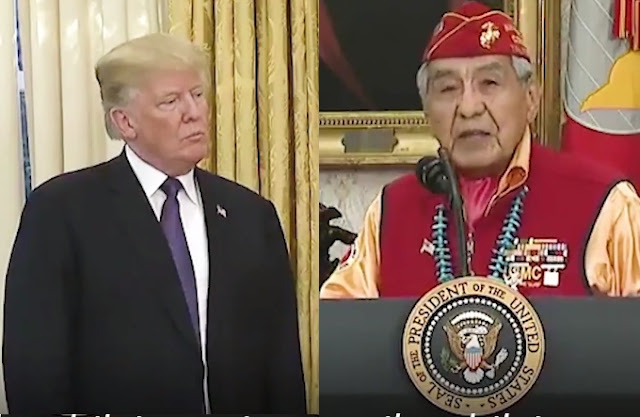
The Navajo code talkers were commended for their skill, speed, and accuracy demonstrated throughout the war. At the Battle of Iwo Jima, Major Howard Connor, 5th Marine Division signal officer, had six Navajo code talkers working around the clock during the first two days of the battle. These six sent and received over 800 messages, all without error. Connor later stated, "Were it not for the Navajos, the Marines would never have taken Iwo Jima.
He grew up in the Teec Nos Pos, Four corners area. He went to boarding school in Shiprock,NM and dropped out in the 6th grade because all the teachers were mean to the Navajos. Raised among traditional sheepherders and trained as a medicine man for 1 year.
MacDonald entered the Marine Corps as a Navajo language code talker during World War II. After the war, MacDonald earned an electrical engineering degree at the University of Oklahoma. Upon graduation, his acumen secured a job with Howard Huges at the Hughes Aircraft Company,
He was first elected Navajo Tribal Chairman in 1970. MacDonald served as Navajo Nation Tribal Chairman for four terms between the years 1970 to 1986.
Because Navajo has a complex grammar, it is not nearly mutually intelligible enough with even its closest relatives within the Na-Dene family to provide meaningful information. It was still an unwritten language, and Johnston thought Navajo could satisfy the military requirement for an undecipherable code.
Navajo was spoken only on the Navajo lands of the American Southwest. Its syntax and tonal qualities, not to mention dialects, made it unintelligible to anyone without extensive exposure and training. One estimate indicates that at the outbreak of World War II, fewer than 30 non-Navajo could understand the language.
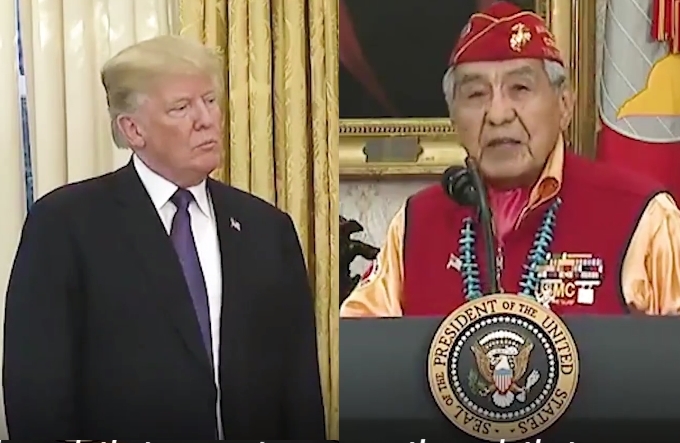
The Navajo code talkers were commended for their skill, speed, and accuracy demonstrated throughout the war. At the Battle of Iwo Jima, Major Howard Connor, 5th Marine Division signal officer, had six Navajo code talkers working around the clock during the first two days of the battle. These six sent and received over 800 messages, all without error. Connor later stated, "Were it not for the Navajos, the Marines would never have taken Iwo Jima.
VIDEO
Link to video....
This is not about Warren or anything but the speech and how our country is built on diversity.
Photo of the first ''Code Talkers''. 19 Choctaw from the 142nd Infantry were recognized as the first ''code talkers''....These men fought for the U.S. even though they were not recognized as citizens of the country that they fought and some died for.
Are you saying they were not citizens? What do you mean by "not recognized"?
Until 1924 , Native Americans were not citizens of the United States. Many Native Americans had, and still have, separate nations within the U.S. on designated reservation land. But on June 2, 1924 , Congress granted citizenship to all Native Americans born in the U.S
Code talkers were used in WWI and WWII, so they were not considered Americans in WWI, yet they served this country.
To learn more before making claims of fake fact, please read here:
http://www.history.com/news/world-war-is-native-american-code-talkers
That is exactly what I'm saying...Indian were not citizens of the U.S. until 1924.
Photo of the Navajo Code Talkers memorial. Window Rock, Navajo Nation, AZ.
Wow, what an amazing and inspirational speech. He really understands what it means to be an American. I was amazed at his love and devotion to this country, despite all the hardships Indians have had with here, their love of country outweighs all that. Something that should be remembered.
Exactly...
In those days, they joined to provide a service to their country - not looking for what services their country would give them.
And you know how their were treated after they came home 1st. Not good at all.
Which makes me proud to see returning service-people get ovations in airports - when all I got was cabbage, eggs, and other shite
Yup, sure is different today.