
Prayer Service Held in US Capitol Urges ‘Unity’ Across Denominational, Racial Lines

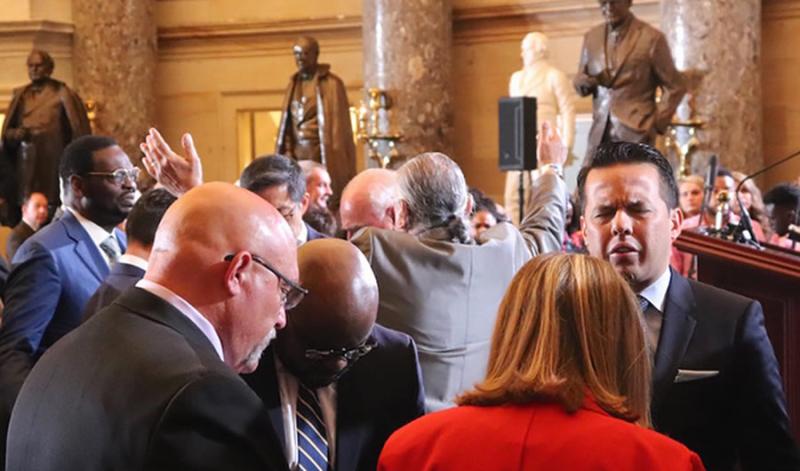
On Thursday evening, hundreds of Christian leaders gathered in Statuary Hall at the U.S. Capitol for the National Day of Prayer. The annual event has a storied history. Recognized in federal law, the National Day of Prayer has been observed on the first Thursday of May since 1988.
Led by Pastor Ronnie Floyd, newly appointed head of the Colorado Springs-based prayer ministry, the worship service broadcast worldwide to an audience of millions. Representative Mark Walker, R-N.C., a former pastor, officially sponsored the event and briefly addressed the gathering.
“Prayer is the most powerful weapon God gave to us,” said Walker. “We’re only 100 feet from the House floor. But throughout our history and biblical history, when we’ve worked through the name of Jesus Christ, it didn’t start over there — it started with God’s people and in his church.”
Focus on Unity in Diversity
The diversity of generations and ethnicities at this national observance was noticeably greater than in past years.
Leading voices included Bishop Harry Jackson, author Priscilla Shirer, White House faith advisor Johnnie Moore, First Nations leader Negiel Bigpond and Lea Carawan of the Congressional Prayer Caucus Foundation. The Brooklyn Tabernacle Singers of New York City led songs of praise, soaring with gospel style and energy.
The annual theme of Unity became evident beyond event branding. A written national prayer for America repeated by all at the event’s end acknowledged sins of racism in which Christians have engaged.
“Oh Lord, because each of us is created in Your image, please give us the courage to stand against all racial and ethnic division,” stated the prayer authored by Floyd. “We denounce it as evil and sinful, coming together in unity with all persons knowing this is God’s will for us.”
“Once we get up off of our knees, the next thing to ask is, Lord, what would you have me do?” — Priscilla Shirer
In an interview, Shirer expanded on why believers must make racial healing and justice a priority. “It’s not okay to sit back and think someone else will take on the task,” said Shirer, author of Fervent and other popular books.
“Once we get up off of our knees, the next thing to ask is, Lord, what would you have me do?” she continued. “Is there anything I can do practically and say publicly that will help forward this cause and help bring equal treatment and reconciliation? The silence, apathy and indifference of many white evangelicals are real concerns.”
Another prayer leader, Rev. Samuel Rodriguez, addressed a common criticism of this movement. Over the past year, elected officials who offer “thoughts and prayers” to victims following tragic events have faced spiteful responses online.
“We cannot be defined by cynical criticism,” said Rodriguez in an interview. “When there is pushback on the idea of thoughts and prayers, don’t drink that Kool-Aid. We as Christians know that prayer changes everything. Sure, it’s prayer and action — but it begins with prayer.”
“Let’s multiply and amplify our commitment to prayer.”
Students Come to Learn History — and Shape It
Educators Corry and Lakisha Robinson traveled to the prayer event with a group of 23 high school students from Victory Christian Academy in Orlando, Florida.
“The main reason we brought them here is the National Day of Prayer,” said Corry Robinson. “To be in this room with the spiritual leadership of our nation, praying for a Great Awakening, has really marked our students in a powerful way.”
He noted that Senator Marco Rubio’s office from their home state provided their group a Capitol tour. They also visited sites to mark the Frederick Douglass Bicentennial celebration this year.
“We desire to merge what they’re taught in the classroom with what’s actually happening in the governmental seat of our nation,” continued Robinson. “We strive to instill a biblical foundation and a well-rounded perspective of the history of the nation in every one of our students.”
The group of primarily African American students stood out among the mostly white, silver-haired audience in Statuary Hall. Matt Lockett, director of the Justice House of Prayer in Washington, D.C. and friend of Robinson, acknowledged that problems exist.
“It’s easy to see a lack of diversity here, but it’s changing,” said Lockett, noting private conversations he’s had with other ministry leaders. “Followers of Jesus are the greatest diversity movement in the world. In prayer together, we lay down our agendas and can truly find each other in the presence of the Lord.”
Concerns on the lack of diversity were also reflected in public prayers.
Help us champion truth, freedom, limited government and human dignity. Support The Stream »
How Scripture Addresses Racism and Unity
Priscilla Shirer hinted at the ongoing conversation on issues of ethnicity among Christian leaders. Some deny discrimination persists in the present-day, while others view reconciliation efforts as a priority.
“The reason why the issue of unity should be a matter of urgent, heartfelt and fervent prayer — not just today, y’all, but every single day — is because we have an enemy who is working overtime,” said Shirer. “He is sending flaming missiles into our families. We can smell the smoke. We can see the soot — denominationally, culturally, and, yes, racially.”
The Robinsons have often discussed these issues with their students. He points to how the church should reflect “every nation, kindred, tongue and tribe” according to Scripture.
“Unity is vital,” says Robinson. “One thing I have learned to embrace is that unity is not necessarily unison, but it’s harmony. Different parts of the body — different ethnic backgrounds and persuasions — are essential for a sound of harmony through the church to be lifted up all over the world.”
In her remarks, Shirer echoed this message. “Unity is not sameness,” she said. “Our brothers and sisters are young and old; Baptist, Methodist, Presbyterian, Pentecostal; black and white, and everything in between. We share unity of purpose and resolution.”
“Christ Himself brought peace to us,” she concluded.
Global Outlook of New Leadership
“Right where you are tonight, pray for the situation in North Korea,” Pastor Ronnie Floyd urged.
The national observance capped off a week of National Day of Prayer (NDP) activities in the capital region, including events at Museum of the Bible and National Community Church. Nationwide, more than 40,000 prayer gatherings occurred.
On Wednesday, Anne Graham Lotz noted her gratitude to Ronnie Floyd for accepting leadership of the prayer ministry. “I am really grateful that Ronnie stepped in and took it on starting this year,” she said. “This entire spring, I thought: Thank goodness I’m not having to worry about all the logistics. I can just see something of the fruit and be a part.”
In addition to the Springdale, Arkansas megachurch he leads, Floyd gives oversight to the NDP ministry staff in Colorado Springs, Colorado. His prayers at the event referenced pressing global concerns, bringing a broader focus than previous years.
“Right where you are tonight, pray for the situation in North Korea,” he urged. “We need a miracle. Ask God somehow, someway through his power that something new would be done in our generation. [Pray] that human life would begin to be respected in North Korea as never before.”
When the leaders of North and South Korea met on April 27, many observers worldwide were encouraged. Others have stressed that the human rights record of North Korea will not be easily reversed. Today, North Korean people face chronic food shortages, prison camps and a lack of basic freedoms.
Floyd also noted the Mideast region, specifically the 70th anniversary of modern Israel to be celebrated May 14. “Let’s ask God for the peace of Jerusalem, according to the Scripture,” he said.
Billy Graham and the Hidden Work of Prayer
Months after the passing of evangelist Billy Graham, Christian leaders still keenly felt the loss. A video montage of Graham sharing the gospel played near the end of the national observance. Floyd welcomed those watching to repeat the “sinner’s prayer” Graham popularized at his stadium events.
The night before, Graham’s daughter paid tribute to his character. “Daddy didn’t want to be a celebrity or make a name for himself — those things we sometimes see Christian leaders vying for today,” said Anne Graham Lotz. “He was a genuine man who walked with God and whose heart was broken to reach people with the gospel.”
Having preceded Floyd in his role, Lotz noted this national event happens due to an army of sacrificial volunteers. She recounted phone calls where a “thousand people were praying together.”
“Being the NDP chairperson opened my eyes and spirit to a movement of God in this nation I had not been aware of,” she said. “So often we see the apathy in the church and anger in the streets. This opened my eyes to an undercurrent of God’s Spirit that is moving.”
Leading a small group of young adults in weekly meetings on Capitol Hill, Lockett also recognizes the prayer movement is often hidden. He says he is hopeful for future generations coming up, though aware of the challenges.
“The firepower in this room is substantial, but they would all admit that they have not had the greatest success in reproducing themselves,” notes Lockett. “Why not pray with young people instead of just praying for them? It’s key to get our feet wet and get involved in their lives.”
“Personally, I am hopeful,” he says. “And the Scriptures say that hope doesn’t disappoint.”
Watch the entire 2018 national observance of the National Day of Prayer and join in prayer: https://stream.org/prayer-service-held-us-capitol-urges-unity-across-denominational-racial-lines/
Tags
Who is online
80 visitors
What we need is united resistance...
I thought ‘real’ Christians pray every day.
Who told you that?
You mean you don't?
I talk to Him a lot
If he answers seek a mental health professional immediately.
I missed my appt.
This is the entirety of Trump's comments at this occasion. He does not mention any other religion besides Christianity. In his introductions he does name a handful of clerics who are from the other religions Jewish, Hindu and Muslim. But in his comments, he mentions Christian people and Christian tenets throughout, but no mention of the other faiths.
Rose Garden
11:38 A.M. EDT
THE PRESIDENT: Thank you very much, everybody. Thank you. Please. Thank you very much. What a day. What a beautiful day. And our country is doing very well. You’ll see some very good announcements very shortly.
It’s wonderful to be here on this glorious spring morning as we celebrate the National Day of Prayer at the White House in the Rose Garden. (Applause.)
I want to thank Vice President Mike Pence and Karen for joining us. Very special people. Thank you very much. (Applause.) We are truly blessed to have a Vice President and a Second Lady who believe in the power of prayer and the glory of God. And they do believe. I’m with them a lot; they believe. (Applause.) It’s good. Thank you, Mike.
Thanks, also, to the members of the Cabinet who have joined us today, along with so many amazing faith leaders from across the country, including my good friend Paula White, who’s done such an incredible job. Paula. Paula. Stand, Paula. Thank you, Paula. (Applause.) And the President of the National Day of Prayer, Dr. Ronnie Floyd. Thank you. Thank you, Doctor. Thank you. Thanks, Ronnie. (Applause.)
I especially want to recognize Cissie Graham. And I will now add that word “Lynch” because I always call her Cissie Graham, but it’s really Cissie Graham Lynch. You like it that way better, right? Don’t you think we — I like it that way, too. I like it that way because you’re married to a great gentleman. A fantastic man. So, Cissie, thank you very much for being here. We appreciate it very much. (Applause.)
Priest Narayanachar, Sister Bingham, Chaplain Agbere, Rabbi Shemtov, Cardinal Wuerl, and the Hope Christian Church Choir. I heard you, by the way, right inside the Oval Office. That was beautiful. That was great music. Thank you. Thank you very much. (Applause.)
As we gather this morning, our thoughts also turn to the memory of a man who awakened the light of God in the hearts of millions of America’s pastors. And that’s the great, legendary, wonderful Billy Graham. Great, great man. Great. (Applause.) So, Cissie, I want to thank you for carrying on your grandfather’s incredible, towering legacy.
Today, we remember the words of Reverend Graham, “Prayer is the key that opens [to] us the treasures of God’s mercies and blessings.” Always beautiful. And when he said it, it meant so much. When I say it, it means something. But I liked when he said it better. (Laughter.) Right? I think he did that a little better than I do.
Reverend Graham’s words remind us that prayer has always been at the center of American life, because America is a nation of believers. Right? That’s very true. (Applause.)
The prayers of religious believers helped gain our independence, and the prayers of religious leaders like the Reverend Martin Luther King — great man — helped win the long struggle for civil rights. Faith has shaped our families, and it’s shaped our communities. It’s inspired our commitment to charity and our defense of liberty. And faith has forged the identity and the destiny of this great nation that we all love. (Applause.)
Americans of faith have built the hospitals that care for our sick, the homes that tend to our elderly, and the charities that house the orphaned, and they minister — and they really do, they minister to the poor, and so beautifully and with such love.
We are proud of our religious heritage. And as President, I will always protect religious liberty. We’ve been doing it. We’ve been doing it. (Applause.) Last year on this day, I took executive action to prevent the Johnson Amendment — a disaster — from interfering with our First Amendment rights. I was so proud of that. I’ve been saying from the beginning. You know that. (Applause.) I was saying for a long time we’re going to do that.
Across the government, we have taken action to defend the religious conscience of doctors, nurses, teachers, students, and groups like the Little Sisters of the Poor. (Applause.)
In January of this year, I was proud to be the first President to stand here in the Rose Garden to address the March for Life. A very special day. (Applause.)
And my administration has spoken out against religious persecution around the world, including the persecution of many, many Christians. What’s going on is horrible. And we’re taking action. We are taking action. (Applause.)
We condemn all crimes against people of faith, and today we are launching another historic action to promote religious freedom. I will soon be signing an executive order to create a faith initiative at the White House. (Applause.) Thank you very much.
The faith initiative will help design new policies that recognize the vital role of faith in our families, our communities, and our great country. This office will also help ensure that faith-based organizations have equal access to government funding and the equal right to exercise their deeply held beliefs.
We take this step because we know that, in solving the many, many problems and our great challenges, faith is more powerful than government, and nothing is more powerful than God. (Applause.)
With us today is a living reminder of this truth. His name is Jon Ponder, from Las Vegas, Nevada. Where’s Jon? Come on up here, Jon. Get up here, Jon. (Applause.)
Jon grew up without his father. As he tells it, “My mother was strong, but she wasn’t able to keep us out of the gangs and off the streets.” Right? Jon was in and out of jail for years until, at age 38, he was arrested for bank robbery. You don’t look like a bank robber, Jon. (Laughter.) He’s come a long way.
Jon soon ended up in federal prison, relegated to solitary confinement. That’s where God found him. Jon began to read the Bible and listen to Christian radio. Right? (Applause.) Incredible.
One morning, at 2 a.m., he woke up to the voice of the great Billy Graham. Reverend Graham’s words came through the airwaves, “Jesus wants to be Lord of your life.” That night, Jon dedicated his life to Christ. (Applause.)
He spent the rest of his time in prison praying, studying the Bible, and bringing the Lord to his fellow inmates. The day after Jon’s release, a visitor knocked on his door. It was the man who put him in jail, FBI Special Agent Richard Beasley — who is here. Richard. Come on up, Richard. (Applause.)
“I want you to know that I’ve been praying for you very strongly,” he said, that, “God called me to the FBI in part because of you, Jon.” The two are now lifelong friends.
Jon, do you like him?
PONDER: I love him.
THE PRESIDENT: You love him? That’s nice. (Applause.) That’s beautiful.
Jon runs a ministry that has helped more than 2,000 former inmates rejoin society, and he’s the talk of the country. The job Jon does is incredible.
Jon and Richard, you are a living testament to the power of prayer. (Applause.) Your story reminds us that prayer changes hearts and transforms lives. It uplifts the soul, inspires action, and unites us all as one nation, under God. So important.
And we say it here. You know, a lot of people — (applause) — they don’t say it. But you know what? They’re starting to say it more. Just like we’re starting to say, “Merry Christmas” when that day comes around. (Applause.) You notice the big difference between now and two or three years ago? It was — Paula, it was going in the other direction rapidly. Right? Now it’s straight up.
Our country was founded on prayer. Our communities are sustained by prayer. And our nation will be renewed by hard work, a lot of intelligence, and prayer. (Applause.)
Today we gather to remember this truth: We thank God for the faith of our people. We praise God for the blessings of freedom. And we ask God to forever bless this magnificent land that we all love so much.
America, thank you. God bless you. And God bless the United States. Thank you, everybody. (Applause.) Thank you very much. Thank you, Jon.
(The executive order is signed.) (Applause.)
Thank you very much, everybody. It’s a great day. Thank you.
Trump's entire speech , after the introductions, serves as a testament to Christianity. That is not the purpose of national prayer day and is not supposed to be the function of any governmental message or ceremony.
By the way, Paula White, Trump's "spiritual adviser" who he singles out here for praise, is a con woman who tries to get poor people to send her their money for "prayer cloths" and other such con games. That he should even mention her name in public is out of line with true spirituality.
That's why Trump likes her - they're both cut from the same cloth.
No surprising, everyone that is associated with trump is a corrupt liar in some way.
Walker and the NRA are clearly in disagreement here.
Prayer is like a weapon that can only shoot blanks. The shot can make a lot of noise, but nothing happens.
Do you mind if I borrrow that pithy quote?
Be my guest.
Thank you.
These things always generate debates, which are good. Religions would be fine if they didn't keep trying to push their ideologies the theologies and minded their own business. They don't. They keep inserting themselves into others lives and going for the the power. We should just do what we believe and let everybody else do the same as long as they mind themselves. And realize that NOBODY has the definitive answers yet, including all religious leaders. I reject their 'authority'.