╌>

Trump Versus the Hog-Maker

  

Category:  News & Politics

Via:  bob-nelson  •  8 years ago  •  63 comments

Trump Versus the Hog-Maker

S E E D E D   C O N T E N T


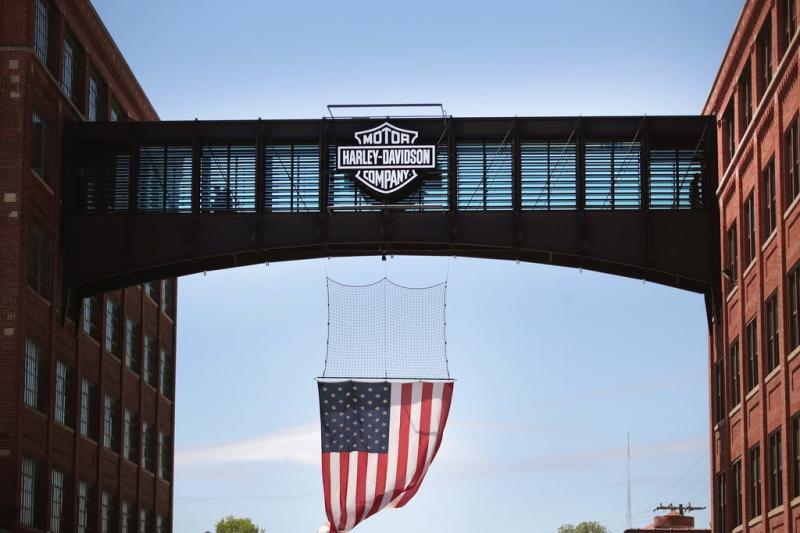
Harley-Davidson, the famed manufacturer of “hogs” — big motorcycles — made headlines this week when it announced that it would be moving some of its production out of the U.S. in the face of the growing tariff war between America and the European Union.

And Donald Trump made more headlines when he lashed out at a company “I’ve been very good to,” accusing Harley of having “surrendered” to Europe. So he threatened it with punishment: “They will be taxed like never before.”
merlin_140443659_4888f03c46da44988327c1add11f0a6cjumbo1.jpg

Now, in general I’m suspicious of news analyses, especially but not only in economics, that rely a lot on a supposedly revealing anecdote (such as, for example, analyses based on conversations with Trump supporters in diners). And the truth is that while Harley-Davidson may be something of an icon, it isn’t a big player in the U.S. economy. At the end of last year its motorcycle segment employed around 5,000 workers; that’s not much in an economy where around 250,000 people are hired every working day.

Nonetheless, I think the Harley story is one of those anecdotes that tells us a lot. It’s an early example of the incentives created by the looming Trumpian trade war, which will hurt many more American companies and workers than Trump or the people around him seem to realize. It’s an indication of the hysterical reactions we can expect from the Trump crew as the downsides of their policies start to become apparent — hysteria that other countries will surely see as evidence of Trump’s fundamental weakness.

And what Trump’s alleged experts have to say about the controversy offers fresh confirmation that nobody in the administration has the slightest idea what he or she is doing.

About that trade war: So far, we’re seeing only initial skirmishes in something that may well become much bigger . Nonetheless, what’s already happened isn’t trivial. The U.S. has imposed significant tariffs on steel and aluminum, causing their domestic prices to shoot up; our trading partners, especially the European Union, have announced plans to retaliate with tariffs on selected U.S. products.

And Harley is one of the companies feeling an immediate squeeze: It’s paying more for its raw materials even as it faces the prospect of tariffs on the cycles it exports. Given that squeeze, it’s perfectly natural for the company to move some of its production overseas, to locations where steel is still cheap and sales to Europe won’t face tariffs.

So Harley’s move is exactly what you’d expect to see given Trump policies and the foreign response.

But while it’s what you’d expect to see, and what I’d expect to see, it’s apparently not what Trump expected to see. His view seems to be that since he schmoozed with the company’s executives and gave its stockholders a big tax cut, Harley owes him personal fealty and shouldn’t respond to the incentives his policies have created. And he also appears to believe that he has the right to deal out personal punishment to companies that displease him. Rule of law? What’s that?

Now, I suppose it’s possible that Trump will, in fact, manage to bully Harley-Davidson into backing down on moving some production from the U.S. At the moment, however, there’s no sign of that.

And anyway, we’re talking about a few hundred jobs here out of around 10 million currently supported by exports, but put at risk by Trump policies. So if we’re talking about a serious trade war, we’re talking about thousands of Harley-Davidson-scale job losses. Even Trump can’t rage-tweet enough to make a significant dent in troubles of that dimension.

So what do Trump’s economists have to say about all of this? One answer is, what economists? There are hardly any left in the administration. But for what it’s worth, Kevin Hassett, the chairman of the Council of Economic Advisers, isn’t echoing Trump’s nonsense: He’s uttering completely different nonsense. Instead of condemning Harley’s move, he declares that it’s irrelevant given the “ massive amount of activity coming home ” thanks to the corporate tax cut.

That would be nice if it were true. But we aren’t actually seeing lots of “activity coming home”; we’re seeing accounting maneuvers that transfer corporate equity from overseas subsidiaries back to the home corporation but in general produce “ no real economic activity .”

So the Harley incident reveals the pervasive cluelessness behind the administration’s signature economic policy. But it also reveals something else: the deep weakness at Trump’s core.

Think about it. Imagine that you’re Xi Jinping, the Chinese president, who has already been telling leaders of multinational corporations that he plans to “punch back” against Trump’s tariffs. How do you feel seeing Trump squealing over a few hundred jobs possibly lost in the face of European retaliation? Surely the spectacle inclines you to take a hard line: If such a small pinprick upsets Trump so much, the odds are pretty good that he’ll blink in the face of real confrontation.

So the Harley story, while quantitatively small, may tell us a lot about the shape of things to come. And none of what it tells us is good.


Tags

jrDiscussion - desc
[]
 
Bob Nelson
Professor Guide
1  seeder  Bob Nelson    8 years ago

Imagine that you’re Xi Jinping, the Chinese president, who has already been telling leaders of multinational corporations that he plans to “punch back” against Trump’s tariffs. How do you feel seeing Trump squealing over a few hundred jobs possibly lost in the face of European retaliation? Surely the spectacle inclines you to take a hard line: If such a small pinprick upsets Trump so much, the odds are pretty good that he’ll blink in the face of real confrontation.


mocowgirl
Professor Silent
1.1  mocowgirl  replied to  Bob Nelson @1    8 years ago
Imagine that you’re Xi Jinping, the Chinese president, who has already been telling leaders of multinational corporations that he plans to “punch back” against Trump’s tariffs.

Do you know the tariffs that China levies against US made products?  These tariffs are used as leverage to force US companies to open factories in China, "partner" with Chinese businesses, and hand over R&D and patents.

China's multiple barriers to American products
Howard Richman, 4/1/2010

The latest statistics released on March 18 by the BEA show that for every $1 that the United States bought from China in 2009, the Chinese government only let its people buy 28¢ of American products. Although the Chinese economy was growing by 8.7%, the Chinese government managed to shrink Chinese imports of American goods and services.

The  2010 National Trade Estimate   (NTE) released on March 31 by the Office of the United States Trade Representative explains how the Chinese government kept out American products. Although the report ignored China's currency manipulations, which raise the cost of all American goods and services in China by somewhere between 25-40%, it still found plenty to talk about. Currency exchange rate manipulation is only one of the many ways that the Chinese government keeps out American products. The report focused upon the Chinese government's expert use of tariff and non-tariff barriers.

Tariffs

The Chinese government imposes high tariffs upon many American products. The report states:

China still maintains high duties on some products that compete with sensitive domestic industries. For example, the tariff on large motorcycles is 30 percent. Likewise, most video, digital video, and audio recorders and players still face duties of approximately 30 percent. Raisins face duties of 35 percent. (p. 60)

Selective Use of VAT

According to the report, China makes selective use of its Value-Added Tax to keep out American phosphate fertilizer:

In 2001, China began exempting all phosphate fertilizers except diammonium phosphate (DAP) from the VAT. DAP, a product that the United States exports to China, competes with other phosphate fertilizers produced in China, particularly monoammonium phosphate. (p. 60)

Procurement Directives

The report points out that China makes use of procurement directives to keep out American telecommunication equipment:

There have been continuing reports of the Ministry of Industry and Information Technology (MIIT) and China Telecom adopting policies to discourage the use of imported components or equipment. For example, MIIT has reportedly still not rescinded an internal circular issued in 1998 instructing telecommunications companies to buy components and equipment from domestic sources. (p. 60)

QIPs to Keep Out Agricultural Goods

The report points out that the Chinese government uses Quarantine Inspection Permits (QIPs) to keep out American agricultural products, causing costly delays while they sit on the docks:

China’s inspection and quarantine agency, the General Administration of Quality Supervision, Inspection and Quarantine (AQSIQ), and MOFCOM have imposed inspection-related requirements that have led to restrictions on imports of many U.S. agricultural goods....

Because of the commercial necessity to contract for commodity shipments when prices are low, combined with the inherent delays in having QIPs issued, many cargos of products such as soybeans, meat, and poultry arrive in Chinese ports without QIPs, creating delays in discharge and resulting in demurrage bills for Chinese purchasers. In addition, traders report that shipments often are closely scrutinized and are at risk for disapproval if they are considered too large in quantity.(pp. 63-64)

Restricting Market Access to Services .

America has a wide variety of financial and insurance services that American companies could market in China, but the Chinese government simply restricts market access. The report states:

China imposes restrictions in a number of services sectors that prevent or discourage foreign suppliers from gaining or further expanding market access. (p.70)

Keeping out Genuine Materials while they are Pirated

American DVD movies and PC games are quite popular in China. However, American companies rarely get any sales. The report states:

An exacerbating factor contributing to China’s poor IPR protection has been China’s maintenance of restrictions on the right to import and distribute legitimate copyright-intensive products, such as theatrical films, DVDs, music, books, newspapers, and journals. These restrictions impose burdens on legitimate, IPR-protected goods and delay their introduction into the market. These burdens and delays faced by legitimate products create advantages for infringing products and help to ensure that those infringing products continue to dominate markets within China. (p. 71)

Demanding American R&D and Patents

The report briefly mentions China's most recent escalation, its November   requirement   that American corporations move their R&D and patents to China:

In order to qualify as “indigenous” innovation under the accreditation system, and therefore be entitled to procurement preferences, a product’s intellectual property must originally be registered in China. (p. 69)

In short, the United States government is letting the Chinese government practice mercantilism, the strategy of maximizing exports and minimizing imports. We freely receive Chinese imports without requiring reciprocity.

It's time to impose a tariff on Chinese goods proportional to our trade deficit with China. Such a tariff, permitted by a special WTO   rule   for trade-deficit countries, would finally force the Chinese government be take down its many, many barriers to American goods and services.


mocowgirl
Professor Silent
1.2  mocowgirl  replied to  Bob Nelson @1    8 years ago
Imagine that you’re Xi Jinping, the Chinese president, who has already been telling leaders of multinational corporations that he plans to “punch back” against Trump’s tariffs.

Let's look at a recent CNN article...

How American cars are really sold in China

Most of the cars sold in China by iconic US automakers are made in China

America's most iconic automakers, such as Ford and General Motors, already make cars in China for Chinese customers in joint-venture factories. That means Ford and GM partner with Chinese firms to make and sell cars.

China is GM's biggest market and has been for six years straight,   according   to the company. Both Ford and GM manufacture the majority of their cars sold to Chinese customers in China. The 25% tariff doesn't apply to cars made in China.

From January to October last year, Ford sold 939,000 cars in China, but only 2% of those were imported,   according   to the company's most recent report on China.

GM and Ford   do export certain models from the United States to China, such as the Ford F150 Raptor. But those models make up a small share of overall sales in China.

The bottom line: It's more cost effective to make cars in a region where they will be sold. That's one reason why Ford and GM build cars in China, rather than ship them from America. By the way, Japanese automakers like Toyota and Honda follow the same principle: They make most of the cars they sell to US customers in North America.


mocowgirl
Professor Silent
1.3  mocowgirl  replied to  Bob Nelson @1    8 years ago
Imagine that you’re Xi Jinping, the Chinese president,

screwing over US automakers during Obama's presidency.

Has the US ever really had "fair" trade with China?

The Obama Administration recently took up the anti-dumping duties imposed by China on imported American-made cars and trucks with the World Trade Organization (WTO), as a violation of the WTO rules. These duties were imposed in 2011 presumably as retaliation against American’s anti-dumping duties on Chinese made solar panels (another move which was highly politically motivated). Heavily affected American cars include Cadillac, with penalty of 21.8 percent, and Jeep Cherokee at 18 percent, on top of other duties (figures are pulled from a report that references data provided by China’s Ministry of Commerce—see the link here

Given that these cars are manufactured in some important election battle states, the Obama administration’s action in an election year is clearly political, but I still want to applaud Obama’s effort to raise awareness of tariffs on car imports to China.

The automobile industry in China is still heavily protected behind a “tariff wall” even though this wall has come down significantly since China’s entry into the WTO. Cars imported to China face a tariff duty of at least 25 percent. In comparison, American duties on cars imported into the US are only 5 percent. Taking into account the 17 percent of VAT and other levies, imported cars and foreign-brand cars produced in China are substantially more expensive than the same type of cars in the United States. 


Bob Nelson
Professor Guide
1.3.1  seeder  Bob Nelson  replied to  mocowgirl @1.3    8 years ago

How many cars sold in America are manufactured in China?


mocowgirl
Professor Silent
1.3.2  mocowgirl  replied to  Bob Nelson @1.3.1    8 years ago
How many cars sold in America are manufactured in China?

I have no idea.


mocowgirl
Professor Silent
1.3.3  mocowgirl  replied to  mocowgirl @1.3.2    8 years ago

I do know that according to CNN....

China often says it will cooperate on trade. And then doesn't

Chinese officials   said last fall   they would lower auto tariffs, but they provided no time line. Xi didn't provide any timing either on Tuesday.

Xi's appeasing comments also stand in contrast to rhetoric from China's Foreign Ministry, which on Monday said trade talks with the United States would be impossible "under current circumstances." Between Monday and Tuesday, neither nation changed its proposed trade tariffs.

Xi has been China's president since 2013 and this year he was effectively granted the presidency for life. So far, he has defied calls to meaningfully change China's trade behavior. It remains to be seen if his words will translate to action.


Bob Nelson
Professor Guide
1.3.4  seeder  Bob Nelson  replied to  mocowgirl @1.3.2    8 years ago
How many cars sold in America are manufactured in China?
I have no idea.

None. Nor are any Chinese marques built in America.

This is why tarrifs are so hard to balance. China can truthfully claim that automobile trade is completely unbalanced in America's favor.

For many products, American manufacturing simply isn't competitive.

And then there are cases, like solar panels, where the Chinese industry was subsidized to the point that the American industry has almost vanished.

It ain't simple!


dave-2693993
Junior Silent
1.3.5  dave-2693993  replied to  Bob Nelson @1.3.1    8 years ago
How many cars sold in America are manufactured in China?

As I have mentioned in a couple other discussions. This is currently in the works.

I will restate in other words here.

Ford stopped domestic production of ALL Ford Focus models some months ago. In about 16 more months production of the STANDARD models will begin in China. If we want them, we will need to import them.

The Sport models, RS and ST, will come from Germany.

Similar story about Buick production shifting to China.


Bob Nelson
Professor Guide
1.3.6  seeder  Bob Nelson  replied to  dave-2693993 @1.3.5    8 years ago
Similar story about Buick production shifting to China.

Not exactly "shifting". Buick would have disappeared years ago, but for the fact that the Chinese appreciate the marque. Far more Buicks are sold in China than in the US.

So it's easy to argue that China "saved" Buick from Oldsmobile's fate.

I drive a Buick. Built in Korea.


Bob Nelson
Professor Guide
1.3.7  seeder  Bob Nelson  replied to  Bob Nelson @1.3.4    8 years ago

I take it back!

The Buick Envision is built in China. A few tens of thousands per year, I'd guess.

It's a nice car... now. When it was first introduced, it was under-equipped for its price point. It recently received a better spec... and a price cut.


dave-2693993
Junior Silent
1.3.8  dave-2693993  replied to  Bob Nelson @1.3.6    8 years ago
I drive a Buick. Built in Korea.

Let me tell you this about Daewoo. If you have any stock associated with it, get it out. Not a good organization.

Nevertheless, main production has been in Michigan. All of it is "moving", "switching" to China.


dave-2693993
Junior Silent
1.3.9  dave-2693993  replied to  Bob Nelson @1.3.7    8 years ago
The Buick Envision is built in China. A few tens of thousands per year, I'd guess.

There you go.

The remaining Buick is moving there too.


mocowgirl
Professor Silent
1.3.10  mocowgirl  replied to  dave-2693993 @1.3.5    8 years ago
This is currently in the works.

Yes.

Good article below...

American car buyers tend to be brand loyal, and it has historically been difficult for newcomers — particularly from overseas. Last year, Ford, GM and Ram pickup trucks topped the bestseller list, followed by the Toyota Camry, the Nissan Rogue and the Honda CR-V.

The Japanese and Koreans both struggled to gain a foothold in the U.S., but now the Asian brands, with 46.3% market share, are neck and neck with U.S. automakers, at 44.4%. European companies account for the remaining 9.3%, according to Motor Intelligence.

But China's rise in production volume and quality has been breathtaking. A minor player as recently as the late 1990s, when it sold about 2 million vehicles, almost all of them in China, the country is now the world's largest automobile producer. In 2017, 25.4 million passenger vehicles — the vast majority made by Chinese automakers — were sold in China, according to LMC Automotive. (In the U.S., 17.2 million vehicles were sold last year from U.S., Asian and European manufacturers.)

As state-owned car companies entered into joint ventures with U.S., European, Japanese and Korean companies, production surged and quality improved. Meanwhile, leaner, meaner private Chinese companies such as Geely are turning up competitive pressure.

GAC's U.S. foray will test Chinese government ambitions to become a world-class, high-quality exporter of essential goods and services. The government's Made In China 2025 plan, released in 2015, identifies 10 key industries, motor vehicles among them, with an emphasis on electric cars and trucks.

Incentives and mandates issued from Beijing and local governments, including polluted mega-cities such as Shanghai, have boosted electric vehicle growth.

Electrified vehicle sales expanded 53% in 2017, to 777,000 vehicles, said the China Assn. of Automobile Manufacturers — 652,000 all-electric vehicles and 125,000 plug-in hybrids.

In the U.S., almost 200,000 EVs and plug-in hybrids were sold last year, according to Inside EVs, up about 25%. While mass consumer demand for EVs remains tepid, automakers have launched ambitious electrification plans. A bill to require zero tailpipe emissions for all new vehicles sold in California by 2040 is in the legislative hopper.

Although EVs are rising fast in China, overall passenger vehicle sales are flattening out — up only 2.8% in 2017, compared with a 15.5% increase the year before.

That puts pressure on Chinese automakers to expand to new markets. Success in the U.S. will translate into more sales back in China, said Mark Wakefield of the consulting firm AlixPartners. The idea: If U.S. customers embrace a China-made car, it must mean the quality is high.

"Competition in China is tough and getting tougher," he said. "There's a premium for a brand that comes with a [U.S.] stamp of approval."

If GAC succeeds with a 2019 U.S. launch, it won't have the China-made market to itself.

Volvo Cars and Volvo's Chinese owner, Geely, have joined forces to create a new line of automobiles, named Lynk & Co., designed in Sweden and manufactured in China. Lynk aims to export a compact SUV to Europe in 2019, while plans to distribute its cars through U.S. manufacturing plants outside China are under consideration.

Polestar, another Geely-Volvo endeavor, plans global distribution of high-end electric cars and could bypass the need for auto dealerships through online sales.

SF Motors, an arm of China's Chongqing Sokon Industry Group and headquartered in Santa Clara, is planning its own technology-loaded luxury car line for the global market. SF Motors' chief innovation officer is Tesla's original founder, Martin Eberhard.

Dozens of other small Chinese or China-funded companies want in, including Byton, headed by former BMW executives, which introduced an electric compact SUV concept car   at CES in Las Vegas last month.

Threatening all these plans is a political buzz saw on trade policy. President Trump has made clear his distaste for imported cars.

But Democrats might see political gain in knocking China too. Soon after GAC Motors' Detroit event, Senate Majority Leader Charles E. Schumer (D-N.Y.) referenced GAC's U.S. entry plan in a speech on the Senate floor, calling China's 25% tariffs on imported cars "manifestly unfair, and a typically unfortunate example of China's rapacious trading policies." U.S. Auto import tariffs are set at 2.5%

"We're beginning to see a lot of bad press on China" in the U.S., said Taiwan-based Greg Anderson of Pacific Rim Advisors. "Right now, an anti-China position is going to play well politically."

Asked about that, GAC's Yu said, "No comment."

He's more focused on a dealer network. "That's an expensive, time-consuming and complicated thing to do," said AutoBeat Daily's Hampton.

GAC has joint ventures with Honda, Toyota, Mitsubishi   and Fiat-Chrysler.


Bob Nelson
Professor Guide
1.3.11  seeder  Bob Nelson  replied to  dave-2693993 @1.3.9    8 years ago

I Googled "Buick Enclave to China". No hits.

The Enclave is on the same platform as several other GM products, so moving it wouldn't make much sense.

The fact is that today, Buick is oriented towards the Chinese market. My (terrific) Encore was designed for the Chinese, and only sent to America as an after-thought. Where it became a (well-deserved) hit, pretty much creating the subcompact crossover market.

I guess Buick is a pretty good example of international trade....


Bob Nelson
Professor Guide
1.3.12  seeder  Bob Nelson  replied to  mocowgirl @1.3.10    8 years ago

China has, roughly, one billion more people than the US. Their economy will be more powerful. Inescapably.

So our quest must be to maintain a proportional role.


dave-2693993
Junior Silent
1.3.13  dave-2693993  replied to  Bob Nelson @1.3.11    8 years ago

Currently the Envision is made there.

I wouldn't bet on most model production remaining here. China is the biggest consumer of Buick cars.


dave-2693993
Junior Silent
1.3.14  dave-2693993  replied to  mocowgirl @1.3.10    8 years ago
Good article below...

Yes, good article.


Kavika
Professor Expert
1.3.15  Kavika   replied to  mocowgirl @1.3.10    8 years ago

One thing that they forgot to mention is the new $1.1 billion dollar Volvo (owned by Greelly/Chinese) plant in SC. It will employ 4,000 at full capacity. 

Another tidbit is the 25% tariff on all light trucks, SUV's and vans from Europe. This is done to protect GM/Ford/Ram from the competition of Fiat, VW and MBZ...


Bob Nelson
Professor Guide
1.3.16  seeder  Bob Nelson  replied to  dave-2693993 @1.3.13    8 years ago
I wouldn't bet on most model production remaining here. China is the biggest consumer of Buick cars.

GM will assemble its products wherever it is most reasonable to... I hope. To do otherwise would be suicidal.

My Encore is an interesting example. It was designed for the Chinese market, with production in Korea. It was sent to America as a "well... why not?" GM didn't invest much, so if they only sold a few, they were covered.

They completely screwed up the marketing. Since Buick is an old-folks marque, GM is always trying to tap into the youth market. So they attempted to sell the Encore to newlyweds.

Ummm... No.

The Encore is quiet and comfortable... but it's a stone . Zero to sixty in... one of these days. Once upon a time, I wanted "fast". As I have aged, ease of entry / exit has become more and more important. The Encore is the best! In other words, it's perfect for empty-nesters. Not for newlyweds. Oh well...

So we have a badly marketed car... designed for China... built in Korea... and a success in America.

Why not? stunned


dave-2693993
Junior Silent
1.3.17  dave-2693993  replied to  Kavika @1.3.15    8 years ago
Another tidbit is the 25% tariff on all light trucks, SUV's and vans from Europe. This is done to protect GM/Ford/Ram from the competition of Fiat, VW and MBZ...

Watch out, Ford and VW are in talks for commercial van and light truck joint ventures. I can see some skirting of the rules somewhere there.


dave-2693993
Junior Silent
1.3.18  dave-2693993  replied to  Bob Nelson @1.3.16    8 years ago
Why not?

Yeah, why not, as long as it lasts?


dave-2693993
Junior Silent
1.3.19  dave-2693993  replied to  Kavika @1.3.15    8 years ago

To help fill the VW picture, VW = VW, Porsche, Audi, Lambo, Bugatti, Ducati and a few others, while employing 3 times as many people as Ford.

Sets the mind wondering.


Bob Nelson
Professor Guide
1.3.20  seeder  Bob Nelson  replied to  dave-2693993 @1.3.19    8 years ago
employing 3 times as many people as Ford

Good point. We still think of the "Big Three". On the international scene... not so big.

OTOH, the Big Three totally squandered their dominant position fifty years ago.

When the Japanese went from "little junky things, but really, really cheap!" to "actually a pretty good car, and still so inexpensive!" the handwriting was on the wall. American manufacturers continued to churn out mediocre products, counting on "badge engineering" to draw large numbers of customers.

The CEOs continued to draw enormous remuneration, while their companies' positions steadily eroded. Standard capitalism...


mocowgirl
Professor Silent
1.3.21  mocowgirl  replied to  Bob Nelson @1.3.12    8 years ago
China has, roughly, one billion more people than the US. Their economy will be more powerful.

Not so long ago, people in China were in dire poverty.  Their leaders signed treaties and imported the world's companies and technology to benefit the one billion people of China domestically and on the world market.

I have errands.  Will check in later.

Deng took power in 1978, when China was in dire poverty. By the time he stepped down 14 years later, over 200 million people had been lifted out of poverty, and the policies he introduced set China on the path to become an economic powerhouse.

Establish good relations with all major countries.   Deng had pleasant discussions with foreign leaders but was honest about differences. He believed the Soviet Union made a grave mistake by making enemies. He was the first leader in Chinese history to go to Japan, where he met the Japanese emperor. He negotiated and signed a treaty of peace and friendship with Japan, promoted people-to-people exchanges, and expanded imports of Japanese movies, TV programs and novels. He completed the normalization of relations with the United States. He made a triumphant visit to America, where he donned a cowboy hat, demonstrating that it was all right for the Chinese to imbibe American culture. In 1989, he welcomed Mikhail Gorbachev to Beijing to show the world that Sino-Soviet relations, broken since 1963, were back on track.


Bob Nelson
Professor Guide
1.3.22  seeder  Bob Nelson  replied to  mocowgirl @1.3.21    8 years ago

I remember, maybe ten years ago, when China's GDP passed France's. That was a country of over a billion people overtaking one of sixty million. Gosh!

Unless the Chinese government does stupid stuff like, say, start unnecessary trade wars... their population ensures that they eventually become the world's leading economy.


mocowgirl
Professor Silent
1.3.23  mocowgirl  replied to  Bob Nelson @1.3.22    8 years ago
Unless the Chinese government does stupid stuff like, say,

To date, I would say that the Chinese government has played the long game very well.


cjcold
Professor Quiet
1.3.24  cjcold  replied to  Bob Nelson @1.3.6    8 years ago

I drive a Japanese truck built in California with Chinese parts and named for a town in Washington. Go figure.


Ronin2
Professor Quiet
2  Ronin2    8 years ago

I love the fact the left thinks Harley's decision was made spur of the moment. They haven't had time to negotiate tax incentives with any countries, much the less choose a spot for a new plant, plan hiring and training, or anything else since Trump announced his sanctions.  These moves take years worth of planning.  Harley made this decision long before the tarriffs were announced. They are just a convenient excuse for the company to try and protect it's image.


Bob Nelson
Professor Guide
2.1  seeder  Bob Nelson  replied to  Ronin2 @2    8 years ago
I love the fact the left thinks...

I love the fact that the right thinks of nothing but what the left thinks.

Deleted


Ronin2
Professor Quiet
2.1.1  Ronin2  replied to  Bob Nelson @2.1    8 years ago

Really. Please explain how businesses work when making a decision to move plants/factories over seas.  What about my statement isn't factual.

Harley Davidson is using the tarriffs as an excuse to protect their public image. The planning and decision to move was made a long time ago. But any excuse to bash Trump is a good one it seems.

Maybe you want to explain why Harley Davidson opened a plants over seas while Clinton, Bush, and Obama were in charge?

Harley-Davison  HOG, +0.60%   made its first foray outside the U.S. near the end of the Clinton administration in 1999 when it opened a plant in Brazil. The company later acquired a parts maker in Australia during the Bush years. It opened a plant in India in 2011 when Barack Obama was president. And shortly after Trump took office in 2017, Harley-Davidson said it would build a plant in Thailand.

The president is known to make a lot accusations, but he might have a point. The union representing Harley’s American workers contends Harley-Davidson was just itching to make the switch.

“I think they had this planned for some time. I think they are using this as an excuse,” Joe Capra of the International Association of Machinists & Aerospace Workers told NPR . Capra is a union representative at a plant in Kansas City that will be closed next year at the cost of 800 jobs.

What the company also failed to mention is that while one Trump policy could cost them money, another saves them plenty of coin. The company could save up to $100 million a year at the lower corporate tax rate under the new Trump tax rules.

In effect, the Trump tax cuts should have given Harley-Davidson extra cushion to ride out the current trade fight.

Instead, the company chose to raise its dividend earlier this year and buy back shares, a decision that could cost far more than any short-term losses from the U.S. trade dispute with Europe.

It was probably inevitable that Harley-Davidson would plant a flag in Europe, however. Sales are slowing in the U.S. because of demographic shifts and they are growing in Europe, the company’s second-largest market. The tariffs may have simply sped up the decision by Harley to shift more production to the continent so it can be closer to its customers.

The earlier shift to Asia was undertaken for the same reason, but there’s a big difference. Countries such as China, India and Thailand have huge and unfair tariffs that force companies wanting to do business to relocate there — exactly what Trump is complaining about.

Funny how the other presidents aren't to blame for Harley's past moves.


Bob Nelson
Professor Guide
2.1.2  seeder  Bob Nelson  replied to  Ronin2 @2.1.1    8 years ago

So the President gave Harley the opportunity to make a necessary move while putting the blame on him.

OK. I understand.


MrFrost
Professor Guide
2.1.3  MrFrost  replied to  Bob Nelson @2.1    8 years ago
I love the fact that the right thinks of nothing but what the left thinks.

That's how they justify their talking points; they tell themselves and others what the left thinks even though they haven't a clue what the left thinks, but, it gives them justification for their hatred. 


Bob Nelson
Professor Guide
2.1.4  seeder  Bob Nelson  replied to  MrFrost @2.1.3    8 years ago

They have nothing positive to talk about. Their program is to eliminate... everything.

That's hardly a great subject for everyday conversation, so they spend their time talking about "the left". Singular. As if there's a monolithic agenda/organization.

It's funny, in a way. They aren't stupid, but they allow themselves to be directed like puppets, with no brains at all. Parrots for Fox News. They allow this. They desire this. Very strange....


Greg Jones
Professor Participates
2.1.5  Greg Jones  replied to  Bob Nelson @2.1    8 years ago
Do you have any original thoughts at all?

Response deleted


Bob Nelson
Professor Guide
2.1.6  seeder  Bob Nelson  replied to  Greg Jones @2.1.5    8 years ago
Making a personal attack happens when one does not have any original thoughts.

That's just silly. Totally illogical.

In this particular case, I was reacting to a (deleted) expounding on what "the left thinks".

Let me persist: It is stupid to generalize in that way... and even stupider for a (deleted ) to make fantastical generalizations about the left.

Clear?


Colour Me Free
Senior Silent
3  Colour Me Free    8 years ago

Interesting that the article does not mention that Harley sold out before Trump's tariff war was even a thing...  here is an interesting read from May of 2017..

Even Harley-Davidson Can’t Resist the Tug of Overseas Factories


Kavika
Professor Expert
3.1  Kavika   replied to  Colour Me Free @3    8 years ago

HD is going to go where there business is. The tariffs, IMO, pushed this business off shore. I don't think that wages and benefits will be lower in Europe. So it's the additional cost of $2200 per bike that did it. Europe is a growing market for them where the US is a declining market. 

As for having plants in other countries, India is a huge market for bikes and there are numerous builders there. The plant in Thailand may not have come about if we hadn't pulled out of TPP, where the duties on bikes would have been greatly reduced. 

BTW, Indian motorcycles will be building a plant in India...


Colour Me Free
Senior Silent
3.1.1  Colour Me Free  replied to  Kavika @3.1    8 years ago

Tesla is actually the only truly made in the USA motor product .. yet that will be changing when they open a plant in China..

But none of that has to do with the point I was attempting to make … for years Harley has been purchasing parts from other countries as well as manufacturing in other countries - this is not some new thing that suddenly popped up due to a 'tariff war' … It is the " un" global world in which we now live (I neither condemn nor condone, it is what it is!) yet it is not 'Trump' and his vast (so called) knowledge or lack there of causing some sudden exodus of Harley - Davidson...

I boycotted Harley several years ago .. sold my scoot … thinking if I ride again I will shop around .. Polaris makes a sweet ride.  I do my best to purchase American made products .. sometimes the search is exhausting but I find what I want .. and sometimes I fail!


Bob Nelson
Professor Guide
3.1.2  seeder  Bob Nelson  replied to  Colour Me Free @3.1.1    8 years ago

The news here is that Harley will move part of their production somewhere safe from unexpected tarrifs. Businesses need to be able to plan ahead. Putting a plant somewhere in the European Economic Area will do that.

This is what happens when you (unnecessarily) rock the boat.


mocowgirl
Professor Silent
3.1.3  mocowgirl  replied to  Kavika @3.1    8 years ago
The plant in Thailand may not have come about if we hadn't pulled out of TPP, where the duties on bikes would have been greatly reduced.

The duties are ridiculous, but certainly have been effective in making US manufacturers relocate to their countries and employ their citizens.

  I wonder just what Thailand was gaining for lowering their 60% tariff via the TPP.

It was probably inevitable that Harley-Davidson would plant a flag in Europe, however. Sales are slowing in the U.S. because of demographic shifts and they are growing in Europe, the company’s second-largest market. The tariffs may have simply sped up the decision by Harley to shift more production to the continent so it can be closer to its customers.

The earlier shift to Asia was undertaken for the same reason, but there’s a big difference. Countries such as China, India and Thailand have huge and unfair tariffs that force companies wanting to do business to relocate there — exactly what Trump is complaining about.

Thailand charges a minimum 60% tariff and India 100%, effectively doubling the price of a Harley shipped from the U.S. Harley-Davidson has built plants in those countries to avoid the steep tariffs and make bikes more cheaply for customers who earn far less money than the typical American.


Kavika
Professor Expert
3.1.4  Kavika   replied to  Colour Me Free @3.1.1    8 years ago
thinking if I ride again I will shop around .. Polaris makes a sweet ride.  I do my best to purchase American made products .. sometimes the search is exhausting but I find what I want .. and sometimes I fail!

Polaris which is the parent of Indian Motorcycles is building a plant in India. 


Kavika
Professor Expert
3.1.5  Kavika   replied to  mocowgirl @3.1.3    8 years ago

If we hadn't pulled out of TPP perhaps the tariffs wouldn't exist for motorcycles. 

Another thing to think of is and the number of foreign company that have plants in the U.S. In 2014 foreign corporations employed over 5 million Americans. I'm sure that since that time that many more are employed by foreign corporations. 

Do I think that China plays fair, no I don't. But IMO there are ways to fight it without a trade war which in the end will hurt Americans. As I've stated many times, NO ONE WINS A TRADE WAR, the best you can hope for is the injuries are not fatal. 

Additionally the U.S. has some pretty steep tariffs as well. It isn't all one way. 


mocowgirl
Professor Silent
3.1.6  mocowgirl  replied to  Kavika @3.1.5    8 years ago
Additionally the U.S. has some pretty steep tariffs as well.

I am embarrassed to admit that the only excessive tariff that I am aware of that is imposed by the US is on sugar.  This has caused some candy companies to relocate to Canada and Mexico where they have access to much cheaper sugar and no tariffs due to NAFTA.

As far as foreign companies operating in the US, some US companies are now owned by foreigners.  Smithfield, the largest pork producer, is now owned by Chinese businessmen.  I wonder how far the Chinese leader will tax his own businessmen who own businesses in the US?

Maybe no one wins a trade war, but isn't there room for improvement on existing trade deals or do you believe that the US workers were treated fairly by ALL of the government reps who negotiated and voted for them?


Greg Jones
Professor Participates
3.1.7  Greg Jones  replied to  Bob Nelson @3.1.2    8 years ago
This is what happens when you (unnecessarily) rock the boat.

That boat was already rocking unsteadily, and the tariffs, or the threat of them, are meant to calm the waters and level the boat.


Kavika
Professor Expert
3.1.8  Kavika   replied to  mocowgirl @3.1.6    8 years ago

Here is a link to the tariffs used by the US to protect some of our industries. 

I believe that you can go to the HTS (harmonized tariff schedule) of U.S. customs and find the duty/tariff on items imported to the U.S. 

There was one that was just overturned a 300% duty on a specific plane made by Bombardier in Canada that was going to be imported to the U.S.  

Maybe no one wins a trade war, but isn't there room for improvement on existing trade deals or do you believe that the US workers were treated fairly by ALL of the government reps who negotiated and voted for them?

There is always room for improvement in the various trade deals. In a global economy American workers and workers from other countries will always be hurt. That is the nature of globalization. The alternative is to become a isolationist country which will drive the cost of products through the roof. 


Bob Nelson
Professor Guide
3.1.9  seeder  Bob Nelson  replied to  Greg Jones @3.1.7    8 years ago
That boat was already rocking unsteadily...

Oh?

I keep hearing how well the economy is running. Which is it?


Bob Nelson
Professor Guide
3.1.10  seeder  Bob Nelson  replied to  mocowgirl @3.1.6    8 years ago
... isn't there room for improvement on existing trade deals...

Of course there's always room for improvement. But trade is two-way. So it's always looking for improvements for both parties. That's possible, because it's not a zero-sum game. Both sides can and should win.


Colour Me Free
Senior Silent
3.1.11  Colour Me Free  replied to  Kavika @3.1.4    8 years ago
Polaris which is the parent of Indian Motorcycles is building a plant in India.

Yeah, I know .. I have been thinking more along the lines of a Victory .. manufacturing of the bike is winding down, but is (at this time) made in the USA.

I do my research Kavika .. as I said I prefer to buy 'Made in the USA' products -  they are difficult to find these days, yet I always search them out before making a purchase ..

As Split Personality stated earlier "capitalism in action" - I tried to buy a stereo made in the USA .. all I could find was one 'assembled in Mexico using parts from the USA'  go figure

Ooops kind of wandered off topic again...


Bob Nelson
Professor Guide
3.1.12  seeder  Bob Nelson  replied to  Colour Me Free @3.1.11    8 years ago
Ooops kind of wandered off topic again...

Not at all. The topic is international trade. You're spot on.


Kavika
Professor Expert
3.1.13  Kavika   replied to  Colour Me Free @3.1.11    8 years ago
Ooops kind of wandered off topic again...

Not in my opinion, the article is about international trade so I think your right on target.


Bob Nelson
Professor Guide
3.2  seeder  Bob Nelson  replied to  Colour Me Free @3    8 years ago
... Harley sold out ...

Are you saying that Harley had a contract requiring them to produce only in America? Who was the other party in this contract?

Or... are you saying that all American companies have an obligation to have all their manufacturing in America? Like Apple, for example?

What, exactly, do you mean by "sold out"?


Colour Me Free
Senior Silent
3.2.1  Colour Me Free  replied to  Bob Nelson @3.2    8 years ago

I do not purchase Apple products ..

What I am saying is I choose the products I purchase carefully .. and buy American (or Made in Montana) whenever possible.  I also pay attention to business models of the companies I purchase from, as well as employee treatment by said companies -   these are things that are important to me..

I was loyal to Harley - Davidson until I wasn't .. talked to my buddy that is a partner in the local Harley shop - sales have been dropping off for sometime … but he thinks now may possibly hit rock bottom - remains to be seen... I wish Harley nothing but success in selling a piece of Americana .. NO longer made in America!


Bob Nelson
Professor Guide
3.2.2  seeder  Bob Nelson  replied to  Colour Me Free @3.2.1    8 years ago

OK... sounds reasonable.  Winking 2


dave-2693993
Junior Silent
3.2.3  dave-2693993  replied to  Colour Me Free @3.2.1    8 years ago
I wish Harley nothing but success in selling a piece of Americana .. NO longer made in America!

I would look for the bikes made overseas to be sold overseas.


Split Personality
Professor Participates
3.3  Split Personality  replied to  Colour Me Free @3    8 years ago

And while that article decried the potential layoffs off 100 HD employees in Pennsylvania, 7 months later in January of 2018,

HD decided to close their Kansas City operations and move them to York PA

transferring or creating 450 jobs in York.

Flash forward to June 2018 and now there's going to be stiff tariffs on the raw material for American made bikes;  steel and aluminum.

Like Mercedes, Toyota, Hyundai, KIA and others, HD will build plants where the tariffs are  lower and eliminate most of the shipping fees across the Atlantic and Pacific.

That's capitalism in action.


Colour Me Free
Senior Silent
3.3.1  Colour Me Free  replied to  Split Personality @3.3    8 years ago

That's capitalism in action.

I hear you Split Personality … yet I am tired of the outcry over Harley and the increase of roughly 2200 per bike, when they already have gone overseas to manufacture …  Tis just me I am sure, but I am far more concerned about the independent farmers and ranchers then I am a corporation and their tale of whoa regarding the bottom line and who is to blame for the shareholders not making enough money for a new yacht. 


Bob Nelson
Professor Guide
3.3.2  seeder  Bob Nelson  replied to  Colour Me Free @3.3.1    8 years ago
... when they already have gone overseas to manufacture...

You understand, I hope, that many companies have multiple production sites. Harley already has a site in Thailand (I think), but now they will create one in Europe.


Split Personality
Professor Participates
3.3.3  Split Personality  replied to  Bob Nelson @3.3.2    8 years ago

Right now they import partially assembled units and finish them in Bankok, but they are working towards a complete assembly process.

which should be complete in Rayong by the end of this year.

.

Harley-Davidson also has a motorcycle assembly plant in India, where it builds the company’s popular Street-model bikes for foreign markets.

they are known as Powersport Motor Co in Thailand. and have a HQ and 2 dealerships.

Many of the engineers are going to Thailand and Union employees suspect some of the equipment will go to Thailand instead of York, PA.


Kavika
Professor Expert
4  Kavika     8 years ago

IMO, the Chinese and a few other countries are playing the ''long game''...Their business plans go out decades, where ours go out five years...

China is willing to lose some of the battles and make concessions if in the long game they reach their goal. US Presidents come and go as do all US politicians and with that is a constant change of attitude and plans. Rarely so with the Chinese and also the Japanese. 


Bob Nelson
Professor Guide
4.1  seeder  Bob Nelson  replied to  Kavika @4    8 years ago

I agree, and I think this idea is essential.


Split Personality
Professor Participates
4.1.1  Split Personality  replied to  Bob Nelson @4.1    8 years ago

Very few CEOs in this country have much honor or moral values;

The majority circle a date on  the calendar in the not distant future where they think they can drive a stock price to a new high in coordination with their contractual obligations,

golden parachutes and obligations to the stockholders and public in order to maximize their personal

profit without a hint of concern for the same customers, stock holders or employees. 

It is the down side of this version of capitalism.

then they run for public office and ask us to look away............focus on their altruism./s


Bob Nelson
Professor Guide
4.1.2  seeder  Bob Nelson  replied to  Split Personality @4.1.1    8 years ago
Very few CEOs in this country have much honor or moral values

Of course not. They aren't paid to be honorable. They are paid to maximize shareholder dividends... regardless of any conflict with honor.

It always surprises me when someone is surprised by dishonesty in business. Dishonesty is not intrinsic to capitalism, but neither is honesty. Capitalism is amoral. It has no moral values at all. "Maximize shareholder dividends by whatever means necessary."

If the law is strict... and if the law is strictly enforced... and if the penalties for breaking the law are significantly greater than the profits to be made while following the law... then a company will abide by the law. Or rather, will stick close to the law...

But if the monetary advantages of breaking the law are greater than those of obeying the law... the CEO's duty is to break the law.

This is the nature of the beast!


Who is online


86 visitors