
Unlikely partners? China and Israel deepening trade ties

 S E E D E D C O N T E N T

On paper Israel and China are unlikely close trading partners.
China, the world's second-largest country, is the biggest exporter on the planet. While Israel, a tiny strip of land in the Middle East, is only in 45th place on the global exporting league table.
And importantly - Israel has always been a steadfast ally of the US.
So given the current trading spat between the US and China, you would expect Israel to be firmly on the American side.
Yet what many people don't know is that Chinese investment in Israel is continuing to boom, at the same time as a growing number of Israeli firms are entering the Chinese marketplace.
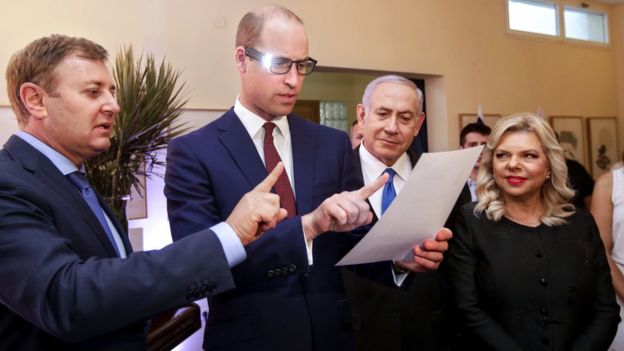 Image copyright GETTY IMAGES
Image caption The UK's Prince Williams was shown some examples of Israeli technology on his recent visit to the country, such as these AI glasses that help people with limited sight more easily read
So while President Trump is slapping tariffs on Chinese exports and talking tough, Israel's Benjamin Netanyahu is happily encouraging his country's firms to accept Chinese investments, as the figures show.
In 2016 China's direct investment in Israel almost tripled to $16bn (£12bn), according to a report in the South China Morning Post newspaper.
Meanwhile, the Jerusalem Post predicts that China will overtake the US as the number one source of overseas investment in Israel.
So what has brought the two countries together, and should Israeli firms be cautious?
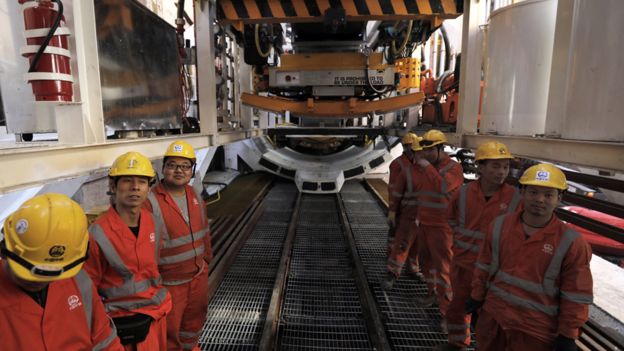 Image copyright GETTY IMAGES
Image caption Chinese firms are not just buying up Israeli firms, they are also working on Israeli construction projects, such as the Tel Aviv Metropolitan Area Mass-Transit System
Over the past two decades the Israeli economy has established itself as a leading hub of technological development.
Commentators say that Chinese firms want to get their hands on that technology, at the same time as Israeli companies want better access to the giant Chinese marketplace.
"The Chinese are leveraging Israeli tech to fuel their economy, Israel is held in high esteem as a hub of innovation," says Hagai Tal, chief executive of Taptica, an Israeli mobile advertising company.
"China is set on learning as much as it can in order to position itself as an innovation economy.
"[Meanwhile], Israeli companies also see important opportunities in the East, and the meeting point of these two approaches is what produces such successful business partnerships."
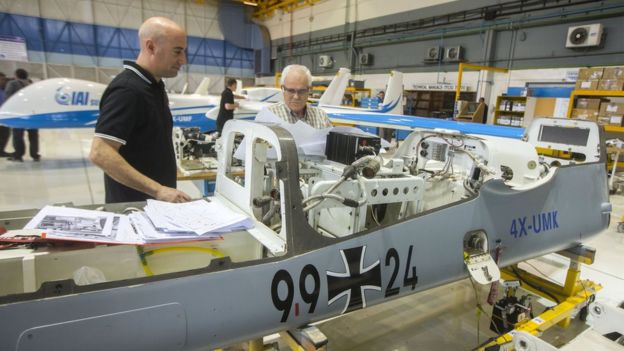 Image copyright GETTY IMAGES
Image caption Israel has built a hi-tech economy over the past two decades
To help bring Israeli and Chinese companies together, a number of business events are now held every year, such as Silicon Dragon Israel, which took place in Tel Aviv at the start of the year, and the China-Israel Innovation Summit, which was held earlier this month in Guangdong.
Rebecca Fannin, a founder of Silicon Dragon Israel, says Israeli tech start-ups that have secured Chinese investment tell her they "are progressing faster with Chinese capital, and through introductions, collaborations, and easier access to the large China mainland markets".
In recent years Israeli firms that have either been bought outright by Chinese companies, or sold them share of their business, include medical lasers operation Alma Lasers, and medical devices group Lumenis. Others are Israeli dairy business Tnuva, image recognition firm Cortica, and gesture control group Extreme Reality.
Royi Benyossef, an Israel-based manager at investment fund Samsung Next, says that the Chinese are "mesmerized by Israel and its technology exporting capabilities".
Other commentators say that the different national characteristics of the two countries complement each other.
Peggy Mizrahi, a Chinese citizen who lives in Israel, says: "The Chinese are known for long-term planning, and being conservative and hierarchical, unlike the commonly recognised Israeli mindset of [being] fast, innovative, flexible, and having a lack of respect for authority."
Daniel Galily, an Israeli expat who has lectured in business at Beijing Geely University, adds that: "The educational system in China places great emphasis on discipline and obedience to superiors, while the Israeli educational system and the Israeli army encourage students and soldiers to think about new ideas, and to solve problems in situations of uncertainty.
"The Chinese understand that, and so they strive to integrate the Israeli creativity into their economy."
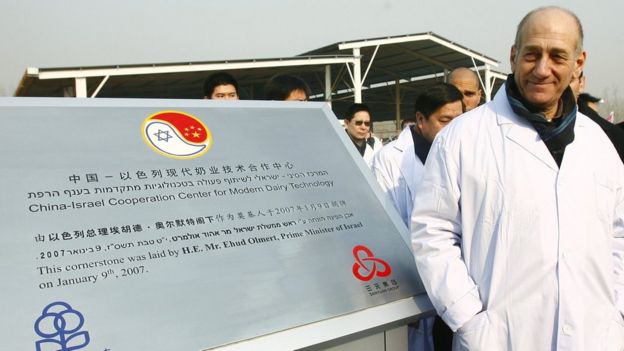 Image copyright GETTY IMAGES
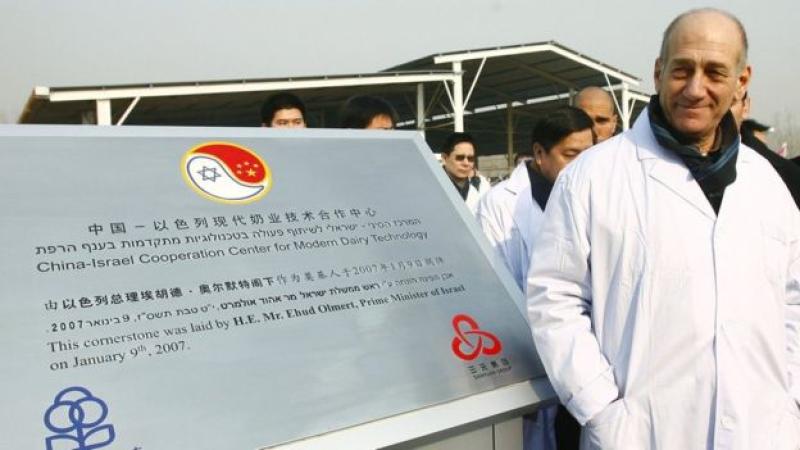
Image caption Former Israeli Prime Minister Ehud Olmert also worked to establish closer trade and business ties between Israel and China
However, it is not just Chinese firms that are benefiting from closer trade ties between the two countries.
Spotad, an Israeli digital advertising firm, entered the Chinese market last year after securing funding from a Hong Kong-based private equity firm.
The company now works with all the major Chinese online advertising exchanges.
Other Israeli firms that are continuing to make inroads into the Chinese market include mobile marketing firm AppsFlyer, and diamond trading platform Carats.
Tags
Who is online

112 visitors
A very interesting partnership to say the least.
There are some interesting points made in the article but this comment is a blockbuster.
Trade not trade wars seems to be the intent of this relationship.
Dear Brother Kavika: It is indeed an interesting series of commercial and industrial alliances between Israel and China.
Each benefits from it, in various ways.
Great article Brother.
Thanks.
Enoch.
I don’t trust Israel anymore than China. They would both stab us in the back given the chance. Israel wants our money and military protection but would do little to help us. If they can make a buck on it Israel will take the technology we’ve given them and sell it to the commies.
Do you have examples of this happening Dean. You are aware that Israel is one of the most technological advanced nations on earth, right?
Yes your article here is a great example.
So Israel trading with China is your example of Israel stabbing us in the back. Interesting since the US trades with China, Russia and Israel, are we stabbing ourselves in the back?
This article explains how Israel has been secretly arming the communist for a very long time. We should stop supplying them with our latest technology and fighter jets. They can’t be trusted.
Dean, I read that article and others regarding this. I would only say that as the biggest arms seller in the world the U.S. has sold arms and are still selling arms to some very questionable countries. In fact one of those countries, Saudi Arabia, has recently purchased arms from China and well as the U.S.
Do we stop selling arms to S.A.? Since the are the largest buyer of arms from the U.S.
Here is an interesting article on the newest F-35 tailored to specific needs of different countries. Israel being one of them.
There is a difference between the US selling arms abroad; and Israel reverse engineering our technology for sale to anyone else.
1st) The money goes to US companies which can be taxed; and which hopefully employ US workers- who can also be taxed. If we allow Israel to sell our technology they reap all of the rewards. That costs the US profits and jobs.
2nd) We can sell to whomever we want. The US government can dictate what countries can and cannot buy our weapons. We don't need Israel doing a reach around to send our technology to China, Russia, Iran, North Korea, or anyone else we don't sell to. Those countries steal enough of our technology as it is.
I will agree with you that the US sells weapons to countries that are sometimes questionable; and might be temporary allies at best- it still better than losing those sales to Israel- where they can get the exact same product with an Israeli tag on it.
Israel is purchasing weapons systems that are complete. In other words the defense contractors are selling them the item and are making a profit and also providing jobs in the U.S. . Please see the link in my prior comment regarding the F35.
I'm not aware of Israel selling our technology to China, Russia, N. Korea or Iran...If there is some proof of this please provide the link, it would be most interesting to see.
We are the biggest arms merchant in the world. Russia is second, China third. After that the dollar amounts of arms sellers is minute compared to the U.S. and Russia. I don't think that you'll be seeing arms being sold to Russia, China, N. Korea or Iran with an Israeli tag on it.
This is a very interesting article regarding how arms are sold. You can see that the Obama administration tried to stop the ''Check the Box'' routine sales.