
New Evidence for a Hidden Lake on Mars

 S E E D E D C O N T E N T

On the surface, Mars is the picture of desolation. A barren land unchanged for hundreds of millions of years, motionless except for the scattering of powdery dust by a faint breeze, or the slow crawl of a rover .
But perhaps just beneath the Martian soil, the picture is very different.
New evidence suggests the presence of a lake one mile beneath the ice-coated surface of Mars’s south pole, according to new research published Wednesday in Science . Scientists say the lake stretches 20 kilometers, or about 12 miles, across, and is one meter, or more than 3 feet, in depth. The findings, if confirmed, would mark the detection of the largest body of liquid water on Mars today.
The data comes from Mars Express, a European spacecraft that has been orbiting Mars for 15 years. While a high-resolution camera snapped stunning images of the surface, a radar instrument probed what was hiding underground.
The instrument—the Mars Advanced Radar for Subsurface and Ionosphere Sounding, or MARSIS for short—emits radio waves toward the planet. The waves penetrate the Martian surface—mostly rock, except for thick ice at the poles—bounce off whatever material they come in contact with, and then reflect back to the spacecraft. MARSIS measures the echoes of the radio waves, which scientists can then use to decipher the composition of the subsurface.
On Earth, scientists use the same technique to detect subglacial lakes and other bodies of water beneath thick, Antarctic ice sheets.
Starting in May 2012, MARSIS spent about more than three years pinging a region at Mars’s south pole with radio waves, producing a grainy image of the landscape beneath.
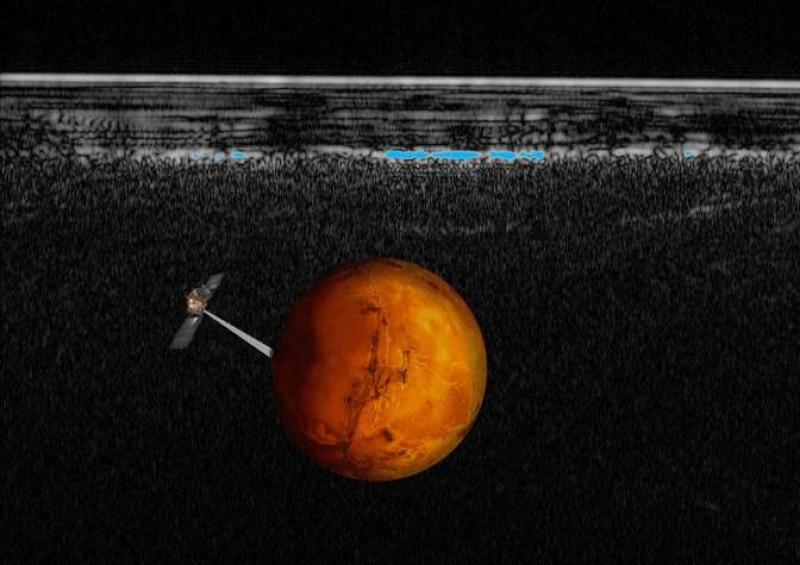
It helps to look at the data yourself. In addition to an illustration that shows how Mars Express studies Mars, the image below features what ’s called a radargram, a picture of different materials, molded out of radio waves. The thick, gray line at the top is the planet’s surface. The squiggles below that are a mix of ice and dust. The thread-like boundary below that indicates rock. And those slivers of bright blue, right along that lowest boundary? That’s water. A little oasis below the vast desert.
“The reflections from the bottom are stronger than surface reflection. This is something that to us is the tell-tale sign of the presence of water,” explained Roberto Orosei, a scientist at Italy’s National Institute of Astrophysics who led the research, in a video published Wednesday. “This condition on Earth happens only when you observe subglacial water, like in Antarctica.”
But Mars is far colder than Antarctica, so how is it possible that this lake, trapped beneath a layer of thick ice, flows with liquid water?
Orosei and his colleagues suggest that the lake is brimming with salts. When salts dissolve in water, they lower the temperature at which water freezes, allowing it to stay liquid (or, if you’re tossing salt on the sidewalk before an icy snowfall, kind of mushy). Scientists have previously detected deposits of salts across Mars’s southern hemisphere. Perhaps some of it dissolved into underground reservoirs, producing briny lakes.
Orosei said the MARSIS data supports this idea. “The radar data tell us that this water must contain a large amount of salts,” he said. “This is because the ice above it is very transparent, and this would not be possible if the ice was too warm, too close to the melting point.”
The thought of a subglacial lake swirling on Mars is thrilling, but scientists will need more evidence beyond radar data to make a definitive claim. “It shows the power of the radar techniques, and gives tantalizing clues about where we might find liquid water today,” said Jeffrey Plaut, a scientist at NASA ’s Jet Propulsion Laboratory who works on MARSIS but was not involved in this research. “If the result is confirmed, it would be the largest known occurrence of present-day liquid water on Mars.”
Plaut said he and his colleagues are “pursuing additional lines of evidence to test the interpretation” by Orosei and his team.
To confirm the finding, humanity would need to make yet another trip to Mars. “Getting there and acquiring the final evidence that this is indeed a lake will not be an easy task,” Orosei said. “It will require flying a robot there which is capable of drilling through 1.5 kilometers [or about 1 mile] of ice, and this will certainly require some technological developments that at the moment are not available.”
Still, the research marks another chapter in the story of water on Mars, which stretches back billions of years ago, when the planet was still young. Back then, Mars was a watery world. The planet was surrounded by a warm, thick atmosphere. Fluffy clouds hung in the sky, and liquid water pooled on the surface, sloshing around in deep craters that sit empty today. Research suggests that Mars may have had enough water to coat a fifth of the planet.
Eventually, nearly all of the water on Mars evaporated into space. The little that remained froze into thick sheets of ice or shrunk into gaseous wisps floating through the planet’s thin atmosphere. These days, scientists find most of the evidence of water on Mars in the traces it left behind—in the winding valleys that once held rivers, or in the smoothed-over pebbles that tumbled down those rivers.
Scientists have long wondered whether life managed to emerge at some point in Mars’s watery history. After all, as far as we know, water is one of the major prerequisites for the emergence of living things. They have found no evidence of it, past or present, on the surface. But perhaps they may have, sometime in the future, better luck down below. Orosei said the lake at the south pole “is certainly not a very pleasant environment for life.”
But life is possible in very unpleasant environments. Scientists have found thousands of microbes in lakes that exist 800 meters, or nearly half a mile, below the frozen crust of Antarctica. These tiny creatures had lived quite happily without the warmth of the sun, feeding on hints of minerals, for incredible time scales. For a long time, the view of their world was, for us, like Mars: the picture of desolation. It was only when someone came along and drilled into the ice that we discovered a new picture.
Tags
Who is online
100 visitors
While not definitive a sub glacial lake on Mars certainly makes logical sense given that similar phenomenon occurs here on earth in our southern polar region.
Dear Friend Freefaller: Please keep us posted.
A most interesting development.
Enoch.
Lol Enoch I'll certainly try, though I suspect we'll both have passed before this is ever confirmed.
Dear Friend Freefaller: The secret to immortality is the following.
Take out a thirty year mortgage.
Always make monthly payments in full, in a timely fashion.
Never pay off the mortgage.
Keep re-borrowing, and paying on time.
No bank will ever let a customer like that perish.
Peace, Abundant Blessings, And Life Eternal Via the U.S. Banking Industry.
Enoch.
Lol Dang, I'm already doomed as I just paid off my mortgage a couple of months ago
You should have talked to Enoch first. LOL!
Interesting information....It certainty is possible and more than probable.
Good article Freefaller.
We need to build a station on the moon that could be an eventual jumping point to send actual people to mars.
50 years ago, man traveled to the moon and found that it was not made of cheese......and we haven't been back since...
Behold the power of cheese.
Who wants to do the calculation to see how many gallons of water this lake holds.
Tip: Convert 12 miles to feet first.
Almost 1.5 million gallons?
I got 70.7 billion gallons
Did you convert your miles to feet and then your feet to gallons?
Hint: You need to calculate the area of the lake
Yes. Miles to feet for surface area times depth for cubic feet, converted cubic feet to gallons.
12 miles across that's 12 miles in diameter. To find the surface area it's pie r squared.
6 miles converted to feet = 31,680 feet
31680 squared = 1003622400 X 3.14 = 3151374336 sq feet X 3 feet = 9454123008 cubic feet
7.48 gallons per cubic = 945123008 cubic feet X 7.48 gallons/cubic feet = 7.07168401E10 (70.7 billion gallons)
My math is correct?
Yay me!!!!!!!!!
Thanks, TiG!