
Dissecting the Multi Billion Dollar Business of Televangelism

 S E E D E D C O N T E N T

Love them or hate them, Televangelists are woven into the very fabric of American life. Make no mistake about it, while the world of Televangelism has a 24/7 global reach, virtually all of the TV ministers hail from, live in, and operate out of the US. This is not to say that you won’t find any Televangelists in other countries – of course there are, but compared to the US operators, those based in other countries are small time operators, at best.
Here in the US though, it is big business. How big, no one really knows, because all of the high profile ministers and their churches keep their financial records confidential. There’s no transparency, and according the American tax law, there doesn’t have to be.
The reasons for this are easy to understand. In the US, we’ve had a tradition of building a wall of separation between Church and State that dates back as to the earliest days of our nation. That cuts both ways though: The Church stays out of government, and the government stays out of Church business.
Unfortunately, the almost complete lack of oversight can (and has) led to a number of high profile abuses and excesses, and it may be causing at least some people in government to start to question whether they’ve been a bit too permissive where Churches (especially ones with large media footprints) are concerned.
Who The Big Players Are
The core doctrine of the Televangelist seems to be this: If you plant a seed in the form of cash, by giving it to one of these churches, then your seed will grow, and you’ll wind up getting the money you donated back, many times over.
Exactly how or when you’ll get your money back is never explained. This, apparently is in God’s hands, and He hasn’t been terribly forthcoming about such things. In the meanwhile, even though we cannot peer directly into the financial records of the biggest Churches run by Televangelists, we can get a fairly good idea what they’re doing with all the money people keep sending them by examining the net worth of the ministers who run these Churches.
That then, is where we’ll start. Now, understand that the people we’re about to mention all make basically the same claim. God blesses those who do His good work by providing them with riches, so according to these people, they deserve the riches they have, because it’s a sign that they’re doing what God wants them to do.
To many, this may seem like a self-reinforcing “prophecy.” If you, as a Televangelist, can convince large groups of people who don’t have money to send you more than you can actually afford to send without skipping a meal, you can buy a multi-million dollar jet and a whole slew of multi-million dollar mansions (just call them “parsonages” and it’s fine with the IRS), and somehow convince yourself that it’s okay, because after all, God must want you to have these things, since you have them. Somehow the part about telling people that if they send you money, they’ll reap a return down the road just never enters into the equation.

At any rate, here’s the list of the top Televangelists in the country, as ranked by their net worth:
- Kenneth Copeland – With a net worth of more than $760 million dollars, Kenneth and Gloria Copeland, who jointly run Kenneth Copeland Ministries, are the 800-pound gorillas of the Televangelism world. They have more wealth than the rest of the name on the top list combined. His ministry’s campus is a sprawling 1500 acre estate near Fort Worth, Texas, and includes not just a church, but also a private airstrip, and a deluxe hanger for the ministry’s $17.5 million dollar jet. The ministry also owns a $6 million dollar “parsonage” which sits on the shores of a lovely lake, and is used to house the hard working minister and his family.
- Pat Robertson comes in a very distant second, with a still-hefty net worth of $100 million. His biggest claims to fame are the Christian Broadcasting Network, which operates out of Virginia, and an unsuccessful Presidential bid in the 1980’s. So much for the separation of Church and State.
- Benny Hinn – Weighing in with a net worth of $42 million, Mr. “Miracle Crusade” holds his meetings and revivals in major stadiums across the country and televised around the world.
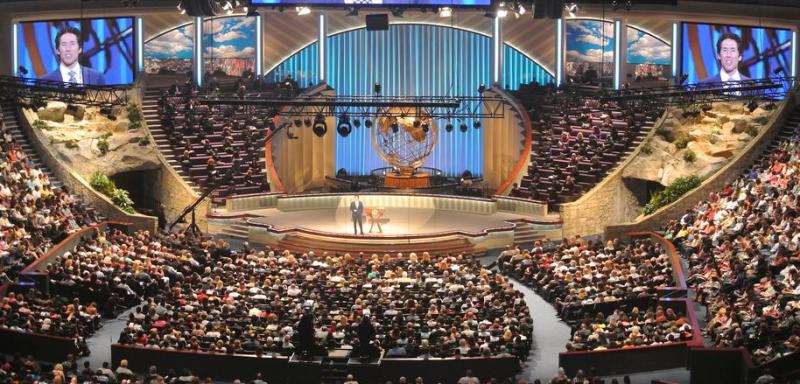
- Joel Osteen – The media darling has a net worth of $40 million, and has one of the largest churches in the country, despite having almost no actual religious training. He inherited his church from his father, and took it up a notch when he moved the church to an old stadium that the city was abandoning.
- Creflo Dollar – Founder of World Changers International, more recently better known as being the guy who told his global congregation to “plant seeds” (code for sending him money) so he could buy a $65 million dollar jet that he wanted. Sadly, he got the money from people eager to plant seeds and reap eventually goodness in return for their generosity. Something about this message just seems to resonate with those who have little, and guys like this take full advantage.
- Billy Graham – With a net worth of $25 million, Billy Graham is the elder statesman of Televangelism, and is markedly different from everyone else on the list. Where the others use the meme “plant seeds” by sending me money, Billy Graham is, by all accounts, the genuine article. He puts his money where his mouth is. For instance, he was active in the civil rights movement and personally posted bail for Martin Luther King Jr., on numerous occasions. He also refused to speak at events that were segregated. Basically, you could say that Billy Graham is a minister who uses media to get his message out to more people, as opposed to being a businessman using the church to pretend to be something he’s not. He’s one of the (few) good guys in the business.
It should be noted that most of these ministers and the Churches that they lead DO have missions in third world countries and they do spend some fraction of their money feeding and clothing the poor and doing the actual work God’s message talks about.
It is equally clear, however, simply by looking at the parade of mansions, private jets, extensive security details, and skyscrapers built not to glorify God, but to glorify the ministers who built them, that significant portions of the donations they receive aren’t doing anything that could even remotely be described as “God’s Work.”

The Hall of Shame
Part of what makes us cringe at high profile Televangelists is the fact of their excesses. The other part though, is the fact that their personal lives are often quite different from the gospel they preach. They can’t seem to live up to God’s ideal any more than the rest of us. The problem with that is that they use other people’s money to fund their lavish lifestyles. Then, of course, there’s a special subcategory of particularly slimy practices. Here, in no particular order, are the worst of the worst offenders:
Gloria Copeland – Regularly tells her audience not to seek medical treatment like chemotherapy. Instead, they should be “planting seeds” (sending money to the Copeland Ministry) so God will bless them with a cure.
Mike Murdock – Many of Mike’s followers are poor. So poor that they can’t afford to send him the money he needs to maintain his lavish lifestyle. His solution? He’s told his followers on national TV that if they put their donation on a credit card, that God will erase their credit debt for them. That’s disgusting.
Robert Tilton – Best known for “speaking in tongues” on live TV, an ABC expose on the man revealed that he spent 67% of his on-air time asking for money. Unfortunately, Tilton’s ministry seems to be all about Tilton. He used his money to purchase his half million dollar vacation home in Florida, and is fifty-foot Carver yacht, among other things. The ABC expose found that most of the prayer requests his organization receives are simply thrown in the landfill, after the cash is removed.
Jim and Tammy Bakker – Their well-known explosion was all over the news back in 1989 with fraud and infidelity being the twin missiles that brought the rising stars in the Televangelism world down. In addition to defrauding the public to help fund Heritage, Mr. Bakker was caught having a threesome with a church secretary named Jessican Hahn and John Wesley Fletcher in a Clearwater, Fl. Resort. The Bakkers were the founders of Heritage USA, which, back in its day, was a Christian Theme park and the third most popular theme park destination in the country, that featured, among other things, a life-sized version of the upper room, where the Last Supper was held. Although the Bakkers raised more than enough money to finish the Grand Tower, it was never completed, and to this day, nobody’s quite certain where all the money went, or why the church kept asking for more.
Terry Smith – The pastor of Canyon Creek Baptist Church is a real piece of work. Not only was he caught having affairs with a variety of women who came to the church seeking marriage advice, but to help support his habit, he was arrested for shoplifting condoms! A relatively small fish in the pond we’re talking about, but put here to highlight the fact that even the guys who don’t have a truly global reach will often abuse what power and privilege they’ve got.
Oral Roberts – Most famous for making a teary-eyed plea to his followers in 1987, warning them that God would “call him home” unless his ministry raised $8 million. His stunt actually pulled in $9.1 million. Nobody really knows why God insisted on that specific amount of money, or what was ultimately done with it. It remains a mystery.
Jimmy Swaggart – Compared to many other Hall of Shame members, Swaggart really isn’t all that bad. So he’s been caught spending church money on a few high-dollar hookers. What’s wrong with that, right?
Bob Larson – Mr. Larson might not be as big, or as well-known as some of the others, but in a lot of respects, he’s the poster child for everything that’s wrong with the industry. He’s been accused of plagiarism, been caught with hookers, been caught on film walking out of gay bath houses, molested a string of secretaries, and more. His answer to those charges? It wasn’t him. He claimed to have been physically impersonated by demonic doubles. Simply unbelievable.
The list goes on, but you certainly get the idea. For every “good guy” using media to expand his (or her) reach and do God’s work, there appear to be several whose goal is to simply abuse the system and rake in as much money as possible before they’re caught.
The bad news is, they are almost never caught. The IRS has only audited 3 churches since 2009. Three. You’re almost as likely to win the lottery as you are to be audited by the IRS if you run a church, and it’s incredibly easy to found one. Almost depressingly easily, actually.

The Bottom Line
Clearly, there are few people who would make the claim that one must make a vow of poverty in order to sincerely do God’s work (although our current Pope might disagree). It is equally clear though, that the biggest names in Televangelism have gone too far in the other direction. The signs of their excesses are everywhere, and if they were genuinely interested in doing God’s work, then one would imagine that the money they make would be better spent on more programs for the poor than on the sixth, tenth, or thirtieth multi-million dollar mansion for the ministers, their friends, and extended family.
It’s hard to reach any other conclusion except that these people aren’t actually running Churches at all. They’re running vast corporate, self-serving empires that only masquerade as Churches in order to take advantage of lax IRS rules where Church oversight is concerned.
Tags
Who is online
84 visitors
Despicable societal leeches.
This type of religious practice has morphed into a tax exempt money laundering scam which allows the purveyors to purchase elected protectors willing to help perpetuate this scale of larceny that victimizes the secular American taxpayer.
Easy to believe that.
Yes, it's pretty sad. What's even sadder to me, though, are those who send such people money. I have a hard time understanding how they can't see through the sheepskins these wolves wear. About the only thing I can come up with as to a reason is that these people try to play God the way others play the lottery. That if they just keep showing "faith" by sending money, God will eventually reward them with all their desires, which appear to be worldly. I think that is what these wolves pander to.
I'm also aware that you probably find this ironic.
I think a lot of them have been raised not to question religious leaders, to the point that they feel that questioning is sinning. Look at the support the Catholic Church still has after repeatedly covering up sex scandals and imprisonment. So when somebody gets in front of a camera, and quotes some scripture, they give instant credence, because that's what they're conditioned to do, often from before they could remember.
Add in some desperation over a serious illness, or some confusion due to early dementia, and maybe a bit of naivete just from having seen little of the world, and you've got an easy mark.
Not at all Drakk. I would have been both surprised and disappointed if you supported these charlatans.
Possibly, but I think that may be overstating things somewhat. The reason I say that is because you'd think, with me being religious and all, I'd have run into those types of people a lot more often than I do. Or perhaps I'm just not recognizing it when I see it. Dunno.
It's also possible that it isn't so much not challenging an authority figure as it is that this authority figure is telling them what they want to be true. If they challenge the authority figure, they have to challenge their own beliefs. That is, challenge what they want to be true about God.
I think this is pretty much true of any authority figure. When one sits in their professor's class, they generally take what he or she says to be truth. In something like math or other hard science, this is reasonable for the most part. Sociology, psychology? Probably not so much. But I get your point. When I hear someone speak on religious subjects, such as my pastor, I automatically assume that he knows a lot more about the subject than I do. But I don't stop there. I take what he says and dissect it for myself. I come to my own conclusions. Sometimes I don't agree with the pastor, although that's rare with the one I have now. I think that's what most people do who are serious about following Christ.
Agreed.
However, for most of them, being a mark is their own fault and not the fault of the advantage taker.
Not what I meant. I meant you probably wonder why I can see through things like this but not my own belief in God for which there appears to be no evidence.
Not at all. I would be surprised and disappointed if you did not immediately see through these charlatans.
You have solid evidence (their actions and their words) to determine their motives and integrity. They are clearly out to take advantage of people. I certainly would not expect you to accept what another person says s i m p l y because he or she claims to be religious.
It may well depend on what kind of church you've attended. I've attended some really authoritarian ones in my time. The pastor spoke; we listened. He (and it was always a "he") was right. If we disagreed with him, we were wrong. Whatever opinion our pastor or Sunday school teacher gave was correct, whether it regarded how we dressed, what music we listened to, whether or not alcohol was permissible (all churches I attended forbade alcohol), or how our family life was to be conducted (husband was in charge, of course). Education was viewed with caution, and discouraged by many.
It didn't "stick" with me, obviously
My grandmother would no sooner have questioned her Pentecostal preacher than she'd have jumped off a bridge.
My uncle was a preacher, and thought that gave him license to tell everybody, part of his congregation or not, how to live, because for a lot of folks, it did.
Actually, I'd say by college, probably not. I know that all of my math major friends had to do proofs ad nauseum because nothing was ever taken for granted. And in science, there's generally evidence for what a professor says - students are not expected to accept the accuracy of their instructor's words without question.
The Bible can be interpreted so many different ways, and with no empirical evidence to back up any interpretation, anyone can be right or wrong. Some churches recognize this, and some don't. Those that don't will likely have congregations that don't question, either because they've been conditioned against it, or because they attract people who psychologically lean toward a strong authority figure.
Apparently. I remember when I was in the Army and got stationed someplace new and was looking for a church. I ran into some strange (for me) churches. Some I attended were perhaps like that. I avoided churches that preached and only went to one's that teached. (Yeah, I know, but it rhymes with preached. sue me : ) In any case, I never went back a second time to those kinds of churches and perhaps that explains why I don't know many like you describe.
I didn't mean that students wouldn't have questions, but I doubt students questioned the professor's authority on the subject. I don't think a student is going to say "why should I believe you" when the professor is discussing quantum entanglement. Rather, the student has an expectation that the professor will lead them to an understanding of quantum entanglements that the professor has. The point was that people have a natural tendency to believe that an authority figure in his or her given field knows what they are talking about. Disagreement may come after a time, but initially they are usually assumed to know more than ourselves or we wouldn't be listening to them in the first place.
But as you say, your math major friends had to do proofs ad nauseum. Actually, that's pretty much the way a congregation should be with their pastor. If all they ever do is sit there on Sunday and listen, they're doing it wrong. A true disciple will take what the pastor says, go home and study it for him or herself. They will come to their own conclusions on the matter after study and prayer. Probably they will mostly agree but if they don't, most of the time it shouldn't be much of a problem. The point though, is that the pastor isn't the focus. He's really just a teacher and leader in the manner a professor would be, but it's up to us to do our own homework. I know my pastor practically begs us to do this. He doesn't require us to believe exactly what he does. He knows he isn't the focus of the church. Instead, he stands up there and does his best to give us the tools we need to grow in our relationship with God, which is the focus. In reality, there's little difference between what he does and what my instructors in college did.
I disagree. Not that it can't be interpreted in different ways, but that there is no empirical evidence for a correct interpretation. If you look at someone who's basically a wreck in some way. Is a selfish jerk, maybe. A drug addict or alcoholic perhaps. Liar, cheat or some other thing. Has lost hope. Something. But then finds God. Starts living according to what God says he wants us to do as described in the Bible. You know, loves God and loves people. Instead of being a proud jerk, is now humble and compassionate, gentle with those around them. Genuinely cares about people and helps them with their problems. Beats their addictions and lives a selfless life in the service of others. Loves when it hurts and tries to do what is right, even when it is a disadvantage. Always seeks peace, never puts himself first and so on. I'd say that person has a correct interpretation of the Bible. After all, isn't that what it plainly says those who follow Christ should do? In short, the empirical evidence in a correct interpretation is whether or not they do what it says to do.
Still, there's room for differing interpretations. Most of them are minor. Take women speaking in church. If you believe that women should not, then go to a church where they believe the same, but don't impose it on others who don't. But arguing about it is foolish. In Corinthians, Paul talks about eating meat sacrificed to idols. To the mature Christian, it should be nothing to eat it because we know there is no God but God. It's just meat regardless of what some other religion might think it is. But he also says those who feel they shouldn't eat it because it was sacrificed to an idol also do well not to eat it because their conscience bids them not to. They do not eat in order to honor the Lord and those who eat do so to honor the Lord. This is how all minor differences should be handled. Do yourself what your conscience bids before the Lord and don't cause someone else to fall by insisting on your own interpretation It is He who will judge, not each other.
That might( work for a long-existing church, where a person may enter as a child... but these meg-churches are relatively new. Their congregations have actively chosen to belong.
The members went looking for the churches that then bilk them.
It's the sect mentality - a need to surrender one's own will to a greater power. Jonestown and Scientology.
I wouldn't consider that evidence of anything, really, considering how many people manage to live well without religion, or with religions other than Christianity. He found words that suited him, but that doesn't mean those words are truth.
Some of those megachurches have been around plenty long enough for people to have grown up in them. And some people join them after having attended smaller churches with similar doctrines, and similar authoritative stances.
Thing is with the lottery everyone knows the chances of them winning are extremely small. No one seriously has any expectation that they are going to win, they all know that they just might get lucky but nothing is for sure. Everyone knows what the prize is if they do win as well. And we know people do actually win the lottery.
Compare that to what these fuckers are promising. That if you send them money then god will pay you back and then some at some point and in some way, but no one knows how or when.
The lottery's pitch is "buy a ticket and you have a small chance of winning the jackpot". The pitch from these guys is "send ME money and stuff will happen at some point".
The point wasn't that people can't live morally without the Bible. Obviously they can. The point was that one can identify someone who has correctly interpreted the Bible if their actions reflect what it says to do. Galatians 5:22 - But the fruit of the Spirit is love, joy, peace, patience, kindness, goodness, faithfulness, gentleness and self control. If someone who loves God exhibits those characteristics, it's evidence of correct interpretation. If one's interpretation leads them to persecute others, then that is evidence that they have not interpreted it correctly. If the person's actions do not parallel Christ's they aren't interpreting it correctly or are not applying what it says.
Not really. We would have to first establish that God exists, in order to be able to say that anyone had stumbled upon the correct interpretation of his supposed words.
Ummm, are you sure this is the hill? I mean, if someone flat out murders a gay person on sight can I assume they are a proper Christian? Or if they shoot their neighbor for mowing the lawn on Sunday? Again, you seriously may wanna rethink that statement.
I don't see why. What would it change if God suddenly appeared in the sky, so huge that most of the world could see Him? Would the words or meaning in the Bible change? If so, how?
No need to rethink it. I think you are confusing Mosaic Covenant Judaism with Christianity. It is a mistake often made by those who do not know what Christianity is. Understandable.
If the grandest possible entity appeared before us I would expect the Bible and all other 'holy' books would be clearly exposed as nothing but the products of human imagination. So, IMO, the Bible, etc. would change 100% (discarded).
But I think what Sandy is getting at is this. The only possible way to know what God has communicated is to have God certify said communication. If there is no God or no way to secure this certification, all the various interpretations are on equal footing - unsubstantiated.
Further, given the number of interpretations (much less the number of historical gods) the evidence suggests that creating gods and stories of gods is a very natural thing for human beings to do. We are very good at creating gods and their stories. So when we come across a god and a collection of stories it is quite reasonable to view that as yet another product of human imagination.
Conversely, it is illogical (out of all these gods and all these stories) to designate one as: 'oh this is where we got it right'.
That's fine. However, not the topic. The topic is the correct interpretation of the Bible. It tells us to love our enemies, for instance. How would proof of the God the Bible describes change the meaning of that in any way?
Also, even an unbeliever such as yourself can correctly interpret the Bible enough to see these predators for what they are. Even you recognize they don't follow it and you don't even put any faith in the Bible.
First of all, claiming the Bible teaches 'love thy neighbor' is highly problematic. You must mean the New Testament exclusively when you say 'the Bible'. I will assume that.
Second, I answered the question in my prior post so discarding it as 'off topic' means you missed my answer. Certification is the only way to know the true interpretation. So given a certifying God, He will either give us the one true interpretation of the Bible or will basically dismiss the Bible as not His Word. Sans a certifying God the meaning of the Bible remains vague with myriad contradictory interpretations all claiming to be the true one.
Taking your question literally, if one could prove that the God of the Bible actually exists (Yahweh with all of His contradictions) then by definition that cannot logically change the meaning of the Bible.
Since going absolutely literal means I am now dealing with a tautology: if X is true the X is true this is a pointless exploration. Is it not?
I agree. Where we do not agree is the method of certification. You apparently demand something empirical while I know it is subjective.
But this is still beside the point. This isn't about whether or not the Bible is the word of God, it's about correct interpretation of what the Bible says. Regardless of whether or not God is proven to exist, the Bible exists. That is not debatable. It's writers intended to convey a particular message and a correct interpretation conveys that message. As I pointed out to Sandy, even non-believers can interpret it correctly enough to see through the predators this seed is about. It isn't a matter of having a different interpretation with these predators. We all know that isn't what they do. It is about selectively choosing what aids them in their con and ignoring the rest. It is completely unnecessary for God to show up and validate this. Anyone who can read and think can see that their "interpretation" is bogus according to what is written right there in the Bible, whether they believe in God or not. God doesn't need to make an appearance to validate this. He doesn't have to be proven to exist to validate this. Especially if it's obvious to even non-believers that these guys don't actually follow the Bible, let alone Christianity.
So let me ask you, do you think it's necessary to determine whether or not God exists in order to determine whether or not these predators are obeying what the Bible says, or violating it? I hope your answer is no, because even if God did make an appearance in a manner acceptable for you and said the Bible was not His word, it still wouldn't make a difference. Because the issue here isn't whether or not the Bible is God's word, but rather, are these guys, or anyone, following a correct interpretation of what the Bible actually says. Or, rather, does a person's actions match what the Bible says they should be.
No, I mean all of it.
Late for bed. Have a good night, TiG.
Yes
The two seem rather related.
Okay, if the focus is strictly on trying to understand the meaning human authors were trying to convey I have no issue. However, once you posit that these human authors are conveying the divine Word of God the issue comes back.
For the purposes of this discussion, I'm not positing either one. It isn't necessary.
Or they haven't bothered to read it
Steady on!
In addition, capitalism plays a big role. Consider another industry: the food industry. Marketing has changed generational eating habits and in some cases make people-who should know better-not do any better with their eating habits. Generation to succeeding generation. We have disposal income-and we have an economic system primed to get some of it away from us.
Excellent and consistent paragraph above, Drakkonis.
The term in churches is, "baby Christian." All believers come into the faith realm needing to be 'taught' the meaning of spiritual life. It is not simply kneaded into the believer. Issue with growth and problems with 'stunned faith' derives when an individual believer or adherent (may not be a believer which complicates all this) does not 'develop' to a mature understanding—which is to be had.
More Saturday. . . .
The name "Creflo Dollar" always gives me a chuckle. It's so very apt.
I have to sigh every time one of my friends shares some quote from Joel Osteen on Facebook. They're reasonably intelligent people in general, but they seem to have a blind spot when it comes to those professing to be religious. I suppose much of what he says is in keeping with Christian teachings, but many of his actions are not. To my mind, actions are more telling.
Those who follow "profit gospel" seem to have forgotten about the moneychangers in the temple.
That is part of the dynamic. Without said blind spots how could anyone buy the nonsense that we call religion? Note, I am not referring to general principles such as belief in a supreme entity but rather the specific, contradictory stories and claims. One can see this clearly in debate. Come across a very good example of this - say the lack of the biblical God denouncing slavery - and people will argue that God holds slavery to be immoral. Show passages where God is making up rules for proper slavery and people will argue 'out of context'. It is a remarkable blind spot. Sometimes staggeringly so.
By the way, the passage on slavery I referenced is this one (one of many):
How on Earth does someone read the above (in context of the chapter and book even) and conclude that God is not saying it is okay to beat your slave to the brink of death (beat your property to the point of death) as long as your slave recovers in a day or two. This is the opposite of God condemning slavery, right?
We see it with regards to slavery, to rape, to genocide. It's all condoned right there in the OT, but it's not pretty, so some people don't see it.
Never underestimate the depth of peoples general ignorance and/or gullibility.
That is in the Bible?
I don't doubt that. Is that the verse that made the Democrats start the KKK?
You just read the actual scripture.
But, but, but, that's the OLD TESTAMENT, that's not the NEW TESTAMENT!
Funny thing about that excuse is that they are essentially undermining the very foundations of their religion.
E.A With all due respect::
Have you ever done a project with what is called a " Progressive Contract "? ( Progressive Payments are normally part of it! )
What does that mean, and when a part of the Contract is " fulfilled " does one keep harping about it?
You can play the old and new covenant tune all you wish. That does not change the moral example of Yahweh in the OT. You might argue that Yahweh changed His mind or that Yahweh really did not mean what the scripture would suggest. But, per the Bible, at least in the past, Yahweh not only did not condemn as immoral the practice of human slavery, He devised rules for what is proper vs. improper slavery.
How do you interpret these words ?:
Your reference to Exodus 21 leaves out important facts and context.
A Hebrew servant: There were four basic ways a Hebrew might become a slave to another Hebrew.
· In extreme poverty, they might sell their liberty (Leviticus 25:39).
· A father might sell a daughter as a servant into a home with the intention that she would eventually marry into that family (Exodus 21:7).
· In the case of bankruptcy, a man might become servant to his creditors (2 Kings 4:1).
· If a thief had nothing with which to pay proper restitution (Exodus 22:3-4).
i. The ideas of man-stealing and life-long servitude – the concepts many have of slavery – simply do not apply to the practice of slavery in the Old Testament. Normally, slavery was:
· Chosen or mutually arranged
· Of limited duration
· Highly regulated
c. He shall serve six years; and in the seventh he shall go out free and pay nothing: In all of the four above mentioned cases, the servitude was never obligated to be life-long. The Hebrew servant worked for six years and then was set free.
i. “He was, more properly an ‘indentured labourer’, bound for six years.” (Cole)
ii. “That this servitude could extend, at the utmost, only to six years; and that it was nearly the same as in some cases of apprenticeship among us.” (Clarke)
iii. G. Campbell Morgan, after looking at the laws regarding slavery, wrote: “A careful consideration of them will show that they abolished slavery, and substituted for it, covenanted labour.”
iv. “Henceforward the condition of slaves among the Hebrew people would be in marked distinction to slavery as existing among other peoples. It was the beginning of a great moral movement.” (Morgan)
d. If he comes in by himself, he shall go out by himself; if he comes in married, then his wife shall go out with him: At the end of the six years the servant went out with what he came in with. If the master provided a wife (and therefore children), the wife and children had to stay with the master until they had fulfilled their obligations or could be redeemed.
i. By himself: “Literally ‘with his back’, i.e. ‘bare back and nothing more’. The phrase is vivid and unique, but the meaning is clear. This provision may seem hard to us, but the wife was presumably a perpetual slave, and therefore the master’s own property.” (Cole)
Further commentary from the Jewish commentaries show that the Christian commentaries echo that of The Jews.
You can equivocate all you wish but we have a situation wherein a master beats another human being to the brink of death and as long as the other human being (the slave) does not actually die (in a day or two) God says 'not a problem, the slave was your property after all'.
Your equivocation is disgusting!
I like how your sky fairy says that not only is slavery OK but it's also OK to beat your slave to death as long as they don't die right away. Truly that's a sky fairy worthy of worship!
Your attempt to justify slavery is truly disgusting. Slavery is slavery regardless of how it's conducted or how long it lasts. At best, you're just trying to argue theistic semantics about it.
It is even worse than that.
First, he totally ignored the scripture I presented and deflected to what he thought he could portray as 'softer'. Next, he focused on the Hebrew slave. Hebrew slaves were under different conditions than non-Hebrew slaves (a kinder, gentler enslavement). However, even then, if a Hebrew slave had a family under the master, when the Hebrew slave was set free his family was not. If he wanted to stay with his family he would have to become a slave for life. (Using the label 'indentured servant' rather than 'slave' is a dishonest euphemism given the terms of the 'service'. )
Exodus 21 1-6 :
LFOD quoted apologists rather than go to the text so as to present a 'softer' but wholly inaccurate case.
Rather than admit (because clearly he knows) the slavery of the Bible, LFOD chooses to cherry-pick and deflect to try to make it seem better than it was. Disgusting is again the word I will use.
Addendum : reminder on what LFOD tried to soften through deflection:
That would be an appropriate term in this case.
Can you explain what this "blind spot" is you are referring to?
Have you spoken with a Rabbi about this at all?
You do realize Christianity came out of Judaism? It is not Judaism. Thus Christian's do not generally answer questions about the Torah from a Jewish perspective. Despite what some Christians say and how those believers characterize the Old Testament.
Blind acceptance that what some other human being states or writes is truth. Simple example: the Roman Catholic concept of Purgatory.
No, but you are invited to share rabbinic exegesis on this.
Yes.
True. Seems problematic too. Who is correct?
Also, the OT is part of the Christian Bible. Christianity has not denied the OT so the depiction of Yahweh (good and bad) needs to be addressed.
But Cal, come on, when you read the passage below (and similar) in the Bible how can you deny that Yahweh clearly did not condemn the practice of slavery as immoral? Yahweh is making rules for how to properly enslave. The argument I have heard is that Yahweh did not want to upset the economic system so even though Yahweh does not approve of slavery (have to just assume that) he lets it occur (but with some softening rules).
Contrast this with Yahweh's rather harsh rules on sexual acts with the death penalty as a consequence (at least per the actual words).
There are some with "blind acceptance," these people do no research or reasoning with the biblical texts to determine what is spiritually true. All of this is complicated, because the New Testament explicitly makes clear we are walking by faith. That is, we are exampling and 'executing' all these concepts by trust in God. In this manner, each of our journeys is personal-subjective. And there is an important and potent experience that is diminished or left out of these kinds of discussions. The "Born-Again" experience personalizes trust in God, setting each such individual apart from a simple corporate body experience often found in generational familial associations with Churches.
As Christians, we no longer have a tutor bearing down on us in the form of the Old Testament or Judaism. Old Testament books are better considered as frames of reference to appeal to for background information and historical richness. Christians are not duty-bound to the Old Testament. (Again this is complicated by Christian denominations which do use the Old Testament as if it is for the church today.)
Christians are individual and collective expressions of our mutually shared faith. And, Christianity has as one of it tenet-liberality and differences of expression all "housed" under one Spirit.
Understood. But there is more than being duty-bound to follow the old covenant. I fully understand how Christianity would abide strictly by the new covenant and that is cool (and better). But one cannot deny what Yahweh ostensibly ruled in the past. Ergo the slavery quote. A Christian can claim that Jesus (and thus Yahweh) in the NT does not condone slavery (comes close though and nowhere does Jesus condemn slavery). But Yahweh certainly operated differently in the OT.
So either Yahweh changed His mind about the morality of slavery or the Bible maybe contradicts itself (again).
Another point, Christians using the OT as a frame of reference is significant. Many of the religious stories (e.g. Adam & Eve, Tower of Babel, Noah's Ark, etc.) are drawn from the OT and taught to Christian children. The whole notion of Creationism draws from the OT. In this way, Christian religions (and thus beliefs) are rather tied to the OT. Not the OC, but certainly the content of the OT. Thus the moral view on slavery seen via Yahweh's actions and inactions is relevant.
I was not finished with your earlier comment. I have been out and away since my earlier "in part" comment. I will start again there.
Meanwhile, consider this. A believer is a "captive" to his/her spiritual nature. A born-again believer is changed and no longer looks to his or her carnal nature for a supply of all of life's answers. I can venture this is the case also for other religions—with a spiritual aspect. After "the change," we become spiritual babes, not fully mature. We enter a trek to learn-be taught-grow up and most importantly live spiritually in a natural order.
When a believer does not grow up spiritually, he or she has the liberty, to become and behave as "stunned" in understanding.That is, s/he will not come to 'rest' in faith and God's provisions for humanity. This materializes in the world as people seeing to compel others into the faith. As a side note, l could add that Judaism realized that compelling people does not work for "the people of the Way" dispersed whether than convert to their native book of laws. I digress.
So yes, we turn to source-books which concern themselves with spiritual matters (science books do not). However, we are instructed to reason-be reasonable-in our spiritual understanding. That is, not to use or allow these insights to cause of to become 'fools.'
In a tangible way, we glean great value and worth from the pages of "the Book." We have something imparted to us -(Spirit-nature) allowing us to do so.
Some ask why aren't believers on the same page, then? It is a monumental question. One for which we can ask God when we see Spirit once and for all. Right now, for all our confidence (which we are instructed to have in faith), we readily admit we do not have all the answers. Elsewise, we would have no need of faith in that instance.
Going back to your earlier comment now. Once I have completed my comments on it, I will look to see if anything remains to be added on account of this comment.
Exodus 21 “These are the laws you are to set before them:
Hebrew Servants
2 “If you buy a Hebrew servant, he is to serve you for six years. But in the seventh year, he shall go free , without paying anything. 3 If he comes alone, he is to go free alone; but if he has a wife when he comes, she is to go with him. 4 If his master gives him a wife and she bears him sons or daughters, the woman and her children shall belong to her master, and only the man shall go free.
5 “But if the servant declares, ‘I love my master and my wife and children and do not want to go free,’ 6 then his master must take him before the judges . [ a ] He shall take him to the door or the doorpost and pierce his ear with an awl. Then he will be his servant for life.
7 “If a man sells his daughter as a servant, she is not to go free as male servants do. 8 If she does not please the master who has selected her for himself, [ b ] he must let her be redeemed. He has no right to sell her to foreigners, because he has broken faith with her. 9 If he selects her for his son, he must grant her the rights of a daughter. 10 If he marries another woman, he must not deprive the first one of her food, clothing and marital rights. 11 If he does not provide her with these three things, she is to go free, without any payment of money.
Personal Injuries
12 “Anyone who strikes a person with a fatal blow is to be put to death . 13 However, if it is not done intentionally, but God lets it happen, they are to flee to a place I will designate. 14 But if anyone schemes and kills someone deliberately, that person is to be taken from my altar and put to death.
15 “Anyone who attacks [ c ] their father or mother is to be put to death.
16 “Anyone who kidnaps someone is to be put to death, whether the victim has been sold or is still in the kidnapper’s possession.
17 “Anyone who curses their father or mother is to be put to death.
18 “If people quarrel and one person hits another with a stone or with their fist [ d ] and the victim does not die but is confined to bed, 19 the one who struck the blow will not be held liable if the other can get up and walk around outside with a staff; however, the guilty party must pay the injured person for any loss of time and see that the victim is completely healed.
20 “Anyone who beats their male or female slave with a rod must be punished if the slave dies as a direct result, 21 but they are not to be punished if the slave recovers after a day or two, since the slave is their property.
. . .
26 “ An owner who hits a male or female slave in the eye and destroys it must let the slave go free to compensate for the eye. 27 And an owner who knocks out the tooth of a male or female slave must let the slave go free to compensate for the tooth.
1. TiG, is your 'concern' that God allowed a male or female slave to 'beat' in and of itself?
2. By definition of the law, God does not disallow slavery, that is why these laws governing the certain types of treatment.
3. Could it be that the law was designed to ward against abuse of the male and female 'household' slave? What if you beat a slave and s/he accidentally dies? Does this make the master more careful of his/her conduct?
4. Verse 12 says " Anyone who strikes a person with a fatal blow is to be put to death ." Could this be "up to" the level of punishment (see verse 20 above) for the master who kills a slave, as determined by the judges in verse 5?
There is much going on 'inside' these rules beyond what is on the face of an individual verse.
Well sure that is a concern, but that is not the concern I raised. The concern I raised is that God is making a rule here on how to beat one's slave and thus God is clearly NOT condemning as immoral the owning of another person. Much less the beating of another person.
Correct. God does not condemn the practice of slavery. Thus when looking at the Bible for moral guidance one would have to deal with the fact that God made/endorsed all sorts of rules (over 600) dealing with some really nit-picky stuff like the weaves in clothing yet somehow neglected to make the rule: 'do not own another person as your property'.
The point is that there should not be any slaves in the first place.
I think (reading above) you know what I would answer
Yet the face of this individual verse (and I could bring in more to show this is not unique) is that God did not condemn as immoral the ownership of a human being.
This all goes to the question: is slavery moral? I suspect most everyone would state that slavery is immoral. That poses a bit of a biblical problem since God (as the source of objective morality) should be leading the charge. Yet the Bible shows God doing the opposite.
You'd think there would be at least 12 top ten sharia laws, including:
XI: Thou shalt not beat thine slaves.
XII: Thou shalt not own, sell or traffic slaves.
.
Which brings up a question - would a real sky fairy be concerned about Bronze-age mores when formulating eternal laws?
not sure
would an artificial "sky fairy" not be concerned....
rhetorical
of coarse, cause how could such a fine sky fairy treat his creations
,
as if some were less worthy,
than say, some others.
I try to avoid these conversations, as all are free to put faith in what ever floats their boats, as I don't wish to be a U,
but when logic and reason are thrown to the curb, its ass's phault, that cement my views into more, tours of the particulars, that R able to accept this concept, cause bricks n blocks, without a foundation in logic, can't bear the weight of Temples built upon Hallowed ground
so I stay clothed
So, the question you have is not about beating a slave? But, about why God did not end slavery for the Jewish people? Is this right?
Closer.
Specifically: If slavery is immoral then the arbiter of objective morality would naturally condemn slavery as immoral.
If the arbiter of objective morality does not condemn slavery as immoral but, rather, makes rules for 'proper' enslavement then what is the net moral guidance? Answer: slavery is not immoral.
We have a problem here.
XIII. Thou shalt not rape thine slave.
Seems like we could have an entire book of sharia laws stating what shouldn't be done to slaves but it seems that someone forgot to publish it.
Your ability to put forth such a reasonable argument, still does impress me.
I'm not trying to upset your article, I just have my own way of dealing with interpretations, that I can only interpret one way.
it's wrong, but ,
I am at least consistent
I do enjoy reading your logic, and it's amusing to observe so many still challenging your extremely well thought through arguments, as I don't recall seeing a challenger "trump", your opines, so thought through, and broken down to elementary levels, when dealing with a religious theme.
Keep spreading the Truth, for in this day and age, it is truly a welcome sight.
Now, I 'hear' a different question: Is slavery always considered immoral? That is, not conforming to standards of right or wrong, or not right or reasonable. Is this right?
That question does not come from me.
My point is simple. God never condemned slavery yet it was a widespread practice during the entire duration of the OT and NT. When the arbiter of objective morality, the most powerful entity possible, does not condemn slavery yet has no problems outlawing lesser items such as sexual behavior or clothing, the moral lesson to His creatures is that slavery is okay.
Do not have sex with a goat or you (and the goat) will be put to death. By the way, if you choose to beat your slave to the brink of death (okay, since the slave is your property) just make sure you do not kill him/her.
Per me, yes, slavery is always immoral.
Is slavery [owning people as property] sometimes 'moral' Cal?
TiG! God led Israel into slavery as a function of their becoming a free-standing nation (Genesis 46: 1 - 4.) So serving other men and women has its useful purposes. Often, God states, “ Remember that you were a slave in Egypt. . . .” As a refrain to not act as corrupt Egypt did in treating its “settlers.” In addition, slavery was all around Israel in the ancient world. To do away with it ‘wholesale’ would have disrupted the systems of the ancient world resulting in violence. Lastly, as you can sense from the above, a Jewish slave had alternatives and where the proverbial ‘rubber meets the road,’ it is stated a male or female slave's existence could fare better than some freed men and women.
Well, Judges are involved (v. 6 below). Judges are determiners of what is legally right and wrong in most all societies.
- Indebtedness - opportunity to pay back debt on a default.
- Not able to support oneself and placing oneself into slavery.
- Being sold by poor parents as a child.
- Born a slave.
- Criminal conviction.
- Kidnapping.
- Piracy
- Other
Exodus 21 “These are the laws you are to set before them:
Hebrew Servants
2 “If you buy a Hebrew servant, he is to serve you for six years. But in the seventh year, he shall go free , without paying anything. 3 If he comes alone, he is to go free alone; but if he has a wife when he comes, she is to go with him. 4 If his master gives him a wife and she bears him sons or daughters, the woman and her children shall belong to her master, and only the man shall go free.
5 “But if the servant declares, ‘I love my master and my wife and children and do not want to go free,’ 6 then his master must take him before the judges . [ a ] He shall take him to the door or the doorpost and pierce his ear with an awl. Then he will be his servant for life.
7 “If a man sells his daughter as a servant, she is not to go free as male servants do. 8 If she does not please the master who has selected her for himself, [ b ] he must let her be redeemed. He has no right to sell her to foreigners, because he has broken faith with her. 9 If he selects her for his son, he must grant her the rights of a daughter. 10 If he marries another woman, he must not deprive the first one of her food, clothing and marital rights. 11 If he does not provide her with these three things, she is to go free, without any payment of money.
Personal Injuries
12 “Anyone who strikes a person with a fatal blow is to be put to death . 13 However, if it is not done intentionally, but God lets it happen, they are to flee to a place I will designate. 14 But if anyone schemes and kills someone deliberately, that person is to be taken from my altar and put to death.
20 “Anyone who beats their male or female slave with a rod must be punished if the slave dies as a direct result, 21 but they are not to be punished if the slave recovers after a day or two, since the slave is their property.
26 "If a person hits his male or female slave's eye and destroys it, he must let him go free in compensation for his eye.
27 If he knocks out his male or female slave's tooth, he must let him go free in compensation for his tooth.
Deuteronomy 16:
11 You are to rejoice in the presence of ADONAI your God - you, your sons and daughters, your male and female slaves, the L'vi'im living in your towns, and the foreigners, orphans and widows living among you - in the place where ADONAI your God will choose to have his name live.
12 Remember that you were a slave in Egypt; then you will keep and obey these laws.
13 "You are to keep the festival of Sukkot for seven days after you have gathered the produce of your threshing-floor and winepress.
14 Rejoice at your festival - you, your sons and daughters, your male and female slaves, the L'vi'im, and the foreigners, orphans and widows living among you.
15 Seven days you are to keep the festival for ADONAI your God in the place ADONAI your God will choose, because ADONAI your God will bless you in all your crops and in all your work, so you are to be full of joy!
Deuteronomy 23:
15 "If a slave has escaped from his master and taken refuge with you, you are not to hand him back to his master. 16 Allow him to stay with you, in whichever place suits him best among your settlements; do not mistreat him.
This message is very long. Ending now.
Yes, I am sure the slaves were overjoyed that being the slave of another human being was their best option in life. ( Are you suggesting this makes slavery moral?? )
Rather than disrupt operations (which apparently God was not sufficiently powerful to manage) God (as Yahweh) chose to never condemn slavery in the OT and God (as Jesus) chose to never condemn slavery in the NT?
Is that your answer?
Given slavery was the backbone of the early US economy, your argument suggests God was cool with our own history of slavery. Better to have slaves live their lives under the cruel domination of human masters than risk disruption and violence? Good thing we had Lincoln to step up to the plate and get things done.
How, exactly, given God's track record of never condemning slavery in all known history, do you come to the conclusion that God considers slavery immoral? The evidence suggests the opposite.
Keep this in the foreground (pulling from your quote now):
May God bless your effort, Calbab.
What I wrote is an exposition of the positive uses and practices of slavery. "Disrupt"? Why would God want to do this? God hates lying. Shall God "sufficiently and powerfully manage" to paralyze every liar's tongue until s/he ceases and desist? God hates divorce: Ought God achieve "goodly" marriages for all mankind, by bypassing mankind's natural ability to be stubbornly interested in walking away?
What can mankind learn spritually, by having God take away the space for natural tendencies to develop, grow, thrive, and inevitably change?
American slavery? How did we 'skip' to this point in the discussion? I have a mild case of whiplash!
Offering a very familiar, close to home example to illustrate the brutality of slavery confused you?
Anyway, I see no answer to my questions so clearly none are forthcoming. My questions remain:
CONTEXT:
What is that supposed to mean? God made all sorts of rules on human behavior - many with the penalty of death yet neglects to include a note that slavery is immoral??
I did not suggest it "confused' me. I stated something to the effect of getting a virtual "whiplash." The article is on televangelism, then ancient Israel and slavery appeared. Then, Zooom in my front windshield appeared something about the nature of American slavery. It being, by the way, a far cry from anything in Jewish culture, to my knowledge.
I write narrative answers to your questions, whether than simply reply "yes" or "no." My answers are available in my comments. Moreover, if you want a distinct answer in a prescribed format, you should ask a single question and wait for my delivery. Then, ask another. This can go along way with clearing up any comment confusion and treating my, our, time as valuable. (Smile.)
Oh, you did not notice that we have been on a tangent about slavery in this thread? You have been making comments on this tangent so I naturally assumed you realized that we were discussing slavery and why God did not condemn it as immoral.
Really, you did not notice?
I have not written God considers slavery immoral.
Exactly. You have not written that God considers slavery immoral. The lack of that statement is remarkable.
Why not? Does God consider slavery to be moral?
Another two questions, and even four in totality! How am I do answer? In what order? To what depth? Let me answer in the manner I know best, please.
Better yet, read my "narratives" above, TiG!
I did not make any rules for order, etc. I just posed the obvious questions.
Yeah, back to the non-answers. Nevermind Cal, I knew you were not going to actually address this topic anyway. How could you possibly bring yourself to acknowledge that God never deemed slavery to be immoral? I was surprised you decided to get involved in the first place.
TiG, What means this onslaught?
ANSWER: Of course, I would not rule God to be the agent of an immoral act. More to the point, nor did ancient Israel, nor would modern Rabbis - I know I am reading and listening to their perspectives on the subject-matter, and nor would any great-thinker writing on the subject of immorality, touching on slavery and God.
On a personal note, for me, it would serve no purpose to give over my trust to a lesser being, than I can make of myself. Slavery can be immoral, and as I have illustrated slavery can employ standards which do not involve pain.
One last thing: You context statement. In my narrative comments, I took for granted you would "see" my answer to the statement:
20 “Anyone who beats their male or female slave with a rod must be punished if the slave dies as a direct result,
21 but they are not to be punished if the slave recovers after a day or two, since the slave is their property.
God is not immoral because a human beats another human with a rod. For example, in Genesis, God approved Cain's killing of Able simply by not intervening in the situation and utterly wiping Cain from the Earth and any memory of the act! ANSWER: God told Israel in the self-same context:
12 “Anyone who strikes a person with a fatal blow is to be put to death. 13 However, if it is not done intentionally, but God lets it happen, they are to flee to a place I will designate.
14 But if anyone schemes and kills someone deliberately, that person is to be taken from my altar and put to death.
20 “Anyone who beats their male or female slave with a rod must be punished if the slave dies as a direct result,
21 but they are not to be punished if the slave recovers after a day or two, since the slave is their property.
This is about as REASONABLE picture of right and wrong you can get, with judges to make the proper determination of any open question! It is not the striking (beating) of a slave or servant which creates the tension in verse 20. The tension is caused by the possibility of a dead servant in violation of the law given by God.
Lastly, while slavery in other parts of the ancient world could be devastating or according to a specific set of negative standards. I see no EVIDENCE to regard God as an immoral despot over Israel. I leave you with this from the Complete Jewish Bible for context:
Leviticus 25
Okay. So does that translate (somehow) into 'God considers the owning of a human being to be immoral' ? Where do you find God making that ruling?
So let's go there. Read the Torah :
We still have the clear statement that the manservant/maidservant is the property of the master. That would be slavery Cal. And we still have beating to the brink of death being okay.
People routinely equivocate from the ancient text because in many cases (such as this) the ancient words are horrific by modern standards. But if someone holds these to be the divine words of a perfect God then we have a real problem. Ergo my suggestion to NOT consider these ancient books divine.
Can be??? So if someone owns another human being but does not inflict pain that is morally cool? How about: owning another human being is immoral. No qualifications.
Bottom line, God never condemns the owning of a human being as property. Human beings condemn this, but God did not seem to think it worthwhile to formulate a no-slavery rule. No screwing the goat is a rule, but no rule against owning another human being.
You see no problem with this?
1. I do not know how to make it clearer. God does have any issue with Israel owning other men and women with the qualifier that they treat them (slaves) with a measure of dignity as I have been listing above.
2. What nations outside of ancient Israel and in early modern America did with slaves were an aberration as far as Ancient Israel and the Bible is concerned.
3. The beating verse you keep referring back to does not occur in isolation, but in context of other verses:
Personal Injuries
12 “Anyone who strikes a person with a fatal blow is to be put to death. 13 However, if it is not done intentionally, but God lets it happen, they are to flee to a place I will designate. 14 But if anyone schemes and kills someone deliberately, that person is to be taken from my altar and put to death.
20 “Anyone who beats their male or female slave with a rod must be punished if the slave dies as a direct result, 21 but they are not to be punished if the slave recovers after a day or two, since the slave is their property.
26 "If a person hits his male or female slave's eye and destroys it, he must let him go free in compensation for his eye.
27 If he knocks out his male or female slave's tooth, he must let him go free in compensation for his tooth.
THEREFORE, a beating which is severe enough to cause death is a crime and could cause the master his or her life! A beating which is severe enough to maim, will free the slave/servant from his/her bondage or pay back of dead, etc.. Logic would dictate that such a beating so severe would be ACCIDENTAL, because the penalty/s are severe to the Master.
4. You see no problem with this? Answer: NO!
Suggest all you wish, but that does not change the text - the 'word of God'. Do you consider it moral for one person to own another? For one person to be the 'property' of another.
Yup, God seems to be cool with the idea of people owning other people as property. And Cal, do not pretend that the beating of a slave (property) is treating them with dignity. Come on.
Hey, Cal, is it immoral for one person to own another person as property? You want to stick with 'no' as your answer?
3. The beating verse you keep referring back to does not occur in isolation, but in context of other verses:
Personal Injuries
12 “Anyone who strikes a person with a fatal blow is to be put to death. 13 However, if it is not done intentionally, but God lets it happen, they are to flee to a place I will designate. 14 But if anyone schemes and kills someone deliberately, that person is to be taken from my altar and put to death.
20 “Anyone who beats their male or female slave with a rod must be punished if the slave dies as a direct result, 21 but they are not to be punished if the slave recovers after a day or two, since the slave is their property.
26 "If a person hits his male or female slave's eye and destroys it, he must let him go free in compensation for his eye.
27 If he knocks out his male or female slave's tooth, he must let him go free in compensation for his tooth.
THEREFORE, a beating which is severe enough to cause death to a slave constitutes a crime and could cause the master his or her own life!
A beating which is severe enough to maim, will free the slave/servant from his/her bondage or pay back of debt, etc.. Logic would dictate that such a beating so severe would be ACCIDENTAL damages, because the penalty/s are severe to the Master.
Correct! Never suggested otherwise. It is right there in the quote I have repeatedly provided.
Now, how does this change the fact that God never condemned a master owning another human being as property?
Is owning another human being as property moral or not? God apparently has not provided explicit moral guidance on this issue. But in the absence of explicit moral guidance the evidence suggests that God is okay with a master owning another human being as property.
No.
As you certainly know slavery belonged to another time bygone. Similar to any number of systems which served their purposes and exited. Now then, this is no more about my personal morals than it about your personal morals!
I;m attempting to follow this, but am confused, yet again
So, did the slave owner /master, need like a paramedic of those times available to assess the level of brutality, that could possibly inflict enough pain and torture, that said slave was comfortably in the no set free zones and the Master was in the no retaliation zone...
cause, sounds like the twilight zones, but that's just my illiterate read on what read.
.
What "God" produces a worthy to be master, and an unworthy to be slave prototype in his creations, called "his children" ?
Was God punking those he spit out as the destined to be slaves, as opposed to those destined to be slave
cylinders' and spheres chucked as voluminous instruments played like a plucked harp baby seal,
pulled from the jaws of Chummily the Walrus, only to be a down the center strike, for a bat wielding crazy fir tradin
places for personal things, cause as for whom the bell tolls, the head rings, and is so often so busy, there is no line to cross wires conductive for current, while rapidly paddling tides, that throw their weight around for the lunacy of a clouded night
whose,
call waiting,
on a Deer God to Buck the System,
created by a creator whose creations are unequal, in the eyes of men, yet when obscene through the eyes of thus his God,
a wink & nod,
for a sum, a poke and a prod for those God done deemed Dumb,
Sure as Hell sounds it
but WTH would I know,
havin to guess, as much as God determined, to be ENOUGH
ALL READY
this is Bones on Green Pyramid schemes, VS the planet Vulcan BUT done up all teenage girl serious dramatic like, with teen heart throb poster children idols, worshipping a false god
as
there is no True god,
only babble about a completely unproven omnipotent One,
who has an appointment tomorrow at 9:45,
with their gynecologist
You will not get anywhere with TiG. He has no interest in the intent behind the verses he mangles out of recognition. He has no interest in context. He only wants you to read them as he does, like some lawyer looking at the letter of the law rather than the intent. Thus, even though you keep answering and answering his questions, he can't see it. Possibly, he deliberately refuses to see it. But good luck anyway. I'm enjoying your posts.
A flat out lie Drakk. I quoted verses from the King James bible and also the Chabad and delivered links to both. And in response to slavery not really being slavery I have shown where both sources refer to the slave as 'property' and noted that owning another person as property is immoral.
Deliver proof of your mangling allegation.
The point is that God, the arbiter of objective morality, does not condemn slavery. He addresses the topic (proving He has a viewpoint) but rather than condemn slavery, God makes rules for enslavement.
Show where God condemns slavery. Make a contribution rather than resort to a classless drive-by.
That is correct, it is not about personal morals. But it is important for us to at least agree that owning another person as property is immoral. So we agree on that.
Since you clearly do not support slavery, why are you excusing the fact that God did not condemn slavery as immoral? Instead of making rules about proper enslavement, God could have stated that slavery is immoral. This is a rather important piece of moral guidance, right? More important than, say, do not covet thy neighbor's possessions?
If you again argue that God did not want to upset the economy or impact free will I will again note that God made all sorts of rules (impacting free will) and interjected often in the OT. God upset all sorts of things (see, for example, the Tower of Babel and ... perhaps Noah's Flood). So it is a bit of a stretch to argue that God chose to not condemn the owning of another human being as property because He (the grandest possible entity) could not manage the fallout from His moral declaration.
God: 'I need to inform these people that owning a human being as property is morally wrong. But, gee, I don't want to interfere and possibly mess with their economy and trigger violence. So I guess I will just keep this to myself ... maybe make a few rules to soften things a bit.'
Is this really how one should envision God? Wanting to declare slavery immoral but holding back??
so far it seems no one is able to do such a thing - yet will still blindly follow this God as the arbiter of morality. I find this interesting:
so apparently God states it's perfectly fine to own someone else as property, deprive them of their personal freedoms, just as long as you don't kill them, but you still have complete control over their lives since they are your servant and must do as you desire - granting them no personal freedoms of their own nor their own choices. It's a bit ironic given the religious system that's set up to begin with.
so that means the Master can beat their Slave - just do it a tad bit softer so it won't maim the slave, right ? everything is fine at that point, as long as you leave no noticeable marks. you can still deprive another of their own personal freedoms because God endorses it as long as you don't kill them or leave noticeable marks - and this is what passes for morality among the religious who follow this God (since they still worship this God and look to it as an arbiter of morality) ?
well that's interesting - since i'm told God created everything then it created the economy which housed slavery and impacted freewill, so why would it create such a system and then decide not to interfere with it suddenly because... God made a mistake ? God doesn't make mistakes, it's supposed to be a perfect all-knowing all-powerful being - so you would have to conclude that God wanted slavery to exist.. which leads some people to state "well there were positives to slavery !" and completely excuses this immoral, inhumane act that deprives another of their own personal freedoms in life. If there were so many "positives" to slavery - makes one wonder why we don't see slavery as commonly now as it was back then ?
[ deleted ]
Did he need to back in the day, because a now modern human thinks he/she should have ?
I've always understood "WE" are to make our own Human decisions. It's ALWAYS been left up to us and how we proceed with life. It's only in the "End" where things may get a bit hairy because of our Human Decisions.
[ deleted ]
I no longer know what you are asking.
You wrote this above: "Bottom line, God never condemns the owning of a human being as property. Human beings condemn this, but God did not seem to think it worthwhile to formulate a no-slavery rule."
Tig, I will not spend time lecturing you on an anachronism, pulling texts out of context with its times. Nor will I spend more time explaining the inherent conflict with any notion human beings are satisfactorily fit to condemn (or judge) God or as you refer to God, "the grandest possible entity."
Slavery causes God no confusion whatsoever. I will end here on this point.
Hi igknorantzrulz, if you are asking if man was intelligent enough to have a 'working' society back then with "paid professionals," such as judges, physicians, lawyers, scholars, military leaders, religious leaders, etc. Yes, certainly!
Prove that I pull anything out of context. Back up your claim Cal. I have little patience for mere allegations.
Further do you or do you not see that the Hebrew and English scriptures that I quoted (and linked) state that a human being is the property of another??
The fact that we (human beings other than the biblical writers) find slavery to be immoral does not change the fact that God notes that another human being is property and does not condemn this as immoral.
Understandably. The text speaks volumes regardless of the source. Denying the text is about all one can do. Well that and accusing anyone else reading the text as being 'out of context'. If you cannot stand what a biblical passage says then of course the passage is being read 'out of context'.
How could you possible know that?
Or transparent attempt as rationalizations and justifications for slavery because of deference to "the grandest possible entity," right? In other words, if god is ok with slavery and/or doesn't condemn it, then that is good enough for me.
What amazes me is that this is never acknowledged. Clearly God never condemned slavery as immoral in the Bible. He comments on it (perfect opportunity to condemn it) but instead of condemnation, God acknowledges one human being as another's 'property' and makes some rules about proper enslavement.
Why even bother having a Bible if people simply insist that the Bible means whatever they want it to mean?
There are loopholes. If a master knocks out a tooth or destroys an eye the slave is set free.
Seems we have a 'how to properly beat your slave' rule. But what is most damning about this rule is God's statement at the end: after all, the slave is your property. Oh, but that is 'reading out of context' or that is 'ancient times, not modern times' or 'God did not want to disrupt the economy or trigger violence so He went along with slavery' or ...
It is typically a very bizarre route one must follow to excuse the Bible. But addressing the Bible with logic and facts does not go very far in these discussions. The religious side first tries to equivocate on the meaning of words. When that fails typically a move into abstract mode ensues along with the declaration of a nice interpretation they wish were true with the excuse that 'this is really what the Bible says if only you had the brains to read it in context'.
It does read that way.
What kills me about the biblical slavery topic is that slavery is one of the most obviously immoral acts. Who could possibly hold slavery to be moral? Yet when faced with the reality that God never condemned the practice of owning another human being as property this is, in effect, excused.
So God weighs in on slavery, notes that beating a slave to the brink of death is okay as long as the slave does not die because the slave is the owner's property. And the religious response is: oh, you are mangling the scripture.
Religious belief suppresses critical thinking.
Yes, and it seems the religious prefers to justify their god's lack of condemnation of slavery and try to make excuses for it. It's "god can do anything he wants and it's ok, because he's god. Who am I to argue with or question god?"
Sure seems that way. And if you logically and factually challenge that then you are 'mangling'.
Indeed. But you're the one mangling verses or taking things out of context? Unbelievable! I'm not sure how a lack of condemnation of slavery and even rules on how to treat a slave can be taken out of context? It seems quite straightforward to me.
The problem is, you are not filled with the holy Spirit. Therefore, you're incapable of understanding. LoL
I know, this is blatantly obvious.
But forget this damning piece of scripture for a moment. It is undisputed that God does not condemn the practice of owning another human being as property. God made rules on coveting possessions:
and rules on sexual practices such as 'do not screw the goat' under penalty of death:
Yet the only word on owning another person as property are rules for how this is to be done. Where is the commandment: thou shalt not own another human being as property?
Apparently, not to some.
There you go "mangling" again. Or are you taking things "out of context?"
that's the point - for them, the bible and God can mean whatever they want it to mean for them, and all others must follow that path. As you can see, it creates much conflict, but when that arises we go back to "this is what it means to me personally so this must be correct" instead of seeing the contradictions or negative aspects. This is all about feelings and how you feel on subjects, later "logic" is applied to that shaky foundation of feelings.
so the master just has to hit a little softer, that's all. keep that tooth in and don't destroy the eye - that person is still your private property and you can deprive him/her of all of their own personal freedoms as endorsed by the God they worship. Perfect setting for abuse in many forms and this is perfectly good (even endorsed by faith) with the religious
well the excuse is "we didn't know any better"... ok ? if we didn't know any better - why would God allow that and still set rules on keeping a slave when we would "know better" later (which is something God is supposed to also know), didn't God plan ahead ?
is this a "God works in mysterious ways" type of deal ? oh wait... i forgot - there are positives to slavery, right ? so we are supposed to excuse this inhumane and immoral act of depriving someone of their personal freedoms, treating them like property, because there are "perks" ? why did we end slavery to begin with if there were still "perks" and "positives" to it ?
absolutely agree. no logic, no facts nor critical thinking - or things unravel.
or.. you would know it if you were filled with the "holy spirit" or this is a "spiritual journey" or something of that nature - it allows them to "win" by remaining in the abstract and hiding behind it.
This speaks volumes about your credibility in this. Thank you!
[Removed]
What makes you think Gordy never read the Bible?
E.A I was NOT talking about Gordy, but I am willing to take YOU on one to/on one. with Yes No Answers, Game?
No because talking to you is exhausting
[deleted]
DO NOT TELL ME WHAT TO DO!
I will comment to whom and when I choose not because you told me to
[deleted]
That's because the value of the property is vastly reduced. Rather than selling it on eBay's slave market for a good price the best you'll be able to do is try to sell it on CraigsList or just post it on FreeCycle and tie it to a tree near the curb. Some upscale neighborhoods even have those cute little cast iron "slave hitching posts" for that purpose.
[removed]
See 2.1.46 and those other passages I have shared in my comments.
At some point, a realization to be reasonable should kick in. Our scriptures and letters read as they do. I, you, can either accept them at face value, accept them as elucidated and illuminated by great thinkers who have made it their life's works and joy to learn about the nuances of the people and times of the ancient world. Or, you can argue for argument sake like water dripping from a tap landing on one spot. You can do that, but it is not wise.
There is a sea of words surrounding every passage of scripture which can impact meaning. Holding one or several verses up as a means to bring all the rest down is not how biblical hermaneutics functions today or has ever functioned.
Lastly, believers have a vested interest to reason with the scriptures and letters in the Bible. For these form the foundation of our spiritual/religion. These matters have no or little value to you obviously. We see in our books and letters with a different set of 'lens' —spiritual eyes: richness, texture, history, connection, consistency, and yes, salvation.
Everyone who is persuaded of any form of spirituality finds connection with it. The natural man is solely connected to nature.
There is nothing credible about denying the written words in scripture. You have been given both the King James version and the Chabad. Words unchanged by me - scripture speaking for itself. I could pull in all sorts of sources and they will largely correlate. Yes the words are damning and of course you do not want to acknowledge that God weighed in on slavery yet somehow failed to condemn it as immoral and wound up confirming that human beings can have others as property. Thus the only thing left is to pretend that the scripture really is not what it seems.
'Pay no attention to the actual scripture ... what God really meant to say. is ...'
I understand that defending the Bible as divine is a nightmare; I do not envy the position of the apologist. But portraying as dishonest or lacking credibility those who deliver the actual scripture is pretty low. Especially since you cannot show that God condemns slavery as immoral.
Of course I appreciate why you would not want this to be true. I do not blame you a bit. God not condemning slavery as immoral is inexplicable and shows yet again that the Bible is not divine but rather the words of ancient men who (of course) would never deem slavery immoral given it was replete when they lived. I even understand you shaking your head with: no, I do not believe that is what God would say (or equivalent). But to turn around and imply that your challengers are being dishonest (or stupid or stubborn or ....) is going too far.
The issue discussed is slavery and how it pertains to the bible. TiG addressed it and even provided passages. The idea of slavery being just plain wrong is a simple concept too. So how is tiG not in context?
How do you know he hasn't read it? His post show he clearly understands it, but is intellectually honest and rational enough to not have a religious bias or blinders on where the bible or religious rationalizations for slavery exist.
Your transparent ad hom attack only shows you have argument to refute his and resort to attacks and dismissiveness.
All fine and good Cal.
Do you maintain that God has condemned the practice of owning another human being as property as immoral?
If so, show me the actual scripture.
If you agree that God has NOT condemned as immoral the practice of owning another human being as property then acknowledge that.
You have lost me in this discussion. Sadly, I'm out.
I will move back to some of the other areas of discussion above where I left off, with your permission.
E.A Ok Lets take this one step at a time::
Bible was written after what events?
Why so?
When a Crime is committed and an Investigation is started can any Authority interfere with it?
In Genesis Three ( 3) What Crime is mentioned and who are the participants, what is mentioned as the Punishments and how is a possible rectification mentioned and by whom?
E.A Right at the Begging of " The Book " in question how is Humanity willingly place itself in " Slavery " to whom and why?
Cease trying to stir up trouble. Make a thoughtful, topical comment or go elsewhere.
You are quite welcome here Cal. And a different sub-topic would be a very good choice. Like I said, I was surprised you chose to try to defend this in the first place.
Oh, no problem. Going back up now. (Smile.)
I would B igknorantzrulz
That isn't the issue. It's the fact that a supposed (righteous) god doesn't condemn the practice.
I'll take that to mean you can't address TiG's challenge and are now running away.
I salute you sir.
I am not responsible for how you take it.
Is it? Look at how you replied to what I said. That you quoted. Did I claim you couldn't quote? So instead of addressing my charge that you mangle the quote, you simply state your ability to cut and paste as a defense, as if your inability to do so was my charge.
You must be responding to someone else here.
Okay. Easy, if one thinks critically.
You say...
This is what you want it to say, not what it actually says. First, there's no time limit. If the slave dies as a direct result of the beating the master is guilty of murder no matter how long it takes the slave to die. Nor is it permission to beat a slave to the brink of death, either. That isn't even logical. If one beats a slave to the brink of death, the slave isn't going to be up in a day or two. If you were truly thinking critically about this then you would ask the obvious question. What happens if the slave is beat so badly he or she doesn't get up in a day or two? The implication is that if they don't, there should be punishment for the master.
There is no place in the Bible where God specifically condemns slavery. Of course, the slavery that the ANE Hebrews were allowed to practice and the slavery you're thinking of weren't the same in either practice or causation. But you've made it clear that such facts are mere equivocations to you. That's fine. You get to have your opinion. But that doesn't change the facts. You can argue based on emotion, as you have done so far, but if you wish to switch to actual reason I'll be willing to debate you. Until then...
Let's do just that.
I deliver the actual quote and let the quote (actually the quote s) speak for itself since the basic meaning is obvious. If someone disagrees and posits an alternate interpretation (one that goes well beyond plain reading of the scripture) I offer a rebuttal. My rebuttal will challenge the posited interpretation / explanation / excuse. I rebut with reason and you describe that as mangling. That is a lie. Bad form.
Now let's turn to your ' proof ' first the quotes you provided:
And here is what you claim based on the above:
My first response is this: r e a d m y w o r d s . Read this: ' and as long as the other human being (the slave) does not actually die (in a day or two) '. My comment describes what happens if the slave does not die. Until now, I have had no reason to consider specifically what happens if the slave dies. But I will now (for the record).
The scripture is vague (no surprise) and thus one can read it as the master is responsible if the slave dies no matter how long if the death is a direct result of the beating . It can also be read (see the blue above) after a few days the death of the slave will not be attributed to the beating . I do not object to either reading since my point remains regardless of how you wish to read this . The point that I have made is that this scripture shows a master beating a slave -even to the brink of death- and (under certain conditions) the master will not be punished because 'the slave was your property after all' . (Note the property word ... it is important ... keep it in mind).
Breaking this down to super simple comparisons: What I wrote directly correlates with the scripture. No mangling, no twisting. Just taking the words as they are presented in the context of the sentence and the chapter.
Beating a slave where it is possible that he or she might die qualifies as ' brink of death '. Or are you going to debate the meaning of ' beat ' now? See how this matches?
Slave ' does not die in a day or two ' vs. ' slave recovers after a day or two '. See the match? ' not to be punished ' vs ' not a problem ' See that match?
And this last part, if you were to actually try to read what I write, is the key point. The key point in this sub-thread is that God has weighed in on slavery (as evidenced by scripture like the ones delivered) and instead of condemning the owning of another human being as property, God makes rules and actually acknowledges that a human being is indeed property of another.
The idea of critical thinking is first to be objective. Follow the evidence to where it leads and not have your emotions cloud your judgment. Emotion (and/or dishonest intent) causes one to make allegations that do not stand up to scrutiny. (see above)
This is so petty and totally misses the point. Shall we now debate the many ways a master could bring a slave to the brink of death but if he stops, the slave can recover in a day or two? For example, interrupting the flow of oxygen can bring someone to the brink of death (choking or hanging). Petty and misses the point.
Yes. If the slave does not recover in this period of time the scripture says the master will be punished . Not sure what makes you think I have suggested otherwise (other than reading what you want to read in spite of what I actually write):
Do you recognize the above as the condition under which the master is not punished? Do you (somehow) not see that exact same condition stated in the scripture? Do you understand why your complaints are without merit?
Agreed. Now we come to the point. Imagine the grandest possible entity - the arbiter of objective morality - weighing in on slavery yet failing to ever condemn it as immoral. This suggests (to me) that maybe the Bible is not divine and maybe the reason 'God' did not condemn slavery as immoral is because the writers of the Bible were mere men who thought slavery was perfectly normal.
Correct. Never said otherwise. Indeed Hebrew slaves had different rules. For example, a Hebrew male slave serves for six years and then he is freed. Let's read the King James version:
That is certainly different. But we should read more (because it gets interesting). And, again, we are only talking about Hebrew slaves. Read this now:
Yes, Hebrew slaves are treated differently. Would you propose this as a moral way for human beings to operate? (Did you read the above carefully?)
That is not what I stated as an equivocation. Why must I correct you at every turn? The equivocation was on whitewashing slavery as nothing more than an indentured servant. Don't just invent ideas and pretend I wrote them. That is such a poor practice.
Projection.
( Bringing out this one point for emphasis. )
Agreed. Now we come to the point. Imagine the grandest possible entity - the arbiter of objective morality - weighing in on slavery yet failing to ever condemn it as immoral. This suggests (to me) that maybe the Bible is not divine and maybe the reason 'God' did not condemn slavery as immoral is because the writers of the Bible were mere men who thought slavery was perfectly normal.
And i am not the one responsible for running away when questioned or challenged. You're the one who's giving up on it, after the questions have been posed. So I "take it" exactly how it is.
I'm good.
So I'm right. Good.
Not to you, apparently. It isn't possible to read it the way you do logically. Especially when you add in all the other proscriptions against doing harm to another, as calbab has endlessly pointed out to you.
The obvious meaning, where you don't actually have to do mental gymnastics, is the way I presented it. Not only does it simply rely on what it says, but it is backed up by other scripture as well. All you have is insistence that your interpretation is correct. Insistence on faulty logic.
Not sure what your point is. That I claim you said something like, it's okay if the slave dies after two days? Nope. I was interpreting the verse. But I guess you can make it about you if you want to.
Not vague at all. It states in no uncertain terms that if the slave dies due to the beating it's murder. Not only that, but your whole argument reads something into it that isn't even there. You read it as God giving permission to beat the slave in the first place. It doesn't say that. It says "Anyone who beats..." It doesn't give or deny approval. It just says, if you do, you'd better be careful how you do it because I care what you do to them.
No, it doesn't. In fact, quite the opposite. Not only can you not kill a slave but if he or she isn't able to get up in a day or two, you're in trouble. That fits with the rest of scripture. Yours doesn't at all.
Do you really think so? So, you're saying that a verse like...
… supports your claim that God says it's okay to beat your servant to the "brink of death" but somehow draws the line at dental issues? You actually find that logical?
Further, the context of the chapter is about taking responsibility for one's actions in the sight of God. But you say your interpretation fits the context of this chapter. Can you give an example from another verse in this chapter that supports your interpretation?
I would think so. Thus, the purpose of the verse. Don't beat your slave that way.
No. Not sure what you want me to see here.
Yes, I'm quite aware of what your point is. It hasn't been lost on me. You wish to demonstrate that God cannot possibly be considered the arbiter of morality and not condemn slavery at the same time.
The problem with your argument, though, is it apparently rests on the idea that nowhere in the Bible does it specifically state that God finds slavery immoral. The reason this is a problem is that it is certainly inferred that He does not approve. Had the Israelites obeyed God's commands, there would have been no need of the institution. But they didn't obey and he allowed such inevitable results.
Lastly, because God allows a thing doesn't mean He approves a thing. Putting restraints on the practice of slavery can't credibly be claimed as approval.
This is beyond ridiculous. You actually think the rest of the chapter supports this "context"?
No. It says if the slave dies as a direct result of the beating. Period. If you brain the slave with a club and the slave dies five days later of a seizure, that is a direct result of the beating.
What a surprise! I totally didn't see that coming. Not. It really just explains why you need the verse to mean what you want it to rather than what it actually says.
But we've been here before on this subject and it turned out the same way. Another not surprise. Honestly, I'm not going to stop you from believing whatever you want to. Wouldn't even if I could.
For their time, culture and tech, I think it was the best they could do. Do you think our culture is moral? Do you think we can't do better? And don't give me crap about evading the question, either. You can't just magically declare something and then not deal with the consequences. Imagine the god TiG going back and telling them that slavery was immoral and you didn't allow it. What do you think would have happened. All those people with nowhere to live and nothing to eat? Go to the welfare office? Get food stamps and housing assistance? Do you have any idea what their world was like? People wanted to be slaves. They wanted the security and belonging to a group. I don't mean they looked forward to it as a life goal or something but that in a world where survival was a struggle for most, with disease, war and famine a constant threat, they certainly didn't see slavery the way we do.
So yeah, God allowed it even though I'm sure He didn't like it. God gave Israel His commands, but they didn't have to follow them. There's tons of laws God gave that were specifically designed to prevent slavery. Every seven years the fields were to be left fallow and everyone was supposed to have access to whatever grew on it. In the other years, they were supposed to leave food for the poor in the fields. Every three years all the money the Levites took in in taxes were supposed to be shared with the poor. On and on there were laws like this. If they simply obeyed then slavery wouldn't have happened. But they didn't.
Of course, that's all just crap to you. Not a problem. But that's the deal.
We are done for good.
Endless, pointless complaining. Endless bullshit allegations. Endless repeating. Not even a hint of objective reasoning. Truly a shame IMO.
My point is very simple Drakk. Clearing your smoke screen we have this:
Now, given this passage:
So you can bob and weave all you wish, but you cannot escape the fact that the Bible is not a good source for morality. If God is not going to clear things up on something as critically important as slavery, what form of reasoning would deem the Bible a moral guide?
Further, given this obvious major flaw, the most straightforward explanation is simply that there was no God involved. That the Bible was written by ancient men who penned their own morals while pretending to be God. That explains the flaws, contradictions and certainly the moral failures of the Bible.
Stop complaining and make an honest, thoughtful argument.
Hi Drakkonis! Starting tomorrow I am going to start a different tack on this. God uses slavery as a form of judgement in the Bible. More after a night's rest. (Hint: Gonna start with the first use of the term slave in Genesis.)
Hi TiG! On Wednesday, I will be offering evidence slavery was used by God as a type of curse and judgement on Israel and "the nations." Frankly, your arguing about how slaves are handled in everyday circumstances is really not the issue at the heart of what you are placing as a challenge. It is late, I am about to not form good sentences due to exhaustion.
God willing, will be back Wednesday!
I volunteer to take this exhaustion,to new lowlight heights, indepths difficikt to be perceived , by my perceptions dictated by dick tator Totted potatoe puffs of smokeless oranges , i pear with apples all full sauced up to be artificialy authentic cheeses
grown by the yeast , produced by bunny Hops, hip to the hops grown from bears , that pronounce them selves B ears, yet differently, so I herd
used to brew toys for Santa
Jose, till the Clause was produced , like a product, irreproducible , then duplicated, for its irreproducible qualities, applied, without quality control
towering , under infernos meant to punish the wicked
witch one
would be my ?
markedly buy,
a question mark that provides solutions and instructions, on how not to be such a DICK !, unless
bean , strung up for bean thin n frail for ones , that can openers
who couldnt bottle
milk toast
toasted , a fine autumn brown , in a toaster that couldn’t brown bred from could
of not adjust a pig meant to Lew Al in Hawaii due to pine scented air fresheners stolen while too stale to be fresh enuff to be wrapped
in a package delivered by Down N Out of line persons included in the line up, for being down the line, incongruent with parrels, that inn tersect where sum, lease suspect to be Highly Suspect, of suspicions , that fuel , suspicions , with suspicious fuels, that power electrical grid s
four kidz, who were one third of the fifth, taken, to be brought
forsaken
to be caught
on a line I could segment, into a totally different portion
of a proportionate proportion , produced to be proportional
to numerical unequal equations,
that
couldn't be equivalent to < than what was never greater
irregarfless of an equator , that dissected the radiant radius, I circle, till pied
like a third
of a
stooge
yet less,
when mores sew lessening, leaves an Erie desire
for lessening
,
It's been fun and interesting to read the comments about slavery so far, but may I point out, these are rules written around 2000 years ago (or longer, there's still biblical scholars study even older scrolls or them new fangled codexs called "books") so it was written by/for a different age, by many different people in a very different civilization in a distant land. Most of those laws have fallen away, thank god. The best ones moved into laws of civilization, like no killing, no stealing, etc. that all civilizations from troops and tribes to nations must have or they're not a civilization.
To sell your daughter into slavery so hopefully she ends up married sounds like a good excuse to sell your worthless daughter for profit. And if you have to make a law restricting slave owners from killing their slaves and some loose regs over killing, crippling, and how bad you could beat them it doesn't sound very "indentured servant-y" to me. I notice there isn't anything about runaway slaves, and I'm sure there were some.
And some people wanted to or did raise it from 6 years to 49 years. What was the average lifespan at that time? 45-50? Gotta love Leviticus, (I'm sure he was on the increase side) he needed some.
Then I guess the former slave owners would have to start paying a living wage.
Really? What's critically important about it? What do you mean by critically important? Like having food to eat critically important? Someplace to live important? Having the security of the group important?
Your problem, and why this is an emotional issue for you, is that you are trying to argue in absolutes. Absolutes are always emotional. It's always wrong to kill another human being is essentially correct, as it isn't what we were created for, but it ignores that this isn't a perfect world. It's the same with slavery. Especially when the slavery in question isn't anything like the anti bellum south. I believe God allowed and regulated the practice because it was that day's version of welfare and it was the best God could hope for from His people. Further, from God's perspective, individual freedom was not a primary concern, but rather, obedience to His will. Being a slave did not prevent that person from being obedient. From living the moral life God wanted from them. Nor does being a slave mean a bad life. Slaves could be more wealthy than many of the free men. They could own property, make deals borrow and extend credit. Even have more power than the "free". This is because the slavery you're thinking of isn't the same as what they practiced.
Maybe you should do some study on what slavery was like in many of the cultures of the ANE and especially what the law said about slavery in Israel. Here is a link to something interesting. It's pretty long and I haven't finished it myself, yet, but it gives a lot of information about cultures and practices of the ANE. It starts off with a discussion of what constitutes slavery to begin with.
I accept your surrender.
Are we talking about morality Drakk? (answer: yes) You are questioning whether slavery is considered a critically important moral issue?? How does one answer such a question? Seems to me anyone who does not think that slavery - the ownership of a fellow human being as property - is repugnant with profound negative historical significance, and actually questions labeling it as critically important needs more than words in a post to set them straight.
I am confident you totally understand and agree that slavery is one of the most immoral practices known to mankind. My conclusion is that you are simply arguing to argue. That is a far better conclusion to reach than what your words imply - that you do not see slavery as 'all that critical' in terms of morality.
Emotional for me ? I do wonder what drives people to use projection as a tactic. Do you think it works? Ignoring your continued personal meta.
Yet God condemned killing, right? Now what point have I made throughout? (answer: God opined on slavery, numerous times, but did not condemn it ) Hint?
Yes it is. One would expect God to condemn slavery as immoral.
Slavery = owning another human being as property. There are all sorts of ways in which this can be done. From a kind master who treats his slaves as members of the family to a cruel master who beats his slaves (sometimes to death) and other inhumane treatment. It is still slavery. It is still immoral.
Of course you do. You cannot bring yourself to even consider the possibility that the Bible is simply a book written by ancient men and thus reflects their mores and embodies their human mistakes. Instead of recognizing flaws, contradictions, critical omissions, etc. (which are to be expected by such a human endeavor) you have routinely (for years) tried to defend the Bible as divine. The Bible cannot possibly be wrong because that would mean God is wrong and that cannot possibly be. Defending biblical divinity is, IMO, an impossible task that would frustrate anyone.
You are speaking for God again. But worse, you are offering excuses for why God did not condemn slavery. Note: God made rules on the most trivial of things (e.g. weaves in clothing) yet made rules for proper enslavement rather than condemn slavery as immoral. Using even basic logic we have a profound problem. If God opines on the trivial yet does not declare slavery immoral, logically that suggests that God did not consider slavery immoral. ( Understandable if 'God' is simply a character dreamed up by ancient men. Does not work if 'God' is actually the grandest possible entity - the arbiter of objective morality.)
Not the point. But you know that, right? We are talking morality, right? Is it moral to own another human being as property? Is it moral to screw the goat? God explicitly answered the latter question.
More like 2,700 years ago but based on concepts that had been around for a very long time.
So if one holds that the Bible was written by ancient men then one would expect to see them support their mores. One would not expect human beings who live their entire lives with slavery as a fundamental part of their economy to declare it immoral. The thought probably did not even cross their minds.
So, sure, if the Bible is simply the work of ancient men this all makes sense.
As you wish, but the question I have posed is why the arbiter of objective morality did not condemn slavery as immoral. After all, nowadays would you expect God to declare slavery immoral? It is 2018, why does God leave everyone with the impression that slavery is acceptable (with rules)? Why has God NOT updated the rule book and declared 'starting now, slavery is not acceptable - it is immoral'?
Odd, right? Argue that God had reasons for not condemning slavery in the past. But then you need to explain why God let it continue without a word for thousands of years past biblical times.
That would be condoning slavery.
Immorality used as punishment is still immorality.
The idea of slavery being used to better an enslaved race or tribe is perilously close to arguments used to excuse slavery in America.
I have not even began to reply; and did you just move the so-called, "goalpost"? Do you even want an answer? Please let the conversation breathe. Okay, let me start.
Sandy, dear lady, you can sat in judgement of deity, is you wish. That is not my role here. Nor is it my role to defend God against godly decisions and acts. So let's be clear. The question came to me that we need to get beyond the torture and death question by looking deeper into what slavery is in the Bible. That is what I plan, and want, to do. Now then, I am getting "pushback" before I even start and frankly, that is disturbing.
I am a servant of the scripture, but that does not mean I in anyway take a position of defending the indefensible. Therefore, dear lady, y'all, let's hear each other out—patiently. These sticky issues deserve time to research and space to elaborate. I hope you understand and agree. I will get on with it next.
Deuteronomy 23:
15 "If a slave has escaped from his master and taken refuge with you, you are not to hand him back to his master. 16 Allow him to stay with you, in whichever place suits him best among your settlements; do not mistreat him.
That would be a 50th Jubilee year (2x a century), which was concurrent with all other rules and laws of slavery.
i find this quite disturbing that there are posters who are literally defending slavery and it's rules written by God - while even stating there were "positives" to it to further justify it. I'm not sure what the "positives" are to having no personal freedoms and living with the constant possibility of getting beaten a couple times week (not able to fight back since you are property) and nothing is done since your God condones it because you didn't die from it - and you are considered less than human in God's eyes which is why you are deemed property. This is getting rather ridiculous the mental gymnastics involved to defend this God and is starting to show an inner side of people that i would never have suspected.
The reason for the pushback is inconsistency. You earlier stated that you believe slavery is immoral. Now you are attempting to defend it.
I was trying to help you out.
I offered to you areas where you are likely to run into challenges. My comment was a heads up. Feel free to write whatever you wish.
Even though it does indeed seem as you suggest, I resist concluding that anyone on NT would actually deem slavery to be moral under any circumstances. (It is getting tough to keep resisting this though.)
The motivation to preserve one's faith is often very strong and the words that come in defense of said faith are sometimes remarkable to behold. But I think that is more emotion speaking than reason.
IMO.
Sandy, the question was directly asked of me, me, do I think slavery is immoral. Of course! I do not want to be a slave - so slavery is wrong. However, my 'particular' flesh nature views do not always jive with God's overall plan for creation. Can you see the difference? There can be any number of states and conditions in life I would prefer, which have no bearing on the nature of deity. (Smile.) Biblically, it is called the differences between carnality (flesh) and spirit.
Now, I got to address slavery once again. . . .
So you disagree with God when he does not condemn slavery as wrong or immoral, nor gives any commandment or rule prohibiting it?
Either your views on slavery coincide with god's or they don't.
That has no bearing on the issue of slavery, including the idea that slavery is immoral, but it's also not condemned or prohibited in the bible (which is supposedly "God's Word").
Drak, your link is missing from the comment.
Lastly,
The "damages" done to the word, "slave" by unbelieving nations and people holding to a simple-minded faith was violent, treacherous, mean-spirited, dangerous, unrelenting, and deathly with intent. Not even the Courts would intervene in U.S. slavery on behalf of its slaves during the worst era of this country's slave trade. And, let's not forget American slaver grew to be deeply racially hateful. In Ancient Israel slaver was multicultural and multiracial. Such inhumane treatment NEVER was approved of by God to begin with!
No, that does not work. When another human being is owned as 'property' there is no equivocating on the meaning of 'slave'.
Could you point me to where God made that clear?
Oh, I forgot to post the actual link I talked about in my last post.
Yes. Of course we can't really discuss why because you speak in absolutes. Personally I think that's a pretty blinkered approach to a complicated subject, but it's your life and all that.
Then your confidence is misplaced. While I would agree that it can be one of the most immoral practices known, it hasn't always been. Sometimes it was quite beneficial to the "slave".
Actually, since we, or I at least, are talking about slavery as portrayed in the bible I don't see it as a critically moral issue in itself. Rather, the treatment of slaves is the moral issue for me.
You think that because there is no verse that specifically states it that He hasn't, but if one looks at God's attitude toward how we should treat one another, especially after Christ came, one can see that it did not thrill Him morally. However, it is equally clear that God often accommodated human weakness out of mercy. Put another way, if God punished every morally wrong action the Israelites committed they never would have made it out of Egypt alive.
Wow! I bet that felt really good to say at last. Or, rather, say it in this manner because you've essentially been saying it for years but in what you probably thought of as politely. Nor does this offend me in the least. I'm actually glad you said this as I prefer honesty.
What makes you think that was trivial?
Let me fix your error for you...
There. That's better.
Well, that's one possibility, but it seems to me a critical thinker would recognize that there may be other logical reasons God did not forbid it, even though it may not have been what He wanted for His people.
Nope.
Generally, I'd say no. It isn't moral. But I also think that, should conditions make voluntary slavery sensible, that it isn't necessarily immoral, either, if done with consciousness of God in mind.
Actually, I think we're discussing whether God could be moral and allow slavery of any kind (your words) and still be moral.
That's because whatever my imaginary friend does is moral by definition.
The part I love is that these are the same folks who claim to oppose "moral relativism."
Of course, and that's the underlying point. These aren't the edicts of an omnipotent but invisible sky fairy but rather the convenient justifications of Bronze-age goat rapists.
But for those who do believe that these ancient (but continuously revised) texts really are the edicts of an omnipotent but invisible sky fairy the result is a rather twisted morality. And slavery certainly isn't the only issue which exposes that dichotomy.......rape, incest, genocide and any number of other issues work just as well.
The owning of a human being as property is ' sometimes ' moral ?
That is certainly true. But the question is not: 'was slavery the best available option for some people?' The question is about the morality of slavery in and of itself . Is it moral to own a human being as property? An object that the owner can beat - even to the brink of death?:
And in 2018 we have intelligent human beings who try to justify the owning of another human being as property as ' sometimes ' moral because it was the best option available to the person.
Given God has opined on slavery quite a few times and never condemns it as immoral, it is fair to note that God has chosen to not condemn owning a human being as property as immoral and that suggests God does not consider it immoral. Especially since God has opined on very detailed, rather trivial items such as weaves of clothing. This is where logic comes in.
Yahweh operates one way and Jesus is remarkably different. That is why I have referred to the God of the OT and the God of the NT in past discussions. It is as though these Gods had different writers with a different take on what might make for a good God. You illustrate a fundamental contradiction of the Bible (the two Gods) yet conclude that the loving Jesus version is the 'true' God, not the 'beat your property but stop short of death, destroy all life on the planet with a flood' God. (Just ignore that awkward OT stuff because it is not what it seems to be.)
I think my explanation makes far more sense. It goes like this: The OT was written by ancient men pretending to be God. The NT was written by an entirely different group of ancient men (and at a different time) with the objective of pushing the notion of a Savior. Here is the key part: in both cases the words come from the minds of many, varied, time-separated, culturally different ancient men. The resulting book (after editing and publishing) is not divine (in fact what we have is not even original). Truly horrible content (such as slavery) or contradictions, errors, etc. is exactly what we would expect to find from a project with a large number of authors, editors over long periods of time and subjected to various cultural and political forces.
Christians should just chuck the OT and be done with it rather than constantly do cartwheels trying to explain it away.
Yes especially since God was often the inspiration for the morally wrong actions (e.g. the brutal treatment of the Amalekites).
You have stated for years that you believe the Bible is divine and thus God to you is what the Bible defines. Why are you surprised that I noted your beliefs in support of my explanation? This was not a secret, was it?
'God works in mysterious ways'. Yeah, I am familiar with that rebuttal. Anything is possible , Drakk. One uses reasoning to distinguish the likely from the unlikely. After all, it is possible that Yahweh exists and is a sadist who messes with our minds and enjoys the resulting havoc. Just because something is possible does not mean it is likely.
' Voluntary slavery'. The conditions for voluntary slavery are no-choice scenarios. You might be captured in battle and given the choice of enslavement or death. Your choice! A Hebrew slave may be set free after 6 years but if he married while enslaved his wife (and children) remain the property of the master. But the Hebrew slave can voluntarily become a slave for life and thus be able to again live with his family. So what options do you suppose a young girl had when her father sells her as a slave? ' Voluntary slavery' is an oxymoron.
The concept of freely choosing to be the property of another human being is a contradiction. People will choose a crappy situation over an even crappier situation. But to suggest such a dynamic reveals cases where slavery is 'sometimes' moral suggests confusion on the concept of morality.
Here's the simplest way to explain why you're wrong about most of this. You think what applies to humans must therefore apply to God. That it isn't moral for one human to own another somehow binds God to a certain action. That the morality that binds us, binds God. It doesn't. Whatever God does, He has the perfect and moral right to do. Not because some external thing makes Him do it but because it is simply His nature. God did not command His people not to engage in slavery and although we aren't told why he doesn't, it can be safely assumed that He had His reasons.
Yes, I know. The completely illogical "God works in mysterious ways" charge is now en route. And that is a truly illogical charge. As if a. a finite creation can understand all that an infinite being does, and b. He has some responsibility to explain everything to us. But go ahead and use it anyway. You already did.
Sorry, TiG, but this is pointless. I understand what you think about God and the Bible and why you think it. After years of talking to you, how could I not? But, also, after those same years of talking I understand that you have no clue about the God I worship and have no interest in learning. You're mind is made up, if you ever had a question about it in the first place.
I will never change your mind and you will never change mine. I think we can agree on that much.
Oh, I almost forgot about this. This is as clear an indication as one can probably get that you don't understand either God or Christianity. We certainly don't see a difference. Jesus has the same attitude as what you describe as the OT God. It only looks different to you because Jesus came for a very specific purpose and only that purpose. He didn't come to condemn, but for salvation. But when he comes back, (before that, even) you're going to see more of that OT stuff you think is so different from Jesus.
Jesus came for salvation and to teach us how to live by the Spirit, but woe to his enemies when he returns. Because Jesus has the same attitude as his Father when it comes to sin.
Just thought you should know.
You have been reading the scriptures in context throughout the thread. This one in particular:
Exodus 21 “These are the laws you are to set before them:
Personal Injuries
12 “Anyone who strikes a person with a fatal blow is to be put to death . 13 However, if it is not done intentionally, but God lets it happen, they are to flee to a place I will designate. 14 But if anyone schemes and kills someone deliberately, that person is to be taken from my altar and put to death.
20 “Anyone who beats their male or female slave with a rod must be punished if the slave dies as a direct result, 21 but they are not to be punished if the slave recovers after a day or two, since the slave is their property.
26 "If a person hits his male or female slave's eye and destroys it, he must let him go free in compensation for his eye.
27 If he knocks out his male or female slave's tooth, he must let him go free in compensation for his tooth.
Inhumane slave treatment:
[JULY 4, 1863 .] HARPER'S WEEKLY. 429
RAID OF SECOND SOUTH CAROLINA VOLUNTEERS (COL. MONTGOMERY) AMONG THE RICE PLANTATIONS ON THE COMBAHEE, S. C.—[SEE PAGE 427 .]
A TYPICAL NEGRO.
WE publish herewith three portraits, from photographs by McPherson and Oliver, of the negro GORDON, who escaped from his master in Mississippi, and came into our lines at Baton Rouge in March last. One of these portraits represents the man as he entered our lines, with clothes torn and covered with mud and dirt from his long race through the swamps and bayous, chased as he had been for days and nights by his master with several neighbors and a pack of blood-hounds; another shows him as he underwent the surgical examination previous to being mustered into the service —his back furrowed and scarred with the traces of a whipping administered on Christmas-day last; and the third represents him in United States uniform, bearing the musket and prepared for duty.
This negro displayed unusual intelligence and energy. In order to foil the scent of the blood-hounds who were chasing him he took from his plantation onions, which he carried in his pockets. After crossing each creek or swamp he rubbed his body freely with these onions, and thus, no doubt, frequently threw the dogs off the scent. At one time in Louisiana he served our troops
GORDON AS HE ENTERED OUR LINES.
as guide, and on one expedition was unfortunately taken prisoner by the rebels, who, infuriated beyond measure, tied him up and beat him, leaving him for dead. He came to life, however, and once more made his escape to our lines. By way of illustrating the degree of brutality which slavery has developed among the whites in the section of country from which this negro came, we append the following extract from a letter in the New York Times, recounting what was told by the refugees from Mrs. GILLESPIE'S estate on the Black River: The treatment of the slaves, they say, has been growing worse and worse for the last six or seven years. Flogging with a leather strap on the naked body is common; also, paddling the body with a hand-saw until the skin is a mass of blisters, and then
breaking the blisters with the teeth of the saw. They have "very often" seen slaves stretched out upon the ground with hands and feet held down by fellow-slaves, or lashed to stakes driven into the ground for "burning." Handfuls of dry corn-husks are then lighted, and the burning embers are whipped off with a stick so as to fall in showers of live sparks upon the naked back. This is continued until the victim is covered with blisters. If in his writhings of torture the slave gets his hands free to brush off the fire, the burning brand is applied to them.
Another method of punishment, which is inflicted for the higher order of crimes, such as running away, or other refractory conduct, is to dig a hole in the ground large enough for the slave to squat or lie down in. The victim is then stripped naked and placed in the hole, and a covering or grating of green sticks is laid over the opening. Upon this a quick fire is built, and the live embers sifted through upon the naked flesh of the slave, until his body is blistered and swollen almost to bursting. With just enough of life to enable him to crawl, the slave is then allowed to recover from his wounds if he can, or to end his sufferings by death.
"Charley Sloo" and "Overton," two hands, were both murdered by these cruel tortures. "Sloo" was whipped to death, dying under the infliction, or soon after punishment. "Overton" was laid naked upon his face and burned as above described, so that the cords of his legs and the ( Next Page )
GORDON IN HIS UNIFORM AS A U. S. SOLDIER.
Source:
430 HARPER'S WEEKLY. [JULY 4, 1863 .]
( Previous Page ) muscles of the back refused longer to perform their office. He was, nevertheless, forced into the field to labor, but being crippled, was unable to move quick enough to suit "Jeems;" so one day, in a fit of passion, he struck him on the head with a heavy stick and killed him.
"Tom" had the consumption, but was forced to work in the cotton-field. One night he was missing from his cabin. Two days afterward his body was found in the field, where he had fallen and died on his way home.
"The poor old slave had gone to rest."
Edmund, belonging on the Widow Gillespie's plantation, has been a witness of or knowing to several cases of punishment by the burning process. Two of these were of girls belonging to the Widow G., in New Orleans , and the others occurring on her "island plantation," before referred to
America, wife of Essex, one of the women in the party, related to me the particulars of one case, as follows: There was a middle-aged woman in the family, named Margaret, who had a nursing child. Mrs. Gillespie ordered Margaret to wean the child. The babe was weakly, and Margaret did not wish to do so. Mrs. G. told her that she would examine her breast the next Monday, and, if she found any milk in it, she would punish her severely. Monday came round, and on that day Margaret's stent was to spin eighteen "broaches"—spools—but she did not finish it. At night the promised examination took place, and the breast of Margaret gave but too convincing proof that, in obedience to the yearnings of a mother's heart, she had spurned the threat of the inhuman mistress. Mrs. G. then ordered the handsaw, the leather strap, and a wash-bawl of water. The woman was laid upon her face, her clothes stripped up to around her neck, and "Becky" and "Jane" were called to hold her hands and feet. Mrs. Gillespie then paddled her with the hand-saw, sitting composedly in a chair over her victim. After striking some one hundred blows she changed to the use of the leather strap, which she would dip into the wash-bowl in order to give it greater power of torture. Under this infliction the screams of the woman died away to a faint moan, but the "sound of the whip" continued until nearly 11 o'clock. "Jane" was then ordered to bring the hot tongs, the woman was turned over upon her back, and Mrs. Gillespie attempted to grasp the woman's nipples with the heated implement. The writhings of the mother, however, foiled her purpose; but between the breasts the skin and flesh were horribly burned.
D uring this terrible infliction "Jeems" came out of his room and remonstrated with his mother for "using the niXXers so." He "did not wish them punished in that way." Her answer was, "They won't mind me, and I will do with them as I please." Margaret was a long time in recovering from her wounds. Rose Ann, who was child's nurse, was sent upon one occasion to find and bring home a little boy named Tommy, whom his father had taken down town with him after breakfast. The child had been left at Mrs. Turner's, a "grass-widow," living in Camp Street, below Julia. It was found after a second hunt and brought home. Mrs. G. accused Rose of not trying to find the boy at first. She ordered her hands to be crossed and tied over her head; she was placed upon her back on the floor, her hands secured to the balusters and her feet to the extension table. In this position her person was exposed, the poker heated in the stove, and to make the punishment the more humiliating as well as most acute, the hot instrument was applied to the most tender part of her body. She then gave her fifty lashes and let her loose. This horrible idiosyncracy seemed to be a favorite method of torture with the widow. America, who saw and related these facts to the writer, in the presence of several of her fellow-slaves, suffered a similar punishment on the plantation only a few months since. She is a seamstress, and had by mistake served in two sleeves of Mrs. G.'s daughter's dress the wrong way. For this offense she was laid upon a board upon a ladder, her hands and feet secured, and a leather strap and buckle tightly fastened around her stomach and going under the ladder. Having previously placed the tongs in the fire, she ordered them brought and began pinching and burning her about the thighs, abdomen, and other parts until they were baked and stiff. This species of refined torture seemed to be a favorite one with her. On another occasion "America" says she was whipped with a new "yellow cowhide" until her flesh ceased to feel the blows. Mrs. G. then brought a bottle of "No. 6," and with a small sponge wet the lacerated parts with the fiery liquid, causing the most intense torture she ever experienced. Edmund, Essex, and the rest assert that it was a very common thing to see a slave carried by force to the bedroom or the shed-room of Madame for punishment. She would order him to undress, and with her own hands apply the lash until she became exhausted.
Source:
Some of that was pretty gruesome. At least the CIA has improved on our methods of torturing brown people so that the scars are internal rather than external.
LOL
I do? Good grief Drakk, stop trying to speculate on how my mind works. What you just wrote is silly. If we were actually talking about a God that I believed existed I would seek to understand this God as best as I could and certainly would not presume anything about the God. But we are not talking about a God that I believe in. We are talking about a fictional character IMO invented by ancient, superstitious and very naive people who understood that the best way to get others to follow your rules is to pretend to speak for a scary, powerful entity.
Yes, I use the word 'God' without quotes but that is only to avoid awkward English. You believe the God of the Bible is real. I am not convinced you can put yourself in my position. To me, the God of the Bible is no more real than Zeus. The God of the Bible is nothing more than an aggregate of ancient stories. And the evidence supporting this assessment is the Bible itself. While a God (creator entity) might indeed exist, I have no reason to hold that a true God is that described by the Bible. Indeed I have more than enough evidence to conclude that the Bible is not divine - the divine parts being fiction.
Hope that helps put things in perspective. Continuing ...
Yup, God can do whatever God wishes. I think I have stated that to you several times in the past. And I understand your point. Basically God makes the rules so whatever God does is right by definition. My point, of course, has been that the Bible is not credible. Indeed the Bible screams (to me): 'I am the errant work of ancient men pretending to be God.' (Did you notice?)
Among other things.
That is a lame rebuttal Drakk. I did not make it lame, it just is. It is the grandest possible appeal to ignorance.
Quite true. But I never am out to change your mind. This is all about the dialectic. I thought you understood that. Although I remain curious as to how your mind works, my objective is not to convince you of anything. That would be pointless.
I know you do not see a difference. The problem is not that I do not understand your beliefs it is that I find the evidence and reasoning behind your beliefs to be demonstrably flawed. And you can make excuses until your are blue in the face, but what I (and others) see are religious people holding different beliefs and making different excuses to defend those different beliefs. It is collective nonsense. If anything, one can state that the human imagination makes it possible to explain away almost anything. That is why it is so important to learn to think critically. Or, if one knows how to think critically, to actually do so.
Thanks. I reserve my fear for the actual creator entity (assuming one exists). And if we ever have any real evidence of such an entity, I will never presume to know what the entity is thinking and certainly would never speak for the entity.
In other words, it would be nice if religious people would simply state: 'I believe in God, but I have no clue what I am talking about regarding God. Indeed, I even admit that it is impossible for a finite creature to understand the infinite but, then again, I contradict myself and routinely explain how God thinks, what God intends, etc. I am very confused. I admit that. But, hey, I believe in God because ... I just do.'
Or something like that.
This is where you now make your point. I should not have to guess what point you are trying to make. And I am not going to respond unless I have something to respond to.
( The scripture you quoted does not limit the brutality against slaves as long as they do not die. There is an exception for eye and teeth damage. Is that your point? )
God allowed inhumane treatment of slaves. Read the scripture.
Have it your way, TiG. You know I had such a cumbersome time pulling that article together- it took several tries because the frames it was originally set in did not work with this site; so I needed a workaround with fingers crossed. I got a tad confused about messaging. I might have bee hoping you would aid me in "getting it" once the time ticked down on me and I turned to another emergency in my real world. Oh well.
The point: American Slavery was not the same as in Ancient Israel. Our concept of slavery did not EDUCATE slaves, did not allow them to read, did not allow slaves to write, did not permit them to "win" freedom, diminished slaves down to "monkey" status, did not permit them to "micmic" true intellect or business acumen, it beat slaves brutally, knocked out eyes, merciless whipped them, left their 'carcasses' out to rot in the sun, hanged them, raped them, drowned them, shot them, pitted slaves against different shades of their brethren, lied to them, worked slaves from sun up to sun down, did not allow them "holi-days," maimed them—did not set them free. Cut them, did not permit them to marry. Did not allow slaves to integrate with the Master. Cheated them. MiSTREATED SLAVES. And, gave slaves no recourse before Judges. If a slave ran away for a better master, s/he was returned and beat, maimed, or killed.
I guess you can say, slavery in the U.S. was highly unregulated and a disgrace.
I see this caption for the middle (second) image of "Gordon" did not translate to the comment. It reads so:
GORDON UNDER MEDICAL INSPECTION.
Agreed. All you had to do was say that. The first time you noted that I did not disagree with that aspect. I disagreed not with the difference but how you softened ALL of ancient slavery into the best treatment of a Hebrew slave. One needs to acknowledge that ancient slavery was not simply indentured servitude. They really did own human beings as property. To the ancient human beings that was perfectly normal so of course when they wrote the Bible (not having an actual supreme entity guiding their hands) their stories (and rules) were based on their mores.
The Bible makes sense if we consider it the work of merely ancient men with pens. All the errors, omissions and contradictions are exactly what one would expect. It is when we try to claim this to be the divine word of the grandest possible entity that one must go through twists and turns of speculation and apologetics to try to get it to make sense. Frankly, I do not think that is even possible.
I did not type the words, "indentured servants or servitude" or if I did it was in passing based on a point another commenter made. Yes, I did see the words above, nevertheless. Also, I saw no reason to be excessively grisly when dealing with the issue. After all Tig, I am an individual who normally walks around with an optimistic tone and outlook on life. (It tends to come through in my comments.)
You are biased again the Spirit. You do not understand it. Apparently, it disturbs you that other men and women do. Whether than call, "ancient men with pens," what they say they are, what they lived and exampled in life and in their manners of deaths, you deny them. You deny me, you deny us—what we are. You do so because you can, but that does not make it right. Tig, the Bible is a record of a people on a trek to live and learn about their God. They, we now, are the "captive" audience to which its words and deeds, some of which we struggle with yes, "make sense." The stories and activities enhance a spiritual people, because as Jesus put it, many of us have the "seal" of the Spirit. Thus, for us the words leap off the page-impact our minds and daily lives, and change us in significant ways.
For the toughest of unbelievers, they simply are words pressed into the pages.
Have a nice day, my friend. Talk with you as needed.
One more thing: If you wish to understand a spirit-filled people, yes even we struggle with the flesh, try listening to good, "true," men and women of God. Rabbis are good sources too! Such great-thinkers understand their ancient people. And have truly valuable insights too!
critical thoughts, attempting, critical thinking
till the subjects,
become
the
subject
Just because I use a common label to describe a concept does not mean I am saying you typed those exact words.
I wish discussion could take place without people feeling the need to psychoanalyze others.
Good grief. I simply do not find the Bible to be anything more than an ancient document. Thus all of the claims made by the Bible are, to me, the claims of ancient men pretending to be God. It is fiction. Much like the words of modern day preachers who pretend to have audience with the most supreme possible entity who has told them they need a new jet. Sorry, Cal, I do not buy it. Not for a second.
If there is a God, then in my book God has yet to reveal him/her/itself. Should we ever have such an experience I will draw my conclusions based upon the evidence. I will not presume to know this God in any way. But until then, the Bible to me is just a book that has not only failed to convince me of its divinity, it has actually done a superb job of proving (to me) that it is merely the work of many ancient men.
Understandable.
Your example of spiritual men behaving poorly is duly noted. However, to use that example as a means to declare God and spirituality fictions is not a reasonable response. You discount too much that is good, decent, and accurate in exchange.
There are many great dynamics in play at once in this world, which allow for men and women to abuse their spiritual callings, its liberty. Paul noted in the first century, that such people, false people, would use their simple and even complex understandings of spiritual matters as means to corrupt, influence, and gain "filthy lucre."
I did not use it that way.
The Bible has convinced me that it is merely the words of ancient men - no God involved. Let's just leave it at that rather than try to pick nuances or make new claims about what I think or do.
And through it all-with much respect for you, TiG.
Likewise Cal.
Agreed. I don't know much about Osteen, but I automatically cringe at anything to do with the "prosperity gospel." This "gospel" which is no gospel at all, treats God as if He is some sort of vending machine. That acts on our part can leverage material advantages from God. What little I've heard from Osteen makes me think he's the worst of the lot. The reason is that he is so subtle about it. As you say, much of what he says is in keeping with Christian teachings, but he so subtly warps them it can be hard to notice. The measure of a Christian's success is how much they conform to Jesus Christ in their own lives, not material wealth.
It's God as a Ponzi scheme.
And, yeah, he's pretty slick about it.
I think a few people caught onto his game when he wouldn't let people shelter from a hurricane in his church, but not nearly enough did.
Check this out. I would imagine this will offend you to no end. This disgusts me beyond words:
God is casually chatting away with these boys - taking advantage of their high altitude and distance from those 'demons'.
Copeland is worth $750M+. Sold a lot of DVDs and books, eh?
I watched it. All I can say is, I despise the prosperity gospel. I will leave judgment up to God. If things are as they appear, I don't think they will enjoy it.
Me too. It just sickens me to see the degree to which this scam works on people - especially those who are desperate.
Why is it when people such as the Mafia, threaten people with violence if they don't give them money they are charged with felony extortion, but when televangelists do it they get a tax exemption?
Because of the privileged position of religion in our society. One religion in particular, of course.
Can't be upsetting the applecart, now.
sometimes what the Mafia does can be proven
I'd say some of this fraud has been proven, too. Peter Popoff's earpiece, for example.
But they usually only get jailed for tax evasion, not fraud.
I am quite aware that I have a logical failure in my personality. I should have known that logic and religious belief do not mix. I'll try to keep that in mind the next time I consider thinking about a religious claim so I don't make the same mistake again.
It's not a failure in your personality.
It's a failure of society. We let belief in a likely-nonexistent bogeyman keep us from holding criminals accountable, and hold ourselves righteous for it. By "us", I mean a portion of society significant enough to hold the reins, not all of us.
The rest of us have just become accustomed to it, unfortunately.
I'm not sure if I have ever posted this before. I had it framed on my office wall until someone in management didn't quite share the same sense of sarcasm that I enjoy. It's now framed in my home office about the computer desk where I am sitting. If I ever manage to get the sailboat of my dreams I will name it Thinkers Annonymous.
If you've shared it before, I haven't seen it. Thanks for sharing it now.
I'm blessed to have a father who's a thinker. He's been in trouble a time or two for it, but refused to learn his lesson and stop thinking, or talking about his thoughts. He passed that on to my siblings and me. My sarcasm and mouth have gotten me into trouble a time or two, as well. I'm a slow learner, too.
It's probably a good thing I'm self-employed.
As counterintuitive as it may seem, it's actually the opposite. That is, it is one of the ways in which our society has succeeded. Most people agree that separation of church and state is a good thing. For the government to impose it's will in this kind of situation would destroy that. As awful as what these people are doing is, no one is forcing anyone to give them money. People should be able to send them money if they wish to. No one should take that right away from them.
Further, most of the victims are as much to blame as the predators. They are choosing to do it. In my opinion, they aren't interested in God, they're interested in what they can get from God materially. Rather than bothering to know God and His will for their lives, they listen to people like these because they want to. They want creature comforts, possessions, money. That's what they think God is about, even though the truth is readily apparent if one just reads the Bible. Was Jesus rich? Were any of the apostles? No. They were all poor, persecuted and died at the hands of others. Did any of them pursue wealth or worldly things? Again, no. They all pursued relationship with God and others.
So, really, in this much, society is working. Freedom means people can make bad decisions like sending these guys money. It makes my heart sick to see, but that is part of being free.
I still see fraud as a crime.
If somebody offers to sell me something they don't have the ability or right to sell me, and engage in subterfuge to convince me they can sell what they're offering, that's fraud. There are laws on the books about it.
When Peter Popoff is using an earpiece to get secret messages from his wife to defraud his audience, that's fraud, and should be prosecuted as such.
As to the others, well, I reluctantly agree. I can't prove they don't have a hotline to heaven, and people should be able to try to buy access to that hotline. But when there are innocent victims such as those who have dementia, I can't see that as a success of society.
I think you are correct. The helpless victims (like JBB's aunt) are likely a minority. Most are just sucked into the spirit and swayed by a charismatic 'man of God'. (How that is possible nowadays is sad.)
I do too. Yet it is not prosecuted with these con-artists.
Must be the religious angle. I know our system does pretty much everything possible to avoid dealing with religious institutions.
As do I. The problem is that some see all religion as fraud. Some see any preacher living off of what the congregation gives as fraud. People who think all money given to religious organizations should be taxed as if it were a business. Do you see where I'm going with this? Where should the line be and who gets to decide what it is?
Not sure why but for some reason my replies sometimes end up at the bottom. Reposting it here where it's supposed to be, assuming that it actually makes it there.
The problem with this is that the Government would be putting itself in the position of declaring what God will and will not provide. Of acting on God's behalf. It wouldn't be put that way of course. It would be a matter of meeting the legal definition of fraud under US law, but that is what they'd effectively be trying to do. How do you prove in a court of law that God is not going to reward these people for their actions? All it takes is a very few to actually become wealthy and their case is sunk.
Testing REPLY to 2.2.18
Testing REPLY with quote to 2.2.14
Yes, there's always exceptions. Also, there's probably some who honestly don't know any better and really think the "prosperity gospel" is actually truth. Perhaps they've never been to what I would consider a real church. But still, the Bible is right there for them to read. In my opinion, you have to do a massive amount of ignoring in order to not see in the Bible the error of the "prosperity gospel." It's nearly impossible to miss that God wants us to be content with what we have now, not yearn after more material things. If we want more than we have it means our satisfaction doesn't come from knowing God but rather, material possessions. That doesn't mean we're supposed to be poor as church mice, it means our satisfaction should rest in God alone, not things. Any situation can be endured with joy if we have that.
I suspect for the majority of this crowd the notion of research is entirely foreign. Quite a few people, I am sad to note as a conclusion, rely upon others to do their thinking for them.
So it seems to me, but I don't think it's restricted to these people or only religion. In my opinion, it's the default setting for most people. Thinking and doing research can be hard, especially if doing so may mean going against your self interest, preferred assumptions or what you want to be true.
Certainly not. This goes well beyond religion. Politics might even be worse than religion in this regard.
Amen!
Brilliant!
That's why I reluctantly agreed later in my post that people should still be able to give money to religious con men, if they want.
I do think there should be more protections in place for the elderly and so forth, though.
I think if you are actively defrauding someone who's mental capacties are weak (such as dementia), then you should be prosecuted. All it takes is one good son, daughter, sibling, or neighbor to realize what is going on and press charges.
I mean, it is, but these people are just the most blatant practitioners.
They are selling something they cannot show even exists...
I would absolutely love that, cities and states miss out of hundreds of billions in taxes every year because buildings dedicated to a con are exempt from taxation. Unfortunately Christians (what most in government claim to be) can absolutely not be trusted to impose such taxes evenly or fairly, even among themselves. Such a tax would immediately be used to oppress minority religious groups.
Well, at least you make a nice example of what I was speaking about.
Always glad to help!
And that is the poverty doctrine that is taught by the Christian religion that paves the way for conmen to enslave the masses.
Believing this type of propaganda can also effect a person's outlook on being duly compensated while working for their corporate masters if they believe that Yahweh is responsible for their earnings, raises and overseeing that they are compensated according to their "needs".
It is small wonder that people in the Bible Belt are anti-union since they have been taught the poverty doctrine all of their religious lives.
There is more to the commentary below and it states that a rich man can be "saved". However, preachers trying to bilk their "flocks" are more likely to double down on the small numbers of people (maybe, 144,000) who will actually be saved and maybe mention that they should be fearful of having to be tattooed with "666" in the near future because they are living in the "end of days" and don't want to have to endure Hell on Earth being tortured by Satan's minions after the rapture.
Wow! That was quite the shotgun blast : )
I didn't see anything about poverty in what you quoted from me. Finding one's satisfaction in God doesn't mean one has to be poor.
Well, since I don't live in the Bible Belt, I can't say you're wrong but I can say I've never heard of the poverty doctrine before now. In any case, going by what you seem to be suggesting, this "poverty doctrine" sounds as false as the "prosperity gospel."
Not sure what you intend to convey here. That you think all preachers are like this? Only some? I'm sure there are some who perhaps do what you say here. People are what they are, after all. Not sure why you think only 144,000 will be saved, or are you saying that's what they say? As for the mark, anyone who believes in God would be right to fear it. That's only common sense. But I can see how someone might use this as a lever to con money.
Overall, I'm not sure what you wanted me to get from this or whether you are speaking of certain individuals or you think all of Christianity is a con.
From what I have experienced when I was a Christian and read about through various religious tracts, it all depends on the sect and/or preacher and/or the individual interpretation.
Before the world's population numbered in the billions and before the internet, it was probably fairly easy to scare people into believing that the human species was so vile that Yahweh would only find 144,000 worthy of spending eternity singing praises 24/7 to Yahweh. According to Revelations, Yahweh is most pleased with male virgins who have not defiled themselves with women. Since Matthew 5:28 explicitly states " But I tell you, everyone who looks at a woman lustfully has already committed adultery with her in his heart.", then Yahweh must prize above all others ,the men who have never even thought about having sex in their lifetime.
In the OT, Noah's son was supposed to go forth and multiply.
However, in the NT, there are 144,000 "blameless" male virgins that are "first fruits" for Yahweh and the Lamb.
This is all very confusing. I guess that is why there are 30,000 sects of Christianity claiming to know and be practicing the true world of Yahweh.
7,000,000,000
- 144,000
..........................
6,999,856,000
.................................................
I'm Enjoying this world !!
hWow! I didn't think you'd respond : ) Thank you for doing so. I really was interested in what you thought about the 144,000 and why. Appreciate you taking the time to explain.
My experience is people are going to believe what they believe and it's just about impossible to change their mind about it. Even so, I'd like to share my understanding of these things with you.
First, the Book of Revelation is highly symbolic. That is, most of it isn't literal, but rather, symbolic of a concept. Second, since it is highly symbolic there's a lot of ambiguity about what these concepts actually are.
Personally, I don't spend a lot of time in Revelations because of this. I think that it is sufficient to be well enough versed in it to be able to recognize it if something in it happens. When the events of Revelation kicks off, and if I'm here for any of it, I feel sure God will make it clear enough at that time.
Anyway, I've heard, occasionally, that some think only 144,000 will go to Heaven. Mostly Jehovah's Witness and maybe the Mormons. Doing a search on who the 144,000 are, I chose the first site to come up and this is it . It does a pretty good job of explaining the problem of taking the number literally. Perhaps you can find time to look at it.
Not trying to be critical when I say this but I think you'd it extremely difficult to find a Christian who interprets it the way you have here. "Defiled themselves with women" does not refer to men who have never had sex or that sex with a woman is defiling. That is, while you may see it that way, we certainly don't.
The only way sex is defiling is if it is outside the bounds God set for it. In other words, sex between husband and wife defiles neither one. Why would God tell us to multiply and fill the Earth if having the sex necessary to carry out His command is defiling? God blesses marriage. He approves of it. So interpreting it as simply having sex with a woman is defiling doesn't really make sense.
Then there's the quote from Jesus about committing adultery in one's heart. The adultery part is the clue as to why it doesn't really work in the manner you use it. Jesus wasn't speaking about wanting men to be virgins who've never thought about being with a woman. He was speaking to those who thought they were righteous but weren't. They thought that because they had never committed the act they were pure but Jesus told them why they were wrong. It was good that they didn't commit adultery, but he was telling them that simply desiring to, even if you never acted on it, was just as bad. And he wasn't condemning them for it. We're only human and he knows it. He was saying that no matter how clean you think you are, you're not as clean as you think. So don't go around acting all righteous when you're not.
It sure can be. It's part of why I don't spend a lot of time there. It's good to know and it's the only book that says you're blessed for reading it, but I try to put my efforts into the here and now rather than getting lost in trying to figure out the future.
Thanks again for your response. I hope I've given you an alternative to think about concerning this issue. God bless.
I have garden and painting projects that keep me pretty busy so I am not online very much.
I am an atheist who likes to discuss the various interpretations that I was subjected to from childhood to middle age by my family, friends and acquaintances.
These days, I avoid discussing religion with anyone except close friends off the internet and pretty much complete strangers on the internet. LOL!
Well, I certainly appreciate the time you've given.
I'm always fascinated by this. People who say they no longer believe in God because of past experience concerning others. So different from my own experience, which is probably the opposite, in spite of having spent the firsts five years in a Catholic School. (Not Catholic now). None of my family, friends and acquaintances even talked about God, let alone be abusive about it. In a sense, my childhood and young adult life was a religious desert. My parents, especially my father, never talked to me about it and I don't remember asking them many questions even though I had a lot of them. Even when I was young I think I knew they really didn't have the answers. Frankly, I'm amazed I am a Christian now.
So when I hear stories like yours, I wonder what it must have been like. And I wonder if that desert was actually a blessing because those things didn't happen to me.
That is not why I am an atheist. I was a Christian until my mid-50s. It was due to internet access and learning about evolution and the origins of the creation of worldwide religions and gods (including Yahweh) that I became an atheist. There is absolutely no way that I can believe in a god, any god. And there is absolutely no way that I am going to waste another second of my life trying to understand and please a self-serving, evil tempered, non-existent god.
Because I was raised in, and still live in the rural Bible Belt, I have never known a life that did not include discussions (mostly fights) over which Christian sect was the one and only, truer than true church of Yahweh.
I grew up with and still live among people just as religiously zealous as the folks in the following video. I don't know of any snake handling sects in my area, but I don't imagine that is something that is advertised. It is probably something that a person has the misfortune of being born into. I grew up watching Oral Roberts do "faith healing". I am extremely thankful that I was not expected to take up the serpent to prove my faith in a god.
Human beings can, it would seem, believe anything. I think, in some, there is a need to believe.
Never underestimate the magnitude of peoples stupidity and/or gullibility.
Especially for emotional/mental comfort. Much like how drug users need their fix.
Throughout our history, humans are strange creatures who tend to do more preying on others than praying with others.
The internet allows us a more intimate glimpse into the psyche of others than is comfortable for some of us to deal with on an ongoing basis.
I ventured onto internet discussion sites to try to understand the forces that shaped the viewpoints of others. I benefited most from gaining an understanding of the forces that shaped my viewpoints. I am still working on trying to understand the viewpoints of others because of such diverse lifestyles from region to region within the US. It is mind boggling trying to understand the policies that have shaped regions in other countries. This is why I am spending more time off of the internet and more time making my world a more comforting place to live in - largely sans people as much as possible.
more...
Emotion clouds / defeats critical thinking.
Which is why I prefer researching and thinking to discussing most topics with others who have chosen a side and defends it like it is their firstborn.
And few things stir or elicit emotional responses more than religion.
True. The only thing that seems to be more emotive than religion is politics.
Or when the two mix. Just look at how some respond whenever constitutional issues come up about church and state.
Thanks for the clarification.
That was a great article on anger. That's something that's been on my mind a lot lately, especially hanging out in here. Thanks.
To TiG and Gordy,
I'd like to ask some clarifying questions concerning your comments.
The last question isn't directly related to your comments but I would like to know your thoughts on it.
Belief is not a choice. Can you believe anything you want to believe, no matter how ludicrous or nonsensical you honestly find it to be? I can't... wish I could sometimes though! Some of us force ourselves to face reality, no matter how horrible it may be.
Excellent questions.
Contrary to popular opinion, I am not actually Mr. Spock. Having emotions, I also have emotional needs. For example, I think it is fair to say that I need (or really depend upon) the belief that my family loves me.
That is a slightly different question than your first. Your first question correlates with my statement on religious need. This one asks if I hold unnecessary beliefs. Sure, I believe my baseball team is going to win the World Series again in my lifetime.
Here the word 'believe' is inappropriate. I am convinced that the scientific method is rational and is an exceptionally good method for driving critical thinking. I would not discard this 'belief' unless there was a good reason to do so. In other words, the reasons that convinced me of the scientific method would need counter-reasons to dissuade me.
Sure! But one will need to downplay the emotions (at least temporarily) while engaging in critical thinking. That is, one's critical thinking is hindered if one's emotions are at play in the thought process.
Sure, but I think it depends upon how 'God' is defined. For example, critically concluding that there must be a creator of enormous power can and has been done using critical thinking. Not proof of course, but rational and based upon facts as they were known. However, I am not sure one can believe in Zeus through critical thinking - not with what we know today.
And, the part you will not appreciate, I do not see how someone can believe in the God described by the Bible using critical thinking.
For people who are neurologically susceptible to irrational beliefs I'm sure it doesn't matter much what they actually belief as long as it provides them a framework of certainty, no matter how bogus that certainty. And isn't that what converts are all about? Usually the most zealous in any superstition are the converts.
My conclusion is that religious belief is mostly a function of comfort. It is of course more complex than that, but comfort (in my observations) seems to be the key.
Thanks for the clarification.
I'm not sure there's a difference. What do you think that difference is?
I don't have a problem with you having an opinion about it. It doesn't offend me.
Being convinced means one can provide quality reasons for the conclusion. The quality of the reasons and the associated logic is important here. Anyone can say 'I have reasons for my belief' and be correct. But the degree to which those reasons (and logic) hold up to scrutiny is the difference between the continuum with endpoints of 'I just believe' and 'I am convinced'. IMO of course.
I agree 100%. That's why I don't think it matters much what the particulars of the new superstition are as long as a person can achieve at least the same degree of "comfort" as they had with the old one.
I wonder what percentage of Catholics are seeking a new superstition these days because the old one has become uncomfortable?
So one cannot be "convinced" unless they can provide reasoning that someone else approves of?
One CAN be convinced. Whether one SHOULD is a different question.
Odd you got that from what I wrote.
No. I was trying to describe how one might measure the quality of the conclusion. On one hand we have pure belief (e.g. I believe the earth is flat) on the other extreme we have a conclusion based on critical thinking and quality evidence that can hold up to scrutiny.
It came from your use of the word "provide." You said they had to provide quality reasons as to their conclusions in order to be convinced. To whom are they providing this quality reasoning? What do you mean by provide, if not that? Why is a person who thinks the Earth is flat only believing it rather than being convinced of it? I'm not sure why a person can't be convinced the Earth is flat, even if his reasoning is faulty.
A consequence of language. If anything is scrutinized then there would be a 'scrutinizer'. Holding up to scrutiny necessarily involves another party.
I just explained that:
No doubt many flat Earthers are convinced that the Earth is flat. Now add in the ' can hold up to scrutiny ' part (the measure of quality ) and you will have the point I made.
Not trying to be a jerk, here, but I understand your point well enough. But the question was, what is the difference between "believe" a thing and "convinced" of a thing. It seem that, in your mind, in order to be qualified to use the word "convinced", some test has to be passed. I think this is giving the word a weight it doesn't actually have. One definition of "convinced" is to be completely certain about something. One definition of "believe" is to accept (something) as true; feel sure of the truth of it. I'm not seeing the difference, really.
The point isn't to split hairs over meaning. It goes back to what you said earlier...
I can make the same kind of statement concerning my belief, or my state of being convinced, about God. Apparently, you would think it inappropriate for me to say that I am convinced of God. That for my statement, belief would be the appropriate word. I arrive at this conclusion because apparently "believe" carries some meaning for you that it doesn't for me, else you wouldn't have objected to it. I wanted to know why. So, is it correct to say that, in your mind, "convinced" carries some burden that "belief" doesn't concerning meaning?
You think differently than I do. To me, like being "convinced", scrutinizing is an internal thing, not external. Another party isn't actually necessary. Anything can be scrutinized, but what's relevant is what goes on in the mind of the scrutinizer. It happens in that person's mind and is based on whatever conclusions they come to, right or wrong, and they become convinced, based on those conclusions. This is why, to me, it doesn't actually make a difference whether one says they believe or are convinced. Either one is arrived at internally by the same process.
I suspect, though, that you feel differently because of what I think you consider the word "believe" to mean. Something held to be true without scientific evidence or something similar. Is that correct?
You asked me a question and I answered.
You are thinking in a dichotomy when I described a continuum. I used that word -on purpose- for clarity.
Yes, Drakk, one can be 100% certain of their beliefs. Not saying otherwise. But I certainly do not hold that simply because someone is 100% certain of their beliefs that their beliefs have a higher quality than the beliefs of someone who is 90% certain. If we are to speak of beliefs we necessarily need to distinguish between the silly and the credible. You certainly distinguish between belief in a flat Earth from belief in Old Earth Creationism. You would not call these equally credible beliefs would you?
No I am not saying it is inappropriate for you to be convinced of God. Not sure I have another way to correct your misunderstanding. But I will say that you are putting words in my mouth. I spit them out. You try to put them back in. The point I made seems rather straightforward to me. Why do we always seem to get into this pattern where I am constantly paraphrasing myself? The discussions start and then never get interesting because we are stuck on basic meaning of basic concepts.
Okay, this I can clear up. When a religious person (such as yourself) uses the word 'belief' it typically means 'can be accepted as true without evidence'. (Dictionary definition so let's not argue about the word choice, okay?) So, naturally, I will not use the word 'belief' (even with atheists) because that word is far too tied to the religious connotation.
Yes. A person can be personally convinced of pretty much anything. Belief is easy to accomplish - does not require good evidence just appeal to someone's desires and/or emotions. And certainly one can convince someone to believe (happens all the time). But you asked for a distinction and I gave you one. Belief is on the left side of the continuum where as Convinced is on the right side. The most extreme belief is belief without a shred of evidence - belief because someone simply told you. On the far right is convincing a skeptic. Damn near proving the case. Between those two extremes are levels which (if you wish) could be viewed as a function which starts on the left with no scrutiny and to the right with the most extreme scrutiny.
People can believe anything if they self-scrutinize.
Oh I think you might want another data point or two.
If your beliefs are challenged then it really does not matter what the scrutinizer thinks. It does matter how well you can address the challenge. You will know if your answer is along the lines of ' damn it, I just believe ' or ' here is the evidence and reasoning supporting my conclusion '. And I even think you know if your evidence is hard or soft and whether or not your logic is sound.
If the belief is of an individual and the tester of the belief is the very same individual I posit the individual will be capable of holding pretty near any belief.
( see above )
Okay, you think things are going sideways again so I'm going to take a moment and clarify what I think we are talking about and where I am in this conversation.
What got me curious enough to talk to you beyond the original clarifying questions I asked was this statement...
From that I asked you what the difference was between belief and being convinced. To sum up what I understand your answer to be, you believe (or are convinced) that the word believe is to accept something as true without evidence and convinced is to accept something as true based on some evidence of some type. To use your words "Being convinced means one can provide quality reasons for the conclusion."
I totally understand what you are saying. I don't agree with it, but I understand it. Where I am in this conversation is trying to get you to explain why the word "convinced" should be defined as "one can provide quality reasons for the conclusion," especially when there's not even a hint of your qualifier in any definition I've found. In fact, belief seems to be a rather common synonym for convinced.
The reason the distinction is important to me is also associated with the quote above. I think you believe in science and critical thinking in exactly the same way I do about God. I think you know this on some level and that is why you are trying to distance "convinced" from "belief," even though they mean the same thing.
I think I can answer your post from just the above quote.
Look at what I wrote in a prior post:
There is a very old and very lame game that many religious people play (especially those who cannot debate so they resort to word games). ( Not suggesting you are playing a game , but still note this explanation.) Some think it is brilliant to use language whose most common usage is religious (and thus less common is secular). The word 'belief' (and variants) falls into this camp. A skeptic might make a statement such as ' I believe science is the best system we have today for getting at the truth ' and many (not just a few) religious people will issue the 'aha! See, science is just a belief system!! ' (Often in large letters and followed by a LOL or equivalent.) We have people even here on NT (and on other past sites) that lead with that crap. They actually skip past the trickery and declare that science is a belief system just like religion. In result, skeptics have learned to pick language carefully to avoid the superficial declarations that religious belief is as credible as science (and similar declarations). Typically because trying to explain how science is NOT a belief system to someone who would make such a declaration will almost certainly result in a series of intellectually dishonest tactics in response. AKA wasting one's time.
Belief (religious connotation - accept as true without good evidence) and belief (secular connotation - persuaded (convinced) by evidence that this is the best explanation thus far) are profoundly different things.
To wit:
I have explained in my posts that convinced (secular) and belief (religious) do NOT mean the same thing in that they cross usages . And I have also explained (now twice) why most skeptics do not use the word belief except in its religious sense.
I don't find this to be true. The word belief, or rather it's verb form, believe, is one of the most common words we use. It is used all the time in common, non-religious situations. I'd be willing to bet it is used more often non-religiously than religiously in day to day affairs.
I think this is an overgeneralization. I don't think the meaning behind such a statement is that science itself is a belief system but, rather, that thinking that science is the best hope we have, is. So far there is no evidence for such a belief.
Not so much, in my opinion. It seems more like a refusal to deal with the charge. If one believes that science can advance mankind in a manner that makes us better human beings and organizes their thoughts and life around that, then you have a belief system.
To be clear, putting it in terms that make it seem as if actual science is what is being talked about seems intellectually dishonest to me. I think what is meant is the belief that science is the answer for the human condition. That is what makes it a belief system like religion. It is what a person puts their faith in. Refusing to speak of it in those terms doesn't change it.
This is a pretty good example of why we never really get anywhere. I reject your definition of belief as having the connotation of accepting as true without good evidence. There is no reason why I should use your definition. Since this is so, how do we discuss this when we use a word that doesn't mean the same thing to both of us?
Let's look at an example of how your position is as much faith as mine is. I can say that a rock falls to the Earth because God designed gravity to work that way. You can say that there is no evidence for that belief. But the thing is, there's no evidence against it, either. Well then, why not just claim gravity is the result of unicorns on a different plane of existence affecting our universe? Fine. That works, too. Thing is, if you believe something you can't prove on something of the scale believers in science profess, you have a religion.
To be clear, I'm not saying the scientific method or science itself is a religion. It isn't. They are just tools to tell us how the universe around us works. What is a religion is the belief that it is our best hope. To claim it's not a religion is simply denial.
Yes, I know. Nor to I not understand what you are saying. I do understand it. But you say this as if this settles the argument. Not to my mind. What I see are these skeptics trying to avoid the obvious. Science doesn't even address the issue of God, let alone prove that people only believe in God out of emotional need or comfort. It's the same as saying atheists reject God because they want to be their own god.
Well I suppose you might want to ask other skeptics if they ever have the 'do you believe in science' question posed to them (or equivalent).
First, a secular belief is not necessarily a 'belief system' - it might just be a single belief. (And I would not even use that word ... as I have explained.)
Second, where did that stuff in blue come from? Since when is that the question?
That (again the words in blue) is not what we were discussing. This is a new topic. Holding a belief that science is best for humankind is quite different from being convinced that science is probably the best avenue we have for understanding our reality.
You switch topics and then retroactively suggest I am being intellectually dishonest because I was discussing the original topic - the meaning of belief as it applies to religion vs. science??
Indeed. Quite a display Drakk. You slide the topic to something very different and then retroactively blame me for thinking we were still on the same subject.
Focusing on this one statement.
I hold science to be a highly credible source of information about reality - and that includes experiences. This is based upon the method used (the scientific method) which encourages critical thinking (harshly even) and based upon the fact that science delivers. Science continually (in general) delivers explanations that do in fact work. It makes predictions that hold true. It is impossible to operate in a modern society without using that which ultimately is based upon the findings of science.
Religion, in contrast, is pure philosophy at best and mind-control at worst. Religion has no base in reality but rather builds a system based on presupposition. It can answer no questions (credibly) and offer no predictions (credibly). It has no method to measure its correctness and has an organic system of apologetics to try to explain away its many flaws.
If you told me that you believe in God and defined God as something like the sentient creator, I would find that to be an hypothesis. It would be logical since one could look around in awe at the complexity and enormity of the known universe (thank you science) or at the wonders at the particle level (thank you science) or the inconceivable complexity of biological constructs such as the cell or the eye (thank you science) and note that something must have designed this. This is an argument from incredulity but I would certainly understand why someone would support this hypothesis.
And, importantly, there is nothing that shows a God hypothesis is wrong.
But when someone goes below 'sentient creator' and starts attributing God based on absolutely nothing then we see religion veering off dramatically from anything resembling science. As soon as one declares God eternal we have a problem. But then they add omniscient, omnipotent and introduce profound problems in logic. But worse is to go to the level of our ancient biblical writers and pen stories of God's exploits with all sorts of details revealing the wants and needs, personality, moral views, etc. of God. All based on absolutely nothing. The Bible (and other holy books) self-proclaim divinity.
My confidence in science is based on its method and its results. One cannot say that about religion - the best one can do is simply offer 'I believe and that is good enough for me'. No comparison.
I do not believe (in the religious sense) in science, but I am thus far convinced and as long as it keeps delivering (and that includes self-correcting) I will likely remain convinced that science is an excellent source of information about reality.
Thank you for taking the time to read it.
Still on the same topic, TiG, but you believe what you wish.
I tend to categorize "belief" as more akin to wishful thinking. Sometimes, it may be based on current information, evidence, or probability. In that regard, I may "believe" in something. But I personally and generally do not go by true belief. As far as science goes, science is rational because it goes by the scientific method and utilizes concrete analysis, which is the opposite of and negates actual belief. Therefore, it's inaccurate to say science is a belief. I cannot disregard science (or the scientific method) in favor of belief. To do so would allow emotional need or irrationality to override critical and rational thinking.
Yes. However, one must be cognizant that their emotions might affect critical thinking. The greater the emotional component, the greater the risk of diminishing critical thinking. it can be difficult to maintain critical thinking when one is emotionally affected or compromised.
I would say no.
Really? Then which one of these is the ' same topic ' of which you speak?:
-or-
Are we (still, endlessly) discussing the relative meanings of 'believe' and 'convinced' (as was summarized in 2.2.70) or are we talking about this notion that science can make us better human beings (as introduced in 2.2.72)? Or even that science is a belief system (which apparently was the underlying intent all along)?
Having multiple 'same' topics degrades discourse (case in point).
My comment TiG @ 2.2.74 cuts to the chase and addresses where you seek to equate science and religion as equally valid sources of information and again rejects your insistence that I use the word 'believe' to describe my current confidence in the scientific method. (As I explained, 'believe' brings in religious connotations. Not going to happen.)
Don't you just hate it when folks steadfastly ignore all your larger points to quibble about semantics?
Sorry, I couldn't resist. We've been mostly agreeing lately butt I have felt your frustration before :O)...
Well in this case I was doing my best to accommodate the semantic quibbling on 'believe' vs. 'convinced'. But when that is compounded with a denied change of topic and then retroactively accusing me of intellectual dishonesty, that crosses the line for my patience.
Thanks, Gordy. Thoughtful replies. I'm going to be using some of it in my reply to Tig's questions in 2.2.78. Not because I'm trying to denigrate what you've said, but to explain why I don't think the way you guys look at this is as true as you think.
You're welcome.
This should be...interesting.
Before we move on, if indeed we do after I post this, let's take care of this right now.
If your mind is so closed that quibbling is all you see this as then perhaps you should rethink your commitment to critical thinking. I am challenging your notion that there is an actual difference between belief and convinced. The way you differentiate them is not trivial. The ultimate point is that everyone believes, or is convinced in the same way. There's no difference between what you believe from science and what someone believes religiously.
Everything I have said is relative to that point. Rather than have kittens, why not ask me a clarifying question as to why you think an apparent departure from the topic relates?
Do you think you are the topic of this conversation? If not, why do you think I have accused you of intellectual dishonesty.
Here we go again. You ignore the relevant content from my posts and instead drive into meta.
Anyone can look at the amount of time I have wasted explaining my position to you - repeatedly. As usual, you start off all nice and cordial and when you do not prevail, out come the cheap tactics.
You want me to claim that I believe in science and then that belief in science is the same as belief in religion. Your semantics ploy failed at the onset and no amount of badgering is going to make a difference. This is not about the words by themselves - it is about applying these words to religion and to science alike . I have repeatedly explained why using the word 'believe' (with its most common usage being the religious one) with science is incorrect and why it is unwise. No point repeating this again if you are going to ignore what I write and keep insisting that I state that I believe in science.
Do not pretend to be debating the meaning of two English words outside of a specific context. You have been talking about application of those two words to science and to religion. The usage matters. The context matters. Hello? Belief in science and belief in religion are two profoundly different usages of the word 'belief'. As I have repeatedly explained.
I know you want this to be true. But that does not make it true no matter how many time you write it. Also, note that this phrasing now moves from the concept 'believe in science' to 'believe something from science'? Shall I add this to the list of subjects? Is this a mistake or is this deliberate?
So my explaining the problem to you does not count? I have to express my objection in the form of a question? I would have thought my comment TiG @ 2.2.78 was sufficiently clear - especially given the balance of my replies to you with plenty of details. You could have addressed TiG @ 2.2.78 or earlier comments directly instead of deflecting into meta with this latest post.
Here you are pretending that I am the one who is playing games with the subject:
I have a ton of relevant content on the table that you simply ignore and instead play meta games. Consider this me calling you out. You have turned yet another potentially good discussion into crap.
I'm done here, TiG. I have repeatedly tried my best to have conversations with you but it always ends up the same way. I know exactly what your position is. There is not the slightest doubt in my mind about it. Apparently, explaining what is your position on a subject is all you wish to do, though. You don't want to actually discuss it. When I try to, all you do is complain about semantics, quibbling, cheap tactics and anything else you can think of. And then you blame it all on me. Every time.
Best to be done, Drakk, if you demand that a discussion cannot ensue unless I agree with you.
Good points all. "Buyers beware" comes to mind. Any man or woman of God who is fleecing people is in manifest error and guilty of a spiritual violation.
Sounds like they're more guilty of fraud.
You make a very good set of points. This one actually runs afoul of the separation of church and state clause. It is exploitation of the 'separation clause.' Part of the problem lies within the so-called unified church which has divided times and times again! The 'separate clause' protects and give churches cover from other churches' ability to chastise themselves.
Could be fraud. Courts and judges will need to determine. However, as I mentioned just now to Sandy, the 'separation clause' effectively pleads with churches to find a lasting way to deal with those who harm other religious people without crossing the separation line.
I remember the situation where ministry leaders were getting in trouble with the IRS for individuals receiving (rather excessive 'love' gifts) personal donations without any in-kind return to donators. A solution or workaround was found in the form of cds, dvds, book, and trinkets.
I do wish to exempt good leaders who do well and right, from those who simply take more and more for themselves. You can know them by their actions.
It is the separation clause in action. That clause was intended to keep organized religion from taking over government, while benefiting the church/es with a wide berth of operation. FYI, this set of considerations made me look up the first mega-church in the U.S. I am surprised to learn it was headed by a determined woman:
How America's First Megachurch Changed LA's Echo Park
It was New Year's Day, 1923. Since first light, throngs of Angelenos had been streaming into the once sleepy neighborhood of Echo Park. By noon they were several thousand strong, singing spontaneous hymns as they took over the intersection of Park Avenue and Glendale Boulevard. They spilled into the green expanse of Echo Park Lake. At 2:30, an excited hush fell over the crowd as a woman in white fell to her knees and read the prayer of Solomon. Behind her was a new, massive domed building that looked like a theater but was in fact a temple. Her temple. The temple that would completely change its neighborhood. As the glass doors were flung open to the public for the first time, a reporter managed to ask the woman how she was feeling. She replied, "Today is the happiest day of my entire life. I can hardly believe that this great temple has been built for me!"
That woman was Aimee Semple McPherson . Born in Ontario, Canada in 1890, the only daughter of James, a successful farmer, and Minnie, a Salvation Army officer, Aimee was steeped in religion from birth. She converted to the Pentecostal faith when she fell in love with her first husband, Robert, an itinerant Irish preacher. They went to China as missionaries, but he soon died, and after a second marriage to a conventional businessman, Aimee had a nervous breakdown. In 1915, she took her two young children and left the marriage, determined to preach the gospel of Jesus Christ. For the next few years, Aimee, called "Sister" by her followers, traveled around the eastern United States by car, holding tent revival meetings. She quickly became known for her theatrical sermons, for her raucous services full of dancing and speaking in tongues, and, most importantly, for her alleged healing powers.
Oop!
The process is called, "scripture twisting." And many leaders grow too fast in the faith; do this out of: arrogance, laziness, dereliction, and a weak calling into ministry services.
( 2 Peter: 3:15 And regard the patience of our Lord as salvation, just as also our dear brother Paul wrote to you, according to the wisdom given to him, 16 speaking of these things in all his letters. Some things in these letters are hard to understand, things the ignorant and unstable twist to their own destruction, as they also do to the rest of the scriptures.
James 3:1 Not many of you should become teachers, my fellow believers, because you know that we who teach will be judged more strictly. 2 We all stumble in many ways. Anyone who is never at fault in what they say is perfect, able to keep their whole body in check.)
Sandy, it is usually the elderly who are doing the griping over being left alone to decide their (spiritual) end of life. And with all the means at their disposal; ripe targets. The 'beg' is put on them is nearly "oppressive" from an observers' position. 24 hours radio/networks drone on and on with the good, bad, ugly, and okay! Pretty, too.
All fire is hot. Colors are perceptible. Not all religions are frauds.
Very interesting, breathtaking, and question marks!
"My mind to your mind."
Vulcan spirituality. /s
I don't know about that. Most require one to accept its tenets and believe its claims without a shred of empirical evidence to support it. That's where fraud starts-getting people gullible enough to buy into it.
No, that's a Vulcan mind meld, which is a telepathic mind link and method of sharing thoughts and memories. Vulcan spirituality revolves around concepts like the katra. However, the katra can be transferred to another through a mind meld.
Faith is comforting and more complex than religion. By the way, I know we use such terms interchangeably; we probably should stop that. Faith is not religion. Religion is not faith. One can have faith without (new word) organized religion.
You know, I need a new atheist friend. Aside from family. Because I have a lot of questions, apparently ones which can only be drilled down on in person or "deep-dive" on the internet. In other words, what I need is a real world sense of how a truly god-free conscience behaves. See if it is walks as pristine as it talks.
Certainly.
Do you consider faith to be: A strongly held belief ? In this case the belief is about God.
That is certainly different than organized religion. One's belief (again in 'God') need not correlate with any organized religion.
Which is why some people might prefer it over reality or science.
Is it all religions are frauds, or "most require. . . ?
And you believe in "mind melts" and katras enough to converse loosely about them? Those are mere entertainment theatrics for you and me sci-fi lovers!
But you mock tangible changes in people's lives everyday-every year all over the world, when they tell you it is through a belief system "alien" to you?
Straight talk, please Gordy.
I see what you did there. People live and die in faith everyday. Faith having no value to you, simply means it becomes another type of diversity for you.
I said fraud starts with religious appeal.
Where did I say I believed in that exactly? Not sure where you get "melts" from, since I specifically said "meld."
Yes, I am aware of that, which is why I am familiar with it and can talk about it as a sci-fi fan.
Mind over matter.
I've given nothing but. It's you who seemingly wants to put words in my mouth.
Do tell, what did I do?
Faith can be defined and interchanged with trust (in God). Yes.
Word 'bait.'
You should take them to court and prove it, Gordy.
I see no reason to expect an atheist to be any more or less "pristine" than anyone else.
Some atheists are good people. Some aren't. The good ones aren't perfect.
As far as a "god-free conscience", my own is the only one I can speak of in great detail. I try not to cause harm. I try to give more than I take. I try to be honest and keep my commitments. I try to be kind. I fail sometimes, like anybody. I have a quick temper and sharp tongue, so I sometimes say things I regret. IRL, I hate confrontation, so I put up with annoyances or outright unfairness too long, then blow up. I'm working on those things, but I'll always be a work in progress.
I like that, not because it allowed you to be vulnerable (it did), but it feels real. We, people of faith, real faith, get it wrong in some ways. And, as a characteristic of faith, sometimes we are our own best inspirations and vehicles for how we "got over" yet another day. The Word is a guide. But, even the New Testament says liberty is the thing. All of these freedoms masquerading in a faith 'cloud'! Is it any wonder people outside can not get a bead on us? And yet, through it all a born-again "spiritually-ignited" person is changed-remains captive to the Message within "the Books."
We can not answer for all God is telling us. It's a personal frustration, and one we bury and carry inside. Of course, we would like to see God face to face as any human would! As I am sure from your comments, you (may) know Paul explained it for us, we can ask, but we continue to see through "a mirror darkly" and only in our spirit. That, Sandy, I guess, is the very definition of faith: to trust in without all being laid out in stark relief.
Thank you for sharing something of yourself.
How is it baiting exactly? Are you disputing what I said?
I'll leave that to the parishioners to do that.
Faith is comforting and functionally lived in; similar to how you live in your life, Gordy.
Exactly, which I have said before too. So that doesn't contradict with anything I've said.
Even alcoholics can be functional.
I doubt you know me well enough to presume how I live my life.
We're done for good.
I accept your surrender.
Gloria Copeland. Imagine how anyone can believe the nonsense from this disgusting liar.
She should just be locked up in the loony bin
Clearly some people will increase the level of their lies commensurate with the willingness of their audience to accept them. This audience actually seems to accept that a human being controls the weather.
This is unimaginably dumb. But either they accept that Copeland can change the weather or they willingly support a blatant liar. Is there a third option, I do not see it?
If Gloria can control the weather than she's directly responsible for the death and all the damage caused by the 9-15" of rain my area got yesterday.
Well, Gloria says that Ken is the real weatherman. She only takes over when he is not there. So really it is Kenneth Copeland who is not doing his job controlling the weather. Ken is the responsible party.
Seems like a joint venture to me, which means joint responsibility.
I was kidding around with the absurdity of the notion that these arrogant parasites do not even stop at the claim that one spouse has control over the weather but piles on with the notion that the other spouse serves as a backup for weather control. I have to kid about this because the reality that people believe these two makes my mind explode.
I get ya.
If you ever needed proof that organized religion is the biggest scam in history, there it is.
Another reason I want no part of it
1) It's sad people are that effing gullible.
2) His followers undoubtedly said that he didn't die because of the donations.
"I love the poorly educated!"
C
yoU
Next
Tuesday
feckless
Ever watch Tilton 'speaking in tongues'? This is absolutely cringe-worthy.
Or him in full scam mode:
shimmy, shimmy, be-ba-duh, be-ba-duh, I'm not making this stuff up, people!
Pathetic and despicable, is it not? And that asshole is back (like many of his fellow con-men) trying to play the same game with a new generation of sick, elderly and those who are inexplicably grossly naive.
I caught his show a few times while channel surfing in the past. Hard sell seed pitches for cash, backed by scripture and assorted religious theatrics and emotion. It's a hilarious way to start a sunday.
i seem to remember a religious person on NT who claimed to be able to " speak in tongues " once...
Is he speaking a real language or is just gibberish? If it's just gibberish, I don't think he knows his bible very well
It is complete nonsense. No linguistic structure at all, literally just random, meaningless noises. Ask him to "say" a couple sentences twice and he will not be able to repeat them because it is not an actual language where the sounds have established meaning.
Gibberish. Speaking in tongues (in general) has been analyzed seriously . It sounds good but lacks a grammar and semantic structure as is found in natural languages.
I think most "speaking in tongues" is nonsense and it tells me that these people don't understand what the Pentecost truly was all about.
When the "tongues" of fire descended on the disciples, they began speaking in the "tongues" of the region so that they could go forth and preach the Gospel. They didn't speak in gibberish because that would have defeated the whole purpose of traveling to places like Persia and Egypt to deliver the Gospel.
My stronger statement is that I think ALL of this speaking in tongues stuff is nonsense.
My former parish priest told me that there is actual evidence of people who can speak in an ancient tongue. I accepted that with the same amount of skepticism I usually do.
I certainly accept learning the tongue. But extemporaneously acquiring fluency will require some very good evidence.
I concur.
Not quite the same thing. There are people who can speak and read very old languages, but the thing is those are actual languages. They have actual words, with actual meanings and actual grammatical structure. Thus if two different people who know the language read something written in it or say something in it, they will say it or interpret it almost the exact same way (maybe some slight differences, dialect and things of the like). But get two people together who supposedly speak in tongues and ask them to interpret for each other or even say the exact same sentence and I can assure you they will not babble anything similar (other than bullshit, meaningless noises).
Our own tongue talker here on NT stated that when he talks in tongues, he does not know what he is saying.
Two names immediately come to mind, and neither of them are very intelligent. I know for a fact that one has a hard time understanding his own native language.
A lot of unbiblical discussion on the gift of Tongues
For one who speaks in an unknown tongue does not speak to people but to God; for no one understands him or catches his meaning, but by the Spirit he speaks mysteries [secret truths, hidden things]. Now I wish that all of you spoke in unknown tongues, but even more [I wish] that you would prophesy. The one who prophesies is greater [and more useful] than the one who speaks in tongues, unless he translates or explains [what he says], so that the church may be edified [instructed, improved, strengthened]. Now, believers, if I come to you speaking in unknown tongues, how will I benefit you unless I also speak to you [clearly] either by revelation [revealing God’s mystery], or by knowledge [teaching about God], or by prophecy [foretelling the future, speaking a new message from God to the people], or by instruction [teaching precepts that develop spiritual maturity]? For if I pray in a tongue, my spirit prays, but my mind is unproductive [because it does not understand what my spirit is praying].
1 Corinthians 14:2,5-6,14 (Amplified Bible)
Indeed!
How convenient. bif wkor zee bob bob amyoneify aga zobwinctol bemugadani sibil. Sure hope God understands what I just said because I surely do not.
Let me ask you a question. Is this societal parasite one of those who God has gifted with the ability to speak in tongues?
I am confident he does not have clue one of what the modified baby-talk would mean. How about you? How do you distinguish the true 'talkers in tongues' from those who are pretending some special relationship with the grandest possible entity?
Then he's not really speaking in tongues.
According to my parish priest, if the gift of speaking tongues comes upon a person, someone else must be able to interpret it to actually be speaking in tongues, if that makes any sense
And once again you prove absolutely nothing
Wow imagine that. A person just babbling a bunch of meaningless noises is actually speaking to an invisible being that cannot even be shown to be real and the rest of us just cannot understand it. That is incredibly stupid, I kinda hate myself for reading it to be honest.
O I don’t know, it kinda fits in with many other unknowable and pretty unbelievable believes of many religions.
Stuff like a man Jesus was born with no earthly father, the “parting” of a sea, the apple and the serpent thing and most of the other “proof” offered that their GOD is the real and only GOD.
I don’t see where talking to GOD in a language no one understands is so out of place. Seems to fit right in to me. But I really don’t care what others believe so…. I also don’t really care WTF they do as long as they don’t try to include or force me to believe or do as they do.
I believe ...To each their own !!
In my opinion, we have let this disgusting societal leech get away with far too much. The harm he has caused to many of his (many) naive followers should have landed this con-man in jail. But our laws give extreme tolerance to anyone who claims to have a church.
or to those claiming something is part of their religion.
Who is the little Asian male televangelist? I have to laugh at his idiocy.
There is a 60-something televangelist who looks and acts like she is the love child of Nancy Grace. This woman is a nasty witch. Even Hillary Clinton's personality is not as repulsive as hers.
Joyce Meyer?
That's her. She is a nasty, arrogant piece of work.
Benny Hinn? Mr Giggles liked to watch him for the comedy
Joseph Prince is his name. I had to research it.
Ernest Angely is from the Akron area and he has the worst toupee that the world has ever seen. It used to be a local joke that he was sponsored by a carpet company.
I'd never heard of either of them. I wasn't missing much.
I often wish that Comedy Central would bring back the two sarcastic robots of Mystery Science Theater 3000 and do a take on absurd televangelists.
Ooohhh, I'd watch that.
Remember when Dana Carvey's Church Lady was comedy, and not a how-to?
OMG! I loved the Church Lady!!! My aunt could do a wicked imitation
Televangelical World.
Do not underestimate the power of The Deceiver. Remember, He always operates in plain sight and only survives by the hands of the deceitful, gullible and under the lure of avarice.
The problem with this is that the Government would be putting itself in the position of declaring what God will and will not provide. Of acting on God's behalf. It wouldn't be put that way of course. It would be a matter of meeting the legal definition of fraud under US law, but that is what they'd effectively be trying to do. How do you prove in a court of law that God is not going to reward these people for their actions? All it takes is a very few to actually become wealthy and their case is sunk.
And that is the absolute brilliance of the con. There is no possible way the government can prove that these frauds are exactly that. We all know it, but you cannot prove a negative, and because of that there is no way the government can prove that their god isn't doing anything. Because they wrap themselves in religion, they are constitutionally immune from facing a lawsuit for what they are doing.
Yes, they are constitutionally immune. However, they won't be from God.
Lol, I doubt they are worried about that.
Well, as Yoda might say,
Yawn, is their reaction.
Seesm like most these folks start off for the right reason, preaching the word of God, but then the money becomes such a temptation that they give into it. I see lots of others-2 come to mind, immediately:
The 'Rev.' Jesse Jackson, a racist man, who spent all his time promoting himself
The 'Rev.' Al Sharpton, who accumulated a tax bill of over $4M. How much does this pastor from Harlem actually have if his tax bill is that high? His real leap to fame was teaming up with Tawana Brawley to be the spokesperson for what ultimatley turned out to be a faked 'racial' attack.
Seems Men and Women of God are fallibe as human beings to all sorts of temptations.
Yeah... I am pretty sure they are in it for the money from the get go. Why else would they be asking for it?
Honestly, this is the most brilliant con ever conceived, and the most brilliant part about it is that it is not only entirely legal, but constitutionally protected.
What I cannot understand is how anyone believes this crap. Here, you send to me a ' seed ' of $1000 and God will ensure you a bountiful harvest ( see I have a special relationship with God and I can get him to send you money ).
It truly is mind boggling. Like if someone were to make the proposition to me I would look at them and just say "you are out of your fucking mind". I would probably then counter offer them that they give me $10,000 and I will pay them back in an undetermined fashion at an undetermined time in the future. Oh, and no signed contracts or anything. Seriously, how fucking dumb do you have to be to buy into that?
Very true, but the con artists are constitutionally protected. The only defense anyone has against them is publicly exposing them for the dishonest crooks they are and having everyone treat them like the plague.
But that doesn't seem to work. Fools remain fools, and fools and their money are soon parted.
New generations of charlatans take the stage and even old, exposed charlatans successfully start all over.
True. I mentioned elsewhere that there is a web page for people who have been conned by Peter Popoff. The video you posted on another article said he was exposed in, what, '86?
Well, now we're in the Information Age. So, people come across Peter Popoff selling miracle spring water, or whatever, and instead of doing a quick Google search of him, just send him money. That Google search, for me, literally turned up page after page of links referring to Peter Popoff as a fraud. It's not like that info was hidden, buried pages in. It's pretty much every link on the first 3 or 4 pages I scrolled. Pretty hard to miss. But these folks, who obviously had no trouble finding a page to vent on, neglected to ID him as a fraud before sending him money.
People are fucking idiots.
Jim Bakker is selling something for people to survive natural disasters
I've seen some of those ads.
Nuclear orange mac 'n cheese for your nuclear fallout needs. Fitting, I suppose.
Food buckets or something like that.
Yeah...I saw them on Face Book. Where people are making fun
Social media can be harsh. Sometimes, deservedly so.
A small time scam artist in Fayetteville, AR who used religious tax exemption law to fund this lifestyle and avoid paying his fair share of taxes to support local schools and infrastructure.
I wonder how much of our national debt would be paid if people and groups like these were not allowed to fund their lifestyles on any level because they are legally allowed to avoid paying taxes because of religious and/or "non-profit" exemptions?
I don't find this to be true.
Well I suppose you might want to ask other skeptics if they ever have the 'do you believe in science' question posed to them (or equivalent).
E . A Do any one that has the wish for Facts and not for Re Ligious Prejudice!!! This article is ONLY posted because it is the Latest!
https://www.bbc.com/news/science-environment-44711974
Do a search, On I Think/believe/hope and then go to ANY Science article and do that same, then think, what is BIGOTRY!
Closer.
Specifically: If slavery is immoral then the arbiter of objective morality would naturally condemn slavery as immoral.
If the arbiter of objective morality does not condemn slavery as immoral but, rather, makes rules for 'proper' enslavement then what is the net moral guidance? Answer: slavery is not immoral.
We have a problem here.
E.A Interesting how the same keep ON asking the same questions but NEVER seem to listen to any answers::
EG::
1) According to the BIBLE and the very First Book and Chapter Tree ( 3 ) Who does it say usurped the authority of the Creator God, and become god instead?
2) According to The same Chapter and the " Seed of the Woman " who does that seed attest to as being the " god of this world " and " The Father of the Lie "?
3) So Since Humanity chose to follow another god, who is now " Ruling this World " as again attested by " The Lords Prayer " where it says " Let YOUR Kingdom come ON Earth … " What is that an indagator as to the " Will of the Creator " and the " Liar " now ruling?
4) Since I have Stated this over and over to the " Same Players " for Years, what does that indicate?
TiG and Drakkonis and Others
Slave ~ a servant, bondsman, bondage, bond servant. (Reference: Strong's Concordance; Hebrew and Chaldee Dictionary Number: 5650)
From the Complete Jewish Bible (CJB)
Genesis 9: (Noah.)
25 Cursed be Canaan; A servant [slave] of servants He shall be to his brothers."
Genesis 15
13 ADONAI [God] said to Avram [Abraham], "Know this for certain: your descendants will be foreigners in a land that is not theirs. They will be slaves and held in oppression there four hundred years. 14 But I will also judge that nation, the one that makes them slaves. Afterwards, they will leave with many possessions.
Jeremiah 25
8 "Therefore, here is what ADONAI-Tzva'ot says: 'Because you haven't paid attention to what I've been saying, 9 I'm going to send for all the families of the north,' says ADONAI, 'and for my servant N'vukhadretzar the king of Bavel [Nebuchadnezzar King of Babylon], and bring them against this land, against its inhabitants and against all the surrounding nations. I will completely destroy them, making them an object of horror and ridicule, a perpetual ruin.
Jeremiah 27
1 At the beginning of the reign of Y'hoyakim the son of Yoshiyahu, king of Y'hudah, this word came to Yirmeyahu from ADONAI: 2 "ADONAI says this to me: 'Make yourself a yoke of straps and crossbars, and put it on your neck. 3 Send [similar yokes] to the kings of Edom, of Mo'av, of the people of 'Amon, of Tzor, and of Tzidon by means of the envoys they send to Yerushalayim, and to Tzidkiyahu king of Y'hudah. 4 Give them this message for their masters by telling their envoys that ADONAI-Tzva'ot, the God of Isra'el, says for them to tell their masters:
5 "'"I made the earth, humankind, and the animals on the earth by my great power and my outstretched arm; and I give it to whom it seems right to me. 6 For now, I have given over all these lands to my servant N'vukhadnetzar the king of Bavel; I have also given him the wild animals to serve him. 7 All the nations will serve him, his son and his grandson, until his own country gets its turn - at which time many nations and great kings will make him their slave.
8 The nation and kingdom that refuses to serve this N'vukhadnetzar king of Bavel, that will not put their necks under the yoke of the king of Bavel, I will punish," says ADONAI "with sword, famine and plague, until I have put an end to them through him.
So yes! God used slavery for God’s own purposes.
God looked down upon his fledgling nations and caused the bonds of slavery to form. Some human beings were born into perpetual servitude by societal class while others were enslaved as spoils of war. God observed his slavery in active use across the face of the Earth and saw that it was good.