
Huge alien planets detected around baby star for first time ever


 S E E D E D C O N T E N T
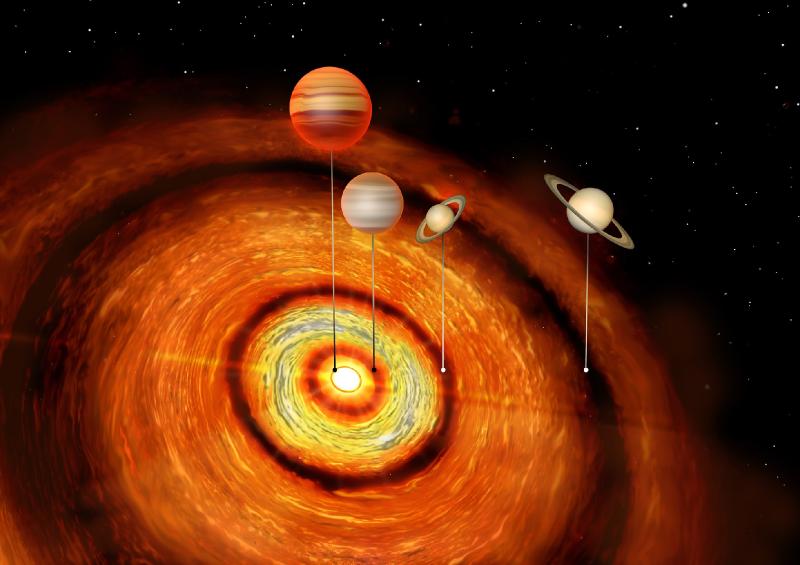
n a discovery that raises questions about long-held ideas about how planets form, astronomers have detected several enormous planets in orbit around a young star — in this case CI Tau, a 2-million-year-old star about 500 light-years away in the constellation Taurus.
This is the first time multiple gas giant planets have been observed orbiting a "toddler" star. Our Milky Way galaxy is filled with stars that have been around for billions of years; our sun is about 4.5 billion years old .
It's also the first time such extreme variation has been observed in the orbits of planets within a star system. The astronomers found that the outermost of CI Tau's known planets orbits at a distance 1,000 times greater than the orbit of its innermost planet, which is designated a "hot Jupiter" because of its size and its tight orbit around its host star.
CI Tau's hot Jupiter, known as CI Tau b, was first observed in 2016 with help from the ALMA radio telescope in Chile. But when the international team of astronomers used ALMA to take a fresh look at CI Tau in the fall of 2017, they detected three gaps in the star's protoplanetary disk — the vast swirling cloud of ice and dust that surrounds it. The gaps are considered strong evidence of the presence of three additional gas giant planets around CI Tau.
 Antennas of the Atacama Large Millimeter/submillimeter Array (ALMA), on the Chajnantor Plateau in the Chilean Andes. ESO/C. Malin
The discovery led the astronomers to question existing ideas about how long it takes large planets to form.
"This is telling us that giant planets must form rapidly in the protoplanetary disk — which is in contrast to the most common model for planet formation, which involves a slow growth of a solid core followed by gas accreting onto it to form a gas giant planet," Farzana Meru, an astrophysicist at the University of Warwick in England and a co-author of a paper about the research , told NBC News MACH in an email.
Read more at the seeded content
Tags
Who is online
63 visitors
This is a major discovery as space goes. A star that is only 2 million years old with planets will be a game changer on what we know about star and planet development.
Quite fascinating indeed. How can anyone not love science?
This is darn interesting. Hopefully we'll see more information on this as time goes on.
I wonder if these gas giants will eventually evolve (devolve?) into rocky planets like ours?
Yes they will, as that star heats up so will the gas giants, their atmosphere will heat until it achieves escape velocity leaving the heavier elements behind to solidify into a rocky planet.
Thank-you. I learned something new today
Perhaps rogue planets caught in the new star's gravity well? But still fascinating no matter what.