
Nonbinary pronoun 'they' is Merriam-Webster's Word of the Year


 S E E D E D C O N T E N T
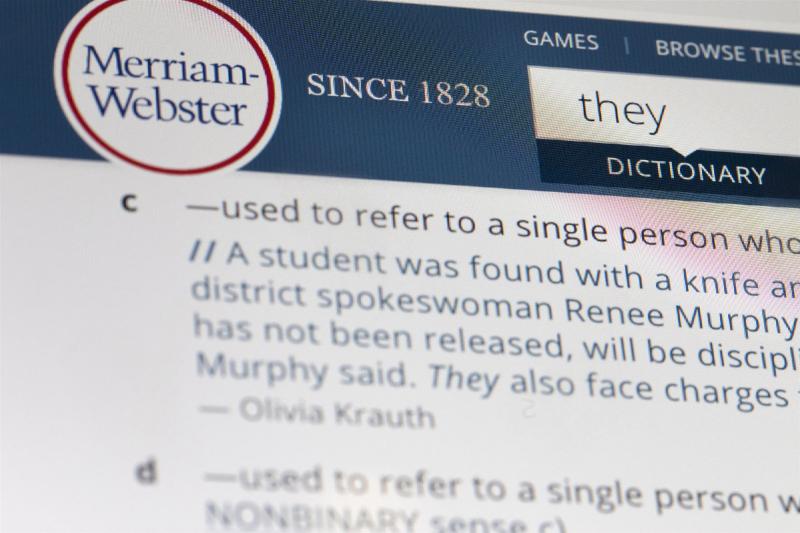
Merriam-Webster's 2019 Word of the Year is "they" — the singular pronoun that has gained popularity as a way to refer to nonbinary people who identify as neither exclusively male nor female.
The decision, which was entirely data-driven and announced Tuesday morning, came after searches of the word trended all year, according to the dictionary's editors.
“Pronouns are among the language's most commonly used words, and like other common words (think ‘go,’ ‘do,’ and ‘have’) they tend to be mostly ignored by dictionary users,” Emily Brewster, senior editor at Merriam-Webster, said in a statement. “But over the past year or so, as people have increasingly encountered the nonbinary use, we've seen searches for ‘they’ grow dramatically.”
“They” was looked up 313 percent more this year than the last year, Merriam-Webster revealed.
In September, the dictionary added the use of “they” as a singular nonbinary pronoun , citing the pronoun's established place in language.
“We are always aiming to reflect usage,” Brewster said at the time. “It’s very clear that this is fully established in the language at this point.”
Data show searches for the word spiked during high-profile moments of visibility for nonbinary people throughout 2019, such as when nonbinary model Oslo Grace walked in the Paris Fashion Week in January; when Congresswoman Pramila Jayapal, D-Wash., gave a tearful speech about her gender-nonconforming child at a House Judiciary Committee hearing in April; and when singer-songwriter Sam Smith, who had previously come out as nonbinary , announced in September that they would use they/them pronouns , Merriam-Webster said.
“In 2019, the increase in lookups for ‘they’ was so significant and sustained that it stood out from all the other top lookups when we went to analyze the data,” Brewster said, adding people turned to the dictionary to clarify its use and learn more.
Merriam-Webster said politics also sent many readers to its dictionary in 2019, with “quid pro quo” and “impeach” as other top lookups. The dictionary said another popular word was “camp,” the famously hard-to-define word that was the theme of this year’s Met Gala .
Tags
Who is online

136 visitors
"Merriam-Webster's 2019 Word of the Year is "they" — the singular pronoun that has gained popularity as a way to refer to nonbinary people who identify as neither exclusively male nor female."
That's just beautiful.

"Hey….."THEY"....whatchya doin' today" !

It used to be …...."THEY"..... was a pretty derogatory word when referring to a "Group" of certain people !
I wouldn't have guessed that you're a grammar stickler.
You only see it as a "Grammar" thing ?
You object to using "they" for some other reason?
For " Some " reason ?
Really ?
Maybe "Actually Read" what I posted....the next time you want to comment.
It's impossible to tell what you are trying to say.
Why not use actual English so people can understand what you're talking about?
So what would you rather call people?
In your mind ?
Maybe this is a good time for good grammar.
So you actually did know what I was speaking about !
What a waste of time on your part....huh !
Quick....what does "Shuffle" mean !
I think my mission has been accomplished, but thanks for your concern.
And that would be ……. ????????????
The "Borg" ?
Merriam-Webster is one of our better dictionaries, and it's sad to see that it has caved to "popularity" instead of defending grammatical accuracy.
Language evolves, and a good dictionary will reflect that evolution.
That being said, I still have a hard time not cringing when I hear "they" used in a singular fashion. And I also still put two spaces after a period when I type, which is apparently now a no-no.
I still do type two spaces after a period, too. I still think it's easier to read that way.
I'm not crazy about a singular "they", but we've been using it informally for years, well before LGBTQI inclusion was a focus. Using "he or she" repeatedly in cases where gender was unknown was always clunky, if grammatically correct.
Yes, I've used "they" in place of "he or she" but I always cringe when I do.
I also have a hard time with things like "who" and "whom" and the whole "never end a sentence with a preposition." If I'm writing a process or training guide, it just makes it seem too formal if I use proper grammar.
So Merraim-Webster is giving into this mentally deficient mindset?
Sad.
Interesting etymology here:
Singular 'They'