
Mayans built massive structures thousands of years ago. Researchers found the biggest one yet.


 S E E D E D C O N T E N T
Airborne laser scanners that can peer through the jungle have revealed what may be the oldest and largest ancient Mayan structure ever found — a 3,000-year-old ceremonial platform almost a mile long according to research published Wednesday.
The 50-foot-high raised earthen platform was found at a site called Aguada Fenix, beside the remote San Pedro River in Mexico's Tabasco state, near the border with Guatemala. University of Arizona archaeologist Takeshi Inomata, who led the discovery, said the giant platform was almost certainly used for ceremonies and large gatherings, possibly before the emergence of royal and noble individuals who dominated society at later Mayan sites.
"This was a big construction before the social hierarchy," Inomata said of the research released in the science journal Nature. "The really interesting implication is what this site tells us about the potential of human collaboration, which can do really amazing things without the presence of a centralized government."
The site, which has been dated by excavations to between 1,000 B.C. and 800 B.C., was first revealed using lidar - an acronym that stands for light detection and ranging — which works on a similar principle to radar.
Lidar scanners can be carried by small aircraft and bounce hundreds of pulses of laser light every second off the landscape to reveal features that would otherwise be hidden by the vegetation that covers it.
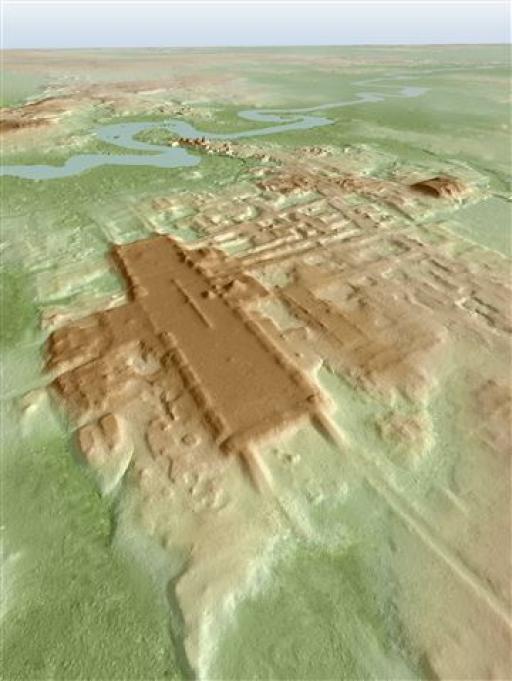
A 3D image of the site of Aguada Fenix based on lidar.Takeshi Inomata
Inomata explained that more than two dozen ancient Mayan structures near the San Pedro river were first seen in low-resolution lidar maps made by the Mexican government. High-resolution aerial lidar scans were then used to reveal details of the largest structure.
"We found Aguada Fenix as this perfect rectangular shape," he said.
Let our news meet your inbox. The news and stories that matters, delivered weekday mornings. Sign Up
The ancient Maya lived in what is today southern Mexico, Guatemala, Belize, and parts of Honduras and El Salvador. They grew to become an empire spanning much of Central America, and reached their peak in about the sixth century A.D. But most ancient Mayan cities were abandoned by 900 A.D. Many descendants of the ancient Maya still live in the region today.
The giant platform at Aguada Fenix is more than 1,500 yards long and 440 yards across. Small pyramids and a central plaza were built on top of it, forming a distinctive Mayan ceremonial center known by archaeologists as an "E-group assemblage."
"It must be for rituals or ceremonies," Inomata said "It's a big, wide space, so it's a place of gathering for many people,"
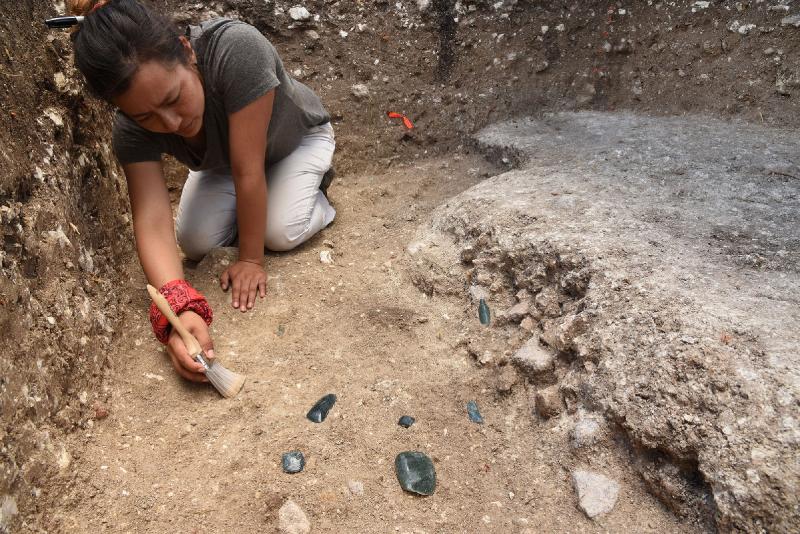
Excavations have also revealed a cache of jade axes that were ritually deposited in the center of the platform, he said.
Nine ceremonial causeways lead away from the platform - the longest is more than 3 miles long - and it was surrounded by lower platforms, ramps, buildings and reservoirs. A smaller raised platform stands about a mile away to the west.
The ceremonies "probably involved processions, because we have those big causeways," Inomata said.
A greenstone perforator - a sharp tool used to pierce the tongue or the ears - found in the deposits suggests the ceremonies involved ritual bloodletting, but there was no evidence of ritual sacrifices, he said.
One thing that the excavations have not found is any evidence of high-status individuals, such as the sculptures of Mayan rulers often found at later sites, or the colossal stone heads of Olmec rulers that are found further west and date from around the same time.
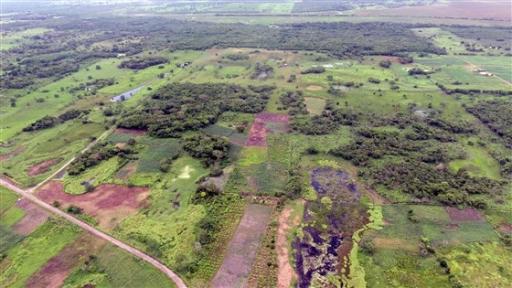
An aerial view of the Aguada Fenix site. The hidden Mayan platform, at the top of this photograph, is so large that it cannot be seen at ground level.Takeshi Inomata
Later Mayan cities are centered on pyramids, "but those are mainly for kings and powerful people," Inomata said. "In this case, it's an open wide space. It's a place for everybody. It's a time before the emergence of kings."
Instead, the construction of giant platforms like that of Aguada Fenix may have led to the evolution of an aristocracy, he said.
"It was a big experiment," Inomata said. "They had to decide who's going to do this work, and who's going to organize the labor, and who's going to design it."
"So in that sense, the construction itself may have promoted social organization, which possibly led later to central government and then to kings and powerful elites," he said.
Maya archaeologist Elizabeth Graham of University College London, who was not involved in the research, said the work by Inomata and his colleagues was "fascinating."
Airborne lidar surveys, like those that had revealed the site at Aguada Fenix, were now showing that much of southern Mexico was once covered by ancient architecture, she said.
Archaeologists "all thought that the forest was covered with buildings," Graham said, "People like to think of it as being a jungle, but it was all occupied at one time."
Tom Metcalfe
Tom Metcalfe writes about science and space for NBC News.

Tags
Who is online
87 visitors
This is an amazing discovery.
Freefaller has posted an article on this yesterday.
Oh I didn't see it. I thought it was really cool, too.
Lol just shows that great minds think alike
I have no doubt there is so much out there that we have zero clue exists. Just imagine what is currently underwater that has sunk and we cannot see. I think this latest discovery is just the tip of the proverbial iceberg. Just think what may be under snow and ice as well.
I have no doubt as well. We live in exciting times.
"This was a big construction before the social hierarchy," Inomata said" There has always been Social Hierarchy among Humans. Many animal species have a social hierarchy including Apes who have highly complex social organization and hierarchy.
Very true. Goes to prove that we are still very close to our animal roots.
Very true, perhaps they meant the highly stratified hierarchy that had developed by later Mayan periods