
Trump's Order to Pull Troops From Germany Alarms European Allies


 S E E D E D C O N T E N T
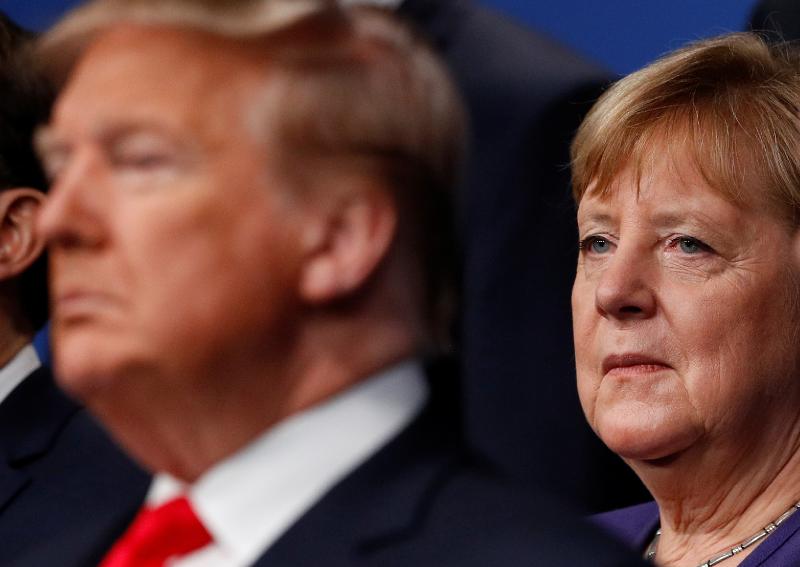
© peter nicholls/Reuters
U.S. allies in Europe expressed dismay over President Trump's plan to slash the number of American troops in Germany by more than a quarter, saying it undermined NATO and boosted adversaries such as Russia.
Mr. Trump's order, reported by The Wall Street Journal on Friday, surprised allies, who hadn't been officially informed, according to European diplomats. The proposed cut to 25,000 from 34,500 would reverse recent increases in U.S. troops in Europe designed to deter Russia, which invaded Ukraine in 2014 and has bolstered armed forces on its western flank.
German Foreign Minister Heiko Maas said Germany would take note of the decision, if confirmed. "We value the cooperation with U.S. armed forces, which has grow over decades," he told the Bild am Sonntag newspaper. "They are in the interests of both our countries."
Get news and analysis on politics, policy, national security and more, delivered right to your inbox
Asked about German relations with the U.S., he replied: "It's complicated."
Allies of German Chancellor Angela Merkel in the German Parliament assailed Mr. Trump more forcefully.
"The plans show once again that the Trump administration neglects an elementary leadership task: the involvement of allies in decision-making processes," said Johann Wadephul, deputy leader of Ms. Merkel's ruling conservative bloc in Parliament. "All benefit from the cohesion of the alliance, only Russia and China from discord."
Mr. Trump has frequently hectored allies over weak military spending and other issues such as Iran, and questioned the value of the North Atlantic Treaty Organization. Allies have complained about not being consulted on major decisions, most recently last month when the Trump administration announced it was withdrawing from the Open Skies Treaty, an accord designed to reduce the risk of war between Russia and the West. Mr. Trump has criticized Germany, Europe's largest economy, in particular over its failure to reach the alliance's spending target of 2% of gross domestic product.
NATO and its members have sought to placate Mr. Trump by pledging to meet that target in the future and offering larger contributions to the alliance's budget, which covers bills such as the cost of utilities at its headquarters in Brussels.
NATO Secretary-General Jens Stoltenberg has attributed increased military spending among members to Mr. Trump's coaxing and frequently praised his leadership.
The alliance held a leaders' meeting last year, hailed as a success by diplomats largely because Mr. Trump didn't launch fresh broadsides against allies and even defended the alliance against criticism from French President Emmanuel Macron.
Speaking the day before the London meeting, Mr. Stoltenberg touted the recent increase in U.S. troops in Europe as evidence of U.S. commitment.
Mr. Trump's decision to cut numbers shows "complete disconnection between the NATO trend, where allies are pushed to a robust posture against Russia, and the reality of U.S. priorities," said one senior European diplomat at NATO.
The planned cut to U.S. forces in Europe is a boon for the Kremlin, which has long sought to drive a wedge between the Western allies and reduce U.S. influence in Europe.
While Russia has largely given up the idea of improving ties with the U.S., it has looked to various countries where it can gain toeholds in the West not only to boost its own influence but reduce that of the Americans, analysts said.
"The only direction Russia can move in boosting relations with the West is toward Europe," said Andrey Kortunov, the director of the Russian International Affairs Council, a Moscow-based think tank with ties to the Russian Foreign Ministry.
With Russia and the EU on opposite sides of issues such as Ukraine and Syria, Moscow has limited room for improving diplomatic ties in Europe. Instead, it has succeeded in pushing through economic projects on the continent, such as the Nord Stream 2 project that could double Russia's supply of natural gas to Germany. The Trump administration's attempts to stop the project have created a bone of contention between Berlin and Washington.
Alexei Leonkov, a Moscow-based military expert, said tensions between the U.S. and Germany over the withdrawal of troops and other factors could help give Moscow further leverage in seeing the project through.
"Germany's economic growth has been held back by the U.S.'s need to sanction Russia for everything and anything. Maybe we can see a change here," he said.
However, Victor Olevich, an expert on U.S.-Russian relations at the Moscow-based Center for Actual Politics, said Russia had to be measured in its expectations. A hacking scandal that exposed Russia's alleged attempts to gain access to Ms. Merkel's emails have hit relations hard. Furthermore, the U.S. is planning to increase further its forces in Poland, which it has steadily built up in recent years.
"The potential move of U.S. forces eastward, from Germany to Poland, is bound to increase pressure on Russia's western borders and elicit visible countermeasures from Moscow," said Mr. Olevich.
Write to James Marson at james.marson@wsj.com and Thomas Grove at thomas.grove@wsj.com
Read More

Tags
Who is online
109 visitors
So this is the fake outrage of the day. We've been in Germany since the end of WWII. This has been talked about since I was stationed in Germany 30 years ago.
So in reality, your "outrage" is because Trump is, yet again, doing what others have only promised to do.
The number of U.S. troops is down considerably from the cold war era, worldwide. Numerous bases in Europe have been shuttered.
Currently, we have roughly 225,000 troops station in foreign countries.
The top five countries with US troops are:
Japan 63,435
Germany 46,900
So. Korea 29,048
Italy 15,478
UK 10,528
Total 165,389
The remaining 60,000 are scattered throughout the world.
Why not bring them all back home? Is there a cost-saving to doing this? Even with our allies paying part of the bill I would suspect there is. What other advantages or disadvantages are there to do this?
As a fair discloser, I have a great-nephew stationed at Luke AFB, AZ. Another nephew stationed at Camp Red Cloud, South Korea. A grandson somewhere in the world with the Australian SAS. A number that has retired from the military with 20 or more years service and a long line of family members that have served as far back as the Indian Wars (on the Indian side). I am also a veteran.
So, let's have a good discussion as to the pros and cons of such a dramatic move by the US.
Texan, is it alright with you to have this discussion on your article? If not please feel free to delete it. '
if we leave the global stage completely, china or another country will fill the void.
someone has to be the world police - better it is the USA than any other country.
so don't expect us to bring ALL the troops home.. not going to happen.
but other countries do need to pay up.
They balk about paying their fair share and they balk about Trump doing something establishment types have talked about doing a long time.
Talk about a sense of entitlement! We take care of their security; they don't pay for it; and when we cut back a little, they whine as if we are taking something that belongs to them. That takes brass!
In other words: "I will gladly pay you Tuesday for a hamburger today." Sorry, this President Popeye is no sucker.
not brass... just progressive leadership, so more like a tin cup - for panhandlers
wait, I heard trump is colluding with russia? really?
only the morons believe anything msm tells them. LOL
U.S. allies in Europe expressed dismay over President Trump's plan to slash the number of American troops in Germany by more than a quarter, saying it undermined NATO and boosted adversaries such as Russia.
That's a load of Crap !
They're just worried more on "Economic Lines". It will put a dent in their "Economy" to lose all those "Spending Folks" !
The pull out in Germany isn't too much of a concern.
Everybody best keep their eyes open on the activities in the South China Sea. A strong Western influence needs to be projected there.
The Russians have moved fighter jets into Libya and along with mercenaries. Best keep our eye on Russia as well. Syria and Libya (lots of oil) what's next?
The 2009 to 2016 U.S. leadership and Others made that accessibility easier for Russia.