
Supreme Court Strikes Down Louisiana Abortion Restrictions


 S E E D E D C O N T E N T
Supreme Court Strikes Down Louisiana Abortion Restrictions
WASHINGTON — The Supreme Court on Monday struck down a Louisiana law that could have left the state with a single abortion clinic.
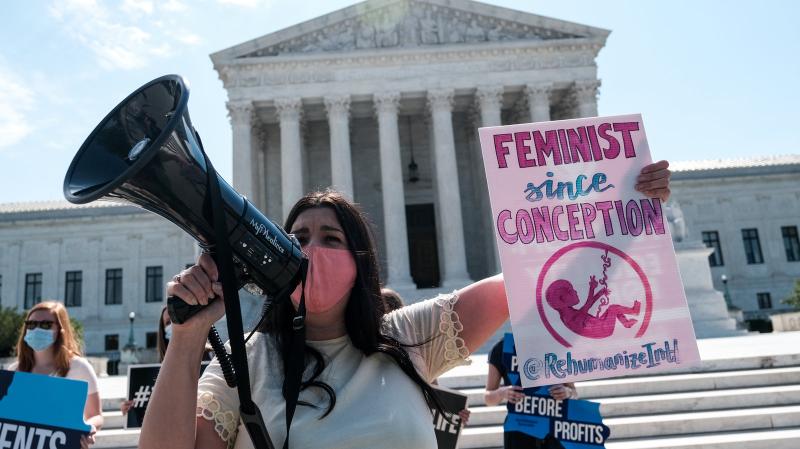
© Michael A. Mccoy/Getty Images Anti-abortion demonstrators protesting in front of the Supreme Court in Washington last week.
The vote was 5 to 4, with Chief Justice John G. Roberts Jr. voting with the court's four-member liberal wing but not adopting its reasoning. The chief justice said respect for precedent compelled him to vote with the majority.
The case was the court's first on abortion since President Trump's appointments of two justices shifted the court to the right.
The Louisiana law, which was enacted in 2014, requires doctors performing abortions to have admitting privileges at nearby hospitals.
Sign Up for the Morning Briefing Newsletter
The law's supporters said the law protects the health and safety of women seeking abortions, and that the requirements for obtaining admitting privileges helps ensure the competence of doctors. Opponents disputed that, saying that hospitalizations after abortions are rare, that women would receive medical care at hospitals whether their doctors had admitting privileges or not and that abortion providers are often unable to obtain admitting privileges for reasons unrelated to their competence.
Only two of the five doctors who provide abortions in Louisiana have obtained admitting privileges, one in New Orleans and one in Shreveport. But the Shreveport doctor testified that he could not handle the clinic's work alone. If the law went into effect, a trial judge concluded, there would be a single doctor in a single clinic, in New Orleans, available to provide abortions in Louisiana.
The judge, John W. deGravelles of the Federal District Court in Baton Rouge, struck down the Louisiana law in 2017, saying it created an undue burden on women's constitutional right to abortion. The experience of the clinic in Shreveport, Hope Medical Group for Women, showed, he wrote, that the law was a solution in search of a problem.
"In the last 23 years, Hope Clinic, which serves in excess of 3,000 patients per year, had only four patients who required transfer to a hospital for treatment," Judge deGravelles wrote. "In each instance, regardless of whether the physician had admitting privileges, the patient received appropriate care."
The law, Judge deGravelles ruled, was essentially identical to the one from Texas that the Supreme Court struck down in the 2016 decision, Whole Woman's Health v. Hellerstedt. Justice Stephen G. Breyer, writing for the majority in that decision, said courts must consider whether the benefits claimed for laws that put restrictions on abortion outweigh the burdens they put on the constitutional right to the procedure.
There was no evidence that the Texas law's admitting-privileges requirement "would have helped even one woman obtain better treatment," Justice Breyer wrote. But there was good evidence, he added, that the requirement caused the number of abortion clinics in Texas to drop to 20 from 40.
The vote in that decision was 5 to 3, with Justice Anthony M. Kennedy joining the court's four-member liberal wing to form a majority. It was decided by an eight-member court after the death of Justice Antonin Scalia that February, and since then, Justice Neil M. Gorsuch was appointed to succeed Justice Scalia and Justice Brett M. Kavanaugh to succeed Justice Kennedy.
In 2018, a divided three-judge panel of the federal appeals court in New Orleans reversed Judge deGravelles's ruling and upheld the Louisiana law notwithstanding the Supreme Court's decision in the Texas case, saying that the law's benefits outweighed the burdens it imposed.
"Unlike Texas, Louisiana presents some evidence of a minimal benefit," Judge Jerry E. Smith wrote for the majority. In particular, he wrote, "the admitting privileges requirement performs a real, and previously unaddressed, credentialing function that promotes the well-being of women seeking abortion."
Judge Smith faulted doctors seeking to provide abortions in the state for not trying hard enough to obtain admitting privileges and said abortions would remain available after the law went into effect.
In dissent, Judge Patrick E. Higginbotham wrote that the majority's ruling was impossible to reconcile with the Supreme Court's 2016 decision in the Texas case and with its 1992 ruling in Planned Parenthood v. Casey, which banned states from placing an "undue burden" on the constitutional right to abortion.
"I fail to see," Judge Higginbotham wrote, "how a statute with no medical benefit that is likely to restrict access to abortion can be considered anything but 'undue.'"
The full Fifth Circuit refused to rehear the case by a 9-to-6 vote. In dissent, Judge Stephen A. Higginson wrote that the Louisiana law was "equivalent in structure, purpose and effect to the Texas law" invalidated by the Supreme Court in 2016.
"I am unconvinced that any justice of the Supreme Court who decided Whole Woman's Health would endorse our opinion," Judge Higginson wrote. "The majority would not, and I respectfully suggest that the dissenters might not either."
Continue ReadingShow full articles without "Continue Reading" button for {0} hours.

Tags
Who is online
100 visitors
it's hilarious watching the alleged defenders of individual liberty [deleted] on this issue for almost 50 years. their own political karma runs over their religious dogma once again. get off the fucking crosses, we need the wood.
Lol. Man social conservatives have been getting their asses handed to them by a conservative SCOTUS in the last couple weeks.
it's been a non-stop comedy, with the right wing as the butt of the joke...
Don't get over confident.... there are still a bunch of other decisions that the court is going to be handing down that liberals might not be too happy about.
pretty sure that SCOTUS justices can be impeached, along with every other judicial appointee...
Oh I just think it is funny as hell. Abortion is their thing, and their own justices are shooting them down.
Taking a cue from you my friend!
Lol, you'd be surprised.
Keep an open mind.
Would it be?
A good call by the SCOTUS. The repeated attempts by some states to restrict or circumvent abortion rights is getting ridiculous.
Getting ridiculous Gordy? This fight to maintain the right of choice for women is long from over. There are still too many people that want to take their shoes away from them and keep them in dual careers as domestic short order cooks and human incubators simultaneously....
Would "absurd" been a better term?
I think you might be right about that. Especially since that fight has been going on since the Roe decision.
Voting against their own best interests...... Seems to be a trend here in the US.
it parallels the do as I say, not as I do mentality involved...
Thank Goodness folks aren't worried if "DOC" can take them to a hospital or not, if things go wrong !
What could go WRONG anyway ? It's like getting a tooth pulled !
It makes no sense to require abortion providers to have admitting privileges. Abortions are generally safe and easy outpatient procedures with a small chance of complications. If anything should go wrong, the a patient is brought to a hospital via 911, just like for any other clinic or office. So requiring admitting privileges is clearly an underhanded and unnecessary attempt to restrict abortions.
Excerpt from:
Sometimes, a doctor cannot obtain or renew admitting privileges until they reach a certain quota of the number of patients they treat. Some hospitals also require their doctors to live within a certain distance away from the hospital in order to be given admitting privileges.
Proponents of abortion admitting privileges claim the privileges are only there for safety’s sake , and that safe doctors should be meeting the criteria to earn the privileges anyway. However, pro-choice advocates argue that admitting privileges are “medically unnecessary” and “a back-door attempt to shut down clinics.” It is also worth mentioning that facilities that provide other medical procedures that are statistically riskier than abortion often do not require their doctors to obtain admitting privileges.
While examining a doctor’s licensing and professional history is an important part of maintaining a responsible and trusted hospital staff, trivial things like the distance a doctor lives from their hospital of employment have nothing to do with how safely they are able to perform medical procedures. Many doctors travel in and out of state to work at different hospitals and medical clinics, none of which suddenly diminishes their medical knowledge and skills. Also, many doctors are unable to meet the minimum amount of admitted patients needed to obtain admitting privileges, because hospitalization is unnecessary for most abortion patients .
Hospitals are also hesitant to enter the political fray that comes with providing abortions in traditionally red states, and some have even taken admitting privileges away from doctors after coming under fire with anti-abortion protestors . “For a hospital to [allow doctors admitting privileges to perform abortions in typically anti-abortion states], it would be making a conscious decision to take on the state legislature,” said Dr. Willie J Parker, who works at Mississippi’s last remaining abortion clinic, the Jackson Women’s Health Organization.
Admitting privileges are just another obstacle on the laundry list of hardships doctors face when trying to provide abortions to their patients, and (perhaps more importantly) yet another hurdle for the patients themselves.
Another thing to take in consideration is, some people are just plain nuts and threaten harm or violence against abortion providers and clinics, which has also been demonstrated in the past. So if a hospital grants admitting privileges to an abortion doctor, they risk an increased threat to hospital security and staff. So a hospital probably doesn't want to deal with the hassle and cost of beefing up security measures.