
Georgia’s Voter Suppression Bill Signed Into Law While Slave Plantation Painting Hangs In Background


 S E E D E D C O N T E N T

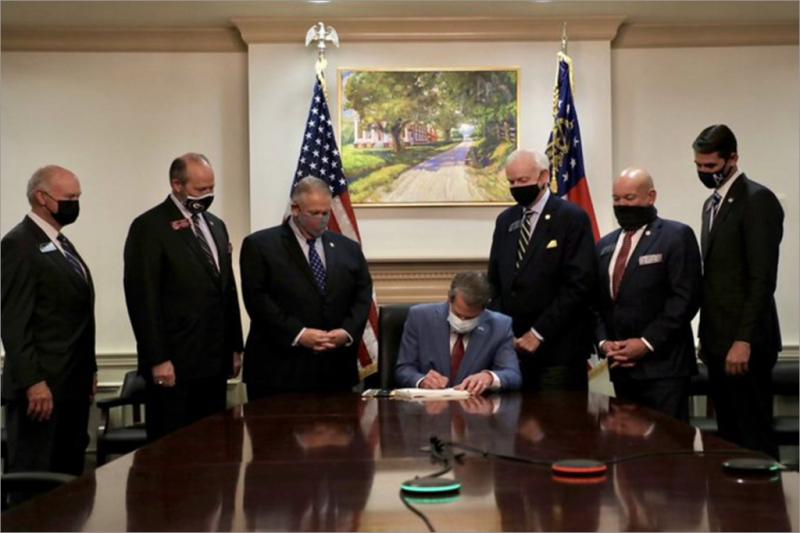
A dding insult to injury, Georgia Gov. Brian Kemp appeared to metaphorically thumb his nose at his Black critics in particular by signing the state’s voter suppression bill into law while seated in front of a painting of a “back-breaking” plantation that “thrived” from slave labor.
Kemp signed the bill Thursday evening amid national outcry at the restrictions the new law would disproportionately place on Black and brown people, who are now expected to have a much harder time voting than in past elections. The Georgia State Patrol even forcibly arrested Democratic State Rep. Park Cannon — a Black woman — for demanding transparency by knocking on Kemp’s closed office door while he was signing the bill.
So already, things were bad enough, optics-wise, at least.
But then Will Bunch, a national opinion writer for the Philadelphia Inquirer, posted a Twitter thread on Friday morning bringing attention to the plantation painting hanging on Kemp’s office wall that was so prominently displayed while the governor signed the bill.
Bunch’s revelation at once underscored terror evoked by the sheer imagery of a southern plantation while also harkening back to a sordid time in American history when Black people did not have a right to vote in the first place.
The Twitter thread pointed to a website that provided more information about the painting , but not necessarily about the plantation. The painting, named “Brickhouse Road (Callaway PLNT),” is named for the infamous Calloway Plantation, which another website describes in more — but not full — detail.
According to the Washington-Wilkes Historical Foundation , the Calloway Plantation remains home to “The Brick House,” in which the Calloway family lived from 1869-1910 — “the time period when the plantation thrived.”
Also on the plantation grounds was the Dally Slave Cabin, quarters that were built in 1840. That is conspicuously the only reference to slavery on that website.
“The promotional sites gloss over the fact that by the time of the Civil War, the Callaway Plantation only thrived because of the back-breaking labor of more than 100 slaves who were held in cruel human bondage,” Bunch accurately points out in his Twitter thread.
Bunch cited a genealogy website that documented the oral life history of a woman who was born into slavery on the Calloway Plantation. Mariah Calloway’s “narrative” addressed some of the harsh realities at Calloway Plantation, including what was effectively a jail for slaves the master “had to punish” for trying to escape.
The bill was signed in front of the plantation painting at a time when there has been a purported racial reckoning and widespread efforts to remove symbols of white supremacy from government property. Georgia in particular has been resistant to removing such imagery, including Confederate monuments.
Tags
Who is online
406 visitors
Why does the governor of Georgia have a painting of a slave plantation hanging on his office wall?
The painting probably precedes him.
Kemp signed the bill Thursday evening amid national outcry at the restrictions the new law would disproportionately place on Black and brown people, who are now expected to have a much harder time voting than in past elections.
Why would they have a harder time voting? Isn't it true that Voter ID would make it easier for those folks to vote
Do you know when the civil war was?
Do you?
Yeah... it ended before the pictured house was built.
Not if the rabid left has it's way.
Ok, I think someone needs to explain why that would be so.
Doesn't matter. One party needs more voter participation and the other party does better when it is in a position to choose the voters.
Two thing here also.
a. Is it better for the voters to choose their politicians?
b. Is it better for the politicians to choose the voters?
x. Isn't this what this is all about?