
Supreme Court takes up major Second Amendment case

Category: News & Politics
Via: texan1211 • 5 years ago • 50 commentsBy: John Kruzel and Harper Neidig (MSN)

 S E E D E D C O N T E N T
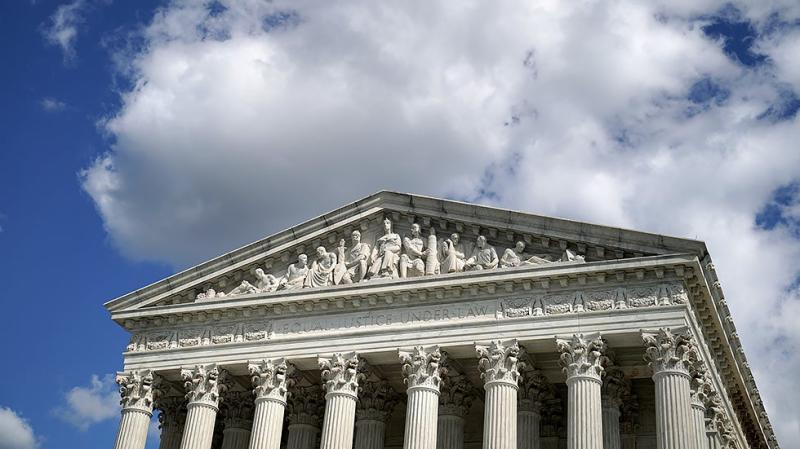
The Supreme Court on Monday agreed to hear a challenge to restrictions on carrying firearms outside the home, teeing up a potentially landmark dispute over the scope of the Second Amendment.
© Greg Nash Supreme Court takes up major Second Amendment case
In an unsigned order, the justices took up a bid by two gun owners and a New York affiliate of the National Rifle Association to challenge the state's denial of their applications for concealed carry licenses for self-defense.
The case represents the first time the 6-3 conservative court will hear arguments over the nation's long-running and fraught debate about gun rights in America.
It will be heard next term, which begins in October.
The court has declined to insert itself in similar cases in recent years and has not issued a major Second Amendment decision in over a decade when it ruled in a pair of cases in 2008 and 2010 that individuals have a right to keep guns in their homes.
With the addition of Justice Amy Coney Barrett last year significantly shifting the court's ideological balance to the right, court watchers have been waiting to see if the new majority would seek to revisit states' gun restrictions.
In the brief order issued Monday, the justices said they would hear the case and focus on whether "the State's denial of petitioners' applications for concealed-carry licenses for self-defense violated the Second Amendment."
The lawsuit was filed on behalf of Robert Nash and Brandon Koch, who were denied concealed carry permits for self-defense because New York officials had determined that they had failed to show a "special need" to carry weapons as required under state law.
Their lawsuit argues that such restrictions on concealed carry permits violate the Second Amendment. If they prevail in front of the Supreme Court, it could upend concealed carry laws across the country.
In a brief filed with the court in December, the gun rights activists called it "the single most important unresolved Second Amendment question" since the last major guns decision in 2010.
"A law that flatly prohibits ordinary law-abiding citizens from carrying a handgun for self-defense outside the home cannot be reconciled with the Court's affirmation of the individual right to possess and carry weapons in case of confrontation," they wrote. "The Second Amendment does not exist to protect only the rights of the happy few who distinguish themselves from the body of 'the people' through some 'proper cause.' To the contrary, the Second Amendment exists to protect the rights of all the people."
The New York state attorney general's office responded with its own brief, arguing that the law has been in place for over a century and the requirement that concealed-carry permit applicants demonstrate a proper cause is not overly restrictive or incompatible with the Supreme Court's rulings on the Second Amendment.
"This flexible standard, which numerous New York residents have successfully satisfied, generally requires a showing that the applicant has a non-speculative need for self-defense," New York's lawyers wrote. "Absent such a need, applicants may receive a 'premises' license that allows them to keep a firearm in their home or place of business, or a 'restricted' license that allows them to carrying public for any other purposes for which they have shown a non-speculative need-such as hunting, target shooting, or employment."
The brief noted that Nash and Koch were both granted restricted licenses.
According to the gun control activist group the Giffords Law Center, 31 states currently require residents to obtain a permit in order to carry a concealed weapon, with varying degrees of restrictions on those permits.
Updated at 11:27 a.m.

Tags
Who is online
213 visitors
So they want to repeal a hundred year old law.
So much for letting states decide, which was the pro gun argument I heard a couple of days ago.
It will be interesting to see if they take into account the entire 2nd amendment as was written by the framers....
A well regulated Militia, being necessary to the security of a free State, the right of the people to keep and bear Arms, shall not be infringed.
be interesting to see if they take into account the entire 2nd amendment as was written by the framers..
You know they already did in exhaustive detail, right? Look up Heller.
And the NRA fearing conservatives on the court got the decision wrong and should have joined the other four justices in maintaining of long standing precedence.
Circular reasoning by the conservative members of the court should never have been a basis in the Heller decision.
Please, please explain how life time appointed justices are afraid of a a second tier special interest group?
so you didn't read it. It's actually an exhaustive study into the language of the entire second amendment, which is what you claim to want.
No....they got it right, and upheld the Framer's intent. From the decision.
So who is the Militia ?
(people ALWAYS get this one wrong and are surprised to find that out)
Miller did discuss it, and Heller has an extensive discussion on the prefatory clause. I'm sure the Court will discuss it again, but my guess is that there is a larger discussion on the level of scrutiny the Court should use when evaluating 2nd amendment cases. That appears to be set up in Heller.
The above is from the Heller opinion. Heller clearly recognizes the states' rights to place reasonable restrictions on possession. The question taken up by the current Court concerns whether or not requiring an otherwise able person to show a "special need" to concealed carry runs afoul of the constitutional right. Again, I think there will be a debate on what level of scrutiny the Court should look at this with. Apart from that, who knows? I am loathe to believe that anyone would think it would be okay to require a person to show a special need to; practice their religion, prevent soldiers from being quarter in their home in a time of peace, be free from an unreasonable search, not be subjected to double jeopardy, have a speedy trial, or be free from cruel or unusual punishment. My bet is that this decision makes a distinction between restrictions such as prohibition on possession by felons, and requiring a showing of a special need in order to exercise a right.
I am starting to think this is actually funny.
all this case will decide is if a person has a right to carry a firearm for their own self, personal defense if they feel they have the need and remove certain state roadblocks about haveing to "prove ' a need to do so .
it will NOT dictate that a state has to do away with any training requirements , or proof of proficiency , or even licencing requirements it will simply change the states requirement that proof of need has to be provided before they will grant a blessing.