╌>

Civil War (Or, Who Do We Think We Are)

  

Category:  News & Politics

By:  john-russell  •  5 years ago  •  49 comments

Civil War (Or, Who Do We Think We Are)

NBC's streaming channel Peacock is currently featuring a documentary titled The Civil War, but it is not at all about the war itself, it is about what Americans today think of the Civil War and the aftermath of that war up until the present day. 

Given the attitudes that we see presented every day concerning "the monuments" and "racism", and "black lives matter" and the "1619 Project", and all of it, this is a timely issue. 

I think we are headed in the direction of a reckoning about race in America. Not necessarily immediately, but over the next 5-10 years or so.  Hopefully it will be a peaceful reckoning that we all can move on from. 

===================

related

Civil War: Peacock documentary for Juneteenth shows the limits of hearing both sides. (slate.com)

https://deadline.com/2021/06/peacock-acquires-documentary-civil-war-or-who-do-we-think-we-are-brad-pitt-premiere-date-msnbc-1234768707/


Tags

jrDiscussion - desc
[]
 
JohnRussell
Professor Principal
1  author  JohnRussell    5 years ago
slate.com /culture/2021/06/civil-war-documentary-peacock-juneteenth-history.htmlA New Civil War

Documentary Shows the Limits of Letting Everyone Talk

Not every opinion is worth hearing out.


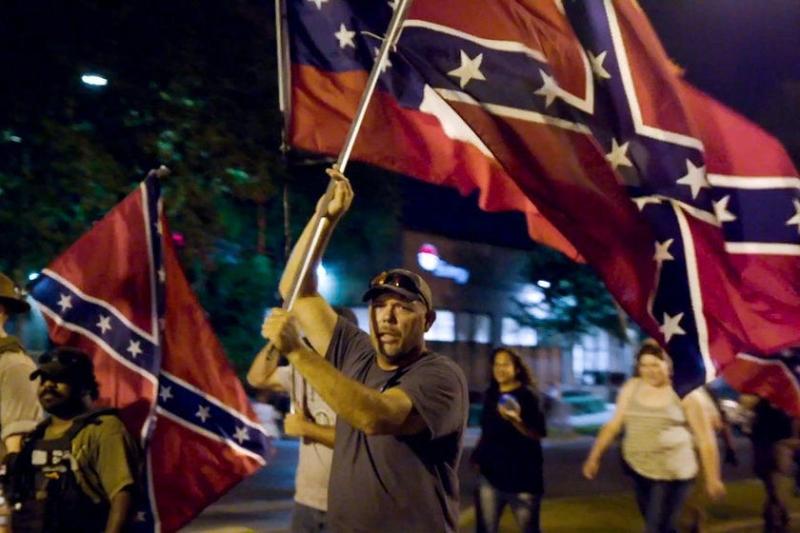
A man protests the removal of a statue of Jefferson Davis. Nelson Walker III/Boynton Films/Peacock
Documentarian Rachel Boynton’s Civil War (or, Who Do We Think We Are) is the latest well-meaning attempt to get to the bottom of our great national disagreement over the meaning of the events of 1861–65. Watching it, I realized how completely done I am with the last decade of polite liberal discourse about the Civil War, Reconstruction, and slavery. I say this as a frequent participant: I am just not sure what all this talking has done.

“This is a film about storytelling,” the movie, which is now streaming on Peacock, begins—an observation that lost its punch long ago. Okay! Put aside the fact that all history is, to varying degrees, “about storytelling”—how could it not be?—and grant the idea that the history of the Civil War has some particular claim to narrative indeterminacy. Now what the hell do we do when some people in our country want to tell a self-pitying, wrong-headed “story,” one that shows the deep lack of empathy in their hearts? One that displays the same racist lack of fellow-feeling that their ancestors once used to justify separating parents from children? That’s what I want to know.

Maybe it’s because the utter imbalance between the two “sides” is so obvious to everyone now, after the past decade or so of heightened public conversation about Black history, that this documentary feels so unsatisfying. For a “film about storytelling,” this movie has curiously little narrative drive. Instead, there are a lot of characters who appear for short amounts of time to deliver declarations about the history in question. Heartbreakingly earnest Black students! Recalcitrant white Sons of Confederate Veterans! Charismatic Black historians of slavery! (Kellie Carter Jackson is particularly magnetic.) White farmers who, bafflingly, blame the “federal government” for the recent loss of their land! Black protestors! Boomer Massachusetts liberals at an all-white evening discussion group about the history of Reconstruction! Mississippi legislators defending their “heritage” flag! Yale historian David Blight, giving one of his typically wonderful lectures! The gang is, literally, all here.

That’s fine. But some of these people are right, and some of them are just wrong. To her credit, Boynton gets some of the white interviewees to say things that had me infuriated. “There’s a lot of talk about reparations for slaves,” the farmer says. “When Abraham Lincoln emancipated the slaves, my great-great-grandfather, he didn’t get paid for them!” But I don’t need to know that “story” exists. I’ve seen this kind of weak-headed apologia over and over on the Internet. When the documentary lands on a group of BLM activists who sing at a white counter-protestor “Get the fuck out of New Orleans/ Get the fuck out of New Orleans”—or a Black protestor who, when asked by Boynton about “Southern pride,” quickly says “Fuck the South. Fuck Southern pride”—I cheered. The time for hearing them out is long over and done.

Besides the moments where Black students talk about elders in their family who don’t want to discuss slavery—an interesting counterpoint to the official white liberal line that we “must” talk about those times, in order to exorcise the poison—the brief glimpses of history classrooms were where I wanted more of this documentary, not less. History classes are the only places in the country where diverse collections of people talk about race day after day, in a systematic way: not while segregated into interest groups, as with the Sons of Confederate Veterans or any number of liberal anti-racist book clubs; not as momentary attempt at “enrichment,” as you might do with a day at a historical site or museum. History classrooms are, as one teacher in the film says in describing a difficult discussion with a student, “where the juice is.” The recent run of anti-“CRT” laws passed by GOP-led state legislatures further proves that this is true. Why are they so scared, one might ask? They know.

Sign up for the Slate Culture Newsletter
The best of movies, TV, books, music, and more, delivered to your inbox.
One particular episode—an eighth-grade class at Boston Latin School, a public magnet school in Massachusetts that has a diverse student population—had a flow to it that the rest of the film sorely lacked. The instructor, an older white woman, apparently a teaching veteran, with the command of the classroom that this status brings with it, is working on a lesson about the lead-up to the Civil War with a crowded classroom. One student in the class, a young man with a ghost of a mustache, keeps speaking up. First, on the causes of the war. “I notice there seems to be a common idea that the Civil War was totally about slavery. I’m gonna disagree with that,” he says. “The South did want to leave the Union because of slavery, but the issue of the Civil War was keeping the South in the Union. So slavery wasn’t the total issue.”

Later, as they talk about Reconstruction and Jim Crow, he gets more and more frustrated, twisting in his chair as the kids sitting around him laugh embarrassedly: Here he goes again. “I just think talking about this is really not helpful,” he says. “What it does is it puts people in an unproductive mindset, it makes white people feel guilty, and it makes Black people feel like victims.” Quickly, a Black classmate jumps in: “If you’re treated differently because of something you can’t change, why wouldn’t you be a victim? You don’t have to talk about something for it to be a certain way.”

Behind the scenes, talking to this contrarian student and his teacher, Boynton draws out how the teacher is trying so hard not to “squash this child,” as she puts it. “He’s bringing some sincere and rigorous—the word he used was ‘logic’—to this problem” of Black people’s status in American society,” she says. “But he doesn’t have an answer when I say, ‘What’s the reason, if it’s not systemic racism?’”

This rich episode takes up only a small fraction of the screen time of the documentary. What happened to this student, after the filmmaker was gone? Did the teacher, and his fellow students, ever convince him to look again at his beliefs? Or did he dig in? Let any future filmmakers looking to explore the American conversation about the Civil War take note: The big-picture ground has been covered. A teaching workforce that’s almost 80 percent white is working through this history with diverse groups of students every day. In every classroom, every year, there’s a story. Get thee to the schools, and bring your cameras with you.


Sean Treacy
Professor Principal
1.1  Sean Treacy  replied to  JohnRussell @1    5 years ago

What’s the reason, if it’s not systemic racism?’”

systematic racism is the new “God’s will.” It explains everything and nothing.


JohnRussell
Professor Principal
1.1.1  author  JohnRussell  replied to  Sean Treacy @1.1    5 years ago

Sean, in this film a half a dozen or so people who are interviewed say they want to fly the confederate flag because it represents their "heritage."  In 2021 everyone knows that the confederate flag represents the attempted preservation of slavery. 

What the hell is wrong with these people? 

We need the 1619 Project or something like it to tell people the truth. 

In this movie one of the experts says that in 1860 "95%" of the US population, north and south, was racist.  

That does mean that America was a racist country at some point, , doesnt it?


Greg Jones
Professor Participates
1.1.2  Greg Jones  replied to  Sean Treacy @1.1    5 years ago

Systemic racism is just an idea, not a real thing


JBB
Professor Principal
1.1.3  JBB  replied to  Greg Jones @1.1.2    5 years ago

That is so very not true, but you should still be able to see pyramids from that river in Egypt!


Greg Jones
Professor Participates
1.1.4  Greg Jones  replied to  JohnRussell @1.1.1    5 years ago
In this movie one of the experts says that in 1860 "95%" of the US population, north and south, was racist.  

No way can that opinion be credibly verified


Greg Jones
Professor Participates
1.1.5  Greg Jones  replied to  JBB @1.1.3    5 years ago

Show us the proof, instead of parroting unsupported bullshit.


Thrawn 31
Professor Participates
1.1.6  Thrawn 31  replied to  Greg Jones @1.1.5    5 years ago

Sentencing disparities for various narcotics and incarceration rates generally. Those are the more obvious examples of racism that had been built into the legal system a long time ago and takes time to filter out. 


JohnRussell
Professor Principal
1.1.7  author  JohnRussell  replied to  Greg Jones @1.1.5    5 years ago

Greg, the average household wealth of blacks is something like 1/10th that of whites. How do you explain that? 


JohnRussell
Professor Principal
2  author  JohnRussell    5 years ago

There is some criticism from "the left" towards this show apparently because there are segments where a confederate flag or confederate monument defender (or a slavery minimizer as a couple people in the film are) are allowed to say their piece without the interviewer contradicting them much. 

That didnt bother me. Let people make jackasses out of themselves, and let everyone see it. 

There is a guy from Mississippi in this film that says the blacks talk about reparations but what about him? His great grand daddy lost all his slaves when Lincoln freed them and the government didnt give him a penny for them. The same guy says the outcome of the Civil War (the south being defeated) was worse than slavery. He is a middle aged white guy of course. 

Good documentary movie. It is a little slow here and there, but I recommend it. 


JohnRussell
Professor Principal
2.1  author  JohnRussell  replied to  JohnRussell @2    5 years ago

Peacock is a free streaming channel with an option to pay a fee to see the shows without commercials.  You can get it on a smart tv app or on a pc or laptop. 


Bob Nelson
Professor Guide
3  Bob Nelson    5 years ago
Not every opinion is worth hearing out.

That's the problem, here on NT. 


Krishna
Professor Guide
3.2  Krishna  replied to  Bob Nelson @3    5 years ago
Not every opinion is worth hearing out.
That's the problem, here on NT. 

As it is on many other "well moderated" Social Media sites!

The idea is that every user deserves to be respected-- and everyone's opinion deserves to be "respected".

Which is why I often have a problem with Social Media sites--- I don't feel that everyone on them deserves to be respected. A few people are not well informed. Others are just overly gullible fools and post toal nonsense.. And some are just downright nasty individuals.

Online, as in the "real" world--- some people don't deserve respect. 

(Which can create a bit of a problem for those users who are truly aware of what's going on).


Bob Nelson
Professor Guide
3.2.1  Bob Nelson  replied to  Krishna @3.2    5 years ago

Racism and racists do not deserve respect. Authoritarianism and authoritarians do not deserve respect. They are welcome on NT. 

The Fascists have a great rostrum, here on NT.

I don't know what to do. If I seed a wide variety of topics, I give cover for the Fascists. If I don't seed at all, I'm abandoning the field. I've been limiting myself to strictly anti-fascist seeds... but my guess is that members have already reached the point of "already know; don't need to read". 


Tacos!
Professor Guide
4  Tacos!    5 years ago
I think we are headed in the direction of a reckoning about race in America.

What kind of reckoning?


Who is online


Freefaller


371 visitors