
Tariffs go to court - a FOURfer!

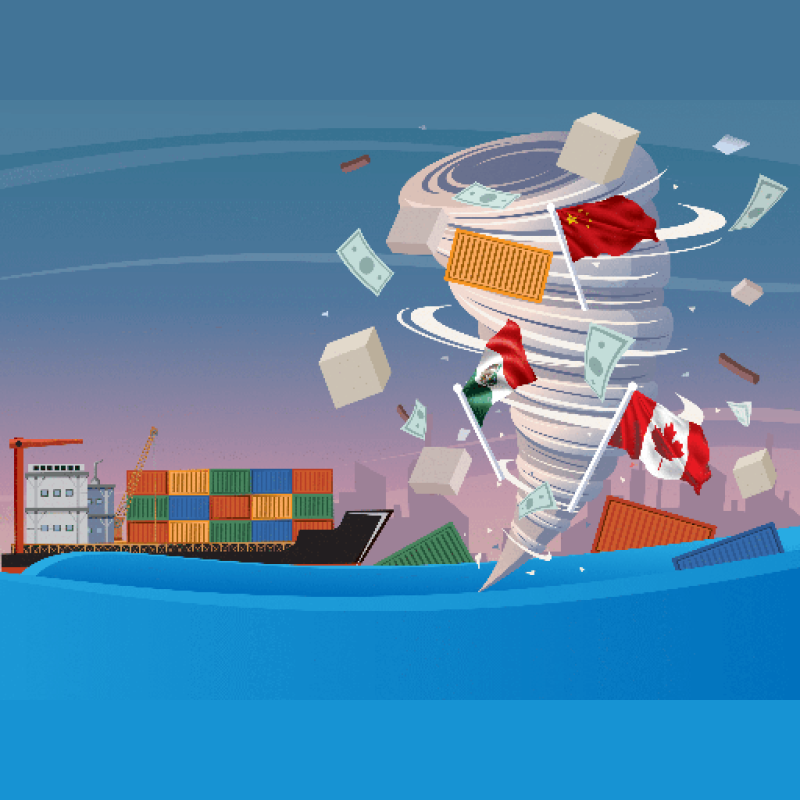

On again
Off again
On again
Off again
On........

Is this ridiculous? Yes. Is this normal for the Trump Administration? Yes.
The mad king's whirlwind keeps spinning. No one knows what happens next.
... which I'm sure pleases businesses...
Is There a Dignified Legal Way, Preferably in Latin, to Say "Holy Shit"?
A court just threw out Trump's whole trade agenda
by Paul Krugman, May 28, 2025
It will take me a while to digest this:
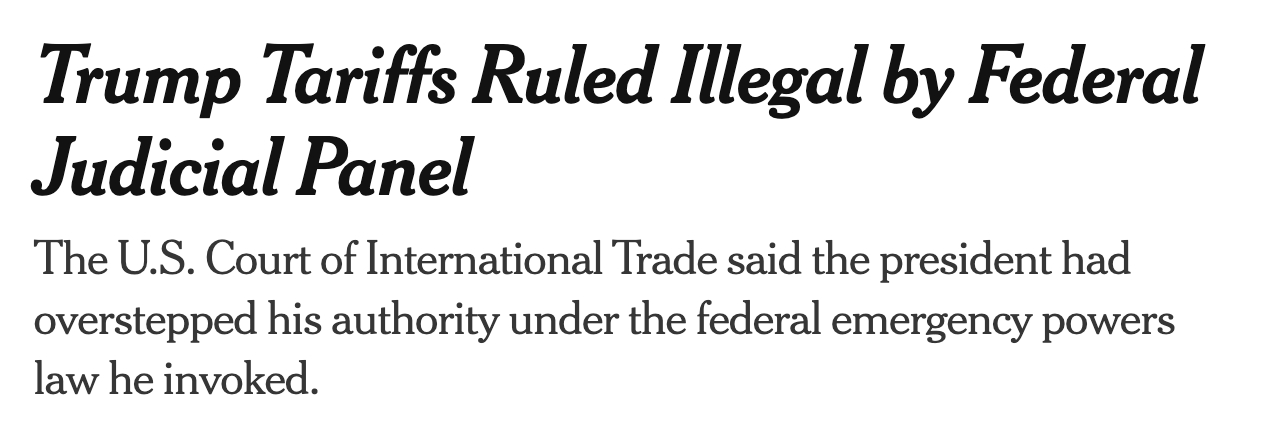
A panel of federal judges on Wednesday blocked President Trump from imposing some of his steepest tariffs on China and other U.S. trading partners, finding in two cases that he vastly overstepped his ability to issue those expansive duties under federal law.
The ruling, by the U.S. Court of International Trade, delivered an early yet significant setback to Mr. Trump in his campaign to strike a series of agreements that reorient the nation’s trading relationships, setting up a legal fight that could soon reach the Supreme Court.
The cases centered on the president’s use of a 1977 federal economic emergency law to issue many of his steep duties, including some of his tariffs on Canada, Mexico and China, and his “reciprocal” rates on much of the rest of the world, which Mr. Trump announced and then suspended in April.
The thing is, it has been obvious all along that Trump’s use of the 1977 International Economic Emergency Powers Act to justify Smoot-Hawley level tariffs was a massive abuse of power. I mean, since when are 4 percent unemployment and 2.5 percent inflation an emergency justifying the reversal of 90 years of policy? But I guess I just assumed that things like that didn’t matter anymore.
And I’ve just had a very long day, much of it spent drafting a detailed takedown of the vile crypto legislation now before Congress. I guess I’ll hold that for a bit.
Some more coherent thoughts in the morning, after a gallon or so of coffee.
The Trade Emperor Has Always Been Stark Naked
But it’s a shock to see someone say it
by Paul Krugman, May 29, 2025
I’d like to apologize for the crude language I used in my initial reaction to the Court of International Trade ruling basically invalidating Donald Trump’s entire tariff policy.
OK, that’s a lie. Given the circumstances, I was entirely justified in using a bad word. But by gosh and heavens to Betsy, I’ll try to be a bit more decorous today. So here goes.
Punitive tariffs on everyone, including the penguins of uninhabited islands, have been one of the Trump administration’s signature policies, along with epic corruption and abductions by masked men claiming to be federal agents. All of these policies have involved blatant violations of the letter of the law, its spirit, or both. But there has been very little effective pushback.
So it came as a shock yesterday when the United States Court of International Trade suddenly ruled that almost everything Trump has been doing on tariffs is illegal. The Court is clearly right on the merits. But I, like many observers, thought that we were past the point where the merits of cases mattered. It’s gratifying to learn that I was wrong.
For the past 90 years U.S. tariff policy has been set through a process of negotiation with other countries — we’ll cut our tariffs if you cut yours. The purpose of these negotiations is, in large part, to protect ourselves from our own special interests. Once a trade deal has been struck, Representative Bomfog of Middletown can’t insert a special provision benefiting his district’s paperclip factory.
But the rigidity of trade deals can itself be a problem. What if rapid changes in trade create irresistible pressure to do something, but you don’t want to renegotiate everything? So U.S. trade law creates some safety valves — conditions under which presidents can unilaterally impose temporary tariffs that relieve some of the political pressure. The idea was always that presidents, keeping in mind both domestic economic consequences and relations with our allies, would use that discretionary power sparingly.
It was a very clever system, but one utterly unprepared to deal with a president like Donald Trump.
Until he announced the massive “Liberation Day” tariffs on April 2, Trump mainly relied on Section 232 of the 1962 Trade Expansion Act, which empowers the president to impose tariffs when imports “threaten to impair national security.” Such tariffs are supposed to follow a quasi-judicial process in which the Commerce Department investigates the claim, reaches a decision, and the president then chooses whether to act:

But hey, this is the Trump administration, so if the president wants his flunkies’ officials’ opinion, he’ll tell them what it is. The result has been a series of absurd claims — Canadian aluminum is a national security threat? — but no real pushback.
But Trump wanted to do much more:

Section 232 and a grab-bag of other measures weren’t going to be enough to get there. So Trump invoked the International Emergency Economic Powers Act of 1977 , which gives the president very broad powers under emergency conditions. And so he went ahead tariffing everyone, penguins included.
It turns out, however, that really major tariff changes are subject not to a quasi-judicial process involving MAGA loyalists, but to an actual judicial process involving the Court of International Trade, which is a real court populated by real judges appointed for life.
And the Court, to almost everyone’s surprise, decided to do its job. It basically said to Trump, “What is this economic emergency of which you speak?” Take a crude but useful measure of the state of the U.S. economy, the “misery index” — the sum of unemployment and inflation:

Do you see an emergency there? I don’t, and neither did the Court, which as I understand it demanded that Trump call off his trade war immediately — do not pass Go, do not collect $2 billion in crypto.
Presumably the Trumpists will try to undo this judgment, one way or another — exploiting other loopholes in the law, maybe trying to bully the Court into submission, maybe just defying the Court altogether. But this is a huge political defeat, and Trump has nobody to blame except his own overreach. You can bet that trade negotiators around the world are snickering, and maybe celebrating with TACOs for lunch.
Wait...What?? What Just Happened to Trump's Trade War and What Might Happen Next
This isn't over, but democracy is not down, it's not out, and it's fighting back and, dare I say...winning!
by Jared Bernstein
[See update as of 4pm, 5/29/25, at the end of this post.]
“Court Strikes Down Trump Tariffs”
So reads the headline in this AM’s WSJ, as last night a three-judge panel of the Court of International Trade unanimously ruled that President Trump had vastly overstepped his authority in applying many—not all—of the tariffs that comprise his trade war.
Let’s quickly go through what the decision means for the tariffs, why the court decided as they did, what recourse Trump has to fight back, and what it all means for the economy.
BLUF: This is very good day for democracy and a very bad one for king-like authoritarianism. Trump can and likely will pursue other paths that are still open to him, and he’ll appeal this decision, possibly all the way to the Supreme Court, wherein the majority is way too prone to ignore both law and precedent, and to give him what he wants. But this is clearly a powerful rebuke to the president and a heavy blow against his destructive trade war.
What Happened?
A three judge panel (Reagan, Obama, and Trump appointees) of the Court of International Trade ruled that President Trump widely overstepped his authority when he imposed the sweeping tariffs on dozens of countries (the “Liberation Day” reciprocal tariffs), including those on China.
As Axios put it, “the judges said an injunction wasn't enough — they issued a summary judgment invalidating and blocking almost all of Trump's trade levies to date.” The panel wrote: “The challenged Tariff Orders will be vacated and their operation permanently enjoined,” meaning absent a stay of execution of their decision—unlikely, from what I’m reading—these tariffs have to come off quickly. The court granted the administration 10 days to stop collecting these import taxes.
The core of the judgement was Trump’s misuse of the International Emergency Economic Powers Act of 1977 to justify the sweeping, reciprocal tariffs. The court correctly recognized that a) there was and is no such trade-induced emergency as specified in the law, and b) “The court does not read IEEPA to confer such unbounded authority” on the president.
Just to squeeze a little (political) economics in here, I’ve written extensively about the false reality in which the Trump administration resides, of which one particularly phony pillar is that the economy was badly broken when they took office. This is an ancient authoritarian play, an attempt to create leverage to violate established norms, institutions, and even laws to address the false emergency.
But, of course, the economy in late ‘24 was fine, with solid GDP growth, strong consumer spending, low unemployment, good job growth, downward-trending inflation, and real wage gains. The trade deficit, which Trump explicitly cited to justify the emergency and invoke the IEEPA, was in the familiar range of -3%, a point that the court itself elevated in rejecting this line of argument.
In fact, Trump tried to argue that the emergency was evident in the extent to which the trade deficit was dragging down real GDP growth. But the data show nothing of the sort. It’s a bit early in the day to hit you over the head with some heavy econometrics, so here’s a simple scatterplot of yr/yr real GDP growth and the trade deficit as a share of GDP, 1970-now. There’s nothing to see here.
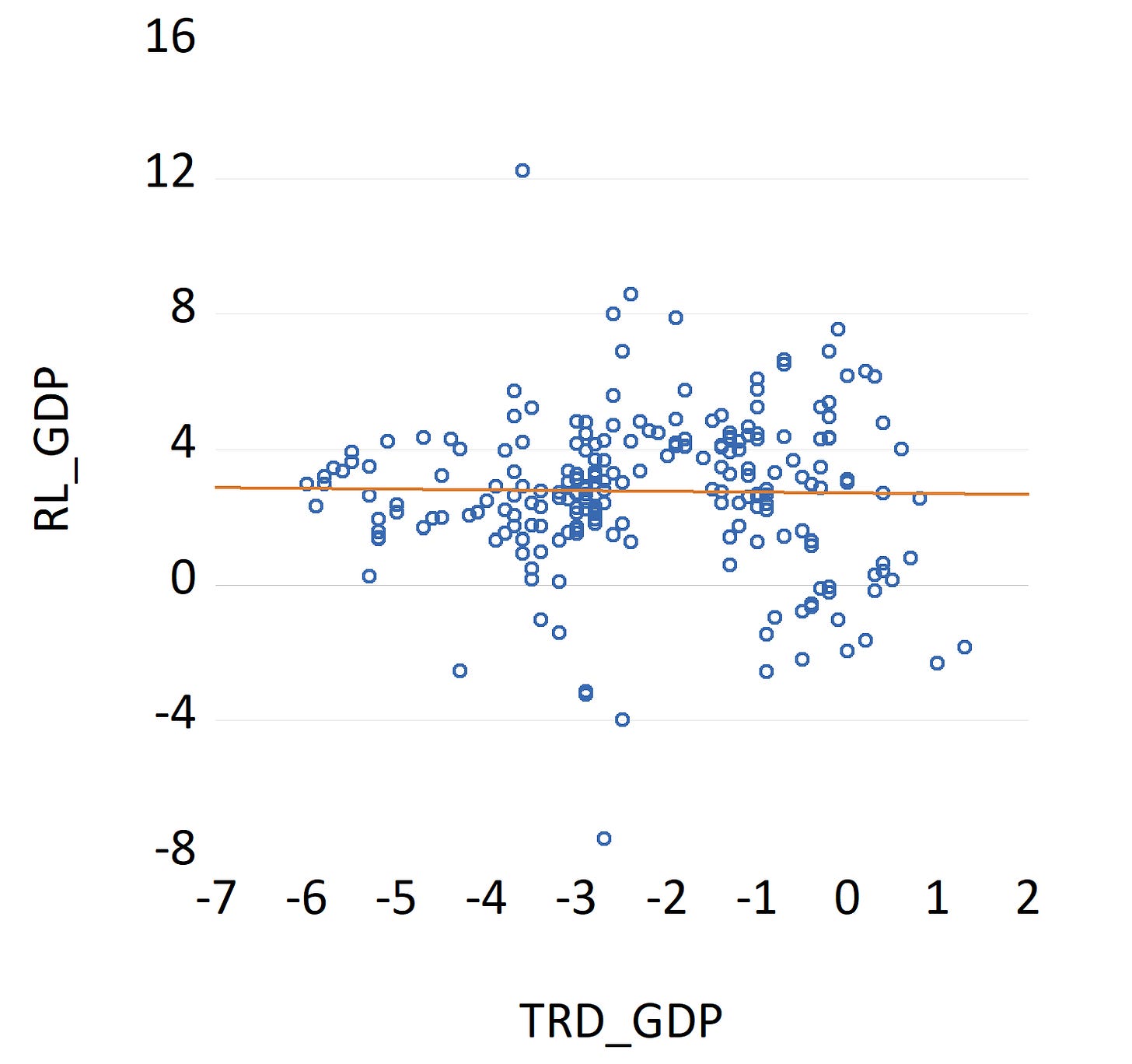
To be clear, this doesn’t mean persistent trade deficits are always and everywhere benign. See the China Shock literature. There are communities, particularly manufacturing communities, that have been lastingly hurt by unmanaged global competition. But, as the court unequivocally recognized, there was no emergency when Trump took office wherein the aggregate trade deficit was dragging down the U.S. economy. In fact, they explicitly argued that the trade deficits shown above do not constitute an “unusual and extraordinary” threat.
What happens now?
The administration has already appealed, but, as noted, absent a stay, they are instructed to quickly stop collecting these tariffs. They could, of course, disobey the court, but I doubt it. The markets, which are poised for a strong open on the back of this decision, would react badly to that.
The decision also throws any negotiations around the reciprocal tariffs into disarray. I assume most countries will pause any such ongoing discussions.
Goldman Sachs researchers have a useful note out this morning on the tariff paths still open to the president, of which there are quite a few:
The ruling blocks 6.7pp [percentage points] of tariff increase since the start of the year: the 10% baseline tariff (worth 3.6pp on the effective tariff rate), the 20pp additional tariff on imports from China (2.7pp), and 25% tariff on non-USMCA compliant imports from Canada and Mexico (0.4pp) all relied on the IEEPA authority. The ruling should have no impact on tariffs imposed under Sec. 232, which includes the tariffs on steel, aluminum, and auto imports (2.7pp) nor should it have implications for the Trump administration’s ability to impose other sectoral tariffs under Sec. 232, which could add another 4.9pp to the US average effective tariff rate if all the pending investigations result in 25% tariffs. The court also noted that the President could use Sec. 122 of the Trade Act of 1974 to impose tariffs of up to 15% for up to 150 days to address a balance of payments deficit, and Sec. 301 to address unfair trade practices.
Will they pursue these other tariff paths while they’re appealing the new decision? I’m genuinely unsure but perhaps not. As readers know, my overview of trade-war politics is that while Trump may reside in an alternative reality, his survival instincts are second to none. He knows the trade war is a loser in this regard, highly unpopular from the WSJ to MSNBC, from consumers to businesses. Which is why he’s been mostly off-ramping for weeks now. There’s even a new acronym on Wall St.—TACO: “Trump always chickens out.”
OTOH, he’s also engaged in a different war, the one with the judiciary, and may well feel he has to fight back to regain and maintain any semblance of authoritarian leadership.
What does it mean for the economy?
That depends on which of the above paths the administration pursues. As usual, the stock market, which spikes up wherever it sniffs offramp activity, is poised to pop in today’s open, but longer term, if the administration only half-heartedly fights back, this will signal they get that the trade war is bad politics and that will be very good for businesses and consumers.
If, as the Goldman note suggests, they start pumping up the effective tariff rate with all those other pathways still open to them, then we’re pretty quickly back in the throes of the trade war, with all its accompanying damage to commerce and prices. One other reason to worry about that path is that, while they tend not to talk about (probably because it proves exporters do not “eat the tariffs), the administration probably does not look favorably on losing revenues from the 10% base tariff, the 30% China tariff, etc.
Another scenario is particularly concerning. If they appeal this to the Supreme Court and win, that will be a major blow to the domestic and global economy, as well as a strong vote for Trump’s authoritarian project.
But for now, this is a great, just, correct, uplifting decision and further evidence of a fundamental fact that I live by these days, and hope you do too: RESISTANCE IS NOT FUTILE!
UPDATE: I wrote above that I didn’t expect a stay on the execution of the court’s decision against the administration. I was wrong. Here’s the situation as of this afternoon :
A federal appeals court has temporarily put on hold a ruling that voided President Trump’s tariffs while it considers the administration’s challenge to the lower-court decision…The order, known as an administrative stay, wasn’t a ruling on the merits of the litigation. Administrative stays are common in emergency appeals.
The D.C. appellate court told the plaintiffs who brought the case against the tariffs to file a brief by June 5 and “instructed the Justice Department to reply to that brief by June 9.” Even if the plaintiffs prevail on appeal, this is almost surely headed for SCOTUS.
And if you’re thinking this is a terrible way to run an economy, or, conversely, a great way to ratchet up uncertainty and chaos to levels that can only put a huge damper on investment, spending, and commerce in general, you’re spot on.
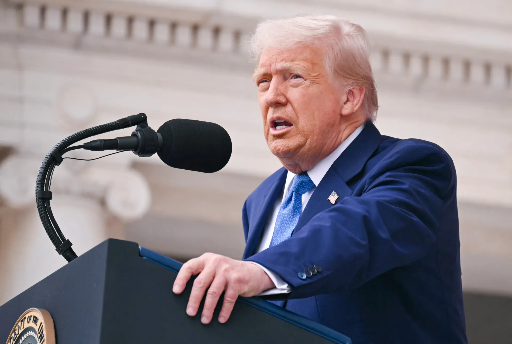
If this decision stands on appeal, it’s a big loss for Trump that will make it difficult for his trade war to continue.
by Ian Millhiser
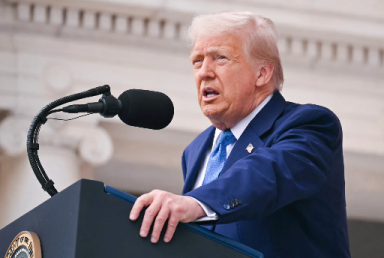
President Donald Trump delivers remarks at Arlington National Cemetery on May 26, 2025.
Saul Loeb/AFP via Getty Images
The US Court of International Trade’s decision in two consolidated cases — known as V.O.S. Selections v. United States and Oregon v. Department of Homeland Security — is quite broad. It argues that the Constitution places fairly strict limits on Congress’s ability to empower the president to impose tariffs in the first place — limits that Trump surpassed — and it reads several federal trade laws to place rigid constraints on Trump’s ability to continue his trade war.
The decision may not be final; it can be appealed up to the Supreme Court. But if higher courts embrace the trade court’s reasoning, Trump most likely will not be able to reimpose the sweeping kind of tariffs at issue in the V.O.S. Selections case, although he might still be able to impose more modest tariffs that are more limited in scope and duration.
The three-judge panel that decided V.O.S. Selections unanimously agreed that the Trump’s tariffs, as they stand now, are illegal in an unsigned opinion. The panel included judges appointed by Presidents Ronald Reagan, Barack Obama, and Trump himself.
The trade court judges reached four significant conclusions in the V.O.S. Selections opinion
Trump primarily relied on the International Emergency Economic Powers Act of 1977 (IEEPA) when he imposed his tariffs. That statute permits the president to “regulate…transactions involving, any property in which any foreign country or a national thereof has any interest,” but this power “may only be exercised to deal with an unusual and extraordinary threat with respect to which a national emergency has been declared.”
The trade court’s first significant holding is that, although a federal appeals court has held that this power to “regulate” foreign transactions sometimes permits the president to impose tariffs , this statute cannot be read to give Trump “unlimited tariff authority.” That is, the IEEPA does not give Trump the power he claims to impose tariffs of any amount, upon any nation, for any duration.
Significantly, the trade court, based in New York City, concludes that the statute cannot be read to give Trump unchecked authority over tariffs because, if Congress had intended to give Trump that power, then the statute would violate the Constitution’s separation of powers because Congress cannot simply give away its full authority over tariffs to the president.
Among other things, the court points to a line of Supreme Court decisions establishing that Congress may only delegate authority to the president if it lays “down by legislative act an intelligible principle to which the person or body authorized to fix such [tariff] rates is directed to conform.” So, if the president’s authority over tariffs is as broad as Trump claims, the statute is unconstitutional because it does not provide sufficient instructions on when or how that authority may be used.
The court’s second significant holding arises out of Trump’s claim that the tariffs are needed to address the nation’s trade deficit — the fact that Americans buy more goods from foreign nations than we export. But, as the trade court explains, there is a separate federal law — Section 122 of the Trade Act of 1974 — which governs the president’s power to impose tariffs in response to trade deficits.
This statute only permits the president to impose tariff rates of 15 percent or lower, and those tariffs may only remain in effect for 150 days. The trade court concludes that Trump may only rely on his authority under Section 122 if he wants to impose tariffs to respond to trade deficits. So, while he could potentially reimpose some tariffs under this law, they would expire after five months.
The court’s third significant holding arises out of IEEPA’s language stating that any tariffs imposed under this statute must “deal with an unusual and extraordinary threat.” Trump justified some of his tariffs by claiming that they will help deter the importation of illegal drugs into the United States, but the trade court concludes that these tariffs don’t actually do anything to “deal with” the threat of drug trafficking — and thus they are illegal.
As the trade court argues, the tariffs do not directly prevent any illegal drugs from entering the United States. Trump’s lawyers argued that the tariffs will help reduce illegal drug trafficking because other nations will crack down on drug dealers in order to be rid of the tariffs, but the court rejects the argument that the tariffs can be justified because they pressure other nations to shift their domestic policies.
“[H]owever sound this might be as a diplomatic strategy, it does not comfortably meet the statutory definition of ‘deal[ing] with’ the cited emergency,” the court argues, adding that “it is hard to conceive of any IEEPA power that could not be justified on the same ground of ‘pressure.’”
Finally, the court ends its opinion by permanently enjoining the tariffs on a nationwide basis.
The Supreme Court is currently debating whether to limit lower courts’ power to issue such nationwide orders , but the trade court makes a strong argument that it is constitutionally required to block the tariffs throughout the country: As the V.O.S. Selections opinion notes, the Constitution provides that “ all Duties, Imposts and Excises shall be uniform throughout the United States .” So, if these tariffs cannot lawfully be imposed on one person, the same rule must apply to all persons.
So what happens from here?
The trade court is the first federal court to rule on whether these tariffs are legal, but it is unlikely to be the last. This court’s decisions ordinarily appeal to the US Court of Appeals for the Federal Circuit, and then to the Supreme Court. And Trump is all but certain to ask higher courts to lift the trade court’s injunction.
These higher courts could potentially reveal fairly soon whether they think the tariffs are legal. In an order accompanying the trade court’s decision, the court announces that “ within 10 calendar days necessary administrative orders to effectuate the permanent injunction shall issue.” So, if no higher court steps in, Trump’s tariffs will cease to exist very soon.
Of course, Trump will no doubt seek a stay of the trade court’s decision from the Federal Circuit and, if the Federal Circuit rules against him, the Supreme Court. That means that, depending on how the Federal Circuit rules, the Supreme Court may have to decide whether to reinstate the tariffs within weeks.
So, while higher courts will need to weigh in before we know if the tariffs will survive, we may know what the justices think about Trump’s tariffs very soon.
Whatever
Tags
Who is online
90 visitors
For some reason, Trump's tariffs make me think of the chorus in Joni Mitchell's song, Circle Game.