
Pentecost : A Reminder that Christ Commanded Us to Love One Another... NO EXCEPTIONS



Immigration is a Good Thing
Immigration is not an "invasion", nor should it be
Latinas for Trump co-founder criticizes president’s immigration arrests: ‘Unacceptable and inhumane’
A bunch of thoughts and evidence on immigration

Christ was totally woke. His empathy was absolute. He cared for the poor, both literally and figuratively. He preached the risks of wealth, toxic for human goodness.
Pentecost is a privileged moment to remember that "love one another" is not an option for anyone who claims to follow Him.
Immigration is a Good Thing
by Fred Clark - slacktivist
I’ve been working on something about the whole “I didn’t vote for this”/”yes, you did” conversation, doing my best to meet the always enthusiastic demand for more Niebuhr blogging, and was hoping to finish that tonight along with the rest of my sorely neglected laundry.
But instead I’ll be heading in to the Big Box on my night off because our crew is getting slammed with another of the ginormous trucks we’ve been dealing with ever since “Liberation Day” put the company’s supply chain and business model in jeopardy.
And also, I’m guessing, I’ll need to read up on the new SOP for how to respond if our location ever has masked federal goons launch so many volleys of tear gas at our store that we’re forced to close for the day, which is apparently a thing that sometimes happens now. OK, then.
And but so here on the first Monday of Pentecost, I’ll just quickly reaffirm the shared humanity of everyone in Jerusalem, and in all Judea and Samaria, and to the ends of the earth, Parthians, Medes and Elamites; residents of Mesopotamia, Judea and Cappadocia, Pontus and Asia, Phrygia and Pamphylia, Egypt and the parts of Libya near Cyrene; visitors from Rome; Cretans and Arabs … everybody.

The international diversity there is all verbatim from the first two chapters of the book of Acts, setting the stage for Pentecost and its unambiguous message of everybody means everybody. The next several chapters of the book show the dazed disciples spinning around, still confused by this lesson, with everybody (except Philip) dithering and questioning, saying, “But when we say ‘everybody’ we obviously can’t really mean, like, everybody everybody, right?” and them getting divinely dope-slapped, repeatedly, until they finally come around to understanding that, yes, everybody means everybody .
And so, in the spirit of Pentecost, let me just point out again that immigration is good, actually. It’s a Good Thing and a Very Good Thing and we should have more of it. We should not just make it possible instead of deliberately impossible, but straightforward and simple and easy.
While it is also true, as we discussed here last summer , that anti-immigration ideology is always wrong — evil and stupid and self-destructive — the more important point is that immigration is, in itself, a positive good.
Seems like a lot of people have forgotten that or, at least, have forgotten how to say it, so we should make a point of saying it, bluntly and clearly and often.

Immigration is not an "invasion", nor should it be
The far right and the far left both want you to think that the purpose of immigration is to overthrow America. Don't let them get away with it.
by Noah Smith

Why is social media buzzing with photos of masked protesters waving Mexican flags over burning cars in Los Angeles? Why are there clashes between police, protesters, and ICE? Why has Trump called in the California National Guard , and why is the administration threatening to send active-duty Marines to the city? Why is California governor Gavin Newsom daring the administration to arrest him? Why are progressives on social media shouting that a fascist takeover is here?
To understand why all of this is happening and what it all means, let’s go back and think about the history of the illegal immigration issue in America over the last few decades.
When I was a kid in the 1990s, illegal immigration was a fairly straightforward matter. People from poor countries wanted to come to the U.S. to work — usually in manual labor jobs like construction, landscaping, child care, and food service. Most were from Mexico, but some were from other countries and overstayed their visas. These illegal immigrants would hide out in ethnic enclaves, keeping a low profile, while the Border Patrol and the INS (the predecessor of ICE) tried to catch them and deport them.
A lot of people were mad about illegal immigration. Conservatives were mad because they thought illegal immigrants lived off of welfare. Many labor-liberals were mad because they thought illegal immigrants took jobs from working-class Americans. There were some people who wanted to turn the issue into a culture war — Pat Buchanan types who thought American culture was being polluted, and multicultural types (the predecessors of modern “woke” progressives) who fought to replace the pejorative term “illegal immigrant” with the more euphemistic “undocumented immigrant”. 1 But by and large, it was economic concerns that pushed up anti-immigration sentiment in the 1990s:

Both parties responded to this wave of economic outrage. In 1996, as part of welfare reform , Bill Clinton and a Republican Congress kicked illegal immigrants off of most forms of welfare. In 2006 George W. Bush and a Republican Congress passed the Secure Fence Act , which constructed fences along the most commonly used border crossings, thus making it much harder and more dangerous to sneak into America. Barack Obama stepped up deportations of unauthorized immigrants who committed crimes, ultimately deporting about 3 million people .
These restrictive policies, plus the Great Recession, sent illegal immigration into reverse. From 2008 through 2020, the number of unauthorized residents in America fell by well over a million (even using alternative estimates that place the total number a lot higher). Possibly as a result, anti-immigration sentiment in America fell steadily during the 2010s. It really looked like the problem was solved.
But it wasn’t. In the 2010s, a bunch of people in poor countries discovered that America’s asylum law contained a loophole — if you snuck across the border and turned yourself in to the U.S. authorities instead of hiding, you were legally entitled to an asylum hearing. Although you’d probably be denied asylum, you typically got to stay in America while waiting for your hearing — working, putting down roots, even having kids, and so on.
The shift from hiding to asylum-seeking muddied the waters of what “illegal immigration” actually meant. If you sneak across the border illegally, but the government grants you the legal right to stay in America for a while, are you an “illegal immigrant” or not? On top of that, there are other gray zones, like Temporary Protected Status, a program that the Department of Homeland Security can use to allow unauthorized immigrants to stay in the U.S. temporarily if it thinks they’d be in danger if they returned to their home countries. Then there are people who are eligible for deportation, but where a judge issues an order temporarily halting that deportation. And so on.
The old distinction between legal and illegal immigration began to break down, swamped by a dizzying array of new quasi-legal forms of immigration that average Americans almost certainly couldn’t understand.
Around the same time, immigration transformed from an economic issue to a culture war. As the Hispanic population increased, the MAGA movement panicked about White Americans becoming a minority. The “Great Replacement” idea — that Democrats were intentionally importing as many immigrants as possible in order to demographically drown the White race and the Republican party, became a common narrative on the right. These fears were exacerbated by rightists’ increasing feeling of affinity with Europe, and their worry that traditional European culture was being swamped and destroyed by Muslim immigration.
Progressives, caught up in the fervor of the new “woke” movement, saw this new backlash against immigration as yet another sign of the white supremacy upon which they now believed their country had been founded. Many began to treat immigration status as an identity marker worthy of protection, like race and gender and sexuality. Prominent progressives began to trumpet books like This Land is Our Land: An Immigrant’s Manifesto , by Suketu Mehta, which argued that the people of developing countries should have a right to move to Western countries as reparations for colonialism.
I read This Land is Our Land in 2019, while I was reading dozens of books about immigration. 2 Most of those volumes had been written in the 2000s or early 2010s, usually by progressive scholars and journalists. They mostly presented a positive, pro-America, pro-assimilation view of immigration — Hispanics are assimilating and moving up economically , immigrants love America , racial distinctions are blurring over time , small towns are welcoming immigrants , and so on. This Land is Our Land represented a radical departure from that patriotic, optimistic view, instead depicting America as a sinner who owed a debt to would-be immigrants.
The new culture war over immigration only intensified during the Biden administration. For reasons that still aren’t entirely clear, the progressives that dominated the administration decided to basically sit back and do nothing about the flood of asylum-seekers that poured over the border after the pandemic. My best guess as to why they did this is that they looked at polls showing an upswing in pro-immigration sentiment in America, and concluded that a more permissive immigration policy would be a winning culture-war issue — a popular way to draw a contrast between themselves and the Trump administration. 3
But whatever the reason, Biden’s lax border policies had a dramatic effect. Even after accounting for the fact that most people who cross the border illegally now turn themselves in, unauthorized immigration under Biden returned to the levels of the mid-2000s:
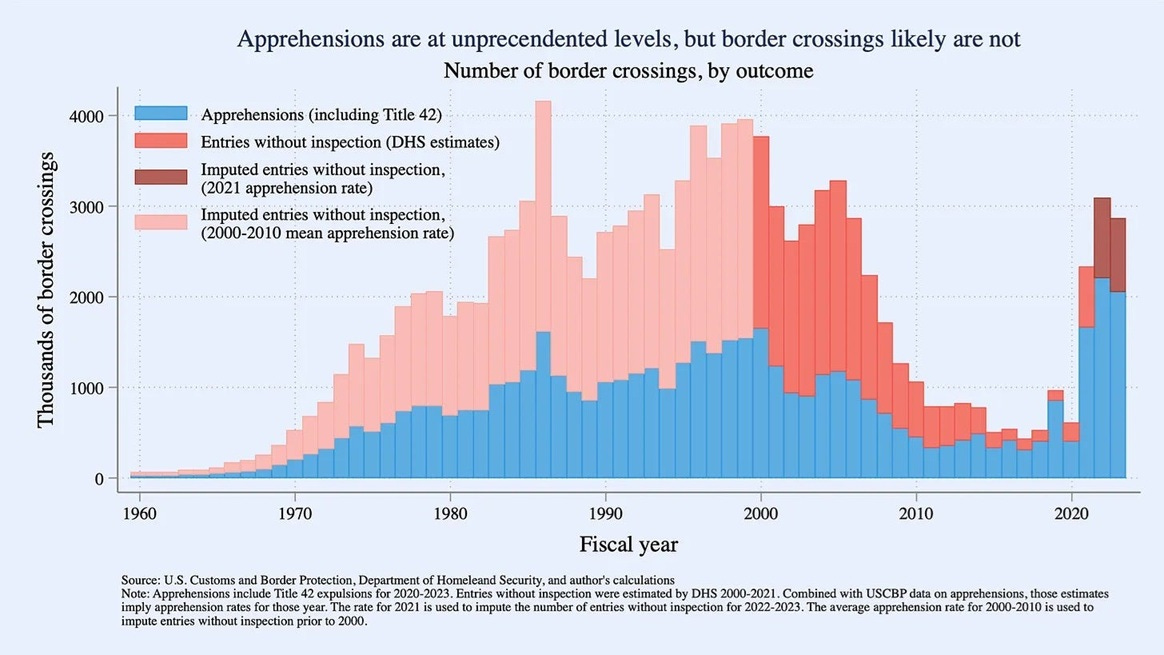
Biden also implemented a “humanitarian parole” program that granted temporary residency to Cubans, Haitians, Nicaraguans, and Venezuelans. This was touted as a way to decrease illegal immigration by simply legally admitting people who might want to sneak into the United States. But to most Americans, this probably just looked like another form of gray-zone quasi-legal immigration.
Republicans, now thoroughly dominated by the MAGA movement, began to routinely call this an “invasion” of the United States. The idea of the “Great Replacement” went from a fringe theory to standard canon on the right.
And the right basically won over the nation on this topic. Fairly early into Biden’s term, opinion polls showed a hard swing against immigration in general, with illegal immigration driving the shift. Mass deportation became a broadly popular policy idea , even among Hispanic Americans. Along with inflation, immigration was Trump’s strongest issue in the 2024 election. It’s not inaccurate to say that Trump was elected with a mandate to stop and reverse the flood of people across the border.
Trump stopped the flood. Border crossings had already fallen quite a lot in the last year of Biden’s presidency, as he belatedly cracked down. But as soon as Trump was elected, they dropped to almost nothing:
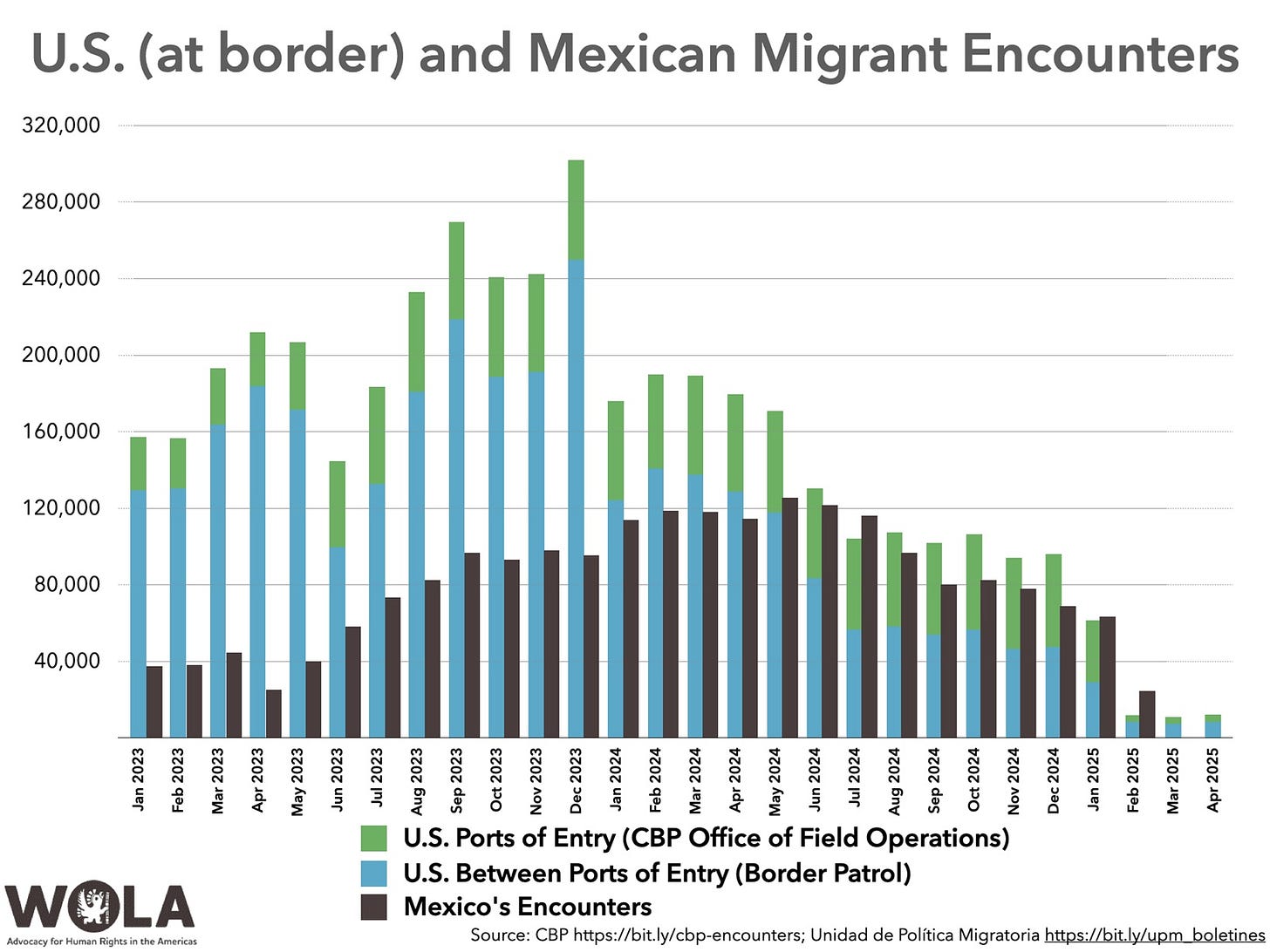
It’s not clear how much of this was due to more restrictive policies, and how much was due to Trump’s election simply being a signal that migrants aren’t wanted in America and won’t be treated well. But either way, Trump seems to have fulfilled the first part of his restrictionist mandate.
But that still left all the people who were still in the U.S. illegally — somewhere between around 12 and 30 million, depending on whose estimates you believe. That’s between 3.6% and 9% of the total U.S. population. The Trump administration and the MAGA movement view most of these people not as economic opportunists, but as “invaders” bent on destroying the U.S. and Western civilization in general . And the polls supported mass deportation, so mass deportation it was.
The easiest way to accomplish mass deportation would have been to emulate the patterns of the past. Illegal and quasi-legal immigrants who committed even minor crimes could have been swiftly deported en masse. And the administration, with the help of a GOP Congress, could have implemented random audits of companies to see if they were hiring any undocumented workers, with harsh penalties for those who were. The resulting loss of economic opportunity would have had an effect similar to the Great Recession, causing millions of unauthorized immigrants to “self-deport”.
Instead, the administration took its rhetoric about “invasion” seriously, and acted accordingly. Trump invoked the Alien Enemies Act , declaring the Venezuelan gang Tren de Aragua to be a terrorist organization, and using this as an excuse to basically round up a bunch of Central Americans who had tattoos or whom someone in ICE suspected of being in a gang. These folks were mostly sent to notorious prisons in El Salvador, usually without due process. It was all very authoritarian .
The most prominent case was that of Kilmar Abrego Garcia, who was deported in defiance of a court order. The Supreme Court ordered the Trump administration to “facilitate” his return to the U.S. The administration resisted, but eventually brought Abrego Garcia back (and promptly charged him with illegal trafficking of migrants).
It was a victory for the rule of law. And the case was a disaster for the Trump administration, which looked like it was acting like a third-world dictatorship. Trump’s approval on immigration, which has generally been his best issue, began to fall .
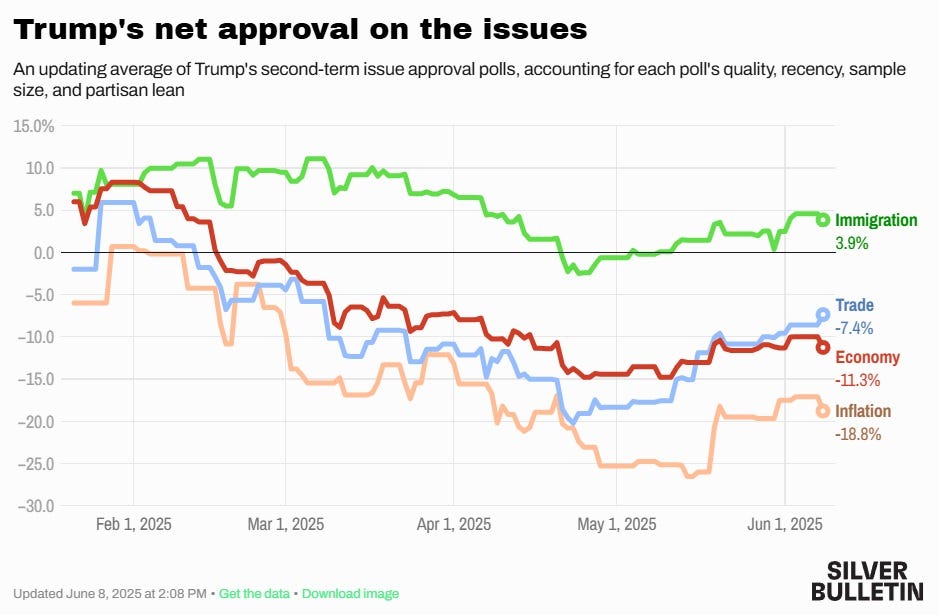
It’s still above his ratings on the economy, and it has recovered a bit since, but the Abrego Garcia case looked like it was doing some long-term damage to Trump’s credibility on immigration — and to the right’s whole narrative on the issue.
But Stephen Miller, Trump’s Deputy Chief of Staff and the administration’s top anti-immigration crusader, wasn’t deterred. He began ordering ICE to start more intrusive action, including arrests of people who were showing up for their immigration hearings, as well as raids of workplaces:
In mid-May, White House deputy chief of staff Stephen Miller, frustrated over what he saw as numbers of arrests and deportations of unauthorized immigrants that were too low, berated and threatened to fire senior Immigration and Customs Enforcement officials if they did not begin detaining 3,000 migrants a day…Weeks later, ICE is launching the Trump administration’s largest immigration crackdown.
If there’s a goal here, besides simply demonstrating zero tolerance for illegal immigration, it seems to be to end the gray zone of quasi-legal immigration — to drive the undocumented back into the shadows like in the 1990s.
I’ve always predicted that this type of deep penetration into American communities would provoke a backlash, since many illegal and quasi-legal immigrants are deeply embedded in those communities. Seeing federal agents — often wearing face masks to hide their identities — charge in and arrest the waitress at your local waffle restaurant — is a powerful argument against MAGA immigration policy.
So this policy seemed like it might continue the trend of the Abrego Garcia blunder — a heavy-handed, brutal, but ineffectual strategy that reeked of authoritarianism.
But then the protests started. Residents of several Los Angeles suburbs began to clash with federal agents doing immigration raids. The agents fought back, with aid from the local cops — and, now, from the NationalGuard. Some protesters waved American flags, but a lot waved Mexican flags — historically not a winning display for pro-immigration rallies, and one that doesn’t do much to dispel the right-wing idea that immigrants are foreign “invaders”.
Pretty soon, all the events that we came to associate with protests back in 2014-2020 began to happen again. Leftists showed up on the scene, summoning Waymo cars and then burning them , and putting up anti-police slogans and pro-Palestine symbols (of course). Twitch streamers showed up and joined the protests. Different angles of the same iconic image of the Mexican flag and the burning car were plastered all over social media, creating the impression that there were a lot more such incidents than there were. Large nonviolent marches were generally ignored by the media and by social media, while small, mildly violent clashes got all the attention. Moderate liberals who called for peaceful protest were dogpiled by leftists on Twitter. Some progressive firebrands called the immigration raids names like “state-sponsored terrorism”, and called for violence in response. Trump administration officials declared the protests an “insurrection” (conveniently seeming to forget the January 6th insurrection they just pardoned!), and calling the protesters “invaders”.
It remains to be seen whether these are scattered, overhyped protests that will fizzle, or the beginning of a new cycle of unrest that will spread throughout the nation. But it seems obvious that Stephen Miller and the rest of the Trump administration are hoping to provoke the latter. Mexican flags being waved over burning cars are exactly the image of immigration Miller & co. want to send to every television set and computer screen in the country — aggressive foreigners, proudly waving the flag of a foreign nation as they arrogantly smash the tools and symbols of American government authority on American soil.
So Miller & co. will keep pushing. They will keep sending federal agents into courtrooms and workplaces, disrupting the flow of local life as much as they can. Before these protests, that strategy might have cost them dearly, provoking a backlash against their authoritarian style. Now that violent resistance to immigration agents has become a meme, however, Miller and the rest of the Trump administration know that all they have to do in order to get exactly the optics they want is to keep poking at Latino communities in Los Angeles and other big blue cities.
What’s happening here is that leftists and rightists are converging on the same narrative about immigration. Rightists say immigration is an invasion; leftists wave foreign flags. Rightists say protests are an insurrection; progressives call for the public to “strike back”. Rightists say that pro-immigration forces want to overthrow America; leftists on social media agree.
The immigration extremists — one side in the White House, the other in the streets and on social media — are essentially teaming up to defy the will of the American public. Americans’ views on immigration are nuanced, subtle, pragmatic, and generally reasonable; they want borders to exist, and they want democracy and law to decide who’s allowed to cross those borders. They are generally favorable to legal immigration, but dislike the feeling that immigrants are being snuck into the country under their noses in defiance of their will. They hate jack-booted thugs rampaging through their community, and they hate it when a President arrests the innocent and seems to flirt with the idea of defying the Supreme Court. But they don’t want the summer of 2020 back, either, and they have no love for the anti-Americanism of the far left.
For too long, Americans have let the extremists drive the narrative on immigration. Twelve years ago, a reasonable immigration compromise — heightened border security and crackdowns on employment of illegal immigrants, combined with a path to citizenship for people who have lived in America illegally for a long time — was rejected by Republicans in the Senate. Americans who don’t want to see their country spiral into authoritarianism or anarchy, or ping-pong back and forth between one unreasonable immigration policy and its polar opposite, need to stand up and demand moderate solutions like the one that was rejected in 2013.
Moderation on immigration can’t be something Americans just grumble silently to themselves while the streets burn on their screens. They have to insist on it, or the destructive battles over this issue are just going to keep happening again and again.

Latinas for Trump co-founder criticizes president’s immigration arrests: ‘Unacceptable and inhumane’
Florida state senator joins US House member in expressing alarm over ‘arbitrary measures to hunt down people’
by Ramon Antonio Vargas (Guardian)
 Maria Elvira Salazar talks with voters in Florida in 2018.
Salazar says that those with pending asylum claims deserve ‘to go through the legal process’.
Tom Williams/CQ-Roll Call, Inc/Getty Images
A co-founder of a group for Latinas who support Donald Trump has excoriated the president on some of the immigration -related arrests being carried out by his administration, which she called “unacceptable and inhumane”.
In a statement posted on X over the weekend, Ileana Garcia wrote: “This is not what we voted for.”
The post from the Florida state senator asserted that she had supported Trump, her fellow Republican, “through thick and thin” and understood the need to remove from the US undocumented people who had committed crimes.
But she criticized how federal authorities had arrested people at immigration courts across the country despite “credible fear of persecution claims” as the Trump White House ramped up his mass deportation campaign after his second presidency began in January.
Referring to Stephen Miller , Trump’s homeland security adviser and deputy chief of staff, Garcia said: “What we are witnessing are arbitrary measures to hunt down people who are complying with their immigration hearings … all driven by a Miller-like desire to satisfy a self-fabricated deportation goal.
“This undermines the sense of fairness and justice that the American people value.”
Garcia’s statement expressed solidarity with comments issued Friday by another Florida Republican: US House member Maria Elvira Salazar. In a statement , Salazar said the Trump administration’s policies had exposed thousands to deportation and seemed to disregard for the “duty to due process that every democracy must guarantee”.
Salazar’s statement added that those with pending asylum claims deserved “to go through the legal process” while urging the Trump administration to stay focused on removing “every criminal here illegally”.
Garcia alluded to how she represents Salazar’s congressional district in Florida’s state senate and said her Cuban refugee parents are “now just as American, if not more so, than Stephen Miller”.
“I am deeply disappointed by these actions,” Garcia’s statement said. “And I will not stand down.”
Garcia’s remarks are not the first time she has gotten cross with the Trump administration. She served as a deputy press secretary for the US homeland security department during Trump’s first presidency before leaving the post in March 2019, ahead of his defeat in the 2020 election to Joe Biden and her joining the Florida state senate.
During his unsuccessful 2020 run, Trump’s campaign launched its own official Hispanic outreach coalition and delivered multiple cease and desist letters threatening legal action against the Latinos for Trump organization who had supported his victorious first presidential run, as ABC News reported at the time.

A bunch of thoughts and evidence on immigration
I've been writing about this for a while
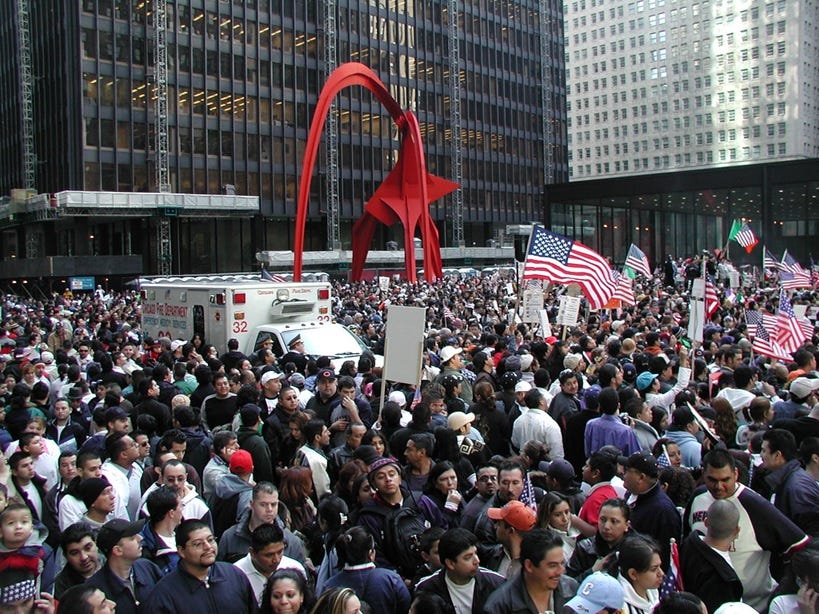
" Protest in Federal Plaza - View West "
by Edu-Tourist , CC BY-SA 2.0
Anti-ICE riots are continuing in L.A., with protests spreading to some other cities . It remains to be seen how big the movement will become, or how harsh Trump’s reprisals will be. In the meantime, the rhetoric on social media around the whole immigration issue is getting pretty hyperbolic. Here are noted right-wing pundits Matt Walsh and Charlie Kirk :

And here’s a DSA leader:

And here was another popular tweet I saw:

Meanwhile, early polling shows that Americans generally disapprove of both Trump’s deportation policies and the protests against them:


I wrote up my basic thoughts on the issue yesterday. Basically, Trump’s deportation policy has been haphazard, cruel, clumsy, largely pointless, and occasionally lawless. But protests that wave Mexican flags, torch cars, and denounce the United States of America will only lend credence to Trump’s story about immigration being an “invasion”, and ultimately hurt the cause they’re trying to help.
But in fact, I have lots more thoughts on the immigration issue in general, and I’ve written a bunch of posts about it over the years. So I thought I’d re-up a bunch of those. I’ve grouped them by topic.
On why Americans are angry about immigration
The most important topic to address, of course, is why Trump’s restrictive stance on immigration, and his plans for mass deportation, have become so popular. I wrote a pair of posts in late 2023 and early 2024 showing that yes, Americans are indeed angry about immigration:
Americans are angry about immigration
My basic hypothesis is that the asylum loophole — the ability of would-be immigrants to illegally cross the border, turn themselves in to the authorities, and be allowed to stay in the U.S. to wait for their asylum hearing — has led to a flood of quasi-legal low-skilled immigration.
Why are Americans mad about this? My argument is that this form of quasi-legal immigration makes it seem like the democratic will of the American people is being flouted, which makes Americans feel disempowered and disenfranchised:
That’s my hypothesis concerning the median voter. But there’s a very different reason that the MAGA movement itself hates immigration — not just of the illegal variety, but all types. The “Great Replacement” theory, which holds that liberals are importing immigrants in order to demographically drown and disempower the white race and the Republican party, has become canon on the right, turning immigration into the right’s core culture-war issue:
In my opinion, Americans are justified in feeling angry about the kind of quasi-legal immigration we’ve been getting over the past few years. But at the same time, I think it’s pretty clear that economically, the U.S. needs large-scale immigration in order to support its economy:
Small declining towns especially need immigrants. Without immigrants, they’ll wither away:
I think Matt Yglesias has the right idea. We should care what type of people we let into the country, and how, but ultimately we want a country that’s growing instead of shrinking, and a country that has a big domestic market instead of a small one:
On why America needs skilled immigration
The U.S. needs large numbers of immigrants, but we also need the best and the brightest if we’re going to hope to compete with China. A year ago I wrote a post with Minn Kim laying out the case:
And back in 2022, Alec Stapp and Jeremy Neufeld wrote a great guest post with some concrete ideas about how to encourage skilled immigration:
You’ll notice that right-wing pundits like Matt Walsh and Charlie Kirk are against all immigration from “third-world” countries, including skilled immigration. This echoes a blowup that occurred last Christmas between various factions of the online right over the issue of Indian immigration (Indians being America’s most highly-skilled immigrant group on average, but also coming from a poor country). I wrote a post weighing in on why Indian immigration has been awesome for America:
The Trump administration has also been trying to restrict the flow of foreign students into the country. I recently wrote a post about why that’s bad:
America needs its foreign students
On the economic effects of immigration
Immigration is now a culture-war issue first and foremost, but economic arguments still matter. In one of my first posts on this blog, I wrote about the mountain of evidence showing that immigration doesn’t reduce wages for the native-born:
One of Trump’s big arguments in his successful reelection campaign was that immigrants are raising rents and other costs for Americans, and that mass deportations would make everything cheaper. I wrote a couple of posts explaining why this is probably wrong:
On the other hand, some progressives argued that the big surge in quasi-legal immigration under Biden was a factor in bringing inflation down in 2023 and 2024. I also think this is highly unlikely to be the case:
Did immigration bring down inflation?
Essentially, I think immigrants are mostly unrelated to the inflation issue, as much as some people would love to link the two.
On the social effects of immigration
Since immigration is now more of a sociocultural issue than an economic one, it’s important to understand the social impacts as well. It’s interesting that while much of MAGA’s hatred is directed at Hispanic immigrants coming from Mexico and Central America, Hispanic Americans themselves have trended toward the Republican party and become more supportive of restrictive immigration policies.
I interpret this as Hispanics basically following the same path as the Irish and the Italians before them; as Hispanic Americans as a group become more economically successful, they feel more patriotic, less aligned with immigrant co-ethnics, and more well-established in American society:
In fact, Leah Boustan and Ran Abramitzky have written a whole book about how today’s immigrants are following basically the same path of cultural assimilation and upward economic mobility as their South and East European predecessors a century ago. I interviewed Boustan here:
In order to win Hispanics back, I think progressives need to stop talking about immigrants as an oppressed class, and go back to telling the positive, triumphalist story of opportunity and upward mobility that they used to tell whenever the immigration issue came up:
Meanwhile, the right’s attempts to scare Americans about this or that group of immigrants is pretty reprehensible, and rarely if ever based in fact:
Basically, Americans have a right to be mad about how immigration has been done in recent years, and progressives shift toward viewing immigration as a social justice issue isn’t helping. But the cure that MAGA is selling is a bad one, and will have negative social as well as economic consequences for our nation.

Appropriate topics:
- Christ was woke
- Christ commanded us to love one another, with NO exceptions
Tags
Who is online
157 visitors
This is a BIG seed. Four different articles on the general topic of immigration, in the particular context of Pentecost.
Fred Clark is profoundly Christian. "Love your neighbor" is a very hard commandment to obey... but if we believe in anything good, we really have no choice. Cruelty, or even simple indifference, to those less fortunate (in both meanings) is... evil.
Noah Smith gives us data. and data, and data, and... yeah... lots and lots of data. Well? Do you want to know what's going on, or will you continue to just pull BS from... oh, wait... it's Pentecost...
And a Trumpist Latina realizes that Trump doesn't like people who aren't lily-White. Oooops!
One cant help but wonder how much of migration from Mexico over the many decades is related to the fact that all of the southwest United States used to be Mexico.
Spanish was spoken in the Southwest centuries before Anglos arrived.
Years ago I was on a race relations forum on the old About.com platform. There was a guy on there, an anglo, who was married to a reconquista, which in the context of Mexico meant the retaking of the land that was ceded by Mexico to the US after the Mexican-American war. One of their precepts was that there are no borders in North America and people are free to wander or migrate wherever they want.
Obviously that is , uh, unworkable in a world of sharply defined nations, but i do think the remnants of that mindset play a part in what is happening now. There undoubtedly are Mexicans who feel they have a birthright to live in the US southwest.
Except that was never true. Prior to American ownership, the southwest was largely empty. In many cases those from what is now Mexico who were in the American southwest were there because they were slaves of indian tribes. They weren't wandering freely where their hearts led them.
The US considers itself, at least from the white point of view, as a northern European civilization. That is not a part of Mexican heritage. It has barely been a part of southwestern USA heritage. The southwest has a strong Spanish and Mexican heritage. I'm sure you have noticed that.
I'm a bit unsure of what the point is supposed to be. It seems to be something like, before the US took control of it, it was Spanish/Mexican in one way or another. Okay. And? Like the US, coming in and taking it from the Spanish/Mexicans is worse than the Spanish/Mexicans taking it from the people before them, and them taking it from the people before them, as if these things didn't happen before Europeans got here? And for sure, little of the "heritage" of the Spanish/Mexicans was the heritage of the indigenous cultures, so what does that matter anyway?
[deleted][✘]
[deleted][✘]
[deleted][✘]
I'm pretty sure that if Christ had come at this time and to the woke, instead of the Jews of the first century, he would have been crucified even faster. The woke definitely wouldn't have liked him. If Jesus had an interest in woke issues, he would have done something about the Romans when he was here.
Apparently your definition of "woke" is non-standard.
What's the 'standard' definition?