
In a First, America Dropped 30,000-Pound Bunker-Busters—But Iran’s Concrete May Be Unbreakable, Scientists Say

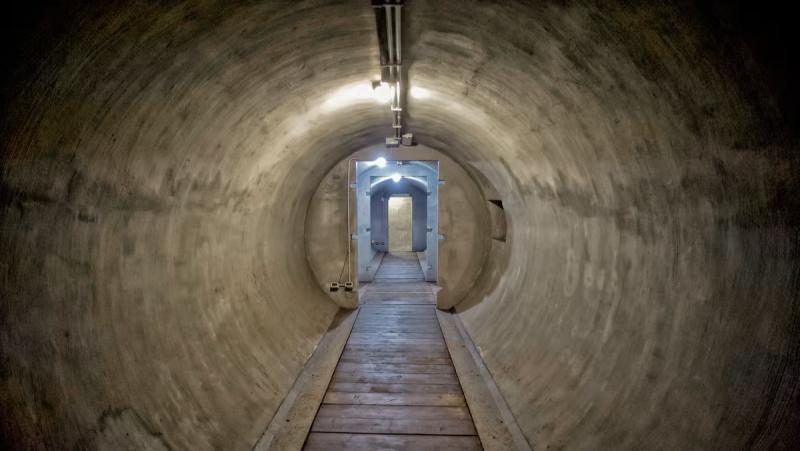
Photo: Popular Mechanics
On Saturday, June 21, 2025, following a spate of unprecedented aerial attacks that Israel carried out against Iran just days before, the United States joined the war and used bunker-busting bombs to strike three key Iranian nuclear sites and their underground bunkers: the Fordow fuel-enrichment plant, the Natanz nuclear facility, and the Isfahan nuclear technology center.
Operation Midnight Hammer, the Pentagon’s codename for the strikes on Iran, marks the first-ever use of the Massive Ordnance Penetrator (MOP), a colossal 30,000-pound bomb that only the B-2 stealth bomber can carry. As such, America has been regarded as the only country capable of taking out Iran’s underground nuclear facilities, and therefore its nuclear program—but if it actually accomplished that feat is yet to be seen.
While President Trump declared that the operation “completely and totally obliterated” the sites, Iranian officials downplayed the attacks.
As of publication time, it’s unclear the level of damage inflicted based on satellite imagery alone, but a CNN report published on Tuesday afternoon claims that the strikes on Iran did not destroy the country’s nuclear program and has instead only set it back by a matter of months, according to early U.S. intelligence.
If history serves as any indication, there is a chance Iran’s underground nuclear facilities could be partially or wholly intact. That’s because up until now, in the quiet arms race between concrete and bombs, the concrete has been winning.
In the late 2000s, for instance, rumors circulated about a bunker in Iran struck by a bunker-buster bomb. The bomb had failed to penetrate—and remained embedded in—the surface of the bunker, presumably until the occupants called in a bomb-disposal team.
Rather than smashing through the concrete, the bomb had been unexpectedly stopped dead. The reason was not hard to guess: Iran was a leader in the new technology of Ultra High Performance Concrete , or UHPC, and its latest concrete advancements were evidently too much for standard bunker busters .
Stephanie Barnett, Ph.D, of the University of Portsmouth in the U.K. is involved in developing stronger concrete to protect civilian buildings from terrorist attacks, and has heard about Iran and its ultra-tough concrete. While civilian audiences have been enthusiastic about the advancements in concrete, she occasionally hears less positive responses from military personnel attending her presentations.
“One officer told me, ‘If you make this stronger blast- and impact-resistant material, we need to think about how to get through it,’” Barnett says.
On June 21, 2025, the U.S. Air Force used six B-2 bombers to drop 12 bunker-busting bombs on Fordow, Iran’s most significant nuclear enrichment facility, an official told CNN. Based on satellite imagery alone, it’s still unclear the level of damage the underground bunker sustained.
The U.S. Air Force introduced its first modern bunker buster in 1985. General-purpose bombs have a thin steel casing filled with explosives, while bunker busters have a narrower profile, with a thicker casing and less explosives. This design concentrates all the weight on a smaller area, making it an ice pick rather than a hammer, so the bomb can smash through concrete or burrow through earth to strike deeply-buried targets.
While the same general-purpose bombs from the 1990s are being used today, bunker busters had to go through several generations of upgrades. In the early 2000s, the Air Force even developed a special type of steel for the purpose, known as Eglin Steel , in association with steel specialist Ellwood National Forge Company.
Eglin Steel is a low-carbon, low-nickel steel with traces of tungsten, chromium, manganese, silicon, and other elements, each contributing a desirable property to the whole. Eglin Steel is the gold standard for bunker-busting munitions, although in recent years it has been supplemented by new USAF-96 steel , which boasts similar performance but is easier to produce and work with.
Materials scientists distinguish between the two qualities of toughness and hardness, and it is the balance between them that drives arms races between weapons and armor.
For example, when a soft lead bullet strikes a Kevlar vest , the bullet crumples and deforms, losing energy because it lacks hardness. Give the bullet a hard steel jacket, though, and the Kevlar gives way. The counter is to make armor harder by adding ultra-hard ceramic plates made out of materials like boron carbide. These are so hard that steel-jacketed bullets break up on impact. This led to special armor-piercing bullets tipped with hard tungsten. When these hit a ceramic plate, the plate breaks up in a process known as brittle failure.
The bunker-buster arms race is similar, but while the attackers have the advantage of steel, defense is based on concrete, which starts with a built-in disadvantage. “Concrete is inherently brittle,” explains Phil Purnell, Ph.D., an expert in concrete technology at the University of Leeds. “It is good at being squashed, not being stretched. The weakness is in its tensile capacity and toughness.” Purnell notes that while some modern concrete is actually stronger than aluminum, its brittleness is its Achilles’ Heel, and it gives way by cracking.
However, this changed with the advent of the type of concrete known as UHPC. Previously, a yield strength of 5,000 pounds per square inch (psi) was enough for concrete to be rated as “high strength,” with the best going up to 10,000 psi. The new UHPC can withstand 40,000 psi or more.
(Cont'd on Popular Mechanics website)
Red Box Rules
Warning: If you make a really stupid comment, I may decide to leave it up for all to see!
Tags
Who is online

124 visitors
My first question would be, who did CNN get its information from - and how did that source know?
Would it help to plate the concrete with that advanced steel plating to shelter the concrete's brittleness? Could that have been done to make the bomb's access to the lab even more difficult?
Sounds impressive, but as I understand it, of the 12 MOPs on Fordow, six went down one shaft, six down the other, one after the other. That UHPC would have to be mighty incredible stuff to withstand that.
I don't know all the details, but apparently the alleged total destriction of Iran's nuclear weapons programme was declared prematurely.
I don't know how anyone can know the extent of the damage by looking at photos taken above the ground (and from the air), when many of these sites are buried deep beneath the surface.
In addition, whatever trials of these bunker busters were carried out by the U.S., it is possible that the people conducting these trials weren't aware of this special type of concrete (?)
I've been following the stroy from the start and until late last night I had no idea the Iranians had developped these special types of concrete.
Nor did I until I read this article that you posted.
maybe they stumbled onto something close to the old roman empire concrete , some of that stuff has been around for 2000 + years and they still havent found out the right mix to duplicate it .
Maybe there was some kind of rapport between the Roman Empire and the Persian Empire. Were there Persian rugs being used in Rome?
We will NEVER know the extent of or even if there was any damage at all to the Fordow underground lab because now the Iranians have ended any access or cooperation with the IAEA, and they sure as hell won't provide inspections by anyone. Even before they did not permit the IAEA with access to all of its program.
I doubt we ever will either , not unless there is a complete regime change away from the clerics .
the other thing is anyone that could possible see through other means like satellites , drones and what not , wont say anything because that would show what they are capable of seeing and or finding out , better for them to keep it secret and to themselves , than show their capabilities .
Yes, I do understand, and that is all the more reason why we will never know. Contrary to Trump's declaration that Iran is not to have absolutely any access to anything nuclear, I would allow them the uranium level for civilian use (is it 60%?) if an inspection team that included either the USA or Israel along with others to openly inspect EVERY nuclear processing site regularly and at any time, but, as you say, that is impossible unless there is a regime change.
here is the thing i am pondering , would you trust the people of Iran , under the control of the current cleric government , after seeing what their crotch goblin offspring in lebanon and gaza have done , with any nuclear material?
would they pass the Gallagher test ?
that test being would you trust them with a sledgehammer and a watermelon , and you were standing 6 ft in front of them in a white bridal gown ?
Hell , I wouldnt pass the Gallagher test .....
My stipulation, as I said, was that there would have to be a regime change, and I'lll add to that it would have to be a friendly regime, and becomes a party to the Abraham Accords.
I will say that is an admirable wish list, how realistic it is, is debatable due to the areas history .
Granted.
Is it possible they've added this same substance to kool aid, so as some heads become harder to reach, cause it iz befuddling