
The Great Realignment


 S E E D E D C O N T E N T
The American president wrote , “Vladimir, STOP!” on his Truth Social account in April, but the Russian president did not halt his offensive in eastern Ukraine. The Ukrainian president called for an unconditional cease-fire in May, but the Russians did not agree to stop attacking Ukrainian civilians from the air. Donald Trump repeatedly promised, during his campaign, that he would end the war “in one day,” but the war is not over. He spoke to Vladimir Putin yesterday, and Putin responded with more drones and missiles than ever before. This morning, parts of Kyiv are burning.
The invasion of Ukraine does not merely continue. It accelerates. Almost every night, the Russians destroy more of Ukraine from the air: apartment buildings, factories, infrastructure, and people. On the ground, Ukraine’s top commander has said that the Russians are preparing a new summer offensive, with 695,000 troops spread across the front line.
Russian soldiers also continue to be wounded or killed at extraordinary rates, with between 35,000 and 45,000 casualties every month, while billions of dollars’ worth of Russian equipment are destroyed every week by Ukrainian drones. The Russian economy suffers from high inflation and is heading for a recession. But Putin is not looking for a cease-fire, and he does not want to negotiate. Why? Because he believes that he can win. Thanks to the actions of the U.S. government, he still thinks that he can conquer all of Ukraine.
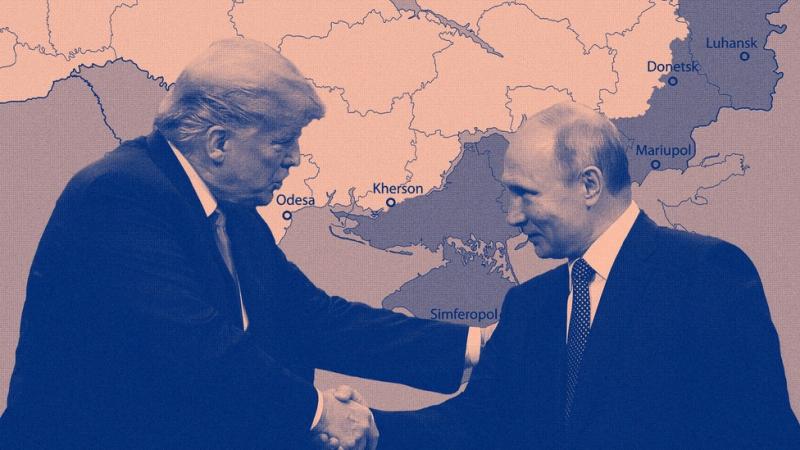
Putin sees what everyone else sees: Slowly, the U.S. is switching sides. True, Trump occasionally berates Putin, or makes sympathetic noises toward Ukrainians, as he did last week when he seemed to express interest in a Ukrainian journalist who said that her husband was in the military. Trump also appeared to enjoy being flattered at the NATO summit, where European leaders made a decision, hailed as historic, to further raise defense spending. But thanks to quieter decisions by members of his own administration, people whom he has appointed, the American realignment with Russia and against Ukraine and Europe is gathering pace—not merely in rhetoric but in reality.
Just this week, in the middle of the worst aerial-bombing campaign since the war began, the Trump administration confirmed that a large shipment of weapons, which had already been funded by the Biden administration, will not be sent to Ukraine. The weapons, some of which are already in Poland, include artillery shells, missiles, rockets, and, most important, interceptors for Patriot air-defense systems, the ammunition that Ukrainians need to protect civilians from missile attacks. Trump had suggested that he would supply Ukraine with more Patriot ammunition, which is an American product. “We’re going to see if we can make some available,” he said after meeting Ukrainian President Volodymyr Zelensky last week . But what he says and what his administration actually does are very different.
Pentagon spokespeople have explained that this abrupt change was made because American stockpiles are insufficient, an excuse disputed both by former Biden-administration officials and by independent policy analysts . But whether true or false, this reasoning doesn’t matter to the Russians, who have already interpreted this change as a clear signal that American support for Ukraine is ending: “The fewer the number of weapons that are delivered to Ukraine, the closer the end of the special military operation,” the Kremlin spokesman Dmitry Peskov told reporters. To be clear, by “the end of the special military operation,” he means the defeat of Ukraine .
At the same time, and with much less publicity, the U.S. is essentially lifting sanctions on Russia. No such formal announcement has been made. But the maintenance of sanctions requires constant shifts and adjustments, as Russian companies and other entities change suppliers and tactics in order to acquire sanctioned products. During the Biden administration, I spoke several times with officials who followed these changes closely, and who repeatedly issued new sanctions in order to counter them. As The New York Times has reported , the Trump administration has stopped following these shifts and stopped imposing new sanctions altogether. This, the Times writes, allows “new dummy companies to funnel funds and critical components to Russia, including computer chips and military equipment.”
In addition to taking Russia’s side in the kinetic war and the economic war, the U.S. is realigning its position in the narrative war, too. During the Biden administration, the State Department’s Global Engagement Center regularly identified Russian disinformation operations around the world—exposing misleading websites or campaigns secretly run or directed by Russian operatives in Latin America and Africa, as well as in Europe. Trump appointees have not only dissolved the center; they also baselessly and bizarrely accused it of somehow harming American conservatives, even of having “ actively silenced and censored the voices of Americans ,” although the GEC had no operations inside the U.S.
At the same time, cuts to USAID and other programs have abruptly reduced funding for some independent media and Russian-opposition media. The planned cuts to Radio Free Europe/Radio Liberty, if not stopped by the courts, will destroy one of the few outside sources of information that reaches Russians with real news about the war. Should all of these changes become permanent, the U.S. will no longer have any tools available to communicate with the Russian public or counter Russian propaganda, either inside Russia or around the world.
Listen: Trump’s betrayal of Ukraine
Inside the United States, Russian propaganda is most loudly and effectively promoted by appointees of the U.S. president. Steve Witkoff, the real-estate developer who became Trump’s main negotiator with Russia despite having no knowledge of Russian history or politics, regularly echoes false Russian talking points and propaganda . He has repeated Putin’s view, which he may have heard from the Russian president himself, that “Ukraine is just a false country, that they just patched together in this sort of mosaic, these regions.” Witkoff has also seemed to agree with Putin that Ukrainian territories that voted for independence from Moscow in 1991 are somehow “Russian.”
By accepting disputed claims as fact, Witkoff is also helping Putin continue his war. In order to keep Russians onboard, to create divisions among Ukraine’s allies, and maybe even to build doubts inside Ukraine itself, Putin needs to portray the Ukrainian cause as hopeless and to describe the Ukrainian “demands” as unreasonable. He has to hide the most basic facts about this war: that he began it, that he has killed hundreds of thousands of people in pursuit of it, and that his goal, again, is to destroy or decapitate all of Ukraine. Witkoff helps make these falsehoods easier to sustain, in Russia, in the U.S., and in Europe.
Add all of these things together, and they are something more than just a pattern. They are a set of incentives that help persuade Putin to keep fighting. Sanctions are disappearing, weapons are diminishing, counterpropaganda is harder to hear. All of that will encourage Putin to go further—not just to try to defeat Ukraine but to divide Europe, mortally damage NATO, and reduce the power and influence of the United States around the world.
Europe, Canada, and most of the rest of the democratic world will continue to back Ukraine. As I have written before, Ukrainians will continue to innovate , to build new kinds of automated weapons, new drones, new software. They will continue to fight, because the alternative is the end of their civilization, their language, and, for many of them, their lives.
The Ukrainians could still win. A different set of American policies could help them win faster. The U.S. could still expand sanctions on Russia, provide ammunition, and help the Ukrainians win the narrative war. The administration could stop the fighting, the missile attacks, and the lethal drone swarms; it could stop the pointless deaths that Trump has repeatedly said he opposes. By choosing to back Russia, the U.S. will ensure that the war continues. Only by backing Ukraine is there hope for peace.
Tags
Who is online
90 visitors
Trump speaks with forked tongue, Putin listens with forked ears.
No, the Ukrainians cannot still win. No matter how much material and support the US provides, it is powerless to end this war,
Thanx(?) for your input but think I'll go with Ms. Applebaum's decades of experience when it comes to Eastern Europe and Russia.
She knows how to write. Logic has always been her weakness.
At she acknowledged that Trump tried to broker an end to the war. Maybe it is time for the Europeans to step up, or does she think they also enabled Putin?
They have and now fund Ukraine beyond the US. You know this and pretending otherwise is not wise.
The Ukrainians are holding their own on the battlefield, largely due to their expert use of attack drones.
Trump spoke with Putin for two hours yesterday. The result was one of the heaviest Russian bombardment of Ukrainian cities of the war last night.
After the phone talk Trump told reporters there was no progress. His influence with Putin is obviously non-existent.
Putin, unlike Trump, is unswayed by flattery.
Trump's recent so called winning streak will make him worse in many areas because now he feels all conquering and invincible. His ascension to an American throne is making good progress.
Would he rather see Putin victorious or Zelenskyy victorious ? We all know the answer to that.