
Nobel Prize: 7 facts we bet you didn't know


 S E E D E D C O N T E N T
1. The Nobel Prize and the Curie dynasty
Marie Curie is unique as the only person to have received Nobel Prizes in two different natural sciences — Physics in 1903 and Chemistry in 1911. Her husband, Pierre, was a co-winner on her first Nobel Prize .
Marie Curie won the prizes for her groundbreaking work on radioactivity, and for the discovery of new elements.
Her daughter, Irene Joliot-Curie , continued the tradition when she received the Nobel Prize in Chemistry in 1935, together with her husband, Frederic, for the discovery of artificial radioactivity — the production of artificial radioactive isotopes in the laboratory.
Over two generations, the Curie family became one of the most famous Nobel Prize winning dynasties in the history of science, accumulating a total of five Nobel Prizes.
2. A prized promise: Mileva Maric & Albert Einstein
In their 1919 divorce settlement, Albert Einstein promised his then-wife, Mileva Maric, that he would give her the entire prize money of a future Nobel Prize — at a time when Einstein had yet to win the prize.
When Einstein finally won a Nobel Prize in 1921, he transferred the money as promised, giving Maric a certain financial security for herself and their children.
3. The Einstein paradox: No prize for the theory of relativity
The Nobel Prize committee repeatedly rejected Einstein's theory of relativity because it seemed too speculative and theoretical to them; they preferred experimental evidence.
It was only when pressure from the international scientific community grew that Einstein received his 1921 Nobel Prize — not for the theory of relativity, but for his theory of the photoelectric effect, which could be measured and verified.
Even at the award ceremony, where the Nobel Committee presented its justification for the award, they avoided mentioning Einstein's fundamental theory about the law of gravitation and its relation to the forces of nature. They continued to reject it. But it still shapes the way scientists approach many aspects of the natural world.
4. Mathematics and the myth of Alfred Nobel's jealousy
There's a popular myth that Alfred Nobel chose not to endow a prize for mathematics because his wife had had an affair with a mathematician.
That story is false; Nobel was never even married.
It is more plausible that Nobel did not perceive mathematics as directly "useful for humanity" — one of the criteria for the prize — and therefore omitted it from his foundation.
The first Nobel Prizes were awarded in 1901. To this day, people wonder why there is no prize for math and, more recently, computer science.
5. It's a man's prize: Ignored female researchers
Lise Meitner was instrumental in the discovery of nuclear fission, but the Nobel Prize was awarded to the chemist Otto Hahn instead. Meitner was nominated for the award a total of 48 times and never won it once.
Jocelyn Bell Burnell had a similar experience with the discovery of pulsars, which are a type of neutron star. Her discovery was recognized with a Nobel Prize in Physics, but it went to Bell Burnell's PhD supervisor, Antony Hewish. That year's prize was shared between two men, Hewish and Martin Ryle .
Bell Burnell's decisive contribution was internationally acknowledged but ignored by the Nobel Committee.
Both Bell Burnell and Meitner's cases are considered examples of a structural disadvantage women still face in science.
6. Millions for a medal: The prize at auction
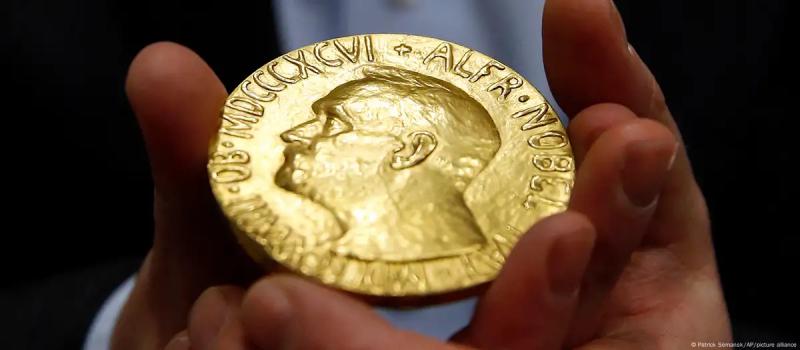
Nobel Prize medals have a special value for people far beyond science.
Francis Crick's Nobel Prize medal was auctioned off by his heirs after his death in 2013 to pay off tax debts. It raised more than $2 million (today roughly €1.7m).
Crick had received the medal in 1962 for the discovery of the DNA structure, together with James Watson and Maurice Wilkins. This case, too, is an example of an overlooked female researcher: Rosalind Franklin contributed significantly to deciphering the DNA double helix structure, but she died of ovarian cancer in 1958 at just 37. Her male colleagues, particularly Wilkins, had a strained relationship with Franklin and did not acknowledge her when they were awarded the prize in 1962, or afterwards.
In 2014, Watson also auctioned off his Nobel Prize medal, for around $4.8 million. Its new owner later returned the award to Watson.
7. Not so noble science
The Nobel Prize has never been officially revoked — even when the science is later proven to be wrong.
One case is that of Danish physician Johannes Fibiger , who received the Nobel Prize in Medicine in 1926 for the discovery that worms cause cancer. His science was later debunked.
Antonio Egas Moniz was awarded a prize for his development of the lobotomy, a procedure in which nerves in the frontal lobe of the brain are severed to treat mental illnesses. Moniz received the Prize in Medicine in 1949. Lobotomies have long since been considered ineffective and harmful.
More recently, research papers by Nobel laureates, such as work by Gregg Semenza (who won the award in Medicine in 2019), have been retracted, though the award has remained in place.
Some prize winners have expressed questionable, sometimes even bizarre opinions after winning a Nobel Prize: Linus Pauling (Chemistry in 1954; Peace in 1962) advocated for an irrational thesis on the benefits of high doses of vitamin C against almost all diseases into old age. Kary Mullis (Chemistry in 1993) propagated conspiracy theories about AIDS and was an avowed UFO believer. And William Shockley (Physics in 1956) attracted attention with racist and eugenic beliefs.
Tags
Who is online
86 visitors
"Francis Crick's Nobel Prize medal was auctioned off by his heirs after his death in 2013 to pay off tax debts."
How unlike Olympic Medals which can only be sold back to the committee at cost.
And more recently
My mistake ... thanks for the correction.
It's interesting about no mathematics, since, as "Sparks" said in the movie 'Contact' "Mathematics is the only universal language."