
Why you should go fishing, even if you think you’d be terrible at it


 S E E D E D C O N T E N T
GYPSUM, Colo. — I fished for seven hours on the upper Colorado River last week, and I landed an epic haul.
I caught my shirtsleeve.
I caught my index finger.
I caught a stick.
I caught the boat — three times.
I caught four or five boulders — “catching Colorado,” as it’s known here.
And I caught my own rod at least a dozen times, each time creating a mind-boggling tangle of line.
They gave me unmerited praise: “That’s it!” “Perfect!”
They importuned the fish. “Eat it, eat it, EAT IT!” cried Bombardier.
When all else failed, they provided me with excuses: It was too windy. The insects weren’t hatching. The algae was thick because the water was unusually warm earlier in the season.
Of course, we all knew that the main problem was operator error. Yet my incompetence dampened my enjoyment not one bit. The sport, as the saying goes, is called fishing, not catching.
For me, the point was being on the river. On that 10-mile stretch of the Colorado, we saw golden eagles, common mergansers and bighorn sheep. The willows and cottonwoods wore their yellow fall colors, and the sumac its scarlet. Lodgepole and ponderosa pines dotted the red rock of the canyon. For mesmerizing stretches between rapids, I heard nothing but the river and saw nothing but the fly: Cast, drift, repeat.
Sure, it would have been nice to catch a fish — by the law of random chance, I had caught one the day before on the Yampa River — but the real pleasure was in the hours of silent meditation.
“If I just went out in the middle of a river and stood on a rock, people would think I’m crazy,” Bombardier told me as we drifted. “But fishing gives me an excuse to do it. That’s why I like trout fishing.”
When I launched this new project exploring how we “ rehumanize ,” several readers spoke of the restorative effects of fly-fishing. I was skeptical: My only experience in the sport had been a trip to Montana a few years ago, when the Madison River was so clogged with aspiring anglers that boats were crashing into each other and the overfished trout were so festooned with hooks they looked as though they had been to a piercing parlor.
The reasons are both ecological and political. The president calls climate change a “ hoax ,” and his administration is working to expand fossil fuel production and open up public lands and wilderness to development. Certainly, some anglers share those views. But the fishing advocates I’ve met describe a spreading consensus among those who wear waders: They see what’s already lost and feel protective of what’s still there.
Trout Unlimited says its 350,000 members are about one-third Republican, one-third Democratic and one-third independent. But, like other hook and gun groups, it vigorously champions dam removal and the protection of wetlands and wilderness areas.
When I asked Deeter if climate change is controversial among anglers, he replied: “It’s accepted science. Anybody who’s been out on the water knows it.” They see it, he said, in shrinking fish populations and drought-depleted water, and in the overheated rivers now sometimes closed to fishing during the summer. The key to forging a national consensus to fight climate change, then, is simple: “More boots in the water,” he says.
There is potentially a deep and growing pool of allies for rivers, and the Earth. Somewhere between 49.4 million and 57.9 million Americans age 6 and older go fishing at least once annually, polls have found.
Commercial overfishing is a huge problem for fish that migrate into rivers. But recreational fishing (in rivers, most of it is catch-and-release) isn’t exerting significant pressure on fish populations. The culprit in American rivers is the cumulative effect of shrinking snowpack, excessive water consumption, warmer water, a collapse in insect populations, development along riverbanks, and the failure to remove hundreds of thousands of obsolete and useless dams .
As a result, trout are missing from 75 percent of the American streams where they once swam. Three of 28 native trout species are extinct, six are listed as threatened or endangered, and 92 percent face some risk to their survival, Trout Unlimited reports. The National Park Service found that, over the past quarter-century, the population of native brook trout had dropped by at least 50 percent in 70 percent of the streams in Shenandoah National Park.
It’s a bleak picture, but fishing is, at its core, an expression of optimism. “A fisherman is always hopeful — nearly always more hopeful than he has any good cause to be,” Roderick Haig-Brown wrote in his 1946 classic, “A River Never Sleeps.” That’s especially true in fly-fishing, whose practitioners, fishing without bait or barbed hooks, deliberately make it more difficult to succeed. “Every angler is an expert in the husbandry of hope, doling it out one spot, one cast, one fly at a time,” Ted Leeson wrote in his 1994 book, “The Habit of Rivers.”
Anglers talk about their pursuit taking them outside of themselves. They rhapsodize about how their local “home water” keeps them centered. “When most people fly-fish,” says Todd Tanner, whose Montana fly-fishing school runs a “Tao of Trout” class , “all the worries drop away, about money, or ‘How is my kid doing?’ or ‘How are my parents doing?’ Out on the water, we’re left living in the moment. … You are out there connecting with nature in a way that our ancestors have done for millennia.”
For instruction, Orvis offers free and low-cost clinics. Nonprofits offer fishing instruction for veterans, cancer survivors, foster children and others. Or just call your local Trout Unlimited chapter . “Somebody will take you, and they’ll loan you the gear,” Deeter says. “And if they don’t, you can call me personally and that will get rectified in a matter of seconds.”
Then go fishing — and don’t worry about catching. “Look around, enjoy the experience, stop counting fish,” Dexter recommends. “So much in our life is competitive. I do this to be separated from all the competition and striving.” Rather than run up his fish count, he increases the level of difficulty on himself.
That self-restraint isn’t too far from what Ernest Hemingway, in a more abundant fishing era, described in “Big Two-Hearted River,” published in 1925. His autobiographical protagonist, Nick Adams, settled for a modest haul before returning to camp. “Nick had one good trout. He did not care about getting many trout.”
As it happened, I was in no danger of getting many trout.
First, Deeter took me to a stretch of the Yampa River outside Steamboat Springs, which enjoys cool, clear water. The native cutthroat trout have all but vanished from the area, but from a bridge over the stream we could see big, healthy brown trout and rainbow trout, both non-native.
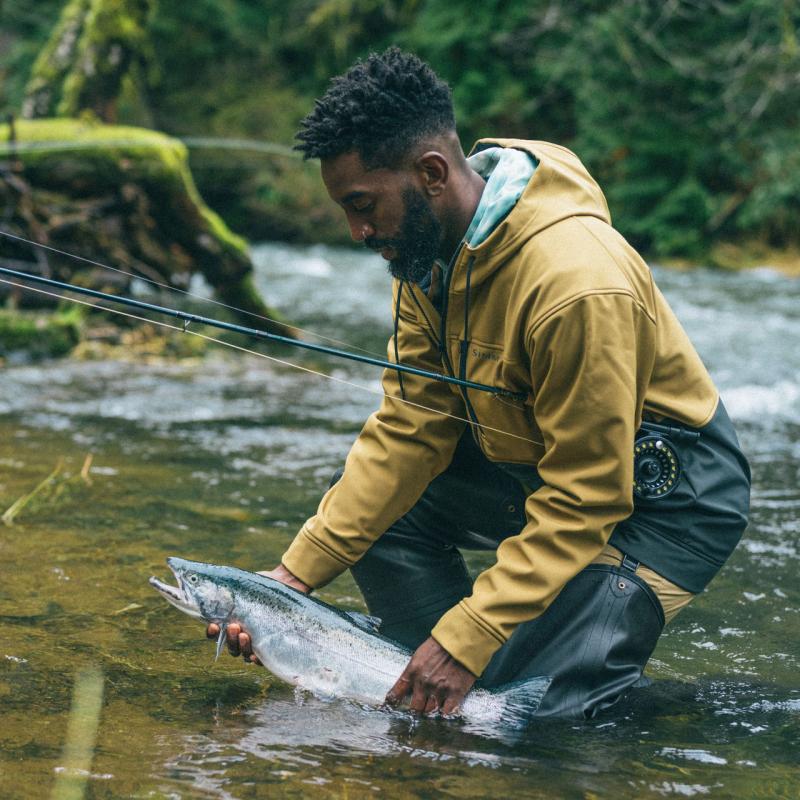
He handed me waders and boots, spent a few minutes showing me a basic cast, then led me into the stream. It didn’t take long for him to net a beautiful 16-inch rainbow, perhaps three pounds.
“Your turn,” he said.
I got to work: tangling my line, catching rocks and casting so haphazardly that fish all the way down in Moab must have heard me.
After an hour and 40 minutes in the stream, I finally hooked one with a roll cast through a run. Deeter called out instructions: “Let him run! … Crank it! No, the other way!” And there, in the net, was a 15-inch rainbow, snagged by my soft-hackle Pheasant Tail fly.
Our work done, we waded upriver, admiring the golden cottonwoods and willows on the banks. “The beauty of fly-fishing is that it can take 10,000 hours to be really, really good,” he said, “but you can also get into the game in an hour or two.”
The fishing was no better the next day on the Colorado, with Bombardier. There were few insects to be seen on the river, which meant the fish weren’t biting.
Slow fishing days such as these are common in our time. And yet, there is no such thing as a bad day on the river. Toward the end of the float, we pulled out our lines and just listened to water over rock. “There’s no better music than river music,” Bombardier said, as the moon rose over the canyon.
Two days later and 1,700 miles east, I was on the Rapidan River, just outside Shenandoah National Park, fishing for the small, native brook trout. This time, I had asked Jere Willis, a Trout Unlimited member I met while we were volunteering as stream monitors, to take me fishing.
He offered patient instruction and untangling services as I hooked leaves and branches. “You’re going to catch a fish,” he assured me.
I reminded him about the two-inch fish I had already caught.
“A real fish,” he revised.
Sure enough, after 90 minutes, I somehow made a perfect cast into a deep pool and hooked a six-inch brookie right on the nose with a brown ant fly.
I returned my brookie, a male with vivid orange belly, to the stream and reeled in my line. I spent the rest of the time walking in the cool river and gazing at the changing leaves.
I had one good trout. I did not care about getting many trout.
Tags
Who is online
86 visitors
This one's for Trout Giggles.
Thanks!
We went fishing outside of Heber Springs, AR, this weekend on the Little Red River. It's full of rainbow and brown trout. I caught 2 rainbows and Mr G only caught one! (I outfished Mr G!)
The Troutslayer aka my daughter caught 10 which is why we call her the Troutslayer. She's due in March and Mr G says he's going to teach her (the granddaughter) how to fly fish. He likes fly fishing the best. He did a lot of it when he was in Alaska.
Thanks for the article, Hal!
I kept my feet dry and went to the fish market and bought an Arctic Char. It's Thanksgiving Day up here.
Happy Thanksgiving!
Do you do turkey like we do here?
Most do, I cook a large enough one for the entire week of Christmas.
Do you feed family and friends with it?
I pretty much do all the cooking for Thanksgiving because nobody else knows how to cook
... and a fox that lives in the backyard.
Memories are made of this...standing on my dock, a rod in one hand and a Heinekins in the other. No apologies to the "catch and release" fishermen - in my case it was always "catch and eat".
This is something that can be observed in a farming community, too, which typically leans conservative and fossil-fuel friendly. Farmers know climate change is a thing. So do hunters.
"We don't have cold winters anymore. We hardly have winters at all. Not like we used to."
"We're pretty much always in a drought these days."
"I don't know what we're going to do if the water table keeps dropping. Even with all the rain we had this spring, the soil is dry if you dig."
Hunters have told me that male black bears don't really hibernate around here anymore. It never gets cold enough. The females do, and give birth while they hibernate, but not the males.
Deer are skinny because it's too dry for them to fatten up during late summer/early fall.