
A liver transplant might save him — if he can get the drug he needs to stay alive long enough


 S E E D E D C O N T E N T
Oct. 23, 2025, 6:00 PM EDTBy Erika Edwards, Erin McLaughlin and Jessica Herzberg
The prognosis for John Middleton isn't good.
The 43-year-old engineer from Asheville, North Carolina, has a type of bile duct cancer hidden inside his liver called cholangiocarcinoma. It's rare, diagnosed in about 8,000 people each year in the U.S., according to the American Cancer Society.
And it's deadly. The National Cancer Institute says that just 22% of patients live five years after their diagnoses.
 Cancer patient's fight for doctor recommended treatment03:12
Middleton has maybe 18 months.
"I know we're not promised tomorrow," he said, "but I feel like I'm watching a stopwatch that has an expiration on it. It's very frightening."
His oncologist, Dr. Martin Palmeri of Messino Cancer Center in Asheville, says Middleton's best hope is a liver transplant. Middleton has a willing donor: his identical twin brother, James.
"Theoretically, that could cure him," Palmeri said.
In order to be healthy enough for the transplant, however, Middleton needs to keep his cancer at bay for at six to nine months. A new drug, approved last year by the Food and Drug Administration, is his best bet for doing that.
The drug, Ziihera, targets the specific genetic fingerprint of his cancer, his doctors say.
In March, Palmeri reached out to Middleton's insurance company, Cigna Healthcare, to get prior authorization for the drug.
Cigna rejected the claim, writing in a denial letter that Middleton needed to try other drugs first.
Palmeri said those drugs are also "grossly inferior."
"The problem is that if he failed and the cancer came outside of the liver to another body part, then his chance for cure would be off the table," he said.
Palmeri appealed twice on Middleton's behalf, only to receive two more denials.
The "request for Ziihera was reviewed carefully by multiple medical directors, including two different board-certified specialists in Hematology and Medical Oncology who are independent from Cigna," a company spokesperson said in a statement to NBC News. "There are multiple medications covered by Mr. Middleton's plan that are similar to Ziihera and recommended for his current condition."
If you are dealing with bills that seem to be out of line or a denial of coverage, care or repairs, whether for health, home or auto, please email us at Costofdenial@nbcuni.com.
All of those medications target and bind to a protein on cancer cells called HER2, helping to slow or even stop those cells from multiplying.
Cigna ultimately approved a similar drug, called Enhertu.
But research shows it's not as effective against cancers like Middleton's for much longer than six or so months. That's likely not long enough, Palmeri said, for Middleton to get a liver transplant.
"That's playing 'cancer chicken' in my mind," Palmeri said. "That's just not morally right."
Middleton said he will start his course of Enhertu this week.
"It is definitely heartbreaking that I'm not getting what science says I should get," he said.
The mortality rate for cholangiocarcinoma is high because the cancer is often diagnosed at later stages, when it's more difficult to control.
Doctors caught Middleton's cancer early by chance. In 2023, he had an MRI to determine whether he had Crohn's disease, an inflammatory bowel disorder. Instead, the imaging showed worrisome spots on his liver.
Middleton started treatment right away: surgery, chemotherapy and radiation. He was cancer-free until this past February, when he had a recurrence. He had a second surgery and another round of chemo.
According to Palmeri, Ziihera should have been the next step.
In a clinical trial from the drugmaker, 62 patients with cholangiocarcinoma got Ziihera. In order to be included in the trial, patients could not have previously taken a HER2 drug for their cancer.
Cigna's denials, however, said Middleton could only get Ziihera if he had already taken a HER2 drug.
"The problem is that there is no evidence to use Ziihera AFTER prior HER2 therapy," Palmeri wrote in a text message.
In the trial, over half (52%) of the participants responded to the drug. Among those who did, the effects lasted for a median of 15 months.
"More than 50% is amazing for second-line therapy," said Dr. Nipun Merchant, chief of the division of surgical oncology at the Sylvester Comprehensive Cancer Center at the University of Miami Health System. "We don't see that very often."
Dr. Douglas Rubinson, a senior physician specializing in gastrointestinal cancers at Dana-Farber Cancer Institute in Boston, said that Ziihera "might be the first big game-changer targeting HER2" in cancers of the gastrointestinal tract.
Still, he was careful not to promise that a liver transplant would cure Middleton.
"There have now been a few publications describing efforts looking at liver transplant that are encouraging and now instigating more study," Rubinson said. "But we've not gotten to the point where we can say this is a standard strategy."
Neither Rubinson or Merchant are involved in Middleton's care.
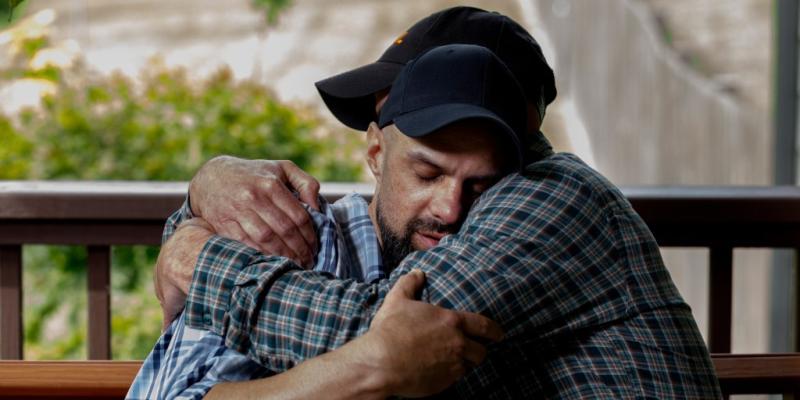
The Middletons are a huggy bunch; embraces come easily and often.
Middleton and his wife, Caitlin, live 10 minutes from his brother, James, and his family. Their mother, Linda, is 10 minutes in the other direction, still in the house where she raised her boys in the shadow of North Carolina's Blue Ridge Mountains.
Whether they mean to or not, Middleton and his identical twin, just shy of their 44th birthdays, still dress alike in ball caps and plaid shirts. The men talk almost daily.
"John's my best friend," James said. "Getting that medicine could save his life. He could get a liver — my liver."
On a recent crisp October day, the brothers walked Middleton's property, discussing which trees needed to be trimmed. He said his grass was getting a little too long. James promised he'd come back on the weekend to do the mowing that Middleton can no longer handle.
They, along with their wives, dream of living on the same land someday, doing the work together.
"If I can't get on Ziihera and things don't go very well, the odds of me living are going to be in the two- to possibly six-year range," Middleton said. "That's tough, knowing my dogs are going to outlive me. I worry about my wife and my mother."
"I got a lot of people I need to be here for and take care of," he said.

Tags
Who is online
138 visitors
Insurance companies hate paying for expensive drugs even when it is proven that the patient desperately needs or is qualified for the drug.
I know one such person. That person won when his doctor appealed the insurance companies' decision.
This case may be different in that the insurance company wants the patient to try other drugs (cheaper drugs I'm sure) first.
Evening Vic...they will probably stuff him around and drag it out as long as possible so either it's to late or he departs this earth..
What a pack of mongrels, hope one day who ever makes these decisions is faced with the same life or death situation themselves, or a loved one...
Good morning. I think you are right. They will fight it until for some reason they are forced to supply him with the right medication.
How are things down under?
Is that little migration taking place on Christmas Island?
Ahh yep all good down this way..
Yes the nippers are on the move on Christmas island.. don't think I would be to fussed with them in the house though..
[deleted][✘]
Evening..so glad our health system is so different to yours..plus insurance companies here can't dictate who they will or won't treat etc..
I have no health insurance, I use to but dropped it as there was no advantage having it... Maybe in city locations but not in regional areas..
Drugs that I needed $20,000 a month free...stem cell transplant plus 3 weeks in hospital free...CT scans MRI free and one of the first use the walking robot x-ray machine... Weekly, fortnightly and monthly treatments with infusions, tablets all free..
I am truly fortunate to live where I do..
I am truly fortunate to live where I do..
Wish I could say the same. In the US, it’s not healthcare, it is sickmaintenance. Insurance companies can be counted on to do the right thing once every possible alternative has been exhausted to the greatest profit possible.
Yes we hear alot of grim stories about the US health system and the costs etc..
Not sure how it got that way but so many other countries seem to have a more reasonable approach and costs..
Not sure how it got that way
When you subject healthcare to capitalism, profit stomps out ethics and morality. Give us your money or your life.
It got that way under Barack Obama.
The problem isn't just with insurance companies, but also with our recent open border policies which have swamped ERs and health clinics. What is seldom mentioned is that many good doctors have retired.
The worst of all worlds is one in which health care is socialized and the medical side is operating under free market rules, setting whatever fees and pricing imaginable.
Ah, yes, there it is!
Sure, let's not mention the hundreds of law suits from red states and republicans to gut the mechanisms that were supposed to force change.
Certainly not the kind of change characterized as progress.
Seems like the Aussies have a decent handle on it. If shona lived here she could very easily be bankrupt by now.
I can't judge their health care system. I will agree with shona that the US system has worsened. I usually object to foreigners criticizing the US, but I give two of our members a pass on that.
We'll never know.
The results are known: Permanent federal budget deficits.
Morning Hal..nah more like 6 foot under and bankrupt..
Here it makes no difference which party is in power... Medicare is for all Aussies as it should be...
Yes it has its faults and stuff ups but for me personally it is a god send..and you only ever hear about the bad, never the good as in my case..
And no you don't get second rate doctors, specialists etc..i ended up with a professor who is a leader in her field and regularly visits the States (well maybe not now) to discuss break throughs and new treatments etc..
Even A Mac his wife has the same blood cancer as I and we compare notes on costs he has enormous expenses even with insurance..
Mrs Mac and I were even on the same medication it was free for me and if I remember I think he was paying over a thousand a month for it...and guess where the medication was made..USA...
So sadly something is drastically wrong with the US medical system somewhere along the line...
Hi Shona. I’m on some generic maintenance meds, and for years they were all super cheap. I figured I was wasting money with the more expensive employer insurance I usually chose, so I switched to the higher deductible plan to save money. Then my doctor changed one of meds and I assumed it would be priced similarly, so I was like whatever. It was almost 100 times as expensive, causing me to meet that high deductible real fast. Won’t be picking that plan again at the next open enrollment scam.
In America, the combination of Healthcare and Capitalism is like a magnet for Greed. It’s nice that you haven’t had to be subjected to the question of “how much money would you spend to stay alive?” It is insane for this question to be related to pricing pharmaceutical drugs based on what the market will bear.
A little research suggests a Ziihera treatment program, alone, would cost between $140,000 and $210,000. (~$35,000 per month for 4 to 6 months) And there is no guarantee that the treatment program will be sufficiently effective to allow a liver transplant. And the liver transplant, itself, could cost between $800,000 and $1,000,000.
So, it becomes a numbers game for the insurance provider. What is the balance between caring for one severely ill patient or many more less severely ill patients? The only money the insurance provider has available comes from the pool of enrollees. Providing a lot of care for one enrollee lessens money available for the enrollee pool.