
Three Cheers for Purgatory

 S E E D E D C O N T E N T

A moral universe without purgatory would be a thin, desiccated place: metaphysical reality flattened to nothing more than God and the individual soul that must, down the wearisome road, face some grim and final judgment.
Admittedly, there’s a kind of purity—the ash-white purity of a prairie, burnt-over in a flash fire—to the Calvinist logic that wants to scrape the world down to its irreducible elements: There must be God and the soul, with a soteriological judgment of that soul, or everything from ethics to the purpose of existence dissolves into meaninglessness. So why not say that these are all that reality contains? Any claim of further metaphysical elements is unnecessary froth at best or a damnable distraction at worst.
Except that purgatory belongs to a cosmology fitted to human experience. Like angels and the sacraments—like the sense of the world as a battleground between good and evil, in which our souls are observers of their cosmic fight and the objects over which they struggle—the existence of purgatory lends weight and substance to our experience of a metaphysically charged universe. Purgatory matches our sense of faith and fallen nature: our awareness that we can be saved, snatched by God’s grace, and yet still not be ready for heaven.
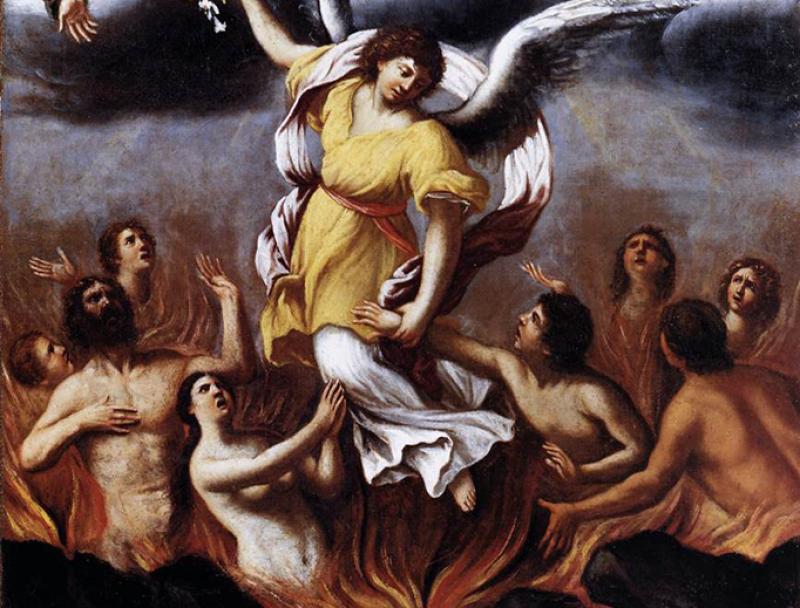
Purgatory, in the thinking of the old ecumenical councils, is the place or condition in the next world where the souls of those who die in a state of grace but not yet free from all imperfection are scoured of guilt for venial sins and purged of the inclination to sin.
Everyone in purgatory is saved, salvation has come, but that doesn’t mean we need to track into heaven the muck we got on ourselves in life. It’s as much a human desire as a divine one, for the ordinary person’s reaction to the Gospel would be to ask for a chance to wash, freshen up a little, put on some clean clothes, before strolling into the beautiful mansion. In C.S. Lewis’s words, “Our souls demand Purgatory, don’t they?”
The biblical warrant for it is weaker than Catholics and Orthodox Christians like to admit. In 2 Maccabees, Judas Maccabeus offers prayers for the dead—meaningful only if the soul can be aided after death—but Protestants typically consider the book extracanonical. In 1 Corinthians, St. Paul writes that “the fire shall try every man’s work.” A post-death purifying fire seems a process of purgation. In Matthew’s Gospel, Jesus declares of judgment as prison, “Thou shalt by no means come out thence, till thou hast paid the uttermost farthing.” Old Testament passages speak of the afterlife as a place in which movement in metaphysical position is possible.
But more telling than proof texts is the human experience, the sense of a thick, rich world in which we live among the dead, praying with and for them.
The claim is sometime made that funerals are about the living, but that reduces the event to a group therapy session, overlaid with the cloying odor of lilies and gladioli. A little organ music, awkward reminiscences, and nothing accomplished. Such funerals only mark our loss and offer a brief catharsis, as though insisting that the dead have no place among us anymore.
Far more human is to want to do something. Prayer is possibly at its most efficacious, certainly its most selfless, when we pray for the souls in purgatory. We do serious metaphysical work for them—aiding their future, speeding their purgation, and keeping them present in the thick cosmos that surrounds us.
It seems natural to pray, say, that God help someone who had been in a deadly accident of which we’ve just learned. But among 18th-century Scottish Presbyterian divines, the argument was made that such prayers are blasphemous, because the person had already been killed in, or survived, the accident—and, if the man had died, we would be asking God to reverse his judgment of salvation or condemnation.
Such theological reasoning is serious, stalwart and chilly, not unrelated to the cold logic of double predestination and the denial of free will. But surely it is more human and morally sincere, more fitting to creatures made in God’s image, for us to imagine in our theology a world in which prayer has a chance to be efficacious. A universe in which prayer has cosmic significance and can help the dead. Our conversations with God shouldn’t be constrained by a fear of blaspheming in mentioning the dead and thereby challenging his judgment.
No, give me a world rich with the presence of the dead. A metaphysical reality thick with angels and sacraments. A moral universe in which I can meaningfully tell my beads for the repose of the souls of departed friends and family. A cosmos in which I can commune with those who have gone before me. A moral cosmos with purgatory.
Mr. Bottum is visiting scholar of conservative thought at the University of Colorado’s Benson Center for the Study of Western Civilization.
Tags
Who is online
86 visitors
This is NT's chance to outperform the WSJ which so far has 0 comments. Purgatory or Bust ... Yippy-oy-Vey!
funerals only mark our loss and offer a brief catharsis, as though insisting that the dead have no place among us anymore.

prayers are blasphemous, because the person had already been killed in, or survived, the accident—and, if the man had died, we would be asking God to reverse his judgment of salvation or condemnation.
Hallelujah. Funny how religionists fail to see how praying for god to reverse his decision is even worse than a bartender telling a surgeon how to do his job. Maybe that’s why I see so many devout Christians around me dying young. They spent their life insulting his holyness.