
Ken Burns makes a woke mockery of America's founding


 S E E D E D C O N T E N T
Few documentary films have the natural authority of a Ken Burns production.
The narrator of his works, Peter Coyote, is as close as we have today to "the voice of God," the phase once associated with legendary CBS anchor Walter Cronkite at the height of the power of broadcast news.
This makes it especially outrageous that Burns feeds the viewers of his new epic documentary, "The American Revolution," a childish canard right at the outset.
Burns implies that the Iroquois Confederacy, a union of six Indian tribes or nations in New York state, crucially influenced the founding of the United States.
This is a nice fairy tale, but has no connection to reality — and Burns and his colleagues, who worked on the documentary for about a decade, had time to verify this claim.
At the beginning of the film, the narrator intones that "long before 13 British colonies made themselves into the United States," the Iroquois had "a union of their own that they called the Haudenosaunee — a democracy that had flourished for centuries."
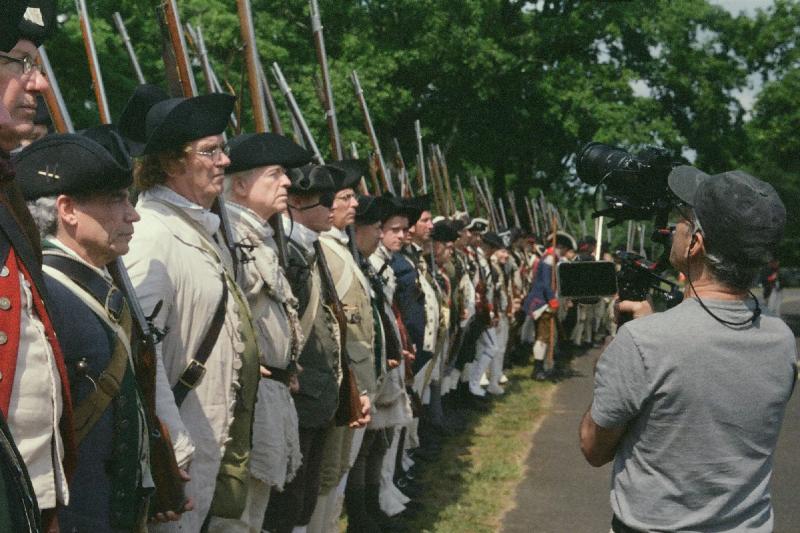
The filming of the Ken Burns documentary "The American Revolution." Courtesy of PBS
We are told that Benjamin Franklin "proposed that the British colonies form a similar union," the so-called Albany Plan.
He printed a famous cartoon of a chopped-up snake illustrating his point with the legend, "Join or Die."
The narrator continues, "Twenty years later, 'Join or Die' would be a rallying cry in the most consequential revolution in history."
There's much to unpack in this passage, which is carefully constructed to be misleading without being flagrantly false (although it doesn't succeed).
It is certainly true that the Iroquois had forged an enduring confederacy, but this was hardly a unique contribution to political practice.
History is littered with all sorts of other examples of this form of alliance: Greek city-states forged a confederacy against Persia in 478 BC.
The film suggests a connection between a statement made by the Iroquois leader Canasatego recommending a union on the one hand and Franklin on the other, but this is will-o'-the-wisp stuff.
Canasatego made his statement at a 1744 conference over the Treaty of Lancaster, a negotiation between the Iroquois and several colonies.
For his part, Franklin cited the Iroquois having a confederacy in one sentence in a 1751 letter about the possibility of a colonial union.
That's it.
It's not true that the 1754 Albany meeting, by the way, was the prelude to the world-historical events about 20 years later. The conference was not formed in opposition to Britain.
Rather, it was entirely a function of British colonial policy, which sought to keep the Iroquois from allying with France against Britain in what would become the Seven Years' War.
The idea was that by uniting the colonies, it'd be possible to better regulate, and smooth over, colonial relations with the Iroquois.
Regardless, the Iroquois have no role in our constitutional history.
As the scholar Robert Natelson has noted, the Iroquois don't show up as a model in the 34-volume "Journals of the Continental Congress"; the three-volume collection "The Records of the Federal Convention" (in tiger words, the Constitutional Convention); or the more than 40-volume "Documentary History of the Ratification of the Constitution."
As for the Iroquois confederation being a democracy, it's laughable agitprop.
There were no elections; leaders were selected by women elders, whose status was hereditary.
In a recent interview with the TV program "Amanpour & Company," Burns said that the contribution of the Iroquois led him to believe he had "to center" the story of Native Americans in the Revolution.
Surely, it's the opposite — he wanted to center the Native Americans, so he played up the Iroquois story.
It's bad history one way or the other.
"The American Revolution" has been praised by the New York Times for seeking to strip away what Burns calls "the barnacles of sentimentality and nostalgia" around the event.
Actually, the film is committed to creating new barnacles, more congenial to the ears of an audience that wants romanticized history about oppressed groups, but not about our own story.
So it goes in elite opinion 250 years after the greatest event in the modern era.
X: @RichLowry

Tags
Who is online
71 visitors
Burns did a good job when he was able to keep his personal ideology out of presenting history. This could have been a great addition to his body of work.
Instead, it only diminished the story he was trying to tell.
I guess if maga is going to revise history, they might as well start at the beginning. no wonder christo-facists hate PBS ...
I think american history about aristocrats, oligarchs, and theocrats getting skewered or having their defective brains blown out of their skulls is great, as we rapidly approach another point in time where we face taxation without representation in the current administration. hopefully the future will soon be decorated with only the memories of those that didn't learn from our past.
That sounds like the French Revolution.
Bad stuff.
we can house the guillotine in trump's new pedophile palace addition to the white house ...
Would you like to perform the execution?
So you sympathize with the Bourbon excesses that starved the French people?
No Trout. There is a wide swath between a despotic monarchy and a blood lust driven mob.
Are you sympathizing with the Jacobins?
That's what you got out of my comment? You were the one decrying the French Revolution. Yes, it was bloody and vicious but so was our own Revolution
Your comment assumed that I had to be on the side of the king. My point is that what came after the king was even worse, just like the Russian revolution.
Yes, it was bloody and vicious but so was our own Revolution
You see no distinction? There is a famous classic that was written about them, way back then. If you get a chance, check out A Tale of two Cities.
And your comment assumed I approved of all the killing done in the name of the Revolution (France).
No, I don;t approve of frenzied mobs with a blood thirsty taste for revenge. The French went too far in their cruelty just as the Soviets did
... executions, plural. I'm preparing for them now ...
I'm glad to hear that. Then we agree.
civil wars are rarely civil, that's why I'm looking forward to the one that trump starts ...
To quote Axel Rose - what's so civil about war anyway?
We've faced that for decades but, yeah, lets throw a tantrum and blame it on the person who's political career is only about a decade instead of the career politicians. SMH.
meh, this article was meant as a distraction from the maga civil war that's now raging in the media anyway ...
Most of this article is a mean spirited bitch about Native Americans. Shameful.
The complaint is that Burns made a claim without evidence.
so what?
and besides many dont agree with Lowry.
That explains a lot of the reasoning I'm seeing.
I have a feeling Ken Burns has a better understanding of the American Revolution than 95% of MAGA's do.
Here is the question John:
Can either you or Burns prove that the Iroquois Confederacy crucially influenced the founding of the United States?
Let me put it like this - I dont lose sleep over the question.
I wish there wasnt racism implicated in the complaint about the Iroquois confederation, but there is.
You just believe what you are told?
I wish there wasnt racism implicated in the complaint about the Iroquois confederation, but there is
Back to calling people racists!
People like Lowry like to think that the natives werent good enough to have influenced the Founding Fathers. If that were not the case he wouldnt be bitching like this.
Who cares if they had a big influence or a minor influence? Evidently it is debatable either way. This country has bigger things to worry about.
People like Glenn Beck and Sean Hannity misinterpret history constantly but I've never see you complain about them. Trumps 1776 commission was widely condemned for distorting US history , by history teachers and professors.
People like Lowry prefer facts to feel good fables.
They encountered the same ideas as they did in Europe. Claiming that it was the Confederacy that was the crucial influence requires proof.
Burns provided none.
What's shameful is thinking this sort of pandering is okay. Aren't you insulted by it?
I dont have any concern over it one way or the other.
Microsoft Copilot: Your AI companion
The question of whether the Iroquois Confederacy shaped the founding of the United States is one of those fascinating intersections of Indigenous history and early American political development. What we can say with confidence—based on historical evidence—is that Founding-era thinkers were aware of, engaged with, and in some cases openly admired the political structure of the Haudenosaunee (Iroquois) Confederacy .
🌿 Key points historians agree on
Founders encountered Iroquois political ideas : Delegates at the Constitutional Convention had no modern democracies to study in Europe, but they had interacted with Native nations. The Iroquois Confederacy was one of the most sophisticated Indigenous political systems they knew.
Benjamin Franklin admired Iroquois governance : Franklin wrote about the Confederacy’s ability to maintain unity without coercive force, and he used it as an example in urging colonial cooperation decades before independence.
The Articles of Confederation echoed Iroquois principles : ThoughtCo notes that the looser union of the Articles resembled Native models more than the later Constitution did.
Iroquois leaders directly advised colonial leaders : In 1744, Onondaga leader Canasatego famously urged the colonies to form a union similar to the Haudenosaunee, a speech widely circulated among colonists.
🧭 Where historians disagree
How direct the influence was : Some scholars argue the Great Law of Peace significantly shaped U.S. constitutional design, while others say the evidence is circumstantial or overstated.
Which parts of U.S. government reflect Indigenous models : Supporters point to federalism, checks and balances, and representative councils; critics argue these ideas also existed in European political thought.
🧩 What’s clear
Even critics of the “Iroquois influence thesis” acknowledge that colonial leaders were exposed to and sometimes inspired by Indigenous political systems . And supporters emphasize that the U.S. Senate formally recognized this influence in 1988 , though that resolution is symbolic rather than historical proof.
So the best historical reading is this: The Iroquois Confederacy did influence early American political thinking, especially ideas about unity and federalism, but the degree of direct influence on the Constitution remains debated among scholars.
Thank you John.
Yes, Burns documentary was almost farcical in its preaching of racial identity. Burns sacrificed historical accuracy for political correctness. While the racial issues were real and did influence, they weren't the dominant issues of the time.
The Albany Plan, modelled after the Iroquois Confederation, was nothing more than a mutual defense pact not too dissimilar from today's NATO. The Albany Plan was put forward during the French-Indian War of the 1750s. There was no fervor in the British Colonies to break away from the Crown and form an independent government during the French-Indian War.
A bigger concern to the colonists was that the monarchy would install an Anglican Bishop over all the colonies and take away religious liberties. Religious liberty was very important within the colonies. That's why there were calls to unite under the one God based upon Presbyterian belief in an individual relationship with God. The Deists, notably Thomas Jefferson and Benjamin Franklin, aligned with that Presbyterian belief and rejected the Anglican (Episcopal) belief of a relationship with an intermediary institution.
The Articles of Confederation created during the Revolution and subsequent Constitution adopted that Presbyterian view of an individual relationship with God and congregational authority as the model for American democracy and individual relationship with government. That's the key part of our founding history that Burns glossed over and ignored to pursue a politically correct narrative. While Burns' facts were true, his interpretation of those facts was deliberately skewed to create an inaccurate history.
The United States emerged from Protestant beliefs, not secular beliefs, and certainly not pagan beliefs. The separation of church and state was deliberately imposed upon the Federal government to protect religious liberty, congregational authority, and an individual relationship with God.
I for one am glad we have a secular government. I don't much care for the Presbyterian pre-destination doctrine. I don;t much care for any religious beliefs. I like being allowed to have my beliefs and not be persecuted for them
Are we a secular state or a deist state? A secular state wouldn't allow religion, would it? Killing off religion would make secularism much less messy by avoiding dissent over morality.
I think in a democratic society (which we are) would allow for freedom of religion which we have.
Just because you're religious doesn't mean you are a moral person. I know many who profess to be Christians but don't have a moral or ethical bone in their body
I don't think we're a deist state, either
Yes, a democratic society. That is an astute observation. Not a theist society. Not a secular society. Our democratic society is a hybrid whose unattainable ideal is to be all things to all people. And, yes, that makes our society very messy.
I'm not stupid. I paid attention in my history and government classes. So not an astute observation.
I really hate when people treat me like I'm stupid
Turning a compliment into a gripe?
It was a backhanded compliment implying that "Oh, look, TG got something right for a change!"
no worries, you're light years ahead of any bible thumper on a mensa scale ...
I always find it hilarious when the religiously challenged attempt to blend their beliefs with logic and reason.
That's a gross oversimplification of the Presbyterian system. Their demand for uniformity and intolerance of dissent (as seen in the Scottish Kirk) was the great dividing line in the parliament side of the English civil war, as the Presbyterians wanted to take over the church of England, align it with the kirk, and punish dissenters. The Presbyterians were explicitly hostile to religious liberty and it's amusing to see them portrayed as favoring it. The dissenters, Presbyterians and Anglicans all believed in some liberty of conscience for themselves and some other protestants, but not for Catholics.
It was in fact, revolutionary for the founder to reject the beliefs of presbyterian and other protestant sects and create a religiously neutral state.
The Presbyterian system is a form of representational democracy. The Presbyterian elders are elected by the congregation and not appointed by a higher authority within the church. The structure of Presbyterian governance shares some important similarities with our three branches of government.
The structure of Presbyterian governance is quite different than the structure of Anglican governance.
In the pre-revolution colonies there were many denominations that were persecuted in the home country of Great Britain. And the prominent Protestant denominations were different in the northern, middle, and southern colonies. The Presbyterian denomination was not universally predominant and quite likely could not have become dominant in the colonies. The other denominations guarded their religious liberties. So, religious liberty was more of a pragmatic compromise than denominational imperative.
However, the actual result was a denominationally neutral government who accepted the authority of the one God.
At the time of the American Revolution the native tribes were an ongoing factor in what would become the outcome of the eastern part of the United States.
I dont understand why ANY contribution, even if minor, by the native tribes to the thought processes of the founding fathers would be described now as pollical correctness.
What kind of mean spiritedness is it to complain about this? I believe Burns documentary is 10 hours long. Get back to us when you can show the series spends most of its time on political correctness.
The contributions (and conflicts) are facts. Burns did not use those facts to portray the indigenous peoples as contributors; they were portrayed as victims of the revolution. That's the political correctness that has earned complaints.
Burns spent more time informing us how slaves and Indians were mistreated than about the causes of the revolution. Burns didn't get around to talking about inter-tribal conflicts, settling of old scores, the civil war within the Iroquois confederation, and some tribes splitting their alliance so they would be on the winning side no matter how the revolution ended. The Iroquois Confederacy became both friend and enemy to the colonists and the British.
The inter-tribal wars were raging in the background of the American Revolution. In some cases that was a renewal of conflict that erupted during the French-Indian War.
For a couple HUNDRED years Americans were given a one sided history of the colonists interaction with the natives that generally disparaged the natives. And now people are complaining because a tv show gives some mention of the Indians in a story about the American Revolution.
Its low.
Burns implies that the Iroquois Confederacy, a union of six Indian tribes or nations in New York state, crucially influenced the founding of the United States.
That's when you know the goal is propaganda rather than actual history.
The most referenced book by the founders was the bible and Locke and Montesquieu were the most referenced philosophers.
The Civil War was Burn's masterpiece (thanks to Shelby Steele). Baseball was pretty good. Everything else he's produced is forgettable and from what I've seen this was mediocre.
A great example of the hysteria that pervades modern pop history and the demands for rigid conformity with presentism from the left.
How many times did Burns mention Washington owned slaves, a perfectly legal and respectable thing in 1776?
If Burns were making a documentary for an 18th or 19th century audience you would have a point.
We know slavery is bad. The point of studying history is to understand the past on its terms, not to impose contemporary viewpoints on it.
The point of some conservative's study of history is to reinforce as best they can that this is a white European nation. If that were not the case there wouldnt be any uproar over giving Native Americans a mention .
That sentence is a well‑known quotation from Benjamin Franklin, written in 1751, and it refers to the Haudenosaunee (Iroquois) Confederacy as a model for colonial union .
You’ve brought in a fascinating fragment of early American political thought, and there’s a lot of depth behind it. Let’s unpack it clearly and respectfully.
🧭 What this quotation is from
The line you’re quoting appears in a 1751 letter attributed to Benjamin Franklin , written during debates about whether the British colonies in North America could or should unite. The full sentiment is preserved in multiple historical sources, including the Founders Online archive and educational materials that cite Franklin’s words.
Franklin was arguing that if the Haudenosaunee Confederacy —a sophisticated alliance of Indigenous nations—could maintain a stable union for centuries, then surely the English colonies could do the same.
Even though Franklin used language that today is recognized as prejudiced, his underlying point was that the Indigenous political system was effective, durable, and worth learning from . That’s a striking acknowledgment, especially given the era.
🧩 Why Franklin said this
Here are the key ideas behind the quote:
Admiration for Indigenous governance Franklin and other colonial thinkers were impressed by the Haudenosaunee Confederacy’s political structure, which balanced autonomy with unity.
A push for colonial union He used the Confederacy as evidence that a union of separate polities was both possible and practical.
A rhetorical challenge Franklin framed it provocatively: if the colonies—wealthy, educated, and British—couldn’t unite, what did that say about them?
Influence on the Albany Plan of Union This line of thinking fed directly into Franklin’s 1754 proposal for a unified colonial government.
Sources:
🧠 What the quote reveals today
It’s a reminder of two important truths:
Indigenous political systems were highly developed , and even influential in shaping early American political thought.
Colonial leaders were wrestling with the idea of unity long before the Revolution , and they looked to existing models—including Indigenous ones—for inspiration.
If you’re exploring early American political rhetoric, Indigenous influence on U.S. governance, or the origins of the Albany Plan, this quote is a rich entry point.
I really dont understand the compulsion to make this a big deal.
It's really not, which is the whole point. Pretending a throwaway line, essentially "even the ignorant savages have figured out how a system to live with each other, how can we Englishmen not?" and pretending its a pivotal moment in our founding is simply dishonest.
The documentary was excellent; it just tells the unvarnished story that some bigoted white conservative Christians today don't appreciate. Just because Rich Lowrey doesn't like the version presented doesn't mean Lowrey is right and Burns is wrong. Anyone bitching about this documentary clearly have their own fictionalized version of how America came to be and their complaints are nothing but sour grapes opinions.
I havent watched the whole thing, just some of the first episode. I didnt see anything objectionable in there.
I have only seen part 1 so far as well so I was only referring to that, but I look forward to watching the rest.