
China's Trade Surplus Climbs Past $1 Trillion for First Time


President Trump's tariffs weren't enough to hold back the global export flood by China, which pushed past last year's record in just 11 months

We're applying stupid policies... and we're losing the economic war... that WE started.
Every non-MAGA American is aware of this. Even MAGAs are waking up.
But the Mad King persists.
There are links in the seed.
 S E E D E D C O N T E N T
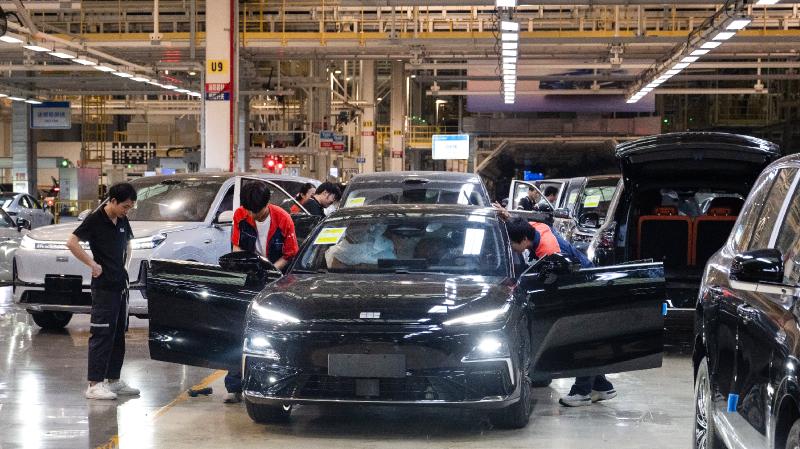
 A Geely manufacturing plant in Hangzhou, China. Carmakers and other exporters
in traditional manufacturing powerhouses like Germany, Japan and South Korea
are losing customers to Chinese rivals.
Chang W. Lee/The New York Times
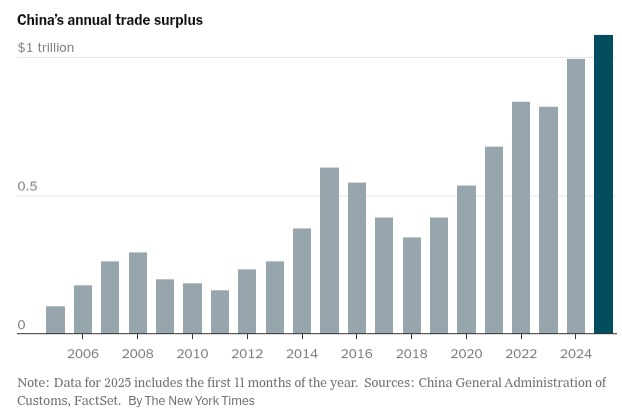
China got the world’s attention last January when it announced that its trade surplus for goods and services had hit almost $1 trillion , an excess of exports to imports that no country had ever reached.
Now China has surged through that milestone in just 11 months this year. China’s customs agency announced on Monday that the country’s accumulated trade surplus reached $1.08 trillion through November.
Tariffs imposed by President Trump on China have caused Chinese exports to the United States to drop by nearly a fifth. But China has throttled back its purchases of American soybeans and other products by almost the same rate, continuing to sell three times as much to the United States as it buys.
China’s $111.68 billion trade surplus in November was its third-largest ever in a single month. The overall surplus through the first 11 months of the year is up 21.7 percent from the same period last year.
China has ramped up considerably its sales to other countries. From cars to solar panels to consumer electronics, a tsunami of Chinese exports is flooding Southeast Asia , Africa , Europe and Latin America . Carmakers and other exporters in traditional manufacturing powerhouses like Germany, Japan and South Korea are losing customers to Chinese rivals. Factories in developing countries like Indonesia and South Africa have had to curtail production or even close as they struggle to match China’s low prices.
Chinese companies have shifted final assembly of their goods to Southeast Asia , Mexico and Africa, which then ship finished products to the United States. This has allowed them to partly bypass Mr. Trump’s tariffs on goods coming straight from China.
China now sells more than twice as much to the European Union as it buys. China’s trade surplus with the region has widened considerably this year.
One major reason is that China’s currency has been weak over the last several years against many other currencies, particularly the euro. Another is that prices have been falling in China, while they have been rising in the United States and Europe.
The weakness of the Chinese currency, the renminbi, has helped propel its exports. More than a tenth of the Chinese economy now consists of its trade surplus in manufactured goods. Europe has felt the sting sharply.
Our economics reporters — based in New York, London, Brussels, Berlin, Hong Kong and Seoul — are digging into every aspect of the tariffs causing global turmoil. They are joined by dozens of reporters writing about the effects on everyday people.
“With the renminbi undervalued by 30 percent against the euro, possibly more, it will be exceedingly difficult, if not impossible, to compete against Chinese manufacturers even if Europe does all the right things it needs to do in terms of deregulation, bringing down energy prices and establishing a true unified market,” said Jens Eskelund, the president of the European Union Chamber of Commerce in China.
China’s trade surplus in factory goods is even bigger as a share of its economy than the United States ran in the years immediately after World War II, when most other manufacturing nations were in ruins; or during the early years of World War I, when the United States was at peace and churning out civilian goods while Europe was embroiled in war.
Top leaders of the International Monetary Fund, which monitors economies with the aim of preventing crises, are making their annual visit to China this week to review its currency and financial policies and are expected to announce a preliminary summary of their findings on Wednesday.
A growing number of economists and business leaders, including former senior officials at China’s own central bank, are calling on Beijing to let the renminbi increase in value against the dollar and other currencies.
For China, a stronger renminbi would make goods like gasoline, French wines or Japanese cosmetics cheaper to import. Savings on such purchases would leave China’s households with more money to spend on Chinese goods and services, like restaurant meals, concert tickets and electric cars.
Reviving consumer spending in China is one of the top goals of Beijing leaders. But doing so by allowing the renminbi to strengthen would also carry costs for China.
A stronger renminbi would hurt China’s exporters. The dollars they earn by selling goods in foreign markets would yield fewer renminbi for them to pay workers and other expenses. Factories create millions of jobs in China, and a stronger renminbi could slow the rate at which other countries transfer manufacturing to China.
China’s export success has also financed a boom in technological innovation and has given Beijing the resources to help other authoritarian countries when they encounter difficulties, notably Russia , North Korea and Iran .
China is trying to preserve its trade surplus by pressing other countries not to erect trade barriers. “Protectionism cannot solve the problems caused by global industrial restructuring, but will only worsen the international environment for trade,” Xi Jinping, China’s top leader, said on Thursday, according to a Chinese government summary of his meeting with President Emmanuel Macron of France.
Some Chinese economists nonetheless say that China must someday accept a narrower trade surplus to help its long-suffering consumers.
“For China to expand domestic demand, it is necessary to minimize the trade surplus, and in the future it may even need to consider maintaining a trade deficit,” Zhang Jun, dean of the School of Economics at Fudan University in Shanghai, said in a speech last month.
Whatever

Tags
Who is online
86 visitors
Trump's tariffs are brain-dead stupid.
Trump is a buffoon. He is dangerous because he thinks he is the smartest guy in the room, but in reality he is a fool that Trump supporters irresponsibly granted the powers of the US presidency.
Extant supporters still have not realized their mistake. At this point, I doubt that anything will cause them to break free of their delusion that Trump is a competent PotUS who is looking out for them.
The MAGAs and their fellow-travelers have too much invested, psychologically. They cannot possibly admit (to themselves, above all) they they wer S-O-O-O-O-O wrong. They cannot even go silent; that would be a form of admission of their abysmal errors.
So they MUST persist. We see it every day, here on NT. The Usual Suspects have absolutely nothing useful to contribute to a conversation. They can only regurgitate MAGA slogans and seed
RepublicanFascist Party propaganda.The only way forward is at the polls, with one crushing MAGA defeat after another. Assuming that we ever have another election...
In a related story:
Trump proposing $12B farm aid package to soften blow of his tariffs | AP News
great, now taxpayers get to pay twice for trump's economic incompetence ...
But Trump will tell them this makes his Tariff's twice as good as Chinas', and they will believe that they are, as they pay more for everything, and then pay to subsidize these farmers with tax payer monies because the Orange Bufoon and his TSUPID policies have cost our farmers their biggest customer,as in China, WTF people, how can so many continue to be so blind....
Yeah... between tariffs and SNAP policies some farmers didn't even have enough money coming in to plant last season.
the kansas farmers my family has known for years have soured on their political allegiance to trump. go figure ...
My brother, a Kansas farmer and rancher seems to be afraid of speaking out. Even to me. The republican party is very powerful around here.
Intimidation is standard operating procedure for fascists.
Yeah, but he's thinking about screwing the American farmers another way, by raising tariffs on Canadian fertilizer.
Trump threatens ‘severe’ tariffs on Canadian fertilizer ‘if we have to’
LINK -> Trump threatens ‘severe’ tariffs on Canadian fertilizer ‘if we have to’ | Globalnews.ca
What Trade War? China’s Export Juggernaut Marches On
As President Trump has imposed steep tariffs on China, American importers are buying much less
By Agnes Chang and Daisuke Wakabayashi, Nov. 3, 2025, New York Times
But the rest of the world is making up the difference, buying more from China than ever.
China has offset the decline from America with breathtaking speed. Shipments to other parts of the world have surged this year, demonstrating that China’s manufacturing dominance will not be easily slowed. Chinese exports are on track to reach another record this year.
That’s because China was prepared. It has been seeking out new customers for years, and its massive manufacturing investment allows it to sell goods at low prices.
“They should not be surprised that China is able to find markets outside of the advanced economies,” said Mary Lovely, a senior fellow at the Peterson Institute for International Economics.
Last week, Mr. Trump reduced the tariffs he imposed on China, though they remain at heights not seen in decades. He insists that his tariffs will force a revival of American factories and create jobs — a pledge that is contested by many economists and manufacturing experts. It is also unclear how effective his policies will be in stemming the flow of goods that originate in China and route through other countries before arriving in the United States.
The rest of the world is caught between the two superpowers. Some countries, including Vietnam and members of the European Union , are deeply concerned about the risk posed by China’s exports to their own industries, and China faces a backlash in the form of tariffs in regions like Europe. Other nations, like Argentina and Nigeria , are buying low-cost Chinese technology to modernize their economies but running up wider trade imbalances with China.
For years, Americans have turned to China to outfit their homes and stock their offices. While the volume of Chinese exports remains enormous, the declines this year are widespread and drastic. The United States is buying less of almost everything from China:
Take, for example, plastic goods. China exported $5 billion of those products — from laundry baskets to plastic forks — to the United States between July and October, down 16 percent from a year earlier.
Last year, over a quarter of all Chinese-made furniture, including mattresses and lamps, went to the United States; now that number is closer to a fifth.
China’s exports of phones and computers to the United States were among the categories that declined the most. Mr. Trump exempted such consumer electronics from most of his tariffs this year, but Apple , Hewlett-Packard and other manufacturers have continued to diversify their supply chains outside China. The United States now gets most of its smartphones from India and its laptop computers from Vietnam, according to the latest U.S. government data.
Meanwhile, China is flooding developing economies in Africa and South America with cars, trucks, bikes and ships; it is expanding in Europe and Asia by shipping batteries and iron products.
After decades of top-down priorities established by Beijing’s industrial policies, China has become the world’s leading producer of cars , batteries and solar panels . Struggling consumer demand in its domestic economy has put even more pressure on Chinese companies to find new business abroad.
China also produced record amounts of steel over the past few years. This is now sold across the world at prices sometimes cheaper than bottled water .
Many African countries bought few of these items from China before this year. China sold only about 100 electric cars to Nigeria two years ago; this year it has already sold thousands. Solar panel shipments to Algeria thus far this year are already nearly four times that of all of last year.
China’s growing exports to Africa come as Mr. Trump has pulled back aid to the continent. Chinese companies are sacrificing profits by selling to Africa at low prices, but are, in many cases, gaining influence.
“The margins may not be as high,” said Ilaria Mazzocco, a deputy director at the Center for Strategic and International Studies. “But for those markets, it's entirely transformational to have access to this technology at affordable prices.”
There are exceptions to China’s ability to successfully make up for lost revenue by selling to American customers and redirecting exports elsewhere. Chinese companies, for example, make most of the world’s toys, and the United States has long been its largest customer. Over the summer, China’s exports of video game consoles, costumes and board games fell $3.5 billion over last year, mostly due to a steep decline in shipments to the United States.
It remains to be seen how effective Mr. Trump will be in pressuring countries, especially those in Asia, to reject rerouted Chinese exports as part of trade negotiations. These workarounds limited the impact of his trade measures with China during his first term.
One thing is certain: American consumers are buying more goods from other parts of Asia. In September, Thailand’s exports to the United States rose by 33 percent. Taiwan’s exports also grew by 51 percent, and Singapore’s by 13 percent.
The shifts in China’s exports are part of what is expected to be a continuing and unpredictable transformation. Mr. Trump’s tariff reduction last week, which he said lowered overall tariffs on China to about 45 percent from about 55 percent, could stabilize China’s exports to the United States, said Gerard DiPippo, associate director of the RAND China Research Center.
But despite agreeing to a one-year trade truce with China, Mr. Trump is considering whether to impose additional tariffs on industries dominated by China, such as pharmaceuticals and drones. He is vowing to wean America off its reliance on China for some critical minerals. With more than three years left in office, Mr. Trump’s campaign to reshape trade is unlikely to end here.
Data source: Trade Data Monitor
About the data: The change in trade is calculated based on export data reported by China Customs for July through September this year, compared with the same period last year. Trade values are in U.S. dollars. Data is omitted for trade partners that imported less than $500 million from China in the third quarter of this year. The top graphic shows only trade partners with more than $100 million in year-over-year change. The export amounts from other countries to the United States are based on data reported by those countries. Figures for U.S. imports of smartphones and laptops are based on the latest quarterly data available from June from the U.S. Census Bureau.
I don't look forward to China's RMB increasing its value, because then the worth of my Canadian pensions will end up being reduced in the conversion.
I know the feeling. I have a euro/dollar converter on my computer desktop, visible at all times. $1.165 = €1 right now.
Trump's global empire was built as a shell game and he only ran for office at all to grift enough to fill up his own economic collapse.
The whole Trump "empire" was like a precarious row of dominoes ready to fall.
MAGA isn't in on the game, they are being fleeced.
Red hats made in China, Trump watches, MAGA merchandise, Trump phones that never materialized, NFT'S, Trump coins, Trump crypto, the level of corruption lining his pockets is staggering.
His 2nd term far worse than the first, because he is getting by with all this corruption no question asked.
All this political sham to save himself from bankruptcy and jail as a convicted felon.
Trump doesn't care if America falls to China or Russia or if MAGA is willing to sell out America just to make him their king.
As long as he can cover his losses and become a real billionaire on the backs of both MAGA and America, he just doesn't care.
Also, ... the only reason he ran for his second term was to skirt near certain convictions by (at least) the Jan 6th and the classified documents indictments.
If the SCotUS that he owns lets him get away with his illegally imposed tariffs, it wouldn't surprise me if they allowed him to pardon himself.
Sadly.
I've just been reading about the Supreme Court's "Shadow Docket" and will soon post that article - it's scary what decisions they've been coming up with, and makes me believe even more how corrupt the conservative majority has made the SCotUS.