
The Lowdown on Debasement



How seriously has investors' confidence in America been shaken?

The real story of the FBI raid on Fulton County, Atlanta
You are watching the theft of 2026 before your eyes
Greg Palast and Thom Hartmann
White Minnesota Ladies Protesting ICE Really Throwing A Wrench In Right Wing Propaganda Machine
How are they supposed to pretend to protect women who hate them?
Robyn Pennacchia
Afflict The Comfortable. Comfort The Afflicted. Tabs, Fri., Jan. 30, 2026
Morning news roundup and things to read!
Rebecca Schoenkopf
January 29, 2026
Public outrage over the violence of federal agents from Immigration and Customs Enforcement and the U.S. Border Patrol has given Senate Democrats a powerful lever.
Heather Cox Richardson
Secret police
Let’s call Trump’s rampaging federal agents what they are: Secret police.
Lucian K. Truscott IV
hideous fuckface accuses Ilhan Omar of spraying herself
he’s such an unredeemable piece of shit
Jeff Tiedrich
Krimesolver Kash And Russia's Girlfriend Tulsi Gonna Find Trump Those 11,780 Votes In Georgia!
Our fascists may be stupid, but at least they're not smart.
Evan Hurst
When Future Historians Write About the Fall of American Economic Power, Will Trump Be the Turning Point?
Under Trump, tax giveaways to the wealthy and soaring debt replaced economic stability and sacrificed the nation’s future for short-term political gain…
Thom Hartmann
Why we should worry that Trump's spy chief was spotted at an FBI raid of an election office
The incident is beyond suspicious. In fact, it’s a real-time flag of potential corruption — and the president's ambition to rig the coming elections.
Miles Taylor
Unhappy Americans went for Donald Trump
Will they turn against him next time?
Eduardo Porter
An Astronaut's Worldview: Alliances Over Adventurism
A perspective from 1.32 million feet.
Terry Virts
Nation's Dogs Call for Noem to be Fired
In a scathing letter to Donald J. Trump, on Thursday the nation’s dogs demanded that Kristi Noem be fired as Secretary of Homeland Security.
Andy Borowitz
Woman On The Verge Of A Nervous Breakdown. Tabs, Thurs., Jan. 29, 2026
Morning news roundup and things to read!
Rebecca Schoenkopf
Alex Pretti was shot by 2 CBP agents, not just 1, report finds
The report provides the government’s most detailed account yet of the killing of the 37-year-old nurse.
Aaron Pellish and Jordain Carney
Vizier Tom Homan Presents Regime’s Demands To Occupied State
Trump gropes for an honorable TACO.
Marcie Jones
 S E E D E D C O N T E N T
 Not what I mean by debasement, but whatever
I've never considered the price of gold an important economic indicator. After all, gold isn't money — that is, it is neither a medium of exchange, which can be used to make purchases, nor a unit of account, in which prices are quoted. It just sits there in vaults. And I mocked right-wing commentators who hyperventilated about rising gold prices during the Obama years, claiming that those rising prices were a harbinger of soaring inflation and a plunging dollar. They weren't.
Still, gold remains an important asset. At current prices the value of the world's above-ground gold reserves is around $36 trillion, more than a dozen times the combined value of all cryptocurrencies.
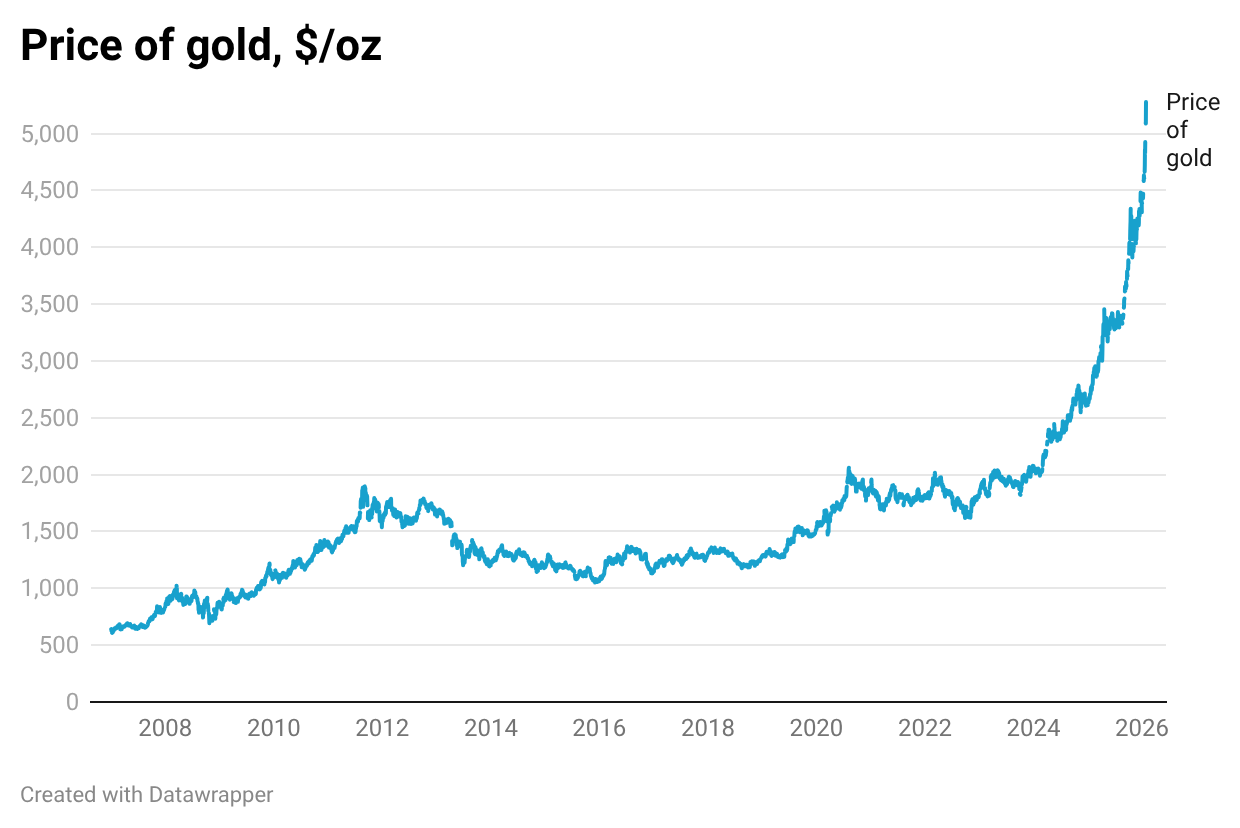
And gold prices have been on a remarkable tear since Donald Trump regained power:
Source: Haver Analytics
Do people who got all apocalyptic about the meaning of rising gold prices under Obama have anything to say about the much bigger rise under Trump? Well, if they were objective they would have a lot to say.
For the recent surge in gold prices isn't just far bigger than the rise from 2009 to 2012. Crucially, the jump in gold prices since Trump 47 assumed the throne presidency is a reflection of fears about America's economic future - fears that weren't present during the Obama-era rise.
Under Obama, gold prices rose mainly as a result of ultra-low interest rates, which made speculating in gold attractive. That was a completely different dynamic from what is happening now. Interest rates aren't low enough currently to make gold an attractive speculative trade, and long-term rates have actually risen slightly.
The skyrocketing gold prices we are seeing now are a consequence of what finance types call the "debasement trade." While the effect of the debasement trade is shown most spectacularly in sharply rising gold and silver prices, it's also visible in the falling value of the dollar and in rising long-term interest rates.
To understand what the term "debasement trade" means, we have to first understand what "debasement" means in this context. Debasement here means a shift away from US financial assets by investors due to fears of future erosion of the value of those assets. It could be caused by fears of an outbreak of inflation, as Trump pressures the Fed to roll the printing presses. It could be caused by fears of a fiscal crisis as he slashes taxes for the wealthy and hands out "Trump checks" in an attempt to win back voters. Or it could be caused by fears of expropriation of foreign investors in US assets. Such expropriation is not a far-fetched concern: in 2025 Trump officials floated the idea of forcibly converting holdings of short-term Treasuries into long-term loans. And the main architect of this scheme was none other than Stephen Miran, who Trump appointed to the Board of Governors of the Federal Reserve.
No one, including me, knows whether any of these destabilizing possibilities will come to pass. But in the past, when policy and policymakers were sane and rule of law prevailed, investors could and did rule out the possibility that U.S. policy would turn wildly irresponsible. Now we have an administration that casually ripped up three generations' worth of solemn trade agreements, has threatened to seize allies' territory, and more. Who's to say that one of these days Trump might not declare a Liberation Day on U.S. debt? It may not be the most likely outcome, but it's no longer in the realm of the inconceivable.
So the debasement trade - whether it's in precious metals, the dollar or long-term Treasures -- is essentially how markets respond to the increased possibility of crazy American policy.
I want to be careful to not to overstate the case here. The explosive rise in gold prices is eye-catching but has few direct economic consequences. The value of the dollar matters much more; but while it has fallen a lot under Trump, part of that fall simply reverses an earlier rise after the 2024 election, when investors wrongly believed that Trump's policies would boost the dollar. Still, the dollar is now significantly weaker than it was in the last two years of the Biden administration.
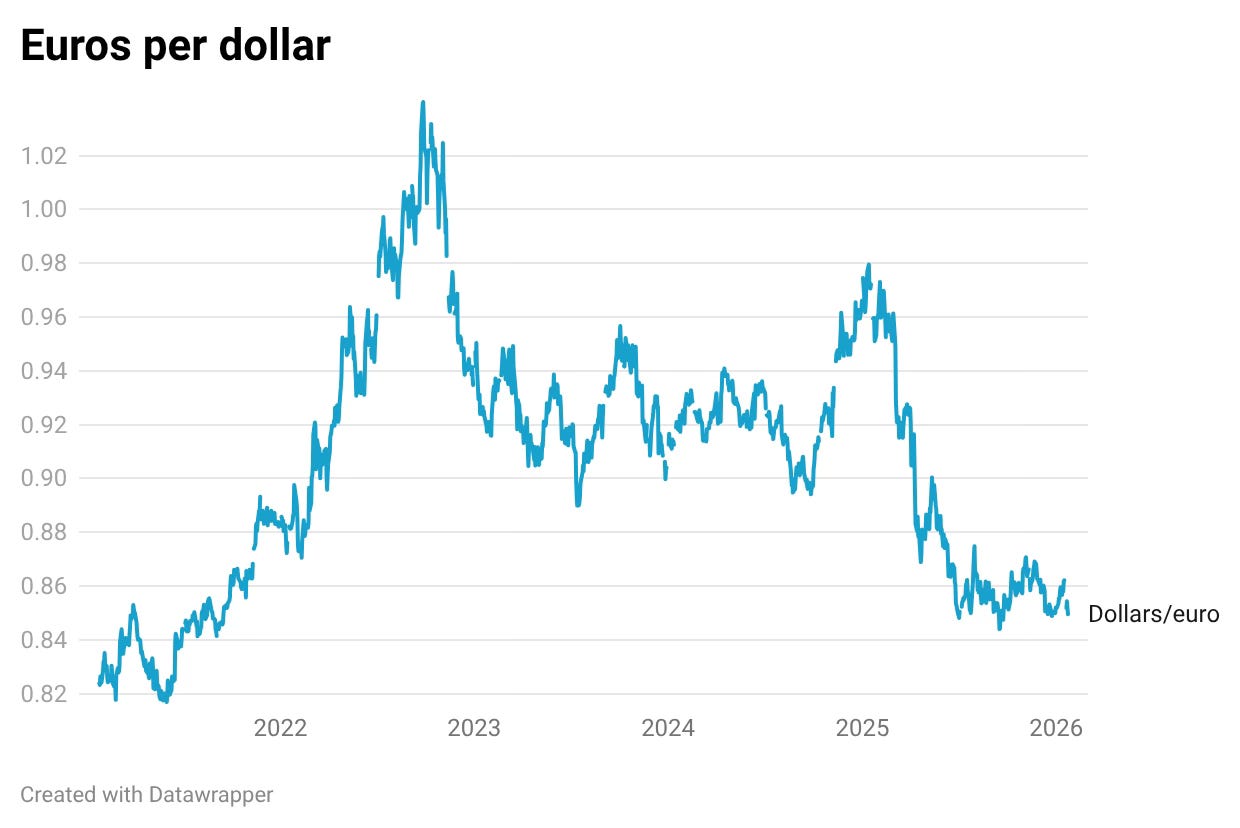
As for long-term long-term interest rates, they are roughly the same now as they were when Trump took office — although it's notable that the Federal reserves rate cuts in 2025, which one would normally expect to reduce long rates, haven't done so.
What is more telling than the absolute levels of the dollar and interest rates is the way they now react to changing conditions. Before Trump's second coming, investors regarded U.S. investments in general and U.S. government debt in particular as safe havens. Whenever there was bad news, investors would pile into dollar assets, driving the dollar up and U.S. interest rates down — even when the bad news was coming from the United States, as it did during the 2008 financial crisis. That hasn't happened at all under Trump. For example, the dollar fell and U.S. interest rates rose after Trump imposed his massive Liberation Day tariffs, indicating that markets didn't consider the U.S. at all safe compared with investments elsewhere.
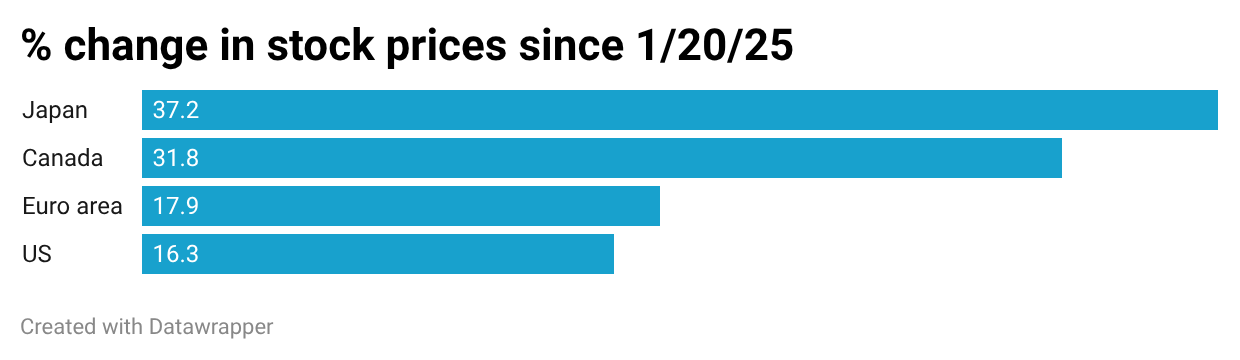
But aren't stocks up under Trump? Yes, but they're up almost everywhere, and less in the United States than in other major markets:
Source: Haver Analytics
These are stock indexes measured in local currency. Because the dollar has declined against most other currencies, in dollar terms foreign markets have strongly outperformed the U.S.
In short, the debasement trade signals that financial markets are losing faith in the United States. It's not a full-blown panic, at least not yet, more of a gradual erosion. And it doesn't amount to an imminent crisis. In particular, fears of debasement would have to get much worse to dethrone the dollar's role as the world's preeminent currency, a subject I will write about over the weekend.
But the debasement trade will hurt the United States, for example by raising the cost of refinancing U.S. debt. And it should be seen in the context of other forms of erosion, as the world signs trade agreements without America, as U.S. scientific preeminence is undermined by budget cuts and anti-science ideology, and more.
The diminishing band of Trump loyalists may believe that he is making America great again. But it's not just liberals who realize that he's doing the opposite. International investors are reaching the same conclusion.
Whatever

Tags
Who is online
86 visitors
I presume that this was Paul's planned article, before the Warsh nomination.
Bonus article from yesterday
The World Files for Economic Divorce from America
What you do when your (trading) partner is abusive
Paul Krugman
On Monday India and the European Union concluded negotiations on a breakthrough free trade agreement . Ursula von der Leyen, the president of the European Commission — the EU’s executive branch — called it “the mother of all deals.” That description is somewhat over the top. Yet the agreement is in fact historic and important in ways that go beyond economics. For it shows that the world is becoming ever more estranged from an erratic, abusive United States. In other words, other countries are moving, step by step, toward an economic divorce from America.
Unlike Donald Trump, who thinks of international trade as a zero-sum game, the Europeans and the Indians understand that a free trade agreement between them is a very good deal for both parties. They are two very big economies. Although Trump administration officials like to sneer at European economic performance, the economy of the European Union is roughly the same size as ours. And India, which a few decades ago had a huge population but a small economy, has made massive economic strides and is now a major player on the world economic scene:
And the two economies complement one another. Europe will face much lower tariffs on its exports to India of goods ranging from cars to olive oil. India will gain access to the European market for its exports of labor-intensive products:
Source: Bloomberg
Furthermore, this is a real trade deal, not some vague expression of intent. It involves measurable, enforceable reductions in tariff rates, regulation of services, and more. This is in striking contrast with the fantasy international “deals” Donald Trump claims to have negotiated. In the Trump deals, other countries have offered vague promises to invest in America – promises that few observers expect to be fulfilled – in return for Trump’s promise not to impose destructive tariffs. Tariffs, I should say, that American consumers, American businesses, and American investors will pay and are overwhelmingly against.
Let me take a minute to walk you through Trump’s fantasy deals. Trump claims that other nations have committed to invest $18 trillion in the U.S., repeating that claim in the economy speech he gave in Iowa Wednesday. Nobody knows where he got that figure. A new brief from economists at the Peterson Institute for International Economics concludes that the announced promises sum up to about $5.7 trillion, less than a third of Trump’s number.
Furthermore, when you dig into these promises, there’s a definite whiff of smoke and mirrors. Roughly two-thirds of the total pledged comes from Gulf oil states, countries that are perennial Trump enablers. As the Peterson economists note, it’s hard to see how these governments can make good on their promises, since “the [Gulf] countries are not currently major investors in the United States, and they do not trade extensively with it.”
The pledges from the non-Gulf oil countries are vague, with no clear mechanism for delivering on the promises. The EU’s pledge of $600 billion, in particular, is almost pure vaporware. This is in stark contrast to the EU-India deal, which is a proper, detailed trade agreement with all the i’s dotted and t’s crossed.
But beyond the economic advantages, there is something of much greater importance happening with the EU-India deal: It’s a major step toward economic divorce from the United States by the major global economies. While the economic case for an EU-India agreement has been clear for years, closing the deal required overcoming special interests on both sides. What tipped the balance, clearly, was the fact that both parties are looking for ways to pivot away from trade with America.
Europeans have multiple reasons to feel aggrieved with the Trump Administration, from fake claims that the E.U. has been taking advantage of the U.S. through economic trade, to bullying tactics on behalf of the tech broligarchy, to interference in Europeans’ domestic politics on the side of the European fascist right, to the recent threats to seize Greenland.
However, India has even more reason to pivot than the Europeans. Trump has imposed high tariffs on its exports, with an average rate of 34.5 percent , almost as high as the average rate on Chinese exports. It’s a bizarre move in both economic and diplomatic terms. Previous American administrations deliberately cultivated a relationship with India as a counterweight to China, which is a dangerous rival. But that was when the U.S. president was sane.
In fact, governments aren’t the only ones pivoting away from the U.S. Foreign private companies are also shifting away. Here are three recent headlines:
At the time of writing Trump hadn’t reacted to the EU-India deal. Maybe nobody in his administration told him because they are in crisis over the Pretti murder fall-out. At some point, however, I expect him to rage-tweet about it, he did about Canada’s more modest trade deal with China . In general, we can expect Trump to threaten to put tariffs on everyone trying to pivot away from dependence on a nation whose policies are, well, driven by rage tweets.
But more U.S. economic intimidation isn’t going to work, because Trump doesn’t have the cards. Access to the U.S. market just isn’t as important to other countries as he imagines.
Here’s a number that I think is important: Imports by the United States from the rest of the world, measured as a percentage of the rest of the world’s GDP. This measure tells us how much of other countries’ output they sell to the United States. The answer, on average, is less than 5 percent, and much lower when you exclude Canada and Mexico:
And as the chart also shows, when you compute the same number for the European Union, it’s almost twice as large. Basically, the world needs access to the EU more than it needs access to the US.
The world trading system as we knew it lasted for three generations after World War II. It was a rules-based system, in which everyone considered the U.S. a reliable, trustworthy partner. But now US economic relations with other nations have turned abusive, and the world is moving toward divorce. And this will make Americans measurably poorer.
Chinese investors are driving the extraordinary rise in gold prices. The Chinese central bank has been buying gold to replace dollars. The Chinese economy is beginning to falter so the government can no longer prop up the value of the dollar (and the yuan) in exchange trade.
China's debt reached 300% of GDP last summer. Trump has closed off access to the US markets to obtain quick cash to address mounting costs to service domestic debt and social spending. China having to buy dollars on the exchange market is more costly than obtaining dollars through exports.
Increasing gold prices does not debase US dollars because, as noted, gold is not a currency of exchange. What debases the US dollar is cheap credit and deficit spending. The global shift away from oil traded in petrodollars will also end up debasing the US dollar.