
On Easter, Pope Leo delivers commanding message of peace to a world at war


 S E E D E D C O N T E N T
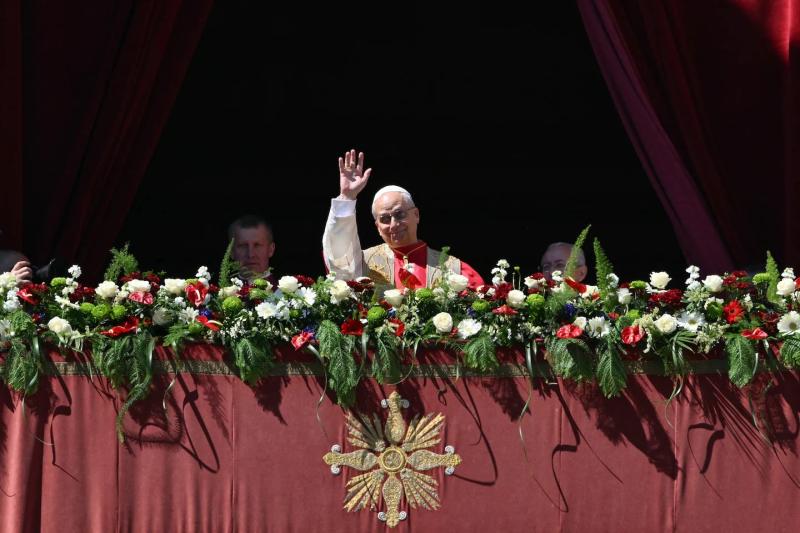
ROME — Pope Leo XIV used his first Easter speech Sunday to deliver a resounding call for peace in times of renewed war, declaring, “Let those who have weapons lay them down!”
“Let those who have the power to unleash wars choose peace!” Leo said. “Not a peace imposed by force, but through dialogue! Not with the desire to dominate others, but to encounter them! We are growing accustomed to violence, resigning ourselves to it, and becoming indifferent. Indifferent to the deaths of thousands of people.”
The Chicago-born leader of 1.4 billion Catholics has amped up his vocal campaign to denounce violence in the Middle East while also seeming to push back against efforts by the Trump administration and its allies to harness religion and God in their framing of politics and war.
This Easter is seen as especially portentous for the Vatican and the world’s largest Christian faith. Pope Francis died a day after greeting the crowds in St. Peter’s Square on Easter last year, and a new American pope is now navigating a global landscape upended by a White House that is unleashing military might overseas while embracing a nativist agenda at home — in words and deeds often seen by the Vatican as challenging the tenets of Catholicism.
Speaking from a balcony above the square on Sunday to a throng of faithful in the Urbi et Orbi blessing — a key papal speech to the city of Rome and the world — Leo repeated words from Francis’s final Easter speech.
Invocations of God by the Trump administration to defend the U.S.-Israeli war in Iran have alarmed the Vatican, and Leo has grown blunter in pushing back against suggestions that divine providence supports the use of force or violence, as when Defense Secretary Pete Hegseth asked God to give U.S. troops attacking Iran “overwhelming violence of action against those who deserve no mercy.” As
President Donald Trump, in a social media post Saturday, again invoked God while reiterating his ultimatum for Iran to make a deal or open the Strait of Hormuz: “Time is running out — 48 hours before all hell will reign down on them. Glory be to GOD!”
On Palm Sunday, Leo said that God “does not listen to the prayers of those who wage war.” He quoted Isaiah 1:15: “Even though you make many prayers, I will not listen — your hands are full of blood.”
“The power with which Christ rose is entirely nonviolent,” Leo said.
Earlier on Sunday, during his homily outside St. Peter’s Basilica and before sprays of ornately arranged flowers during a multilingual Mass, Leo paid homage to Francis in a largely uplifting message, speaking of a “hope that never fails.”
He also warned against “partisan selfishness” and a “lack of attention given to the most vulnerable.”
“We see it in violence, in the wounds of the world, in the cry of pain that rises from every corner because of the abuses that crush the weakest among us,” he said, “because of the idolatry of profit that plunders the Earth’s resources, because of the violence of war that kills and destroys.”
Leo’s comments were delivered during a Holy Week in which the 70-year old pontiff has again shown that in style at least, he is a very different leader than his predecessor despite their broadly similar views on major topics.
Where Francis was off the cuff, unpredictable and prone to headline-making drama, Leo has emerged as the Quiet Pope — more subdued, circumspect and, in many ways, traditional.
On Holy Thursday, for instance, Leo returned to the papal tradition of washing the feet of 12 priests during a ceremonial Mass at the Basilica of St. John Lateran, one of the four major papal cathedrals in and around Rome. The event harked back to old times at the Vatican after years in which Francis broke norms by washing the feet of inmates — including women and Muslims — at area prisons.
During Holy Week, Leo put his stamp on the papacy in other ways. On Friday night, at a solemn, torch-lit spectacle for 30,000 faithful near Rome’s Colosseum, he became the first pope since John Paul II to carry a cross through all 14 Stations of the Cross — doing so, he said, as an invitation to all “people of good will” to be “bearers of peace.”
In his Easter vigil homily on Saturday evening, he spoke again of the “Easter gifts of harmony and peace” and of “driving out hatred.”
On Sunday, he sang out verses during Mass — a departure from the more tone-deaf Francis. At the end of his speech, Leo issued Easter greetings in 10 languages, including Arabic, Chinese and Latin. He also announced a vigil for Saturday to pray for peace “in a world ravaged by war.”
As his first year draws to a close, Leo’s early papacy is being defined in many ways by his response to the leader of his homeland — Trump.
Expressing alarm at polarization, Leo stated near the outset of his papacy that he would seek to avoid “partisan politics” and not “promote polarization in the Church.”
Generally, he has been careful in his language, for the most part avoiding direct criticism of the Trump administration or the United States and allowing listeners to parse or debate his true meaning. He has left more overt criticism of the administration to U.S. bishops considered close to him and other senior proxies.
But Leo nevertheless has waded in.
Last year, he described the Trump administration’s immigration crackdown as “inhuman.” In another gesture, on the Fourth of July, he plans to visit Lampedusa, an Italian island known as the first stop for desperate refugees from the North African coast attempting to enter Europe.
Now, the Iran war has raised the stakes.
Leo spoke Friday with Israeli President Isaac Herzog. A Vatican readout of the call said the pope reiterated the need for dialogue and focused “on the importance of protecting the civilian population and promoting respect for international and humanitarian law.”
During his Holy Thursday homily, Leo said: “We tend to consider ourselves powerful when we dominate, victorious when we destroy our equals, great when we are feared. In contrast, as true God and true man, Christ offers us the example of self-giving, service and love. ”
Leo’s approach to speak softly but carry a big moral stick has fans and detractors.
Alessia Antonelli, 57, a Rome doctor who attended the Good Friday event at the Colosseum, called Leo “tepid” compared to the more outspoken Francis, who once indirectly described Trump as “not Christian.”
“He can’t be compared to John Paul II, or Francis, for that matter,” Antonelli said. “But I think he’s doing his best.”
Her friend, Sonia Brunetti, 58, who joined her at the event, said she couldn’t disagree more.
“For almost a year now, he’s been putting Christ back at the center, entrusting everything to him, even in the current situation. I love him,” Brunetti said.
Stefano Pitrelli contributed to this report.
Tags
Who is online
112 visitors
Careful Leo or you'll be branded as a CINO.
mackerel snappers are pretty far down the feed trough compared to xtian nationalists and magavangelicals ...
It is a duty of the Pope, and all religious leaders, to oppose war.
I saw Raphael Warnock on tv this morning and he said using God or the Bible to justify war is like the way slaveowners pre civil war used the Bible and "Gods will" to justify slavery.
copilot
What makes this moment significant
According to the article, Leo’s message lands in a world where:
The U.S. administration is invoking God in support of military action
The Vatican is alarmed by the framing of war as divinely sanctioned
Global conflicts are escalating
The Pope’s own predecessor died last Easter
Leo is still defining his papacy
So this quote isn’t just a generic call for peace — it’s a direct moral intervention into a tense geopolitical moment.
Which isn't all that hard to do sadly...
Kind of a problem when the source material can be used by both sides so easily.
Religion does have a long association with war. Religion is one reason why the Middle East has been such a hotbed of conflict.
I wonder how many of our "good Catholics" here on NT agree with him? They're probably gathering the kindling now to burn him as a heretic