
An Iran War Winner: China’s Green Industrial Complex

Category: World News
Via: hallux • 7 months ago • 20 commentsBy: Ed Ballard and Yusuf Khan in London and Hannah Miao in Singapore - WSJ
 S E E D E D C O N T E N T

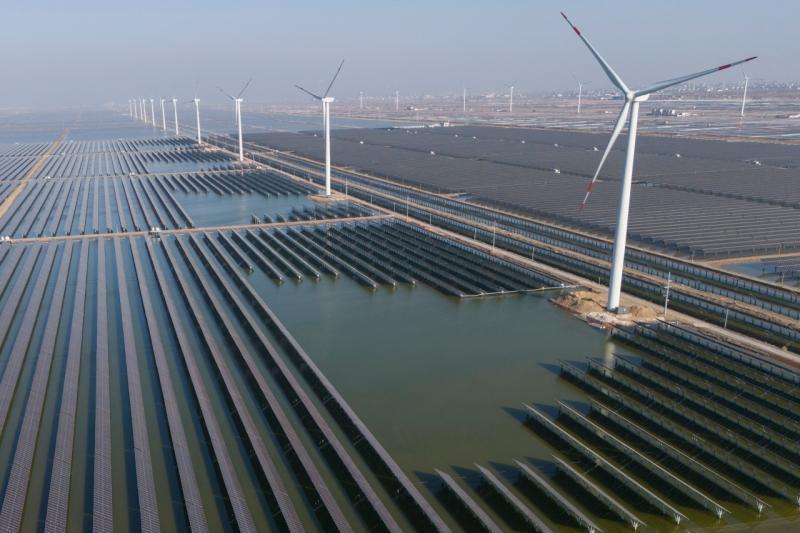
Countries around the world are rushing to add renewable energy such as solar power after the Iran war throttled Middle East oil and gas supplies. It is a boon for Beijing, because the technology often comes from China .
Ali al-Khazali lives in Baghdad and spent $2,000 recently on Chinese-made rooftop solar panels plus a battery to store electricity after sundown. Al-Khazali said he was worried about disruptions to the power supply in the scorching summer months because Iraq, despite its oil reserves, depends partly on imported natural gas to keep power plants running.
“People are trying to fix this problem with clean energy,” he said.
Consumers and governments around the world are thinking similarly. The near-total closure of the Strait of Hormuz has led to what the International Energy Agency called the biggest disruption to energy supplies in history. Four years after Russia’s full-scale invasion of Ukraine, the Iran conflict has been another reminder that oil and gas puts import-dependent nations at the mercy of wars and chokepoints.
“Our future will be at serious risk if we continue to rely on fossil fuels,” said South Korean President Lee Jae Myung.
The answer for many is more solar and wind power plus electric vehicles—even if that means more dependence on a single country.
“China was already completely the dominant force,” said Euan Graham, an analyst at Ember, a clean-energy think tank. “Postcrisis, maybe the clearest winner—we would really expect to see exports from China of clean technologies going through the roof.”
South Korea depends on imported liquefied natural gas for much of its power generation. Nearly 15% of its LNG last year came from Qatar, which shut down production soon after the war started. Now, it is moving to speed up deployment of renewables.
China accounts for roughly four-fifths of solar-technology manufacturing and more than 70% of global electric-vehicle production, according to the International Energy Agency. In February it exported close to $20 billion of clean technology, including solar panels, EVs, wind turbines and batteries, according to Chinese customs data compiled by Ember.
President Trump has said countries should respond to Middle East uncertainty by buying more American oil and natural gas. “ We have plenty ,” he said in early April.
If countries follow through on their renewable plans, however, one outcome of the Iran war will be increased demand for Chinese solar panels and wind turbines—an unlikely legacy for a president who has referred to wind and solar power as “ the scam of the century .”
Countries that moved more quickly to roll out renewables were in a better position to weather the current crisis—including China itself, which gets 40% of its electricity from low-carbon sources, while most of the rest comes from coal, which it largely mines at home.
Pakistan’s minister for power has hailed a similar combination of a consumer-led solar boom and domestic coal for serving as a buffer against higher oil and natural-gas prices.
More than half of Spain’s power is low-carbon, with solar’s share growing rapidly. Thanks to that, “Spain has the cheapest wholesale power prices in the EU,” said Graham, the Ember analyst.
The trend is accelerating since the Iran war began. China’s exports of EVs more than doubled in March from a year earlier as rising fuel prices boosted the appeal of plug-ins.
U.K. power provider Octopus Energy said it saw a 78% jump in sales of solar panels in March compared with February. Sales of heat pumps—a low-carbon technology used to extract warmth from the outside air to heat people’s homes—more than doubled in the month.
“People are saying, ‘I just want the security of knowing what my energy prices are going to be,’” said Rebecca Dibb-Simkin, chief product officer at Octopus Energy.
In the Philippines, infrastructure firm Actis owns a stake in a giant solar-and-battery project being built a few hours’ drive north of Manila. The Philippine government, dealing with skyrocketing prices of imported liquefied natural gas, fast-tracked a grid-connection request for the project and asked how quickly more could be brought online, said Rahul Agrawal, the company’s head of energy in Southeast Asia.
Even before the current crisis, Agrawal said, the MTerra Solar project could sell 13 hours of power a day from solar panels and arrays of lithium-ion batteries at prices that undercut imported LNG. That wasn’t the case even a few years ago, he said.
“The decline in battery prices has been quite phenomenal,” he said. MTerra Solar uses Chinese equipment, although not exclusively, Actis said.
Years ago, Beijing identified solar power and EVs as strategic sectors, prompting local governments to pour money into favored industries and creating cutthroat competition. The result: China now dominates these technologies, but production has outrun demand.
While the race to the bottom has eroded profits for Chinese companies , the low prices are attractive to buyers abroad—especially since the war in Iran broke out.
“Demand will definitely increase significantly,” said Wu Daobin, an exporter of renewable-energy products in Qingdao in northern China. He said his sales in March roughly tripled from a year prior, selling the equivalent of about $150,000 in solar panels to a client in Saudi Arabia.
Renewable-energy sources carry burdens of their own—including the intermittence of solar and wind power, for which battery storage generally can’t fully compensate. And countries are uneasy about relying on China. Some policymakers in Europe and the U.S. fret that solar panels and EVs with wireless connections could be disabled remotely. China’s imposition of rare-earth export restrictions last year showed Beijing’s willingness to wield its market power.
But a crucial difference between renewables and fossil fuels is that buyers only have to pay for a solar plant or wind turbine once. Those buying oil and gas have to constantly import more.
In Cuba, which is suffering energy shortages owing to a U.S. trade blockade, solar panels are popping up on houses, clinics and hospitals, while Chinese electric tricycles have become widely used. The Chinese ambassador to the country, Hua Xin, was quick to make the energy-security argument.
“The sun cannot be blocked,” he said on social media.
Tags
Who is online
86 visitors
Unintended consequences ... Trump's guilty grift gift to Pandora.
the US is now a decade behind china in solar technology, wind power, and storage battery tech thanks to geezus trump ...
The US will just have to do what 'virtuous' capitalist corporations do best ... steal the tech.
... steal it back from the chinese?
What else is industrial espionage good for?
These clowns will do nothing. America will be years behind when a new administration takes office.
IMO China is quite willing to share its expertise with respect to the greening of our planet. When it comes to benefiting all mankind it is not so selfishly protective of advanced technology that others are.
I believe Canada and Carney are ready to become a willing partners in a host of endeavors.
What is that attracts Canada the most to Xi’s totalitarian paradise? The domestic governed that suppresses all domestic dissent, the concentration camps, the pervasive censorship, or the foreign policy of stealing information from competitive countries, ignoring trade agreements at will, depleting foreign fisheries, helping terrorist nations evade international sanctions to secure cheap oil, supplying Putin and allowing the war on Ukraine to drag on etc?
Canada is opting for pragmatism over willy nilly dogmatism.
As in the USMCA that wonderboy called the best trade treaty evuh?
Now he has the mandate to do what's best for Canada, and good for the rest of the world..
To answer your question, Canada does what is good for the rest of the world, INCLUDING the Canadian people. Contrary to your META complaint article that weeps that you're not allowed to criticize China, I'm sure most of us won't bother to interfere with comments denoting jealousy and paranoia.
Oh.. So Canada has no principles and is just doing whatever it thinks is in the best interest of Canada.
Very Trump like.
lol. Sure. Completely jealous of not being able to criticize the government or access basic things like Youtube .
By all means though, show me what I claimed that was factually wrong
Pragmatism has no principles? Take it up with John Dewey.
Your boy Trump is no pragmatist, he's just a run of the mill narcicisst.
2 decades ago, our chinese PVC sales rep attempted to abscond with some proprietary materials from our manufacturing facility. from my office I had seen him arrive with a suitcase and a backpack. a few days later he was scheduled to return to china after attending our sales meeting, only this time he had 2 suitcases and a backpack. I volunteered to take him to the airport. due to the traffic gridlock at passenger drop-off, I couldn't get very close to his airline baggage check, so I pulled in further down and told him to go grab a luggage cart. he jumped out with his backpack and scurried off to the carts. I popped the rear hatch and tossed his old suitcase onto the sidewalk, got back into my vehicle and drove off with his new suitcase watching him running behind me waving his arms. when I got back to the factory, the sales manager and I opened his new suitcase and went thru it. inside were samples of the patented materials from our canadian PVC supplier and samples of the patented materials from our insulated glass suppliers. we stiffed the chinese on their last PVC shipment to us and resold their materials to competitors, since the sole purpose of the chinese rep's visit to us was to apologize for their bait and switch tactics on the degraded quality of the PVC they sent versus the specifications we thought we had ordered. the next company I worked for had a lot of chinese sourced items comprising the final product. their solution to product security was to create a separate LLC on paper for each sourced item and assemble the final product in the US to keep their technology from being stolen. the chinese are just as criminally inclined as republicans, but they're a lot smarter ...
The Chinese learned some hard lessons about the West during the Opium Wars. A main one being: If you are backward you will take a beating.
Yeah, the Chinese learned the ways of the west back then, didn't they? History's a bitch, eh?
Unlike an individual's psyche a nation's can extend far back into the past.