
Memorial Day

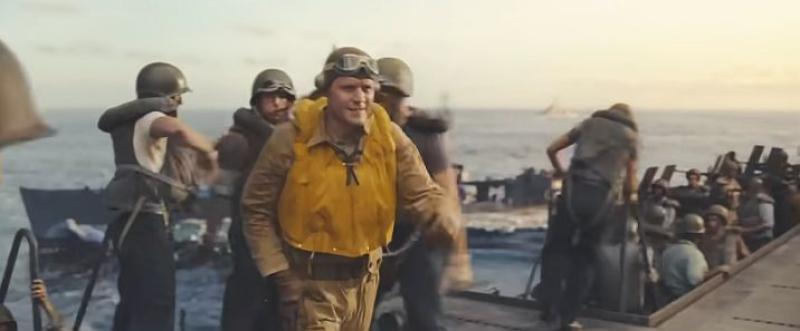

The torpedo planes, however, had been unintended sacrificial lambs. As the Zeros did their work on them at low altitude, Ensign Gay saw McClusky’s dive-bombers come boring down from above, unopposed. They caught Nagumo’s carriers in their most vulnerable position, with their decks crowded with planes refueling and rearming, this time with torpedoes, for an expected wipe-up attack on the American carriers.
from the book The Story Of World War Two by Henry Steele Commager and Donald Miller
Waldron found the main enemy force with few fighter planes in the air, but his squadron had been out a long time and was running short of gas. It had accomplished part of its mission merely by locating the retiring Japanese and reporting their position. Waldron radioed his information and added: “Request permission to withdraw from actions to refuel.” The admiral to whom the request was passed had an awful decision to make. To permit these planes to withdraw might make all the difference between sinking or crippling three carriers (Waldron had not sighted the fourth) and giving them a chance once more to slip out of sight under a squall. Three carriers could determine the balance of power in this 1942 sea war, in which the carrier was a capital ship at least in importance to the battleship, and actually of greater importance judged by performance in these first six months. Hypothetical scores of ships and hypothetical thousands of lives were on one side of the scale; on the other side were fifteen planes and the lives of their three-man crews. The admiral ordered: “Attack at once.”
Before taking off, Waldron had met with his pilots: “I want each of us to do his utmost to destroy our enemies. If there is only one plane left to make a final run in, I want that man to go in and get a hit. May God be with us all.”
All of Torpedo 8’s planes was blown out of the sky by whirling Zeros and a murderous sheet of antiaircraft fire, “and for about one hundred seconds the Japanese were certain they had won the Battle of Midway, and the war,” writes Samuel Eliot Morison.
Ensign George Gay, the only man to survive this American-style kamikaze attack, was shot down and wounded, and watched the rest of the air battle from his floating seat cushion. Two other torpedo squadrons attacked the four carriers. The Zeros, flying at deck level, cut them up, too. Not a single Japanese ship was hit in this massacre.
The torpedo planes, however, had been unintended sacrificial lambs. As the Zeros did their work on them at low altitude, Ensign Gay saw McClusky’s dive-bombers come boring down from above, unopposed. They caught Nagumo’s carriers in their most vulnerable position, with their decks crowded with planes refueling and rearming, this time with torpedoes, for an expected wipe-up attack on the American carriers.
“At 10:20 Admiral Nagumo gave the order to launch when ready,” Matsuo Fuchida recalled. “The big ship began turning in the wind. Within five minutes all her planes would be launched.
“Five minutes! Who would have dreamed that the tide of battle would shift completely in that brief interval of time.”
At 10:25 A.M. McClusky’s dive-bomber group was about to deliver what historian John Keegan has called “the most stunning and decisive blow in the history of naval warfare.”
Lieutenant Clarence E. Dickinson was in McClusky’s Enterprise group:
AS I PUT MY NOSE DOWN I picked up our carrier target in front of me. I was making the best dive I have ever made…. We were coming down in all directions on the port side of the carrier, beautifully spaced…. I recognized her as the Kaga; and she was enormous….
The target was utterly satisfying…. I saw a bomb hit just behind where I was aiming…. I saw the deck rippling and curling back in all directions exposing a great section of the hangar below…. I dropped a few seconds after the previous bomb explosion…. I saw the 500-pound bomb hit right abreast of the [carrier’s] island. The two 100-pound bombs struck in the forward area of the parked planes….
Then I began thinking it was time to get myself away from there and try to get back alive.
When McClusky’s dive-bombers came screaming down on the Japanese carriers, Matsuo Fuchida learned what it was like to be on the other end of a surprise air strike. He was on the Akagi but was not flying that day, having come down with a case of appendicitis:
AT 10:34 THE ORDER TO START LAUNCHING came from the bridge by voice-tube. The Air Officer flapped a white flag, and the first Zero fighter gathered speed and whizzed off the deck. At that instant a lookout screamed: “Hell Divers!” I looked up to see three black enemy planes plummeting towards our ship. Some of our machine guns managed to fire a few frantic bursts at them, but it was too late.
Within less than a minute the enormous ship was turned into an inferno. Nagumo, with tears in his eyes, reluctantly abandoned the doomed Akagi. Fuchida stayed behind to try to hold off the inevitable, but broke both his ankles jumping from one deck to another to avoid the explosions and raging fires. He was strapped to a bamboo stretcher and lowered to a boat, which carried him to a rescue ship.
Tags
Who is online
88 visitors
First Official National Decoration Day (U.S. National Park Service)
On May 30, 1868, a crowd of more than 5,000 gathered at Arlington National Cemetery for the first Decoration Day (now known as Memorial Day) exercises. Before strewing flowers upon the graves of the dead, the crowd listened to an address by James Abram Garfield (1831–81), then an Ohio congressman who had served as a Union major general during the Civil War. In this first of such annual addresses at Arlington National Cemetery and across the nation, Garfield set a standard by explaining what Decoration Day is all about and why it should be commemorated.
Below is the speech then Congressman Garfield gave at Arlington Cemetery:
I am oppressed with a sense of the impropriety of uttering words on this occasion. If silence is ever golden, it must be here, beside the graves of fifteen thousand men, whose lives were more significant than speech, and whose death was a poem, the music of which can never be sung. With words we make promises, plight faith, praise virtue. Promises may not be kept; plighted faith may be broken; and vaunted virtue be only the cunning mask of vice. We do not know one promise these men made, one pledge they gave, one word they spoke; but we do know they summed up and perfected, by one supreme act, the highest virtues of men and citizens. For love of country they accepted death, and thus resolved all doubts, and made immortal their patriotism and their virtue.
For the noblest man that lives, there still remains a conflict. He must still withstand the assaults of time and fortune, must still be assailed with temptations, before which lofty natures have fallen; but with these the conflict ended, the victory was won, when death stamped on them the great seal of heroic character, and closed a record which years can never blot.
there's a lot of unhappy veteran chatter online about the arch d trump blocking the view of arlington ...
Hopefully, they will RISE, and tear his dream down, down, down to the ground and him with it.
[✘]
I get it now
The heroism of those pilots is one of the most memorable moments of WWII for me. Inspiring.
It really was the greatest generation. Give them a hair raising ultra dangerous mission and the response was "yes sir" and on they went.
yet your hero referred to them as suckers and losers ...
maga waited for most of them to pass before pulling out their unamerican bullshit. those guys wouldn't have stood for it, because they were fighting the same ideological enemies.
"What was in it for them?"
Well...in my grampap's case he was drafted. But he went and did his duty and came home again to be the grampap that I loved and cherished
so did my grampa, spent all of WWII in the navy. his brother dropped out of dental school to become a submariner. my uncle joined the merchant marine for the atlantic when he got his draft notice to keep from getting shot and never set foot on a boat of any size ever again after the war. I never got a firsthand war story out of any of them. my uncle pete fought from normandy thru the bulge to germany. he told me a lot of war stories when I was a youngster, while we watched war movies on TV in his basement. in hindsight I think it was therapeutic for him. I learned from his daughter at his funeral that he had never spoken of his time in the army to anyone else in his family.
My Uncle Carl, Grampap's brother got frostbite on his feet during the Battle of the Bulge. I think he saw the worst of it. My Grampap's other brothers were there, too, except for his oldest brother who saw action in WW I.
I was stupid when I was young and didn't pay attention to the stories.
Which only proves what a selfish POS trump is; the only reason he wants to be president is to enrich his wallet..."what's in it for me".