
The Opponents of Data Centers Just Don’t Get It


 S E E D E D C O N T E N T
In the global geopolitical theater, wars are rarely won solely on the battlefield. They are won in the power grids, foundries and server racks that dictate the boundaries of global influence. Today, the most critical arena is Artificial Intelligence (AI). Yet, as the United States attempts to stake its claim on this frontier, it faces an existential threat – not from foreign blockades or economic sanctions but in its own backyard.
For the time being, the U.S. is the leader in the global data center network, consisting of roughly 12,000 active facilities spanning 175+ countries, representing over 67 GW of operational IT load. Infrastructure is heavily concentrated in a handful of zones, with the U.S. housing roughly 40%-45% of global capacity.
As of mid-2026, the official count of U.S. data centers varies based on how researchers track and define a data center (ranging from enterprise server rooms and colocation hubs to huge hyperscale AI facilities). The Commercial Tracker & Inventory Baseline of commercial industry databases reported 2,035 active operational data centers in the U.S. as of July 2026. The broad public directories count smaller edge hubs and multi-tenant properties, putting the total of active facility locations at roughly 4,000 to 4,700.
The Top Five States with Active Facilities
- Virginia: ~329–600+ facilities (Northern Virginia/Ashburn is the largest global hub)
- Texas: ~229 facilities
- California: ~167 facilities
- Ohio: ~113 facilities
- Oregon: ~100 facilities
- Over 800 facilities are actively under construction, with thousands more in development.
Data centers go where there is adequate connectivity, so going to remote areas isn’t always feasible. Data centers must be located near high-capacity fiber networks and high-voltage transmission infrastructure.
Equally important is the time it takes for data to travel between a user and a server. Delays of just 100 milliseconds can reduce e-commerce conversions and slow cloud applications, which is why data centers must be located near major fiber routes and population centers.
Data centers also create jobs and provide real economic return on investment. They generate significant construction employment and produce some of the highest tax revenue-per-acre ratios of any land use.
Construction of major hyperscale data centers often employs 1,500 to 5,000 skilled workers over an 18-24-month period. The average data center salary is roughly $160,000, nearly double the national median household income.
In Loudoun County, Virginia, a major data center hub, data centers generate roughly 38 percent of the county’s general fund revenue, according to government financial reports. For every $1 in public services they consume, they pay approximately $26 in taxes – six times more than traditional manufacturing.
The Backlash Strikes Back – Ignoring the China Threat
In the face of such rapid growth, a fierce backlash against AI data centers is gaining momentum across the nation. Driven by legitimate anxieties over rising residential electricity bills, massive water consumption and localized noise pollution, local governments and grassroots movements are halting, delaying, or outright banning new hyperscale data infrastructure. But while American municipalities debate zoning permits and transformer capacity, China is moving with ruthlessly centralized efficiency.
Opponents of data centers may not realize Artificial Intelligence is not a cloud floating in abstract space; it is a physical, capital-intensive utility reliant on gigawatts of power and silicon chips. If the American public freezes data center expansion, this will hand China an insurmountable lead in the AI race, allowing Beijing to dominate three critical pillars – global governance, economic architecture, and military power.
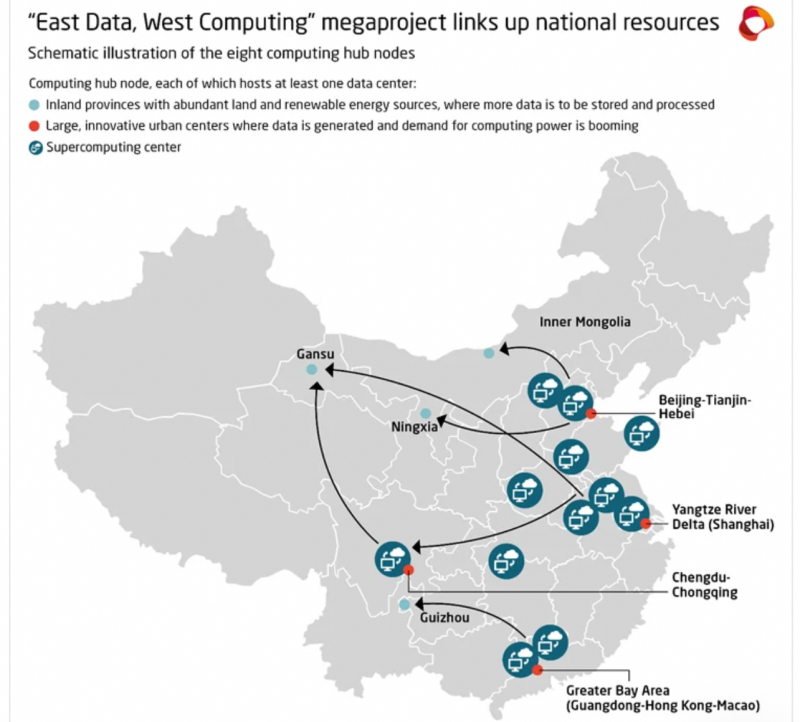
China understands this implicitly. Unencumbered by local zoning boards, environmental litigation or public debate, China is treating computing power as a strategic national resource. Under initiatives like “Eastern Data, Western Compute” (below), Beijing is actively routing massive data infrastructure to energy-rich western provinces, effectively subsidizing up to half of the energy costs for its technology giants.
Conversely, any American paralysis plays directly into our adversaries’ hands, so much so that security reports have uncovered foreign influence networks actively amplifying anti-data center outrage in the West. Slowing U.S. computer expansion creates a bottleneck that no algorithm can code its way out of.
If Beijing captures the lead in computation infrastructure, its dominance will extend far beyond superior chatbots: The nation that first builds and deploys the foundational models sets the default rules for the internet.A Chinese-dominated AI landscape means digital infrastructure exported to the Global South will be baked with algorithmic surveillance, state censorship, and a Beijing-aligned ideological guardrail.
Advanced AI will drive automated manufacturing, drug discovery, financial modeling, and scientific research. If Western firms must ration computing power while Chinese enterprises operate on subsidized, boundless server capacity, the economic growth velocity will shift decisively eastward.
Modern defense relies on rapid data synthesis, autonomous logistics, cyber defense, and real-time battlefield modeling. “Compute scarcity” directly translates to vulnerability in national security.
To prevent this outcome, the choice cannot be binary – between community exploitation and strategic defeat. Instead, the U.S. must treat AI infrastructure with the urgency of the Manhattan Project of the 1940s, the Interstate Highway System of the 1950s, or our moon shots in the 1960s, by reforming grid access, creating clean nuclear and geothermal power, and delivering tax windfalls for local communities.
Blocking data centers in the name of local preservation may offer a fleeting sense of protection, but in reality, it cedes the command deck of the future to an authoritarian rival eager to step into the vacuum.

Tags
Who is online
86 visitors
American NIMBYs are holding us back in possibly the most important race in human history.
We should be building data centers, but the owners should be open and honest about the costs to communities and they are not. They are requiring local lawmakers sign NDAs. They are using RECs to uphold the claims of 100% net-zero, but have bridge power that pulls hard from local power grids. They say it will require thousands of local jobs, but once the data center is online it requires 15 to 30 people to maintain. They also generate serious noise and heat.
Again I'm all for data centers. They just need to be upfront about the issues and build in areas accordingly. I'm tired of corporations pissing on people and calling it lemonade.
I agree with all that, but most importantly we need to be shaping data center policy while AI is developing. We have two problems - getting the public to understand that this is a crucial race with our adversaries, and bureaucracy. The developers of this technology shot themselves in the foot when they took advantage of a situation where they knew everything while John Q Public knew next to nothing about how impactful their product would be. They decided to veil everything as much as possible for as long as they could, forcing as much of their development costs as they can onto anyone, knowing that the people are less likely to rebel about what they don’t understand. Now they’re fighting an uphill battle because they have earned themselves a well deserved nefarious image. Mr. Wonderful can tell us all about that in Utah.
What makes anyone think this race will ever end? We will never defeat our "adversaries" over AI. It will just be a constant. Hello dystopia.
It is what it is. Simpler times are a bygone memory.
i asked meta ai to analyze my comment -
analyze - "that this is a crucial race with our adversaries, and bureaucracy. What makes anyone think this race will ever end? We will never defeat our "adversaries" over AI. It will just be a constant. Hello dystopia. "
=
That statement is collapsing 3 different arguments into one - and each one has some truth to it:
1. "crucial race with our adversaries"
This is the dominant framing in DC right now on both sides. The logic is:
AI is dual-use like nuclear or semiconductors - whoever gets AGI or military-grade AI first sets the rules
China is explicitly pursuing AI as a national strategy, with massive state funding
So the US can't afford to sit out
The counter to this is: framing it as a "race" creates a self-fulfilling prophecy. If both sides believe it's a race, both sides cut corners on safety, oversight, and deployment to win.
2. "and bureaucracy"
That's the second complaint - that while we treat it as a race, we are also bogging ourselves down with licensing, compliance, review boards, export controls, etc.
There are two opposite reads on this:
One side says bureaucracy slows the good guys down while adversaries ignore it and pull ahead
The other side says bureaucracy IS the moat - export controls on chips, safety testing, etc. are how you maintain advantage
Both can be true at once. We can be both in a race and bad at racing.
3. "What makes anyone think this race will ever end? We will never defeat our adversaries over AI. It will just be a constant. Hello dystopia."
This is the strongest part of the argument. It's a critique of the "race" metaphor itself.
Historically, tech races don't end with a winner - they become permanent conditions:
The nuclear arms race didn't end, it became deterrence + non-proliferation as a permanent management problem
The space race didn't end, it became satellites, GPS, and now orbital infrastructure
The cyber race has no finish line
AI is even more like that because:
There's no single finish line like "first to the moon" - models keep getting better
The underlying knowledge diffuses - you can't un-invent transformers
Even if you "win" a generation (GPT-4 vs Ernie), the next generation starts the next day
So the idea that we will "defeat" China or anyone else at AI and then the race is over is fantasy. At best you get a temporary lead that you have to keep re-earning.
Where the "Hello dystopia" part comes in: if it's a permanent race, then you get permanent emergency logic. Permanent emergency justifies permanent surveillance, permanent military AI investment, permanent bypassing of normal checks. That's the dystopian loop the author is pointing to - not killer robots, but a forever-war footing for an economic/technical competition.
The honest synthesis:
It's both crucial AND endless. That is actually normal for great-power tech competition. The question isn't how to end the race, it's how to run it without destroying what you're trying to protect - i.e., can you compete hard without becoming a centralized, bureaucratic surveillance state yourself.
If you believe the race is real, you want speed and state capacity. If you believe it's endless, you want rules and institutions that can survive an endless competition without burning out.
Most people arguing about AI are arguing past each other because one group is arguing "we must win" and the other is arguing "winning is impossible, so we must manage."
If there is no end there can be no happy ending. If AI becomes one day on the verge of "overtaking" humanity and the only way to stop it will be to "pull the plug", who will want to be the one to pull the plug and end what took many years and trillions of dollars to create? Maybe no one.
It’s a race with no finish line. The point is to remain competitive, and not allow our adversaries to influence our masses into believing it needs to be stopped in its tracks, thus allowing them to take and remain in the lead. The uproar over data centers in my area is so over the top. People here are always on the lookout for something to be outraged over, and social media is easily manipulated to tap into that.
Look at the message foreign bots are pushing.
I was speaking with a friend over the weekend who is a private sector DoD contractor. Everyone in his company is afraid to use AI. These are the people whose opinion matters, as they are the tip of the spear for how to prevent military disaster. For those who think public LLMs are still too primitive to be reliable, understand that the version you are evaluating is eight versions behind the private versions that currently have the godfathers of this technology worried.