
Texas heat wave is so bad, meteorologists are apologizing for it



 S E E D E D C O N T E N T
Texas heat wave is so bad, meteorologists are apologizing for it
Dangerous heat expected to continue for at least another week and possibly longer.
By Dan Stillman
Jun 23, 2023 06:17 PM
A brutal Texas heat wave is now entering its third week for some places and shows no signs of slowing down. If anything, it could expand north and east and get worse over the next week. The expected intensity and longevity of the heat has forecasters concerned about dangerous and deadly consequences and even apologizing for it.
“Sadly, temps are going to creep back upward next week, too. Sorry, y’all. We’re gonna get back to our typical levels of heat someday, but not real soon. Keep up the fight against the heat!” the National Weather Service in Houston tweeted Friday morning.
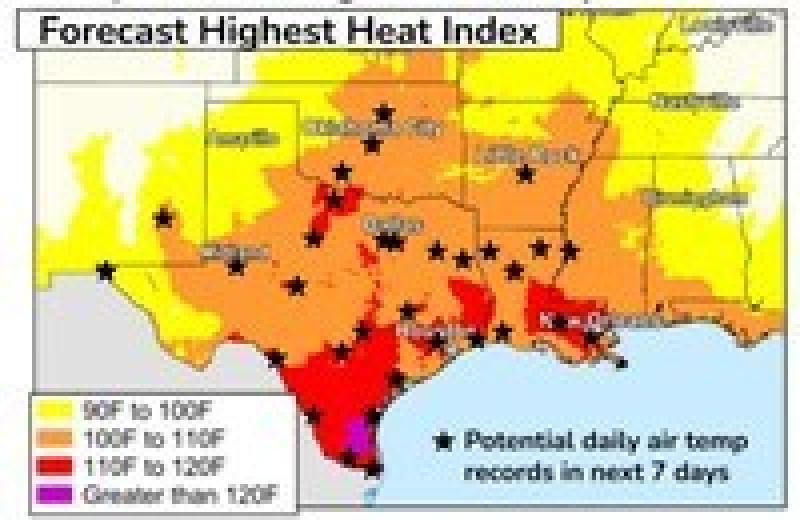
The heat was ramping higher once again Friday after easing by only a few degrees Thursday. Six out of the 10 hottest U.S. cities Friday were expected to be in Texas, according to The Washington Post’s U.S. heat tracker , with each city’s temperature forecast to top 100 degrees every day through Thursday. Meanwhile, the heat index is predicted to reach 110 to 120 degrees or higher for an extended period across a large swath of the state. Numerous records could be threatened.
“Oppressive and persistent heat will become increasingly dangerous and potentially deadly in south and south-central Texas, especially to people repeatedly exposed for long durations. Many locations in those parts of Texas have already experienced a yearly record number of hours of dangerously high heat index readings,” the National Weather Service said in a summary of key messages about the heat wave. “There is increasing confidence that the dangerous heat wave will continue through the beginning of the July Fourth holiday week.”
Computer models project that the heat will be most expansive next Wednesday and Thursday when it could creep north into Oklahoma, Kansas and Missouri and also eastward into Arkansas and Louisiana.
Many records already broken
The coming six days of punishing heat follow numerous records that were tied or broken during the past week. San Angelo reached an all-time record high of 114 on Tuesday and then tied that record again Wednesday.
“As much as we don’t want to tweet this … We did hit 114° here at the office in San Angelo today. So that means we have tied our all-time record high, set approximately 24 hours ago,” the Weather Service office in San Angelo said .
Del Rio reached an all-time record high of 115 on Wednesday, breaking the previous record of 113 set Tuesday. June 16 to 22 was Del Rio’s hottest seven-day period on record, weather enthusiast Don Sutherland tweeted . Temperatures on Thursday topped out a few degrees lower at 108 and were forecast to be about the same Friday before trending hotter again.
Some of the other all-time record high temperatures set during the month of June include 118 at Rio Grande Village, 117 at Falcon Lake, 116 at Cotulla, 115 near Laredo and at Cope Ranch, 113 at Carrizo Springs, and 112 at Comanche and Bronte, according to data compiled by Sutherland.
Many locations are piling up the number of hours spent in triple-digit territory. Between June 17 and 21, portions of south and southwest Texas spent 30 to 40 hours, out of a possible total of 84 hours, at or above 100 degrees, tweeted Greg Carbin, chief of the Forecast Operations Branch at the National Weather Service’s Weather Prediction Center. Carbin also posted maps showing a 24-hour average temperature of 100 degrees between the Rio Grande and San Antonio.
The humidity has driven the heat index past 110 degrees across most of the state. In Corpus Christi, where the heat index reached 125 degrees Saturday, “13 days have reported the highest heat index for that day going back to 1947,” the Weather Service said .
The heat index reached at least 116 degrees in McAllen for the 10th consecutive day Thursday. “This streak shatters others we found in June, as well as total June days with such occurrences (4 in 2019 and 1998). On all days in the streak, 116+ lasted 1 to 5 hours,” the Weather Service in Brownsville reported .
High temperatures were a few degrees cooler across parts of the state Thursday after severe thunderstorms and a violent tornado struck some areas Wednesday. Crews in Southeast Texas, including around Houston, were rushing to restore power before temperatures climbed again. More than 400,000 customers were without power at one point late Wednesday, but that number had dropped to less than 59,000 as of Friday morning.
Unrelenting heat dome, climate change fueling high temperatures
A historically intense heat dome , or sprawling area of high pressure centered over northern Mexico that traps heat underneath it, was to blame for the ongoing heat wave. Scientists have found that such heat domes are becoming larger and more intense with human-caused climate change.
Computer models project the strength of the heat dome over northern Mexico, swelling into Texas, to hover in the 99th-percentile range into next week — meaning it’s statistically exceptionally rare.
Climate Central, a nonprofit science communication organization based in Princeton, N.J., has developed the Climate Shift Index , which estimates how much climate change is increasing the likelihood of extreme heat. The index is at a Level 5 over southern portions of Texas , indicating that climate change made this excessive heat at least five times more probable.
The heat dome responsible for the current heat wave is expected to persist through at least next week and possibly into the following week. That means an extended stretch of daytime highs in the 100s across much of the state while the heat index could top 120 degrees in South Texas.
As is the case with most heat waves, it is the warm nighttime temperatures that make it especially dangerous.
“There may be more danger than a typical heat event, due to the longevity of near-record or record high nighttime lows and elevated heat index readings,” the Weather Service said. “It is essential to have a way to cool down and interrupt your heat exposure.”
The heat dome should finally start to weaken by the end of next week or the following week.
“We will escalate the heat daily until about Wednesday or Thursday, when things should peak. This will push us into the low-100s for highs, with lows again near 80,” wrote Houston-area meteorologist Matt Lanza. “Should that happen, perhaps we can resume more typical summer weather here in Houston, which while still certainly hot, would be a little less stressful on our bodies.”
Little ray of good news for the searing South #heat wave.
Ensemble models are suggesting a bit of a break in the heat could arrive the week of July 4th as the upper ridge retrogrades.
Still a searing week of heat to wrap up June, though. pic.twitter.com/Gl92CYRC5Z
— Jonathan Erdman (@wxjerdman) June 23, 2023
Tags
Who is online

214 visitors
By the end of the century it will be over 100 degrees in Texas most days of the year.
100 days over 100 degrees in normal now in Oklahoma. That used to be unheard-of...
Humans will just have to evolve.
Really John? Haven't you heard of winter? It's not going away. Remember the deep freeze in Texas just a few years ago? This is just summer weather in that region, not climate change. The 1930's were much hotter over much of the US
These "heat domes" or areas of high pressure can become stationary and persist for days or even weeks.
Computer models and reality can different. Here in Denver so far this year we've yet to reach 90 and have almost reached our average annual precipitation totals.
California and other parts of the West also are in for more uncomfortable, even at times dangerous, summer weather.
For California, the study found:
Regardless, the warming will affect the entire United States, the study found.
There currently are 29 cities that experience a summer heat index of 100 degrees or more for at least 30 days a year. But at the current rate of warming, that will jump to 251 cities by mid-century and will include Sacramento, Cincinnati, Omaha, Chicago, St. Louis, Washington, D.C., and even Fargo, North Dakota.
“We are looking at the types of conditions that we only see in places like Yuma, Arizona, becoming very widespread in places like Tampa, New Orleans, Houston, and southern Indiana,” Dahl said.
Welcome to purgatory.... I guess the bright side is that California's wuss population will look elsewhere, or perhaps not..... Suck it buttercup
In 'Cruces today - 101; tomorrow 106, Monday 108; Tuesday 108; Wednesday 109; Thursday 106 - typical summer. But, the heat/hottest will be in August when we will be experiencing triple digits for 'bout two to three weeks.
Normal summer - do what Ed sez - don't go outside unless it's in that AC 4 wheel thingy with the air full on and a HUGE glass of iced water for hydration.
How many times are the rest of us gonna have to hear about you all bitching about power outages?
Wtf does that mean? I haven't heard of any power outages, which is a good thing because in this kind of heat that would mean more people dying.
The nightly news outlets actually show Oncor's power production versus our
consumption.
The lines are perilously close, almost parallel.
Oncore is offering rewards to turn the AC down to 82 degrees from 4PM to 8PM
etc.
I scanned an article the other day that basically said what is keeping things going right now was the addition of solar and wind.
Ahhh, Fox?....
Did it mention that we had solar and wind power during the last major outage?...
Solar makes a difference because it is spread out across the state and is fairly dependable. Homes like mine sell into the system.
Most of the wind generation only exists in West Texas and there are no power lines extending their excess production to Dallas Fort Worth or Houston where it is needed.
Unlike the sun, the wind blows fairly constant but the PTB turn off up to a third of the windmills because there is nowhere to send the excess.
The legislature cant decide where to build the transmission lines or how much to spend...
Only hit 113 today - humidity 8% - tomorrow to be higher.
Hell, even the golf course is shutting down its Cleveland Wedge demo and sale day on Thur 'cause the temp is "supposed" to be 'bout 115-118.
Typical summer down here.
Solar power proves its worth as heat wave grips the state (msn.com)
Earned a degree in environmental science over a decade ago after determining that early climate research correctly identified anthropogenic forcings (AGW) as being responsible for global increases in temperatures and extreme weather events.
At that point far right wing think tanks funded by the fossil fuel industry (Heritage, Heartland, etc...) were spending millions of dollars in an effort to convince the public that AGW was a hoax.
Decided that the best use of my time was to go online to combat the well-funded climate denial machine. NewsVine and other similar sites became the tip of my denier killing spear.
Unfortunately, education efforts were/are much too little and much too late.
Pretty sure that it's now much too late to do a damn thing about AGW/climate change.
So to hell with the solar panels, the wind turbines, the bicycle, the conservation.
Going out to light up my mothballed 68 muscle car and ride that highway to hell!
Goodbye cruel world! I tried!
Well, it's 102 right now bown on the border in SE Arizona. The fortunate thing is that those of us here are acclimatized to the heat and only go out when needed in our AC equipped vehicles. Supposed to get up to 103 tomorrow. I have lived in places in much of the world where temperature extremes were very hot in one place and extremely cold elsewhere. I went the Philippines to McMurdo Station, Antarctica the coldest, windiest, driest place on Earth, then to Pearl Harbor, Hawaii. I actually prefer the cold weather.
No doubt...
Got the same degree - have the same attitude. Gonna find me a TR-6, top down, full forced air, loud music and nice cold iced 20 Oz Green Tea with honey and ginseng
Have been to a few of those places in my travels.
A dry heat isn't so bad. Sweat can then keep one cool.
Wet jungle heat is a bitch and definitely takes getting used to.
Arctic cold isn't so bad as long as the sun is shining (don't forget Goggles).
Dressing in layers is always a good idea no matter the temps +or-.
No matter the conditions, staying hydrated is everything.
P.S. Given my druthers I'll take Pearl any day of the week.
We are still trying. Solar on the house and one all electric vehicle, when the battery power is there we will dump gas powered entirelty. dont give up.
Can you imagine the mineral resources underneath that 1+ mile of ice?
Momma didn't raise no quitter.
Batteries are getting better every day.
Well where i am out here in the boondocks , the year is shaping up to be one out of the norm or what people have become use to as normal , the past winter has been one of the harshest in 30 years im being told , couple that with a very wet spring ( combination of snowmelt and rain ) we already in some places have had double the amount of precip and run off . the temps are holding their own , not above or below average actually .
I took a job in the beginning of may with county weed and pest as a seasonal worker going around even further out in the boonies spraying for noxious/ invasive weeds , the crews are usually made up of those 18-25 , being my age im called grandpa by all , but still get looks when im out doing just as much as they are , just not quite as quickly .
I think this year is going to be one to be remembered weather wise ,
I hope not, dealt with record snow, and then rainfall and wildfires all summer long.
Way i see it is the weather is something we really have little to no control over and cant really change to much effect. it has its own drivers and will do what it will on its own cycle . best we as humans can do is try to somehow adapt , or move somewhere more suitable to our own individual tastes .
The problem being is that we have already screwed the global climate.
The "weather" is only local.
[deleted]
the "climate" on this "rock" spinning in space we call earth has been changing since day one of its existence , and it has not always beer able to support life as we know or define it , and there never was any guarantee it would remain in just the right range to do so .
[deleted]
Chicago got in on the Canadian wildfire smoky haze today.
Air quality officially listed as "very unhealthy".