
The ‘American Whitelash’ Is Far From Over



 S E E D E D C O N T E N T
There’s an oft-repeated story that the rise of Donald Trump was propelled by a wave of white grievance in the wake of President Barack Obama’s election — and that an uptick in white supremacist violence followed. But Pulitzer-winning Washington Post reporter Wesley Lowery says viewing that backlash solely through the lens of Obama’s election — or as a response to social justice movements like Black Lives Matter — glosses over a deeper pattern: The white racial violence that has been embedded in our culture not just in the last few election cycles, but since the nation’s founding.
Weaving together history, interviews and close examinations of key incidents of violence — from the police killing of Oscar Grant in 2009 to a 2014 shooting at a Kansas City Jewish community center that left three people dead — Lowery shows us that white fear and resentment of the “other” has always been with us. What we call backlash at certain moments is really a long-running “whitelash” that’s intricately woven into American history and currently targets not just Black people, but any group that threatens a shifting consensus of who is American and who is not.
“This book is an attempt to put human faces on the relentless cycle of violence that has defined American history,” Lowery says, “to put flesh and bone on our discussion of white supremacist terror.”
Three years after the eruption of protests following the death of George Floyd, Lowery isn’t convinced that America is any better prepared to deal with whitelash as a political force, let alone a cultural one — particularly as we head into a sharply contentious presidential election. Trump once again leads the GOP primary field, and his closest rival is Florida Gov. Ron DeSantis, who has stoked controversy by curtailing education on Black history.
“People have talked for years about civil war,” he says. “We don’t have something as embedded as slavery anymore, but we’re going in diametrically opposed positions; we’re ripping ourselves apart from each other. I certainly think that’s true. It’s a soft civil war. One of our historical blind spots is thinking multiracial democracy — what America should be — is a settled question. Many people are not sure of that.”
This interview has been edited for length and clarity.
Erin Aubry Kaplan: What compelled you to write this book, after writing about police brutality and Black protest?
Wesley Lowery: My first book came out November 2016, following the election of Donald Trump. People said, “So, what’s the next project?” To me, 2016 was obviously the closing of one thing and the opening of another. I couldn’t help but notice and be horrified by headlines of white supremacy — Nazi activity, the Tree of Life shooting in Pittsburgh. It was clear to me this was going to be a moment of white racialized violence.
Kaplan: People kept insisting after Trump was elected that this is not who we are. I don’t hear them saying that so much anymore.
Lowery: This is who we are. Who we wish to be is real, but who we wish to be is not who we are. When we look at American history we look at tug of war between forces of white supremacy and the forces for multiracial democracy. In 2008, you have two great big forces fueling white supremacy: the election of Obama, and the prediction of America becoming a minority-majority country. The country is fundamentally changing demographically. For many Americans, they were horrified, because these were developments that would come at their own expense. What we see historically is that, in moments of Black racial advancement, we see America’s white majority lash out with rhetoric, with policy, but also with violence. We see a strengthening of that white supremacy and violence now. In the Obama years, there was a delusion of a post-racial America. Instead what happened is that people lashed out in anger. A Black president was replaced by one who stoked nakedly nativist anxiety — he wants to get rid of birthright citizenship, for example. He wants to keep the country as it is now.
What we’ve seen is an intensity of political rhetoric being wielded to foment a movement to win the presidency, and it’s upended our politics. The single through line of that movement was nativist rhetoric and anxiety. Now we stand approaching another election with candidates — not just Trump — who intend to use the same dehumanizing rhetoric, the same demagogic attack on minorities. And the fear has to be, will this violence be happening again, will it increase?
People have talked for years about civil war. We don’t have something as embedded as slavery anymore, but we’re going in diametrically opposed positions, we’re ripping ourselves apart from each other. I certainly think that’s true. It’s a soft civil war. One of our historical blind spots is thinking multiracial democracy — what America should be — is a settled question. Many people are not sure of that. That’s why there’s real backlash in this moment to embracing social progress for Black people and other groups.
Kaplan: You talk about the whitelash to the phenomena of immigration. Is it equal to the whitelash around racism? Is it different?
Lowery: Fear of immigration is economic fear, but it’s also about fear of the other. Those things can be hard to separate — we’re doing hair-splitting when we talk about what is racial fear and what is economic. Ultimately it’s all about who is winning and losing. Importation of new workers is about people taking things from you — you’re losing. The number of caps and quotas on immigrants in history is always entangled with racialized anxiety.
Anti-Black bigotry is not worse than other kinds of bigotry — it’s all bad. It’s all reaction to change, whether it’s racial, whether it’s about sexual or gender identity. When you see a rise in the KKK, you see anti-urbanism, anti-Blackness, etc. A whole set of social and cultural prejudices. We make a mistake when we say prejudice is all interpersonal.
Kaplan: People point to media as a problem perpetuating violence, not just by putting out false information and stoking extremism, but also by taking a kind of neutral position on extremism itself: Report on it, let readers figure out what it means. What do you think needs to change?
Lowery: Yes, it’s easier for journalists to just write down what happened and wonder who was right. Making change would require us in media to police our public square, to hold our elected officials accountable for their rhetoric. If you value multiracial democracy, it’s your job to curate the public square so that people don’t abuse it, don’t abuse freedom of speech. The big problem is that all our institutions — not just media, but law enforcement, political parties — have not taken white violence seriously enough. Were there rhetoric leading to attacks on white people as a group, our institutions would take a much harder line. If someone were calling for the genocide for whites, we would not give them a town hall on CNN. I think it’s very clear that as country, we allow demonizing of some people and not of others.
Kaplan: You say that bigotry is less important than a long American history of fueling racial resentment to keep the status quo intact, to justify a set pattern of injustice. But doesn’t that pattern spring from bigotry, specifically anti-Black bigotry? How can Black people cope with this pattern in this moment?
Lowery: We know that race is a social construct, not biology. But whiteness is real; it’s power. And whiteness has shifted and changed over the years in terms of who is white, and who isn’t. But it’s still about who’s in and who’s not. The strategy for Black people has always been one of two things: Assimilate or resist. It’s true for any minority group — either assimilate or stand up for your humanity. Black history has been one of resistance to the idea that they are subhuman, not entitled to equity or opportunity. That is still the battle line.
Kaplan: What about the slight increase in Black support for the GOP in the last several years, especially from Black men? How does that figure into racial divisions?
Lowery: It’s hard to talk about this through a political lens. The increase in Black support of the GOP is insignificant, especially compared to the number of Black people who don’t support. You could have five black people supporting Trump, and it’s a 100 percent increase — but it’s totally insignificant. Two in 10 people think we faked the moon landing (in 1969), which is significant. But we don’t pay attention to that.
Kaplan: Whitelash drills down into the idea that many white people who are not at all disposed to violence or even racism, at least on the surface, are the real problem. Why?
Lowery: When Barack Obama was elected, a lot of white people really wanted to believe this was progress. They wanted to live in a world where things had been done. It was aspirational. We know that we still live in a country where peoples’ fortunes are very tied to their race. The only way to overcome the problem is to be honest, but instead, we have people who insist that inequities don’t exist anymore.
Kaplan: You talk about Louis Beam, a white supremacist leader who said in 1992 that the future of the movement would depend on individual actions, and reactions to events, not on visible hate groups like the KKK. Kind of like a thousand points of light, minus the positive connotations. With the internet and social media making it easy for individuals to radicalize, has that prophecy come true? How can we change the dynamic?
Lowery: The strategy of white supremacists for decades has been to flood the nation with propaganda with the hope that, as more people become more disaffected, they will themselves find their way into the movement. Dylann Roof, who murdered nine black people in Charleston in 2015, did a Google search to find stats about Black crime after the Trayvon Martin shooting. What that means is that, in a country that’s still majority white, people are feeling racially anxious. Those of us who exist as gatekeepers, or as facilitators of the public square, have to take our jobs more seriously. There’s this desire to cover politicians normally, to treat those of them spreading racist or bigoted ideas as if they are not doing something abnormal. We have to make choices, understand the differences between who we’re covering and how. Having a live camera on a Mitt Romney speech is different from having a camera on a Donald Trump speech, because only one of them can incite people to violence.
CNN said in 2016, ‘We’re going to treat Trump like we treat any other candidate.’ That may sound fair, but it’s a choice to not do something. There are plenty of ways media can inform people. We can contextualize, we can explain. I think we can’t abdicate our responsibility to that.
Kaplan: I’ve heard people complain that the media covered Trump too much, that he gets too much exposure.
Lowery: I don’t agree. We can’t say that Trump or DeSantis should not be covered, but we can’t cover them as normal people. We can’t be robots and say, ‘Oh this is just a candidate, a candidate is a candidate.’ We need to ask, who are they and what are they saying? When someone constantly lies and dehumanizes other people, we shouldn’t put them on live TV. I don’t think that’s a radical or a crazy idea.
Prejudice is not a vampire that dies in the light when it’s exposed — it’s like a weed, it grows. We in the media have to think about, what is our job? We should not do anything that isn’t informative. Something can be news in that it just happened, but it’s not of consequence. We need to slow down, widen the aperture, not follow whatever sensational thing has just been said.
Kaplan: One of the incidents of racial violence described in Whitelash is the murder of a Latino man in Patchogue, Long Island, in 2008 by a white teen who was out wilding with his friends, looking to attack Mexicans. The case raises a question that troubles us now: Why would a white person who seems tolerant and normal, like this teen, commit an obviously racist murder? And when he says he’s not racist, why do we believe that? There’s a parallel here in how people vote for Trump, but say they don’t approve of his racial views or actions.
Lowery: It means very little to insist you don’t have personal prejudice when you choose candidates who weaponize language to hurt people. It doesn’t really matter to me if you’re voting for a racist person because he’s a racist or for some other reasons that appeal to you. You’re making a choice. You actually can trace how prejudice goes from being interior and personal to being expressed publicly. In Patchogue, the jury selection for the trial of the guy who murdered the Latino immigrant was interesting. A lot of people confessed to being anti-immigrant and therefore couldn’t judge things fairly. It was another case of how public rhetoric results in violence or resentment. Steve Levy, the Long Island official at the time in Patchogue who criticized immigrants, insisted he was simply responding to his constituents’ uneasiness about the impact of immigration.
Kaplan: On the other end of the spectrum is Simi, a white researcher who becomes conscious of racial realities early in his life through seeing it up close as a teen among white friends and realizing, ‘Oh my god, that’s the world I’m going to live in when I grow up.’ He chose a career in studying white supremacist groups. Three years after the ‘awakening’ of George Floyd, are more white people becoming like him?
Lowery: I’m not optimistic. There are very few people in our society who are willing to see our world for what it is, who recognize that there is a strong avowed white supremacist movement, and that that movement is often strengthened by our mainstream politics. There are people in my book who are willing to look at this and engage it, to call things by their name. But there’s not a critical mass of those people. The majority of white people want to believe the world is better than it is. That doesn’t sound terrible, but it’s a big problem.
Tags
Who is online
142 visitors
Democrats must be uber prejudiced than.
I seem to recall this Lowery (not to be confused with the writer Rich Lowry) as being a Boston Globe reporter, circa the Marathon bombing. He seems to be another leftist who knows how to write and is filled with radical ideas and an awful lot of white guilt. White supremacy is not rising. As we witnessed during the 2020 riots that left about 2 dozen dead, the violence and hate emanates from the left. In 2020 that violence was condoned by local democrat governments.
I have been saying this for years, but I didnt create the observation, the reaction to Obama's nomination and subsequent election created the observation. At the same time Obama was running for president, predictions were coming out from social scientists and demographers that the time would come (relatively) soon when whites would be a minority group in America. This news freaked countless conservative whites out. Thus birtherism , thus Trumpism. We are still dealing with it and will be for the forseeable future.
The joy? The hope? The overwhelming public support for a President that hadn't been seen in 50 years? Lol.
The reality is plain and easy to check. Race relations started worsening in 2104 when Democrats started gaslighting the public over Ferguson and then kept adopting ever more racialist positions. They managed to undo decades of progress with their obsession with race.
Obama in 2008 got a greater percentage of white votes than McGovern, Carter or Mondale got. He matched the white vote that Clinton got.
They also doubled down with the incessant racist claims to anyone who opposed Obama’s policies, they lacked the intelligence to defend them on their merits and just pulled the race card at every challenge.
Trump retweeted white supremacists about a dozen times in 2016. He was quoted by them many many times more. David Duke endorsed Trump. As did the guy who gave the Heil Trump salute at a white supremacist meeting the day after the election.
None of this is coincidence. Without the "fear of a black planet" that began in 2008 Trump never would have been elected 8 years later.
It's seven years since then. Can you not have a conversation without bringing up Trump?
So what? 12 retweets means what exactly? Is that worse than taking pictures shaking hands with Louis Farrakhan? What about bending the knee to Al Sharpton?
If any democrats retweets a Kendi tweet, does that make them and everyone who supports them a racist?
. David Duke endorsed Trump
And then endorsed Biden in 2020.
ithout the "fear of a black planet" that began in 2008
Lol. "fear of a black planet" would have kept Obama, the least qualified nominee in history, from winning an election, let alone coming into office with historic approval ratings.
He's running for president and is in the news every single day. Every day. And if they somehow skip a day he posts something on social media to get the attention back on himself.
That is reality. I dont know what your comment is.
Your idea that white America, on the whole met Obama with open arms is ridiculous. White "liberals" accepted Obama. Very few white conservatives did. Why do you think the Tea Party took hold? Or birtherism?
all taken from tea party rallies in 2009
Obama won, according to exit polls, by being better with white voters than Kerry and Gore. He greatly improved on on Kerry's performance in most states, including battlegrounds states like Pennsylvania, Ohio, Michigan, Indiana and North Carolina. Many of these white voters turned despicable 8 years later.
He is running for the GOP nomination Snuffy. He is the leading candidate right now. He is under indictment. He is likely to be under indictment for his Big Lie campaign wrongdoings.
He is a flaming asshole who is routinely lying to the American people (and the world, really).
Of course he will be discussed.
“Many of these white voters turned despicable 8 years later.”
And more disturbing today in their inexplicable support for the most failed candidate we have ever been witness to.
He may indeed survive an impeachment or two, an indictment or 37, and multiple as yet to be announced charges, to somehow gain the nomination.
If so, it will be a race determined by who do you hate the most…an election promising to be fraught with allegations over policy and acrimony over possibility…a sad, tragic, and self destructive exercise in futility.
Your pictures on the internet, some of them likely photoshopped, mean what exactly? Large data beats anecdotal evidence everyday of the week.
There are 330 million people in this country. You can find thousands who believe anything. Do you think anyone is arguing that there is not a single racist person anywhere in America?
Looks like all of them are if you really pay attention to the differences between the background and the signs.
Yes he's running for president again and he's (unfortunately) the current leading candidate. Doesn't change my question, can you have any conversation without bringing Trump into it? From your history on this chat site it would seem not.
Despite the fact that he's running for president and currently the leading candidate, the world does not revolve around him. I really don't understand why you have to bring him into every conversation.
[deleted]
i make a lot of comments and seeds that are not about trump
lol.
If you dont think there is still a lot of racism in America you are dreaming and hallucinating
Sure there is...but the majority of it comes from the left, especially white liberals.
That is about as accurate as you saying no one has proven wrong doing by Trump.
I've never said that. I've told Tig a million times that I believe Trump has done wrongdoing, as he has asked me and others that question multiple times, no matter id we had answered before or not.
What I di say, was that of all of the seeds tyou have done over the years, you have never proven anything in those seeds true...and still have not to today.
BTW,....white liberals are by far the most racist in this country.
Bullshit. I ask the question when someone posts a comment that defends or is in support of Trump.
I understand that it is difficult having to admit (which you eventually did r e l u c t a n t l y and then engaged in a whiny victim campaign) that the GOP's most recent PotUS has done wrong, but dishonestly playing the victim is cowardly and pathetic.
Probably because it is irrational, irresponsible, unpatriotic and basically outrageous that he is even considered for the GOP nomination (much less leading the pack).
These are 10 are some of my seeds from this week. One of them is about trump.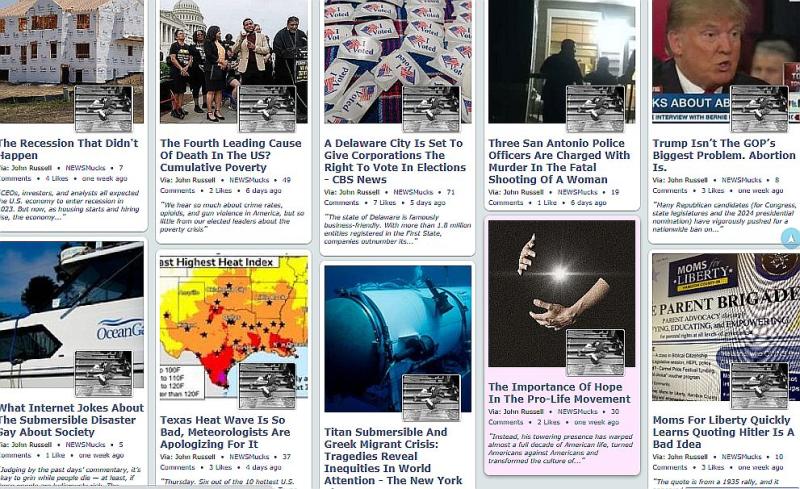
I didn't say your seeds, I questioned if you are able to have a conversation (in any seed) without bringing up Trump. I looked at your comment history and it shows you have commented in 11 seeds so far for the month of July. Out of 11 of them, you have typed Trump in five of them and a sixth one was another "bash Trump" seed. So over half of your entries so far this month included Trump.
So I guess that answers the question, yes you can hold conversations without bringing up Trump but you are more inclined to add in Trump than not. But hey, nice cherrypicking up there.
I agree.
Exactly, so I’m still allowed to comment unlike later in the month.
“ I looked at your comment history and it shows…”
…someone needs another hobby.
Meh....who cares
That's a lot to say "yes, you answered my question over and over until you answered it to my liking."
But you haven't used the exact words he is looking for so it doesn't count. He has also tried to lead me down the same rabbit hole more than once. That tactic ranks right up there with the people that misinterpret your post to try and get you to defend a comment you never made. Pretty bush league but is seems to make them feel smart.
Exactly. Sometimes after 45 minutes of not getting it quite right I just ask my wife exactly what she wants me to say. Some people here seem to use the same tactic.
How does extreme projection differ from regular projection?
Your post is a lie; and it is more whining.
When you deflect from a question, you have not answered the question. Consider answering an easy, clear question instead of whining that you were asked.
So asking you if Trump was wrong to claim the 2020 election was rigged, that millions of voters were disenfranchised and that Biden is not the legitimate PotUS is leading you down a rabbit hole??
How ridiculous.
“That tactic ranks right up there with the people that misinterpret your post to try and get you to defend a comment you never made.”
Funny that.
Have you not read the resident right wing wingman’s imbecilic, incessant, and incoherent commentary?
Just because someone does not answer a question to your liking it does not mean they didn't answer the question, it only means you did not like the answer.
Never said that. Or is that an example of trying to put words into someones mouth and trying to get them to defend something they never said? Good example
But but but....the other guy!
Yeah well you are lying when you say that this boils down to not answering a question to my liking. It was not answering the question at all. Deflection.
And you can whine incessantly about this but next time you deflect from a question, I will bring you right back to the question asked.
Try and remember that Obama won twice and he couldn't have done it without white people.
Tea Party movement , conservative populist social and political movement that emerged in 2009 in the United States , generally opposing excessive taxation and government intervention in the private sector while supporting stronger immigration controls.
A comment from the NYT summed it up nicely
The tea party was born from anger about having a black president and a furious refusal to be led by him. Its members voted against anything the government attempted to do because they wanted to refuse to be led by Obama. All the other rhetoric - which disappeared when a bigot was elected president - was just cover and noise.
Great point. Trump and Obamas policies were indistinguishable. Republicans just wanted them from a white person.
That’s where the demands of a racialist obsession takes progressives, they now have to do a 180 and argue trump and Obama offered identical policies except for their race.
That's BULL SHIT
Yes, great fictional sum up from the propaganda arm of the DNC. Playing the race card, big surprise.
Well, it is from the NYT so.............
The same New York Times that promoted the collusion hoax.
Reality is TDS sells.
Leftist media knows that TDS driven lemmings will hang on whatever they post about Trump (real or fake).
They are giving you what you want- and you are still bitching about it!
No, that is BULL SHIT
They don't care.. Whatever laws they break, whatever violence they commit is always "justified". The long and the short of the modern progressive is they don't believe the Constitution. laws, or norm, or any rules actually apply to them because they believe they are, in effect, holy warriors whose ultimate cause justifies any transgression against the rules that apply to others. Much like Stalinists.
Look at the reaction the AA decision. Just anger at those who won't go along with their racialist plans and almost a complete refusal to even acknowledge their desire to continue systematically discriminating against Asians.
As I can attest to first hand: they can be very nasty.
(Why's everybody always pickin' on me?)
The entitled should just be quiet
I think you found the theme song for the perpetual victims at the next democrat convention.
The lyrics seem appropriate for that fun fest in Chicago:
Don't know much about history
Don't know much biology
Don't know much about a science book
Don't know much about the French I took
But I do know that I love you
And I know that if you love me, too
What a wonderful world this would be
Don't know much about geography
Don't know much trigonometry
Don't know much about algebra
Don't know what a slide rule is for
But I do know one and one is two
And if this one could be with you
What a wonderful world this would be
Now, I don't claim to be an A student
But I'm trying to be
For maybe by being an A student, baby
I can win your love for me