
Statue of Black teen who fought segregation replaces Robert E. Lee at U.S. Capitol



 S E E D E D C O N T E N T
The symbolism was hard to miss: In the halls of the U.S. Capitol on Tuesday, the statue of a Black teenager who fought against segregation replaced a Confederate general who fought to preserve slavery.
Barbara Rose Johns was only 16 when she led a walkout in 1951 to protest horrendous conditions at her segregated high school for Black students in rural Farmville, Virginia. Students complained to the NAACP, and their case went all the way to the Supreme Court, part of the set of cases known as Brown v. Board of Education that struck down school segregation.
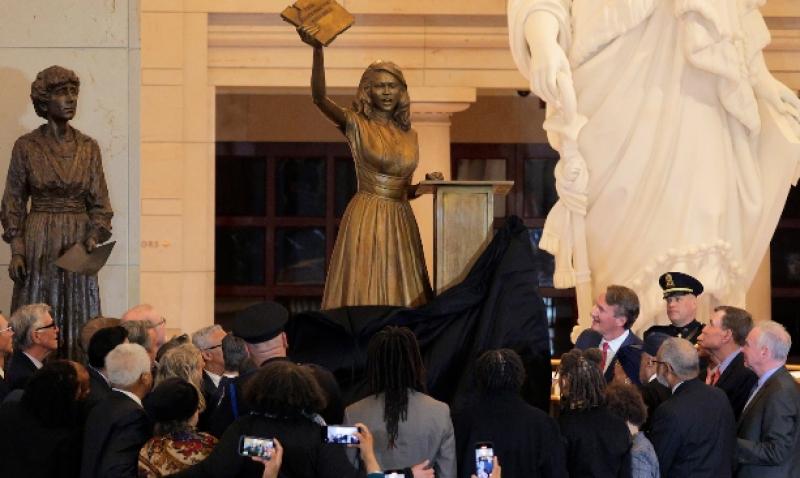
Tuesday afternoon, a statue of Johns was unveiled at the Capitol to replace one of Confederate Gen. Robert E. Lee that had stood for more than a century. Every state is represented by two statues in the halls of the Capitol building, and Johns joins George Washington to represent Virginia.
“The Commonwealth of Virginia will now be represented by an actual patriot who embodies the principle of liberty and justice for all, and not a traitor who took up arms against the United States,” said House Minority Leader Hakeem Jeffries (D-New York).
A crowd of hundreds gathered in Emancipation Hall, named for the enslaved workers who helped build the Capitol, including about 200 members of Johns’s family — one of the largest gatherings ever assembled there for a statue unveiling, said House Speaker Mike Johnson (R-Louisiana).
Cheers rang out when the statue was unveiled. There was Johns , who died in 1991, frozen in time — her right arm lifting a book to the sky as she stands beside a podium to rally her peers. The pedestal of the statue quotes Scripture: “... and a little child will lead them.”
In a few days, the statue will move to the Crypt, where Lee stood until he was removed in the middle of the night almost exactly five years ago.
For the Johns family and the Farmville community, the fact that her name is spoken alongside Washington’s was stunning — and also fitting.
“The notion of one of the founders of our country being paired with one of the saviors of the soul of our country — I think it’s a really, really powerful juxtaposition,” said Cainan Townsend, who runs the museum in the former Farmville high school where Johns took her stand. His own father was locked out of school there after the Supreme Court issued its ruling in Brown , when White leaders shut down the system rather than desegregate.
Today, the Trump administration has told schools that efforts to address racial inequalities are illegal. Any effort to consider race in constructing policy, the Justice Department says, amounts to racial discrimination.
Virginia Gov. Glenn Youngkin (R) was a leading figure in the backlash to that 2020 reckoning. He campaigned against teaching critical race theory, a term used to describe a range of topics related to systemic racism. Once in office, he ended diversity, equity and inclusion efforts in state agencies and public colleges and universities.
At Tuesday’s ceremony, Youngkin recounted visiting the school site where Johns took her stand and recalled the courage she had to muster to lead her classmates in protest of “the lie of separate but equal.” Separate was not equal, he said: “It never was, it never is and it never will be.”
In an interview ahead of the event, Joan Johns Cobbs, 87, remembers the fear she felt in 1951 when her older sister Barbara led that walkout. “It was dangerous for Black people to stand up,” Cobbs said in an interview Sunday, as she and her husband prepared to drive to D.C. from their home in New Jersey to attend the ceremony.
But she said Barbara never showed any fear. They were a farm family — poor, mostly working tobacco — and because their mother regularly traveled to D.C. for jobs, Barbara was left supervising her younger sister and three younger brothers.
Steven Weitzman works on the statue. (Bill O'Leary/The Washington Post)
“We always perceived her as being bossy,” Cobbs said. “She was thrust into a role at an early age that caused her to sort of be aloof from us, because she had to reprimand us.”
The situation made Barbara Johns reserved, stubborn and filled with determination, she said. “She always acted as if she wasn’t afraid of anything.”
When she saw White school kids speed by in their comfortable school buses, carrying new books and studying in heated and clean classrooms, Barbara Johns realized that the drafty, tar-paper-covered facilities where Black students huddled were unacceptable. She arranged for friends to get the principal summoned downtown one day, then rallied more than 400 fellow students to walk out in protest.
Later that year, a friendly White farmer warned the girls’ father that Barbara was in danger, Cobbs said, so she was sent to stay with a relative in Alabama — her uncle, civil rights activist Vernon Johns — for her senior year of high school.
Johns’s complaints contributed to what became one of the Supreme Court’s most revered decisions, but the legacy of Brown is mixed.
“It’s very clear that many of our leaders today are more comfortable celebrating Brown as a symbol than actually worrying about whether we’ve achieved the promise of the case,” said Ary Amerikaner, executive director of Brown’s Promise, a nonprofit that is working to challenge school segregation.
Last year, the Civil Rights Project calculated that 20 percent of all U.S. schools were “intensely segregated” as of 2021, meaning White students make up 10 percent or less of the student body. These schools were far more likely to educate students with the fewest advantages and most needs — in 2021, 78 percent of them were poor.
So although today’s school segregation is not remotely comparable to what it was in 1951, experts say the problem has not been solved.
“The story that we tell ourselves about Brown is one of struggle, victory, success,” said Genevieve Siegel-Hawley, an expert on school segregation at Virginia Commonwealth University. “We sort of leave it there and don’t explore the contours of modern-day segregation.”
Lluvia Pinzon, left, works on the statue. (Bill O'Leary/The Washington Post)
On Tuesday, Rep. Robert C. “Bobby” Scott (D-Virginia) recounted Virginia’s resistance to desegregation and asked members of the audience who were denied an education when the schools were closed to stand. At least a dozen people in the audience did so.
Yet if Johns, now standing in bronze, simply represents an idea or an aspiration, that has value, said Wil Del Pilar, senior vice president at EdTrust, an advocacy group that promotes racial equity programs.
“Even if it’s just a symbol, it becomes important, especially for those people who don’t see themselves reflected in those spaces,” he said. “Symbolism can give us hope for a new day.”
That was true for state Sen. L. Louise Lucas (D-Portsmouth), who, as a Black girl growing up in Virginia during Massive Resistance — the period of organized refusal to comply with Brown — heard about Johns from relatives. “You have no idea the pride I feel” to see that statue going up in the U.S. Capitol, Lucas said.
For decades, Johns was virtually unknown. Her old Robert R. Moton school was nearly demolished 25 years ago, then preserved as a museum in conjunction with nearby Longwood University. But in recent years, the honors have multiplied.
Today an image of the Moton School has been incorporated into the Prince Edward County seal and flag. The school is among a list of about a dozen civil rights landmarks across the country that are in the process of being considered as a collective UNESCO World Heritage site.
Former Virginia governor Terry McAuliffe (D) said he didn’t know about her until after he was elected, but he became an admirer and cited her in speeches. He presided over the renaming of the state building that houses the Virginia attorney general’s offices in her honor.
“It’s time to move on,” Northam said in an interview. He was among a phalanx of Virginia politicians at Tuesday’s unveiling.
Also among them was Sen. Tim Kaine (D), who five years ago went to the Capitol in the wee hours of the morning to witness the statue of Lee being removed from its pedestal. Virginia House Speaker Don Scott (D-Portsmouth), the first Black person to hold that office, was there, too.
“Even during this moment when people are trying to go backwards, these green shoots of history and truth still come through,” Scott said in an interview. “That’s what’s so powerful about this moment.”

Tags
Who is online
92 visitors
The Robert E Lee fan club is upset.
It always confuses me that the same people that want to honor Confederate generals and such because of "history" are the same ones trying to rewrite "history" to remove the concept of slavery from it.
Robert E. Lee owned slaves, and commanded the armies of a government dedicated to the preservation of chatel slavery. Gentlemanly manners do not change those realities.
I have seen anything about Bill Clinton being upset about it.
Probably, seeing they are still mad Republicans freed their slaves 160 years ago.
ohhhh....trmp is gonna blow his wig off his head
Let's salute the moral bravery of the people who brought off this remarkable gesture for human rights.
I wonder how long it will take for Trump to fire them.
And gold plate the statue.
At Tuesday’s ceremony, Youngkin recounted visiting the school site where Johns took her stand and recalled the courage she had to muster to lead her classmates in protest of “the lie of separate but equal.” Separate was not equal, he said: “It never was, it never is and it never will be. ”
Then why are universities reverting back to segregation?
"We at the National Association of Scholars (NAS) recently launched Separate but Equal, Again: Neo-Segregation in American Higher Education, a project examining racial segregation on college campuses such as Columbia University, Yale University, MIT, and others. Surveying 173 schools, we found that 42 percent offer segregated residences, 46 percent offer segregated orientation programs, and 72 percent host segregated graduation ceremonies. We call this “neo-segregation”: the voluntary and institutionally sanctioned segregation of minority students in the post– Brown v. Board era."
American Colleges Offering Segregated Dorms and Graduations | National Review
Anyone?
[✘]
Prove that statement.
[✘]
Gee, Vic...
Are you implying that racism is intrinsic, systemic, in America?
Are you woke, Vic?
Gee, Bob ...
That's a strange interpretation.
60 years after the US abolished segregation in the south, American universities now offer it to black students who seem to demand it.
So, the obvious questions, Bob, are the following:
Was segregation racist to begin with?
Are universities now racist?
Are black students now racist?
Am I getting through to you, Bob?
No. Irrelevance never does.
Unremarkably, your comment has virtually nothing to do with the seed.
The subject of your seed was an active fighter against segregation. In many American universities today segregation is demanded by black students. The question is valid:
Is segregation still a form of racism?
For his next trick DJT will posthumously deport her back to Africa for being such an ingrate.
Sara Stock is described as a C List MAGA influencer who has nonetheless drawn the favorable attention of the vice president of the United States.