
Battle of the Little Big Horn

 S E E D E D C O N T E N T

June 25, 2026.
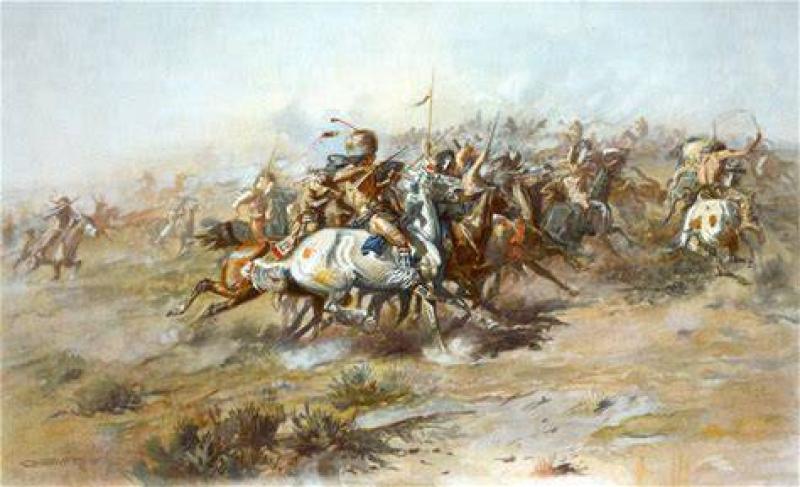
Today marks the 150th anniversary of the Battle of the Little Bighorn in 1876, when Lieutenant Colonel George Armstrong Custer, who led the 7th Cavalry, lost his entire command to Lakota warriors after falling on them unexpectedly in their own territory. The only Army survivor of the battle was a horse, Comanche, who became the 7th Cavalry's mascot,trotted out draped in ceremonial black for years after the event itself. The road to the Little Bighorn started during the Civil War. In 1862, Santee warriors in Minnesota rose up against settlers there after the U.S. government, financially strapped by the Civil War, stopped providing the food promised to the Santee's by treaty.
Soldiers put down the Santee Uprising, now known as the Dakota War, brutally, and terrified survivors fled west to what is now Montana to take shelter with their relatives, the Teton Lakotas.The Tetons welcomed their eastern relatives, but discounted their horrific tales of the revenge enacted on the Santee insurgents, although the army had, in fact, hanged 38 Santes in December 1862 in the largest mass execution in American history. The Tetons rarely saw an American, and they could not believe the lone traders who passed through their territory were a threat.
Teton nonchalance ended abruptly in November 1864, when northern Cheyennes, their allies to the south, straggled into Teton villages with even worse stories than the Santis had told. Stories of the massacre of women and children at Colorado's Sand Creek, where drunken soldiers first killed surrendering Cheyennes and then mutilated their bodies, taking human remains as trophies. By 1864, American miners were pushing into Teton territory over the new Bozeman Trail that stretched from the old Oregon Trail up to the Montana gold fields. Stories of the Sand Creek Massacre convinced the Tetons that the interlopers must be resisted.
By 1865, the conflicts, now known as the Lakota War, had escalated to the point that after Confederate General Robert E. Lee's surrender at Appomattox Courthouse, Army leaders transferred General William Tecumseh Sherman from the southern battlefields to the plains. To his intense frustration, he found it impossible to protect both the Union Pacific Railroad, which stretched across the middle of the country, and the Bozeman Trail, which went north, from Lakota attacks. Caught between these two necessities, the government chose to protect the railroad. In 1868, it abandoned the Bozeman Trail, allowing the Lakotas to control what became known as the Great Sioux Reservation. This reservation covered most of the land from the Missouri River that runs through the center of what is now South Dakota, west to the Bighorn Mountains.
The treaty each signed guaranteed that land to the Lakotas forever. Forever turned out to be short. Rising Lakota leaders Sitting Bull and Crazy Horse vowed to keep Americans off their land, but miners wanted gold and businessmen wanted railroads. By 1874, army officers decided to build a fort in the Black Hills to intimidate the warriors skirmishing with intruders.
In 1875, they sent out the boy general, George Armstrong Custer, along with a thousand soldiers, teamsters, scouts, and reporters to find a place to build. Custer brought back ideas for a fort, but more importantly, he also brought back news of gold in the hills, hills that belonged to the Lakotas. Within months, prospectors in the Black Hills had thrown up boom towns like Deadwood, which attracted about 20,000 people in its first year. The government tried to buy the Black Hills, but Lakota leaders refused. We want no white men here, Sitting Bull said. The Black Hills belong to me. If the whites try to take them, I will fight. Government officials interpreted Lakota refusal to sell, as hostility. In december 1875 authorities told sitting bull crazy horse and other hostiles to report to agencies more than 250 miles away on the eastern side of the reservation by the end of january or to expect war. For their part sitting bull and crazy horse who had never frequented the agencies made no attempt to set off on a long journey in the brutal cold of a dakota winter.
It's not clear they even got the message. So on February 1st, 1876, the War Department commanded the army to subdue the hostile Lakotas. A month later, General George Crook led 800 men into Lakota territory, hoping to fight the indigenous Americans while their ponies were still weak from the winter.
In mid-March, half of Crook's men attacked a camp of Cheyennes on the Powder River, mistaking it for a village of Crazy Horse's men. Cheyenne survivors took refuge with Sitting Bull, who had had enough. We are an island of Indians in a lake of whites, he told his people. We must stand together or they will rub us out separately. These soldiers have come shooting. They want war. All right. We'll give it to them. Sitting Bull sent runners across the reservation, calling men who wanted to fight to meet at the Rosebud River to stand against the soldiers. By spring 1876, thousands of men had rallied to him. In early summer 1876, Sitting Bull's camp was the largest in Lakota history. There were at least 1,400 lodges with individual men sleeping on their own.or as guests in others tepees. Badly underestimating the number of warriors he faced, Crook planned a three-pronged attack. Columns from west, east, and south would converge where the Lakotas were hunting. Crook's plan was wounded on June 17th when his own column, moving up from the south, crossed Lakota warriors near the Rosebud River.
In a confusing battle obscured by dust and gunpowder, the Lakotas managed to knock Crook's men out of the campaign for the next six weeks. Those weeks would prove crucial. As the other two columns continued their march, indigenous Americans celebrating the outcome of the Battle of the Rosebud continued to pour into Sitting Bull's camp, bringing the numbers up to about 7,000 people, 1,800 of whom were warriors.
In the vibrant atmosphere, families visited, couples courted, and warriors danced. The numbers meant that the Lakotas and their allies had to keep moving to provide enough food for the horses. By June 24th, they had settled on the river they called the Greasy Grass, the one soldiers knew as the Little Bighorn.
Unaware of the two columns approaching, the Lakotas were watching Crook's soldiers, but knew his battered troops were hunkering down. On June 25th, a hot, buggy day, the Lakotas were lazing, the women digging wild turnips and the men swimming and lying about in the heat, when Custer's troops fell on one end of their mile-long encampment. The soldiers cut down some women and children, but the Lakotas mounted their horses quickly.
Custer had divided his men into three battalions. He had sent one under Captain Frederick Bentine up the valley and out of action, and sent one under Major Marcus Reno to attack the camp. Recovering from their initial surprise, the Lakotas chased Reno and his men into the bluffs on the other side of the river. Then Custer's battalion entered the fight. Custer ordered his men to dismount.
The Lakotas promptly stampeded the Army horses. Then, surrounding the desperate troops, the Lakotas killed the soldiers to a man. The U.S. Army lost 263 men that day, the Lakotas about 40. I feel sorry that too many were killed on each side, Sitting Bull said. But when Indians must fight, they must.
=======================================================================================
Letters from an American was written and read by Heather Cox Richardson. It was produced at Soundscape Productions, Dedham, Massachusetts. Recorded with music composed by Michael Moss.
Tags
Who is online
85 visitors
I doubt this battle made its way into Freedom 250's American history timeline.
Likely not , unless its just local recognition or from the NA perspective .
Custer made the same mistakes made 10 years earlier by Fetterman , out of Ft Phil Kerney in 1866 on the Bozeman .
Took a nice small basket 8 point Wt buck last hunting season on the old Bozeman trail about 3/4 mile from Fetterman massacre site and 5 miles from the fort .
Should it? Did the waxhaws massacre? did the Malmedy massacre or the Baataan death march?
American Indians are Americans. Their history, from their viewpoint, belongs in any honest history of this country.
Your two examples are red herrings.
So should we celebrate confederate victories? Especially massacres like fort pillow?
they were Americans too!
I dont know who you think is celebrating anything.
Now you are comparing American Indians to the Confederacy. There is no respite from the madness.
Isn't that the Freedom 250 timeline is? A celebration of American history? Maybe I'm wrong. I don't know much about it. You brought it up. Explain your point. Does it include other massacres of American soldiers? What other war crimes committed against Americans are included?
re comparing American Indians to the Confederacy. T
The comparisons are obvious. They both killed American troops. Confederates are also Americans who killed American troops.
It all depends on the thoroughness of the timeline.
Certainly, "Tarleton's Quarter" real or imagined became the South's version of "Remember the Alamo", propaganda vastly increasing anti British sentiment and greatly increasing recruitment for the cause of the Revolution.
Malmedy occurred very late in WWII and illustrated the frustration and exhaustion of the Waffen SS unit that tried to execute 400 Americans in a snowy field. 90 Americans escaped. But the news spread like wildfire and American retribution in the field for the last few months of the war made many of the SS ditch their uniforms for fear of retribution. It happened.
The Bataan Death march grossly illustrated the disparity between reality, race and politics. Between 5,00 and 18,000 Philippine soldiers died on the Death March as opposed to estimates of 500 to 650 Americans. At their destination, Camp O'Donnell 26,000 more Philippine soldiers died compared to 1,500 Americans. Again the Americans used the events for propaganda to sell War Bonds.
All History deserves to be told as truthfully as possible.
No Sean - the comparisons ARE NOT obvious.
"Other massacres of American soldiers"???? White guys killed over 120 MILLION Native Americans just to show how powerful the white dynasty is/was.
How 'bout talking to your white government to find out just why they have to be the big dog in the fight - all fights - including all the deaths of Vietnam, Europe, Asia, Middle East, etc. - white guys killing white guys just to show that their dingle dangle is the biggest one on the block.
But white and Native American "battles/massacres" are always started the exact same way - EACH AND EVERY TIME - whites want something, so they just take - period - regardless of who it belongs too - specifically when it comes to Native Americans.
Custer knew, explicitly, that he was violating the 1868 treaty between the white guys and the Native Americans and his main goal was to WIPE OUT the Native Americans. Not to bring them back to the reservations - but to WIPE THEM OUT.
Historical evidence and tactics suggest a key element of Custer’s battle plan was to target the noncombatants (women, children, and the elderly) to use as leverage and human shields, forcing the warriors to surrender.
Not the same with the Civil War when white brother was fighting white brother, where 620,000 to 710,000 white brothers killed their own brothers because of the white attitude of "I'm a bigger badass than you are."
All about being on top.
We've had this discussion before and it's always the same - and the other details of domination because of sovereignty always raises its head in favor of the white guys.
History, as written by the white population, will ALWAYS exclude the fact that Native Americans are sovereign to their nations/tribes AND to the U.S government (1924 American Indian Citizenship Act) and the U.S. government and Constitution has recognized that - but the government still refuses to accept that as a legal fact.
Again depending on how much space is devoted to the time line, the Civil War is central to what we have become.
Confederate victories were numerous in the first few years and always acknowledged.
Including treason would be misconstruing the recognition of what the North considered to be un Constitutional behavior by the CSA which it only recognized on the battlefield.
Especially Fort Pillow, where Nathan Bedford Forrest when asked to parley the surrender of the Fort, attacked and refused to accept the surrender of some 270 Black Union soldiers, who were given no quarter. Now the Union did not use the incident as propaganda but refused to participate in any more prisoner exchanges.
Black troopers knew that surrender was no longer an option and recruitment increased anyway.
Those are the American stories that should be told and remembered.
Of course. It's extremely important. But I'm trying to understand what John meant by dismissively bringing up the Freedom 250 American history timeline.
We are approaching the anniversary of the First Battle of Bull Run (a massive confederate victory, not known for atrocities though) which essentially started the mass combat phase of the war and ensured it wouldn't end quickly. Will John post an article commemorating that and highlighting the heroics of Thomas Jackson, who earned the nickname Stonewall for his performance there? Will he be mad the 250 American timeline won't cover it?
Especially Fort Pillow
Yes exactly.
, where Nathan Bedford Forrest when asked to parley the surrender of the Fort, attacked and refused to accept the surrender of some 270
Let's get the facts right though. Forest Demanded the surrender of the Fort and the acting Union general commander refused. Forrest attacked and overwhelmed the defenders. Many, black and white, were killed while fleeing the battlefield. Though unlike Little Big Horn, some quarter was given and not all troops, black or white, were exterminated.
The point being American troops were massacred and what we consider war crimes were committed, Just like at Little Big Horn.
Literally none of that is true, but this is about American history not "white people from Spain bringing over diseases that native populations had no immunity to"
your white government to find out just why they have to be the big dog in the fight - all fights - including all the deaths of Vietnam, Europe, Asia, Middle East, etc. - white guys killing white guys just to show that their dingle dangle is the biggest one on the block
What do you imagine North America was like before those evil "white governments" showed up?
was violating the 1868 treaty between the white guys and the Native Americans
Sitting Bull was intentionally violating the treaty as well.
Irrelevant.
I didn't realize that the anti-American conspiracy thinking had become so ingrained that the massacre at Waxhaws is now considered possibly imaginary.
heir destination, Camp O'Donnell 26,000 more Philippine soldiers died compared to 1,500 Americans. Again the Americans used the events for propaganda to sell War Bonds.
WTF does that have to do with anything? Of course the AMERICAN government focused on the atrocities committed upon AMERICAN soldiers.
But if the standard is the Bataan death march can be waived away as just "propaganda" because only thousands of American were killed in horrible conditions,. then so much history needs to be rewritten..
Of course it isn't. We know how war ravaged and violent it was. To claim "white people" are somehow unique in engaging in war is silly. White people were just really good at it.
The true equation is Forrest = Custer.
The Indians at Little Big Horn were the attacked, not the attacker. Thats just one of the things wrong with your comparison.
American Indians are Americans, why do you object so much to their story being told. Embarrassing much?
Does being the defending army mean its acceptable to not give quarter? Can you cite where that comes from?
I guess, to talk about Fort Pillow in the progressive approved way, you should describe it as the "real or imagined massacre at Fort Pillow that the American government exploited for propaganda purposes."
merican Indians are Americans w
So were confederates. What does that have to do with anything?
Why do you object so much to their story being told. Embarrassing much?t's your point?
I don't at all. The opposite really. I read "Empire of the Summer Moon" a few months ago. I think it'd be a great book for kids in the southwest to be taught in high school. Just tell the whole story. The story of Little Big Horn includes the massacring of American troops who tried to surrender and the desecration of their bodies.
C0-pilot
George Armstrong Custer participated in and commanded operations that resulted in the killing of Native Americans , including non‑combatants, during the Indian Wars. Historians do not all use the word “massacre” for every incident, but several of Custer’s actions meet the criteria many scholars use for massacres : disproportionate killing, targeting villages, and deaths of women and children.
Below is the precise, factual breakdown.
⚔️ 1. The 1868 Washita attack — the clearest case
The strongest historical evidence involves Custer’s attack on Black Kettle’s Cheyenne village on November 27, 1868 .
What happened
Custer led the 7th Cavalry in a dawn assault.
The village contained men, women, and children .
Black Kettle and his wife were killed.
Multiple eyewitnesses (Army scouts, Cheyenne survivors) reported non‑combatants shot while fleeing .
Custer ordered the destruction of the village , including lodges, food stores, and winter supplies.
He took 53 women and children prisoner .
Why many historians call Washita a massacre
The attack targeted a peace‑seeking village ; Black Kettle had repeatedly pursued diplomacy.
The killing of civilians was documented by both sides.
The destruction of winter supplies guaranteed additional deaths from exposure and starvation.
Not all historians use the term “massacre,” but many do , and the evidence is substantial.
They killed every soldier in Custer’s immediate command because the battle conditions made it a fight for survival, not a selective engagement — and Custer’s battalion was completely overwhelmed, isolated, and unable to retreat. This wasn’t about “killing every single soldier” as a special objective; it was the natural outcome of a chaotic, close‑range battle in which one side was vastly outnumbered and surrounded.
Why Custer’s battalion was wiped out
The sources make the reasons very clear:
1. Custer attacked a massive village he didn’t realize was there
Custer believed he was facing a few hundred warriors. In reality, more than 1,000 Lakota and Cheyenne fighters were present, part of a camp of over 10,000 people gathered in defiance of U.S. orders.
He split his regiment into three parts — a fatal mistake — leaving his own battalion isolated.
2. The Native forces responded immediately and decisively
When Custer’s men approached, Crazy Horse and other leaders led a large force straight at them, while Sitting Bull ensured women and children were moved to safety. The warriors quickly encircled Custer’s position.
3. Custer’s men were overwhelmed and unable to retreat
The fighting was at extremely close range, in broken terrain of ravines and ridges. Once surrounded, Custer’s 210–267 men had no defensive position, no reinforcements, and no escape route.
In such conditions, annihilation is a common outcome in 19th‑century frontier warfare.
4. This was a battle for survival and sovereignty
The Lakota and Cheyenne were fighting to protect:
Their families in the village
Their treaty‑guaranteed lands (the U.S. had violated the Fort Laramie Treaty)
Their way of life, threatened by miners, settlers, and forced reservation policies
They had already been declared “hostile” by the U.S. government for refusing to abandon their lands.
In that context, once the fighting began, they fought until the threat was eliminated — which meant Custer’s battalion was destroyed.
5. Other parts of the 7th Cavalry were NOT wiped out
Only Custer’s five companies were annihilated. Major Reno and Captain Benteen’s forces survived because they fought from a defensible hilltop position and were not surrounded.
This shows the Native warriors were not trying to kill “every soldier,” but were responding to the tactical situation.
The bottom line
Custer’s battalion was wiped out because:
He attacked a vastly larger force
He split his regiment
His men were surrounded
The Native warriors were defending their families and homeland
The battle conditions made survival impossible for Custer’s isolated command
This was not a massacre — it was a battle, and Custer’s tactical decisions made his defeat total.
This was not a massacre — it was a battle
the massacre happened after the battle was lost, like at fort pillow.
Do you think the Indians who survived were lying when they talked about soldiers being killed while trying to surrender?
moreover, Simple common sense will tell you that not all soldiers were killed while fighting. Many were definitely wounded and probably incapable of fighting before the battle ended That zero survived tells there was a concerted effort to kill the wounded.
native americans did a great job in making sure that most irish immigrants didn't die from cirrhosis of the liver ... /s
Maybe you should have majored in history instead of assuming what you see in the movies is accurate.
American success was sometimes tied to breaking the accepted rules of engagement at the time.
The Europeans held officers, especially mounted officers as non combatants and non targets.
That did not fly with our ancestors as many were veterans of the French & Indian Wars and were known to target officers first.
At Waxhaws Tarleton was being his usual reckless self, leading form the front when the colonists shot and bayonetted his charging mount.
He fell, pinned under the horse and his men reacted with rage and fury that their officer was not only down but the Americans were shooting at him while trapped
under the mount. There is no evidence that Tarleton ever ordered captured or surrendering troops to be killed.
The surge of his Tories and regular British swept the Americans away and for whatever reason, unrestrained by Tarleton, some of his militia killed Beuford's surrendering troops.
From Wikipedia
Please note that 53 were captured, hence, not executed, murdered in cold blood or massacred, or denied quarter.
The Presbyterian church at Waxhaw's was burned to the ground but there is no evidence that the congregation was locked inside. Tarleton hated and burned everything Presbyterian including a large number of churches, shops and homes with or without their occupants.
Tarlton relished his legendary status as much as British Generals hated it. Tarleton in fact burned almost as many Anglican/ Church of England churches and rectories with imaginary excuses of sedition or lack of reporting to the Crown.
Tarleton escaped to England as a national hero, eventually becoming an MP.
90 some years later, William Tecumsah Sherman would emulate Tarleton by burning his way from Atlanta to Savannah using two parallel armies
many times burning the same churches that Tarleton once had.
Just say: "You were right." Save me the trouble of all bothering with all that lead up and dishonest framing.
he Presbyterian church at Waxhaw's was burned to the ground but there is no evidence that the congregation was locked inside.
Who claimed otherwise?
They were also hyper vigilant because they knew they were trespassing in Crow territory and fully expected an attack from the north where the Crows were.
Custer and Renos scouts were trying to get the Americans to attack first.
Reno attacked from the South and fucked that up.
Custer for whatever reason went north past the village and circled around to what he believed was the northern ford over Reno Creek.
It was however in the middle of the village.
The Indians themselves said that a Buckskin clad officer and the man with the Guidon were shot off of their horses approaching the ford.
Custer had a single fatal bullet wound to the chest that likely bled out. He also had a bullet wound to the left temple that did not bleed ( he was right handed so it was not suicide)
They were evacuated by other troopers and retreated to where the Indians simply attacked for hours.
Several times Custer's troops signaled by rifle volley for help, but Reno stayed put roughly 4 miles away.
Shit happens without communication.
The Cheyenne called Custer "Attacker at Dawn" because of the Washita Massacre of 1868, in which he attacked and killed Cheyenne Chief Black Kettle's camp and captured 53 women and children. According to Native testimonials, many women were raped as their village burned. This attack despite the fact that Black Kettle was peaceful, had signed the Treaty of Fort Wise and moved his people to the Sand Creek Reservation in Colorado as instructed. He was given both a white flag of truce and an American flag and told to fly both above his lodge to make clear his was a peaceful village. Both were flying when his camp was attacked and he and 160 mostly women and children (although the exact numbers are hotly contested) were slaughtered. Most warriors were away hunting game.
After the Battle of the Little Bighorn, Buffalo Calf Road Woman, according to Cheyenne oral history, kept Custer's saber. In the days and years to follow, she wore it honorably hanging from her leather belt. This woman was highly respected by all for her warrior deeds. For the many generations since the Battle of the Little Bighorn, Cheyenne women have continued to honor and remember her by wearing a leather sheaf with silver drops on their side attached to their leather belts. Aho!
Who Killed Custer? It May Surprise You: PART 2
To the Cheyenne, the White Flag had no power and Custer had no honor, killing him and everyone with him attacking another Indian village were not spared.
An eye for and eye.
Tarlton never ordered the killings, that legend came later, that legend was the "dishonest framing".
The Movie "The Patriot" and those that think Tarleton did it.
But nice deflection
No you aren't.
This Administration has made no secret of ignoring the history of what is significant to ALL Americans, not just what they perceive as the white male christian class.
The current military officer corps has been systematically stripped of diversity, female officers and minority officers.
The White House replaced historical markers with rewritten histories according to them.
Pictures and paintings of blacks like Obama or General Daniel James Jr., the first African American four-star general in the U.S. Air Force moved or dissapeared with the Tuskegee Airmen.
It is the Administration's lack of appreciation of history that is dismissive.
Sorry I missed this imaginative version of the battle.
First of all the position was intended to protect the river. In design it was terrible to defend from behind because the parapets were too wide. Troops had to crawl across the surface of the parapet to shoot downhill. This exposed them to sharpshooters on the adjacent higher hill. Ditto, despite the cannon slits in the parapet the cannons could not be lowered enough to be effective against approaching troops.
Major Booth, the commanding officer, was one of the first casualties from a sniper.
Forrest had no idea that Major Bradford, the commander of the two Colored Artillery units had only arrived two weeks ago and was now in command. Without identifying himself he asked for an hour to consider.
Forrest offered 20 minutes.
At that point Forrest was informed of another union gun boat coming up the river and ordered an all out attack fearing Union reinforcements.
No doubt.
The first confederates reached the ditches around the three parapets; the second wave climbed onto their shoulders and the third wave leapt on to the parapets now pulling up their brothers who all fired at once upon the trapped Union troops.
So it wasn't a massacre?
Factual but not correct. Despite Forrest's own dishonestly phrased after action reports, 60% of the 300 white Union soldiers were captured within the fort.
Only 20% of the 300 black Union soldiers were captured. As they begged for their lives one after another, expecting to be returned to slavery, they were shot dead.
General Braddford, out of ammunition, attempted to surrender his sword and was shot.
A third of the blacks and remaining whites went over the bluffs edge down the steep embankment to the gun boat New Era which was supposed to provide cover fire, but its sailors were hiding inside, also subject to the snipers, now from two directions. Practically no one made escape in this direction.
It was Forrest who claimed that he killed 500 black troops, dozens of citizens, women and children unfortunate enough to have sought refuge at the fort and warned that the North should reconsider arming the Negros.
But that too was a lie, factually, by the numbers and belies the fact that all civilians had been removed by barge upriver two days before.
So it was an atrociously morally reprehensible act of racism by Forrest and his troops but if there were 226 survivors out of 600, was it really a massacre?
And nothing was gained. The Fort was poorly designed and indefensible, now littered with over 200 bodies, blood and brains, Forrest's own troops were sick form it.
They abandoned the fort the same evening leaving the American Stars and Stripes still flying over Ft Pillow, supposedly a sign it had never surrendered.
Facts matter.
Thanks for confirming everything I wrote was correct. Again, you don’t have to waste your time confirming it.
Tarlton never ordered the killing
so what? He was in command and as you cut and paste, he did not restrain his men from massacring the Americans.
The Movie "The Patriot" and those that think Tarleton did it.o
[deleted][✘]
Ah yes - the "Battle" of Washita
At daybreak on November 27, 1868, the 7th U.S. Cavalry under the command of Lieutenant Colonel George Custer attacked a Cheyenne camp of 51 lodges on the Washita River in Indian Territory (present-day Oklahoma). Custer's troops were able to take control of the village quickly, but it took longer to quell all remaining resistance.
Women and children were killed, as Custer acknowledged in his report of the battle, and troops directed to take other women and children who had been captured to a designated lodge in the village to be held under guard as the battle continued. One of the scouts, Raphael Romero, was sent to assure those women and children who had remained in their lodges during the attack that they would not be harmed.
A total of fifty-three women and children were taken captive. There is credible evidence that, following the attack, Custer and his men sexually assaulted female captives. One historian writes, "There was a saying among the soldiers of the western frontier, a saying Custer and his officers could heartily endorse: 'Indian women rape easy.'"
"Mo-nah-se-tah or Mo-nah-see-tah (c. 1850 – 1922), aka Me-o-tzi , was the daughter of the Cheyenne chief Little Rock. Her father was killed on November 28, 1868, in the Battle of Washita River when the camp of Chief Black Kettle, of which Little Rock was a member, was attacked by the 7th U.S. Cavalry under the command of Lieutenant Colonel George Armstrong Custer. Mo-nah-se-tah was among the 53 Cheyenne women and children taken captive by the 7th Cavalry after the battle.
According to Captain Frederick Benteen, chief of scouts Ben Clark, and Cheyenne oral history, Custer "cohabited" with teenage Mo-nah-se-tah during the winter and early spring of 1868–1869 after she and many other Southern Cheyenne women were captured by the US Army at Washita. Mo-nah-se-tah gave birth to a child in January 1869, two months after Washita; Cheyenne oral history alleges that she later bore a second child, fathered by Custer, in late 1869. Custer, however, had apparently become sterile after contracting venereal disease at West Point, leading some historians to believe that the father was really his brother Thomas ."
What are you? Half of what you spouted is legend, not fact.
Forrest was on his way back from Peducah where Hicks told him to bugger off when Forrest sent his demand they surrender or get no qaurter.
Hicks had a properly built fort ( Fort Anderson ) that could easily withstand a siege.
So they moved on to Fort pillow.
There was no general in charge at FT Pillow as you claimed.
Again stop wasting your time and mine with the trollish responses.
Easy Peasy.
You can’t even stick to one story. You make things up, add extraneous pints and then point to some imaginary strawmen you pretend to have defeated.
youve been wrong from the very beginning and and all deflections don’t change from that..
let’s recap:
Let’s ask ChatGPt. Is that a correct?
This is misleading. Forrest did not attack after being asked to parley. Rather:
the next sentence : Now the Union did not use the incident as propaganda but refused to participate in any more prisoner exchanges.
per ChatGPT:
all you’ve done is provide misinformation when trying to rebut what I wrote or simply add facts that either confirm what I wrote or are irrelevant. Quit wasting my time and admit everything I wrote is correct.
Are you being deliberately obtuse?
The Patriots fired in a point blank volley killing Tarleton's horse and second in command instantly.
Tarleton was pinned under a 1,000 lb dead or dying horse for at least several minutes.
His men assumed that both of their leaders were down and dead.
It took Tarleton several minutes to extract himself and then find another horse.
Again what is a massacre? Is it a massacre if they killed one surrendering American, a dozen, but captured more than 50?
What it became was propaganda that Tarleton embraced for his own advancement.
His men assumed that both of their leaders were down and dead
It doesn’t matter. The massacre happened, knock yourself apologizing for tarleton, It doesn't change anything regarding what I wrote. Just another red herring.
Certainly it does or you would stop and go watch the soccer game.
There was a typical battle for that period, both sides armed equally, that does not fit the definition of killing helpless or surrendering people.
Who apologized for anyone?
Well, since you think you are the master of all knowledge, constantly misspelling or leaving out words altogether in your screeds doesn't impress me.
I hope you can see the irony in that comment but I doubt it.
Now please, have the last word.
Certainly it does
It only matters if you care how much blame is assigned tarleton. For purposes of this discussion, that doesn’t matter at all.
There was a typical battle for that
It absolutely was not and the reaction to it by both sides makes that blindingly obvious.
h sides armed equally, that does not fit the definition of killing helpless or surrendering people.
both sides being “equally armed” does not make it permissible to slaughter soldiers who are trying to surrender after the battle is decided. You know that.
constantly misspelling or leaving out words altogether in your screeds doesn't impress me
that’s fine. The fact that my points are correct should.
Just curious - but what does your discussion/obsession about what happened - "Did the waxhaws massacre? did the Malmedy massacre or the Baataan death march?" have to do with John's thread/seed regarding the 150th anniversary of Custer and the Greasy Grass battle???
Do you think Custer and his men were "massacred" at little Big Horn or were they merely receiving their just punishment for Washita?
It wasn't a sneak attack at dawn on a compliant village on the reservation, flying a white flag and the Stars and Stripes. That was a massacre followed by ritual rape.
There weren't any women and children to rape or capture with Custer's 210 men and scouts.
.Custer got what he deserved.
Unfortunately, his widow wrote several books, eventually elevating him to a national hero instead of a racist devil he was.
There's a difference of 100 years. Why should the expansion west be mixed in with celebrations of the founding of the United States?
The American history timelines associated with Freedom 250 are not only concerned with the founding, they span the past 250 years.
That's only a thin excuse to air every friggin' grievance. Donald Trump is better at airing grievances than any rabid progressive.
I have no sympathy for either.
What grievance do you associate with the facts of the Little Big Horn ?
Didn't you read what you seeded?
I read all of it. It seems to me that the article just tells what happened. Do you doubt the truth of the article ?
I read all of it, too. What does the seed have to do with the signing of the Declaration of Independence? The Declaration was signed before there was a United States.
First of all , the seed was written on the 150th anniversary of the battle. It has nothing to do with the Freedom 250 history timelines. I added that observation in the first comment.
Second, the timelines are not confined to the Declaration of Independence. I already told you that.
Granted. But your comment was "I doubt this battle made its way into Freedom 250's American history timeline." Why should this battle make its way into either the America 250 or Freedom 250 timeline?
Why should the timeline be expanded to the history of something that did not exist when the Declaration of Independence was signed?
As I stated, this is just a thin excuse to air grievances. And it's more likely these grievances are seeking political advantage rather than telling history.
ask the people who do the timeline. I'm done with this.
Typical white man response ?
Thanks for seeding it John.
I did not know that the 25th was the 150th anniversary of LBH, then I saw a video was made about it by Heather Richardson and I thought it was a good topic since American history is a current topic (in connection with 250) I have Innoreader, which is usually able to transcribe You Tube videos, and there it is.
This was unfortunately one of the biggest laughs I have had recently.
The word "unexpectedly" has to be the greatest example of one of Sean's "dishonest framing" I have ever seen.
Maybe Custer became the victim of a whim. /s
I suppose you have no grievances. No, you wouldn't. Not as a white man. White, conservative, Christian man
What does that have to do with Freedom 250? I am responding to comment @1 -- "I doubt this battle made its way into Freedom 250's American history timeline."
Why should the battle at Little Bighorn be part of America 250 or Freedom 250 celebrations? Little Bighorn happened 100 years after the signing of the Declaration of Independence.
What are we celebrating? Every damned grievance since July 4, 1776? Even the seeded article is more grievance than celebration of achievement. The victory of Little Bighorn is because "the white man made the Indians do it". There's more information about what the 'white man' did in the seeded article than information about American Indians.
whatever Nerm. If you can't see yourself in the mirror that's your problem not mine
Point out where I have listed any grievances, white or otherwise. I am asking what Little Bighorn has to do with celebrating the signing of the Declaration of Independence? That's not a grievance.
You're the one who jumped on the 'white grievance' band wagon. And it's clear why. Your comment only lends support to what I pointed out about using a national celebration to air every grievance since July 4, 1776,
do you always have to have the last word?
that date represents the result of the first documented national airing of grievances, the declaration of independence ...
symptomatic of a god complex ...
Do you always try to leave a discussion with a snide remark? Is that how you win? That's how Donald Trump does things, too.
And the first rebellion.
I personally think you should have followed John's thread/seed and not jumped into the discussion block with your own complaint about the 250 year thingy and the DoI.
But, that does regularly happen.
I am not the one that brought the '250 year thingy' into the discussion. Read the fist comment @1. How can I follow John's thread and ignore the '250 year thingy'?
Great read!
Thank you John - I "personally" think you did a good job.