
Peter Max, Trippy Artist of Counterculture Era and Beyond, Dies at 88


 S E E D E D C O N T E N T
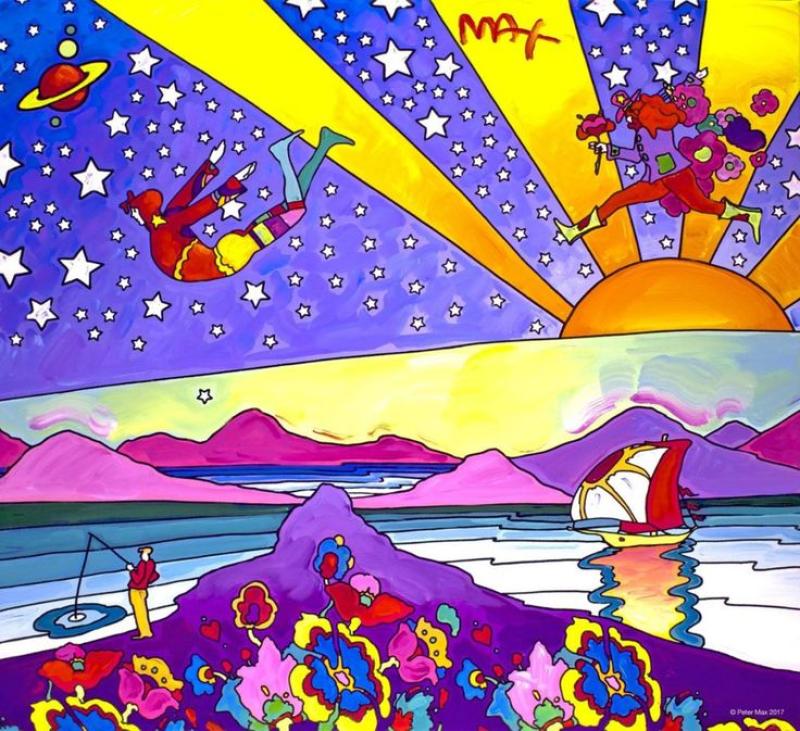
Peter Max , whose trippy posters of Day-Glo flowers, butterflies, rainbows, stars and planets sold by the millions and expressed the blissed-out exuberance of the countercultural 1960s, died on Monday in Manhattan. He was 88.
The death, at a hospital, was confirmed by his son, Adam Max. He had long suffered from dementia.
Mr. Max, a vegetarian and a teetotaler who expanded his consciousness through yoga, not drugs, was one of the most visible and successful artists of his time, selling posters in the millions.
His simple graphic images, brightly colored and infectiously happy, lent themselves to a long list of licensed commercial products, from sheets and glassware and shower curtains to airplanes and, on one occasion, a stamp for the Postal Service.
Incorporating Art Nouveau, Op Art and psychedelic motifs, Mr. Max’s designs offered instant visual gratification and a cheery endorsement of the generational politics of love, joy and universal consciousness. His “panopticon” images repeated visual elements in tight formation, producing a kaleidoscope effect that recalled Easter mandalas.
His “cosmic jumper,” a young man in bell bottoms traversing the globe in giant strides, became an emblem of modern youth, eager to explore the far reaches of inner and outer space. Barefoot and surrounded by puffy clouds and chubby birds, the jumper appeared on the 10-cent stamp commissioned for Expo ’74, the conservation-themed World’s Fair in Seattle.
In “The Universe of Peter Max,” a memoir published in 2013, he wrote: “My cosmic art subjects were always euphoric: Himalayan sages levitating under a shower of flowers beside snowcapped mountain peaks; faces and flowers exploding into a symmetrical cosmic butterfly; mirrored lakes and waters with a cascade of stars and planets; flowers in perpetual states of organic growth, begetting blossoms. My inspiration came from the new youth movement in America and in return spoke to it.”
Peter Max Finkelstein was born on Oct. 19, 1937, in Berlin, where his father, Jakob, was in the import-export business and his mother, Salla (Zeisel) Finkelstein, had been a fashion designer before her marriage. With the rise of Nazism, the family moved to Shanghai, where Jakob set up as a pearl merchant. Peter attended an English-language school and spent much of his spare time talking to monks at the nearby Buddhist monastery.
As the Maoist revolution gathered strength, the Finkelsteins moved again, this time to Haifa, in Israel, where Peter learned Hebrew and, infatuated with the stars and planets, took special courses in astronomy at the Technion, the Israel Institute of Technology.
In 1953, the family emigrated to New York, settling in Bensonhurst, Brooklyn, where Peter attended Lafayette High School. He had taken private art lessons in Israel, and, at the urging of a classmate, signed up for summer classes at the Art Students League in Manhattan after high-school graduation. Abandoning his rather vague plan to pursue astronomy as a career, he threw himself into art.
Initially he painted as a realist, then dabbled in abstraction and finally concentrated on commercial art. Riverside Records gave him his first assignment, to design the LP sleeve for “The Blues Piano Artistry of Meade Lux Lewis,” released in 1962. His moody, vaporous portrait of Mr. Lewis at the piano won a gold medal at the annual exhibition of the Society of Illustrators.
With Tom Daly, he formed a design company that quickly found favor with advertising agencies and book publishers. Within two years, Daly & Max Studio had collected more than 60 awards for its book jackets, album covers and other work, but Mr. Max, feeling constrained, left in 1965. For two years, he lived in virtual seclusion in his duplex apartment on Riverside Drive, turning out thousands of drawing and ideas.

Tags
Who is online
92 visitors
Peter Max was great. A real innovator. His artwork is beautiful. I remember seeing one of his original paintings in the late 70's when I was working with a music management company in an office where the L.A. branch of his business managers rented some space. It was a painting of Mick Jagger and it was very cool.
???
That's not the one as far as I recall, but it was 1978. I think he did more than one version.