
US seen as bigger threat to democracy than Russia or China, global poll finds

By: Patrick Wintour (the Guardian)
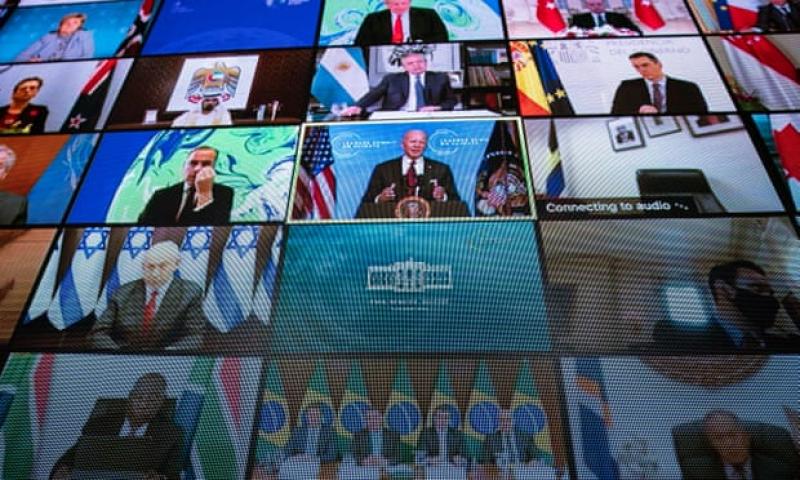


Democracy for fun and profit. Big tech and inequality are viewed as that biggest threats to democracy.
Who's the world leader in big tech and inequality? Never mind. Just tax the world, spend the future for today's profits, and censor what we don't want to hear - and - everything will be fine. Ain't democracy grand?
 S E E D E D C O N T E N T
The US faces an uphill task presenting itself as the chief guardian of global democracy, according to a new poll that shows the US is seen around the world as more of a threat to democracy than even Russia and China.
The poll finds support for democracy remains high even though citizens in democratic countries rate their governments' handling of the Covid crisis less well than people in less democratic countries.
Inequality is seen as the biggest threat to global democracy, but in the US the power of big tech companies is also seen as a challenge.
The findings come in a poll commissioned by the Alliance of Democracies Foundation among 50,000 respondents in 53 countries.
The results will make stark reading for the G7 foreign ministers as they hold a final day of talks in London in which they have collectively assumed the role as bulwarks of democratic values determined to confront autocracy.
The survey was carried out by the Latana polling company between February and April, so a hangover effect of Donald Trump's "America first" foreign policy may linger in the findings. Overall the results show perceptions of the US starting to improve from last year.
Whereas in the spring of 2020 people in both more democratic and less democratic countries were equally satisfied with their government's pandemic response (70%), a year later the approval ratings have dropped down to 65% in less democratic countries, but in more democratic countries the rating has fallen to 51%. In Europe the figure is 45%. Positive ratings reach 76% in Asia.
In perhaps the most startling finding, nearly half (44%) of respondents in the 53 countries surveyed are concerned that the US threatens democracy in their country; fear of Chinese influence is by contrast 38%, and fear of Russian influence is lowest at 28%. The findings may in part reflect views on US comparative power, but they show neither the US, nor the G7, can simply assume the mantle of defenders of democracy.
Since last year, the perception of US influence as a threat to democracy around the world has increased significantly, from a net opinion of +6 to a net opinion of +14. This increase is particularly high in Germany (+20) and China (+16).
The countries still overwhelmingly negative about US influence are Russia and China, followed by European democracies.
The study shows an attachment to democracy globally, with 81% of people around the world saying that it is important to have democracy in their country. Only a little more than half (53%) say their country is actually democratic today - even in democracies.
The single biggest cited threat to democracy is economic inequality (64%).
In almost every country surveyed save Saudi Arabia and Egypt limits to free speech are seen as less of a threat to democracy than inequality.
But half the people surveyed (48%) say the power of big tech companies, as opposed to the simple existence of social media, is a threat to democracy in their country. Among democracies, the US is the most concerned about big tech (62%), but wariness is growing in many countries compared with last year, reflected in broad support for greater regulation of social media.
Voters in Norway, Switzerland and Sweden are most confident their country is democratic, but so are the Chinese, where 71% agree that China has the right amount of democracy. In Russia only 33% think their country is democratic. Global support for Joe Biden's plans to stage a Democracy Summit is high in every country save China and Russia.
The findings will also make disturbing reading for the eastern European democracies such as Hungary where only 31% of voters think their country is democratic - on a par with findings in Nigeria, Iran, Poland and Venezuela.
Anders Fogh Rasmussen, chair of the Alliance of Democracies Foundation, former Nato chief and Danish prime minister, said:
"This poll shows that democracy is still alive in people's hearts and minds. We now need to come out of the Covid-19 pandemic by delivering more democracy and freedom to people who want to see their countries become more democratic.
"The positive support for an Alliance of Democracies, whether the UK's D10 initiative or President Biden's Summit for Democracy, shows that people want more cooperation to push back against the autocrats. Leaders should take note of these perceptions and act upon them."

Tags
Who is online
114 visitors
The United States is a democracy and we'll censor anyone that says otherwise.
that makes sense, or ship
"Democracy" is not binary. It is not "yes or no". There is a spectrum, running from "very little" through "some" and "quite a bit" to "lots". There are flaws, even in the most democratic systems.
The US is a flawed democracy. The extent of the flaws - voter suppression, for example - is currently in public debate. Certainly, there are many other democracies... some of them considerably more democratic than America.
So, voter suppression interferes with the tyranny of the majority?
Democracy and freedom are at odds with each other. A democratic society isn't necessarily a free society. Conversely, a free society isn't necessarily a democracy.
Two different subjects.
Could you cite an example of a free society without democracy?
Tribal and nomadic societies tend to experience a high degree of freedom without democracy.
Decentralized government tends to prioritize freedom over democracy. Centralized government tends to prioritize democracy over freedom. That's the philosophical debate between small government and big government.
It's important to note that Fascism, Socialism, and Communism require a highly centralized, big government. The best defense against Fascism is decentralized small government.
Could you cite a specific example, please?
The silence is kinda deafening, isn't it?
Cherokee, Seminole, Arapaho, Comanche, Apache, Navajo, various Inuit tribes, Hawaii before colonization, several Polynesian societies, Australian Aborigine, Bedouin society, Swahili, Sámi people. This is only a small number of the many examples that can be found of free societies without democracy.
.
Unlike some here, I read what is posted and react accordingly.
Democracy encroaches on freedom. The tyranny of the majority is still tyranny.
Who is advocating for big government mandated by a democratic national majority?
Autocracy requires concentrating political power and authority at the national level, doesn't it? A national majority provides the pathway to autocracy.
That's the lesson provided by Adolf Hitler. The wants of the many justifies sacrifice imposed on the few. Adolf Hitler certainly didn't weaken the national government of Germany. Adolf Hitler is the poster child for government overreach.
We are all well aware of the advantages of a national government. But the lessons of Fascism are that checks and balances are necessary. Decentralized small government really is the best defense against Fascism. Concentrating power in national government (or national political parties) really is the pathway to autocracy; Fascism is only one example.
We can't allow the courts to be packed, as Adolf Hitler did. We can't allow the national government to exert control over local law enforcement, as Adolf Hitler did. We cannot allow national government to exert control over local elections, as Adolf Hitler did. We cannot allow the national government to control the nation's commerce and economy, as Adolf Hitler did. We cannot allow the national government to control education, as Adolf Hitler did. We cannot allow the national government to control science and innovation, as Adolf Hitler did.
Is what is happening in our Federal government making the country less prone to Fascism - or - more prone to Fascism? What would Adolf Hitler do?
Thanks for answering, but we're still not connecting. Could you explain precisely how any of these societies operated? I thought they had "chiefs".
I'm not sure what you mean, here. Hitler was defeated by an American economy that was centrally controlled in almost all details. Was that also "overreach"?
Government is a tool. It is intrinsically neither good nor bad.
You establish quite a list. Some items are pretty consensual; others are IMNAAHO more than dubious.
Why? The German economy was pretty effective under the Nazis. The great corporations flourished. The rich got richer. Of course, we probably should banish slave labor...
My point is that vast generalizations are lousy bases for real-world policy.
How so? Unless you equate freedom and chaos...
You asked for examples of free societies without democracy and there are numerous examples. Democracy isn't the only means available for a free society to govern itself.
Were these free societies Fascist because they had 'chiefs'?
You're the expert on Fascism, you tell me.
Doesn't that list show what our democracy is accomplishing through a tyranny of the majority?
So, it's all about the money, after all.
C'mon Nerm... I'm sure you can stay on the same subject for more than one Reply
You listed some societies that you consider "free". I asked you to be a bit more explicit about them - what is it about them that makes them "free"?
Could we please come to some conclusion on this, before changing subjects?
I'm sorry, but I really don't think I can explain your ideas to you...
I have no idea what this sentence means.
That was sarcasm.
So first, polling random opinions is about as useful as as a dumpster full of used Band-Aids. Peoples opinions about big tech, private companies or even democracy has very little to do with the actual threat to democracy or any freedoms it is supposed to provide. Should private companies be forced to advertise their negative Yelp reviews when they buy a commercial spot on TV or should they make sure that's the first thing that pops up when you search their company on their own platform? That would be ridiculous. Of course for profit companies are going to regulate their platform for things they feel are against their company policy or would hurt company profits. They have a duty first and foremost to their shareholders, that's at the very root of capitalism which most conservatives say they want to protect up until that private company is no longer carrying their disgruntled water for them.
It's a catch 22. You want freedom for private companies and freedom of business and individuals to choose what platforms they frequent, but at the same time some want government to force private companies to carry their content and their opinions even if they run counter to the private companies objectives or stated policy and threaten private company capitalist profits.
How did those big tech companies threaten democracy? Oh yeah, its because individuals who wanted the benefits the tech companies offer handed over their entire lives and clicked on that EULA because they desperately wanted those benefits, but now are having second thoughts and are demanding the benefits without having to pay the price. I'm sorry, but those people should go fuck themselves. I've never used Facebook, I don't have a cell phone, I didn't sign up for any of that shit and I'm just fine, no social media company is taking my data or using me as some tool to create better marketing algorithms so I guess I don't have any skin in the game, but it certainly seems like there are a bunch of whiny bitches who signed up to get the access and are now regretting their decision and trying to blame it on the giant tech company they built with their cash and their support as they scratch their itch like a crack junkie needing another hit.
It's alive like the memories of a crack addict remembering those good old times before they became addicted. The fact is no one is going to come in and slap that phone away from your face, and even if they did most people would lash out in fury like the crack addict being surprised by an intervention. People want private companies to give them free access to the world, but they don't want to pay the price the private tech companies are demanding which is that they get to regulate their platforms content and are steering it towards more profit as a capitalist private company is supposed to do. These big tech companies would just evaporate if everyone just stopped using them, trying to force them to bend to some altruistic will is not only impossible, it's anti-Democratic.
You can say that again! A recent 'attack' was made on this site, trying to make trouble over 'algorithms.' So-called, "liberty whores" are always seeking where they wish to 'lay it down,' but balk at the regulations on how 'dropping it like it's hot' works in real-life on platforms!
Such people are liberty whores. They want your liberty or they give you 'clap-back.' And, we know the cure for Clap-back is an injection of the right proportions! Tech companies cater to the world and the world is a client, therefore, they have to project something of a unified-with distinctions image or the whole platform falls to whataboutisms ad nauseams!
(There is not enough cure for a platform blown so far out of proportion that it no longer has connectivity to its 'body'.)
The high minded prose and self-satisfying promises completely ignores the conundrum.
How can the tyranny of the majority protect freedom?
A free, democratic society will be in constant conflict with itself. Democracy encroaches on freedom - and - freedom encroaches on democracy.
A democracy cannot tolerate too much freedom. And freedom cannot tolerate too much democracy. That's why the ancient Greek experiment with democracy didn't last very long.
The Roman Republic was felled by dictatorships...
Because there weren't checks and balances to limit the concentration centralized authority of the Roman government.
See my comment @1.2.15
The Roman Republic was never a democracy.
I've been around for a few decades. I cannot think of a single case of our successfully fostering a democracy. I can think of several cases where we have overthrown a democracy, to install a dictatorship.
So it's logical that, on the world stage, America is considered a threat to democracy. That is objectively the case.
Did they poll a bunch of Russian and Chinese people?
Probably used social media analytics.
It's sorta like Jeopardy. Start with an answer and then ask the right question.
I would interpret that as meaning that the Chinese people are quite happy with their present form of government, but then how would I know that, eh?