
Carbon Footprint of Tourism

By: (Sustainable Travel International)


Such a small price to pay for cultural experiences that will die when you do.
 S E E D E D C O N T E N T
How Travel Contributes to the Climate Emergency
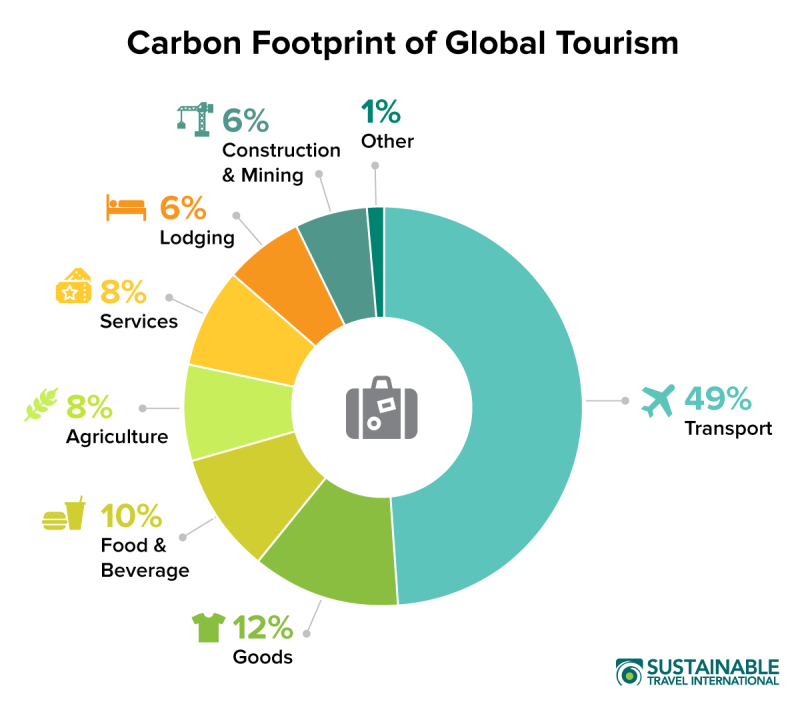
Tourism is responsible for roughly 8% of the world's carbon emissions. From plane flights and boat rides to souvenirs and lodging, various activities contribute to tourism's carbon footprint. The majority of this footprint is emitted by visitors from high-income countries, with U.S. travelers at the top of the list. As the number of people who can afford to travel grows, so will tourism's environmental footprint.
Keep reading to learn about some of the different ways that travel produces CO2.
This graph shows the different activities that contribute to tourism's total carbon footprint.
Transport
Getting from here to there is the most basic component of tourism. Planes, cars, trains, boats, and even hot air balloons allow us to explore destinations all around the world. However, all of our jet-setting and road-tripping comes with a hefty carbon footprint.
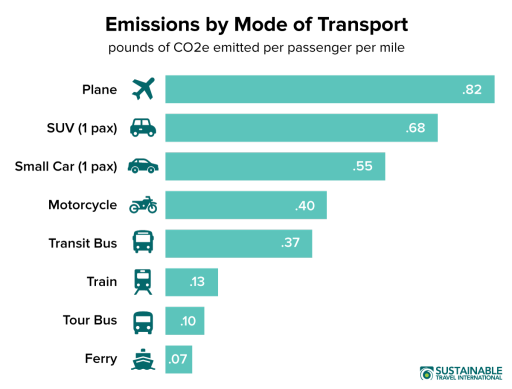
Today, transportation is tourism's main source of greenhouse gas emissions. On average, planes and cars generate the most CO2 per passenger mile, with tour buses, ferries, and trains coming well behind. In recent years, the number of people traveling internationally skyrocketed as airfare became more affordable. Similarly, between 2005 and 2016, transport-related tourism emissions increased by more than 60%.
These are averages based on 2020 UK conversion factors. Values will vary based on distance traveled, vehicle model, occupancy rate, flight class, and various other factors.
It would take an acre of forest a year to absorb the same amount of CO2 emissions of a one-way flight from London to New York. That's about the same amount of emissions that the average person in Zimbabwe generates over an entire year.
Lodging
In the same way your house generates emissions from energy use, so do the hotels, homestays, and rental homes that you stay in while on vacation. Many accommodations rely on heating and air conditioning to keep guest rooms at a pleasant temperature in hot or cold climates. These energy-intensive systems create CO2, as do the water heaters used to warm showers, pools, and spas. Electricity used to power lights, TVs, refrigerators, laundry machines, and other equipment is also a big contributor, especially in areas with dated or inefficient systems.
Emissions from lodging tend to be highest in resorts and hotels that offer modern services, while smaller lodgings such as homestays and guest houses have lower emissions for the most part.
Data Source: Caribbean Hotel Energy Efficiency Action Program (2012)
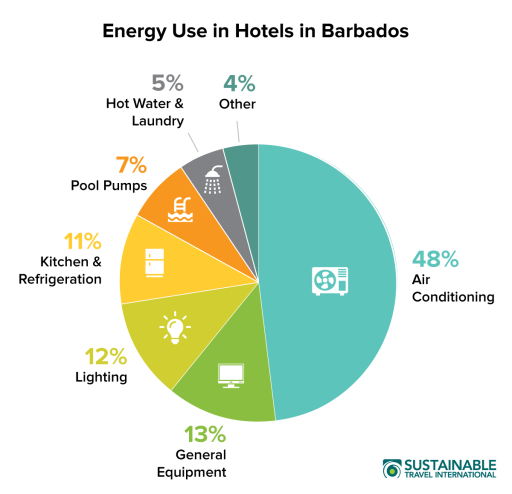
While hotels can lessen their footprint by utilizing clean energy sources, most still depend on dirty fossil fuels for the majority of their energy. According to the 2018 Green Lodging Trends Report, only 21% of hotels currently have on-site renewable energy.
Construction
Resorts, airports, and other tourism facilities can produce massive amounts of carbon even before they open their doors to tourists. Constructing a new building is an energy-intensive process - manufacturing the materials, transporting everything to the site, and constructing the building all generate carbon emissions. And it's not just buildings that leave behind a footprint - the development of roads and other infrastructure for tourism also contributes to climate change.
Destruction of Carbon Sinks
Along with the construction process, tourism development emits carbon through the clearing of natural areas. Ecosystems, such as forests, act as carbon sinks by absorbing and storing emissions. When this carbon-rich vegetation is removed, CO2 is released back into the atmosphere.
The mangrove forests that grow along coastlines in many tropical destinations have a tremendous capacity to store carbon. Studies show that they can store up to 4 times more carbon than most other tropical forests around the world. Sadly, vast areas of mangroves are often cleared to make way for tourist infrastructure such as seaside resorts, beaches, marinas, and entertainment areas.
The world lost a football field-sized area of tropical forest every five seconds in 2019, causing the same amount of carbon emissions that 400 million cars would produce over an entire year
Food & Drink
Food production is responsible for roughly one-quarter of the world's greenhouse gas emissions. Getting food from farm to table means growing, processing, transporting, packaging, refrigerating, and cooking - all of which require energy and contribute to your meal's carbon footprint. Travel often multiplies this footprint since people tend to indulge more while on vacation.
Imports
To cater to visitor tastes, many hotels and restaurants import the majority of their food products from other countries. Remote island destinations are especially dependent on imports. It is estimated that up to 80% of the food consumed by the tourism industry in Pacific islands is brought in from overseas. The farther food travels, the more emissions are generated - and to get food to these secluded islands, it has to travel a very long way
Food Waste
Thanks to all-you-can eat hotel buffets and oversized restaurant portions, a substantial amount of the food produced for tourism ends up getting thrown away. When food is wasted, this means that all of those emissions that were generated by its production were unnecessary. Globally, less than half of hotels compost their food waste. When this food decomposes in landfills it creates methane which is 21 times more potent than carbon dioxide.
Data Source: Waste & Resources Action Programme
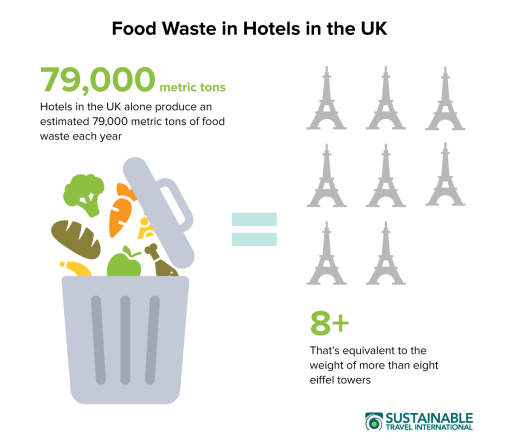
Wastage of food in tourism is part of a larger, global issue. In fact, if food waste were a country, it would be the world's 3rd largest emitter of CO2.
Shopping
Though every trip must eventually come to an end, tourists are sure to return home with magnets, hats, art pieces, and other trinkets to remind them of their vacation. But traveler purchases aren't limited to kitschy souvenirs. From street markets to high-end boutiques, shopping is now a travel experience in itself.
Whether its jewelry or electronics, the carbon footprint of an item must be calculated with production, manufacturing and shipping in mind. There's something special about purchasing an item that was made locally in the destination, yet oftentimes souvenirs and other products are mass-produced in factories far away. An item may have travelled between a number of countries and continents before reaching its final destination. For example, the cotton used to make a t-shirt sold in New York may have originated from China, been shipped to Vietnam for manufacturing then flown to New York for sale. Travelers' buying habits are often different from locals', thus increasing production emissions.
Looking Ahead
With the impacts of climate change becoming increasingly evident, it is critical that local governments, tourism businesses and suppliers, along with individual travelers all take action to reduce the industry's reliance on fossil fuels.
New technologies such as solar-powered water heaters, temperature control systems, and energy saving appliances allow the industry to lessen its carbon footprint. Yet these innovations are not enough to outweigh the emissions created by a growing number of travelers. Projections indicate that tourism emissions could reach 6.5 billion metric tons by 2025. This represents a 44% increase from 2013, and is equivalent to about 13% of current global greenhouse gas emissions. For those emissions that aren't yet avoidable, carbon offsetting should be used to complement sustainability practices and reduce tourism's carbon footprint.

In the 1950s and 1960s world travelers would put on slide shows to impress friends and acquaintances. It was a good excuse for cocktails.
Travel isn't a social event any longer. Nowadays tourism only provides the backdrop for self-indulgent selfies. People really are killing themselves trying to get that perfect selfie. And that selfie has a very large environmental cost.
If you are going to be the center of attention in that travelogue then why waste money traveling? That photo gallery is really about you and not the location. Are you only trying to impress people you don't know on social media?
It appears to me that you posted this article to contradict the one I posted about comparing the world to a book. I really have no problem with the fact that you may be using it as some justification for your not ever leaving the USA. However, I doubt that the article will convince many people to not travel, or if they must, to only use a bicycle.
Of course you are correct with most folks. Most think CO2 emissions are someone else’s problem. When in reality it’s everyone’s problem.
Well, yes, your seed did encourage me to post this one. I have posted articles about the environmental consequences of tourism in the past. I have pointed out the contradictions of imposing restrictions on people while promoting tourism. We're all supposed to be frightened by climate change so let's plan a trip to Disneyland.
But this is not a contradiction of your seed. This article points out the associated costs of tourism. If the travel is just to obtain personnel experiences then those memories will die with you. But the consequences don't just disappear when you do. So, if you travel, do it responsibly and for more than selfies.
You know, I've traveled to every state east of the Mississippi River except Delaware and Rhode Island. I've only visited 10 states west of the Mississippi River, that I recall. I've spend a lot of time on narrow body regional jets, usually Douglas DC-9s, and turboprops, usually metroliners. The one I regret missing was a Shorts 330 that had a mechanical problem that cancelled the flight. As a Federal employee I was usually responsible for an emergency exit. And I've spent more road time than I care to remember. 1,800 mile and 20 hour road trips weren't uncommon. So, please, don't lecture me about travel.
We had a two ton utility truck we used for field work. The truck carried about 900 lb of gasoline and we had about 1,000 lb of tools and equipment on board.
We were working an abandoned mine site out in the boonies. Access to one part of the site was through cut in a natural berm and across a low water stream crossing. Since our truck was heavy, it was necessary to carefully line up with the cut and give it the gun so the momentum would carry the truck across the low water crossing. So the guy driving gave the truck the gun and somehow got the truck sideways in the cut. The front corner buried itself in the right side of the berm and rear corner buried itself in the left side of the berm. Spent most of the day digging the truck out but the cut was a lot wider.
Fun trip but we didn't take pictures.
Of course, I can't disagree with that.
Too bad you didn't take pictures. It would have been a perfect illustration of the phrase: "A stick in the mud."
I'm not familiar with that phrase. What does it mean?
LINK -> Stick In The Mud - Meaning & Origin Of The Phrase
(The guy in photo was my boss, at the time.) The retention damn on a tailings impoundment blew out. The tires were to control further erosion.
At least we weren't mired in the mundane. And we invented some new, descriptive language, too.
Moderation is the key to all happiness.
People who travel a LOT should not brag about it and rub peoples noses in it, and people who dont travel away from their home area should not berate those that do.
I think the other article gave the impression that if you dont travel to foreign countries you are a little lesser something or other. This article goes in the opposite direction and appears to have been written by environmental activists.
Then there are a lot of really unhappy people on NT who constantlly bitch about the moderation.
This idea should expand to include all outdoor, motor-driven entertainment - rounding up the offenders like ski slopes, boats and ATVs. All that environmental destruction in the nation of the fattest people.