
India and EU reach a landmark free trade agreement

By: Rajesh Roy and Sam McNeil (AP News)


The European Union has been taking proactive steps to try to sustain the neoliberal world order and isolate the United States. If Trump does not follow through on revitalizing the industrial base of the US then the country's economic future looks bleak. Without increased self sufficiency, the US will have little choice other than becoming a trade slave to China.
 S E E D E D C O N T E N T
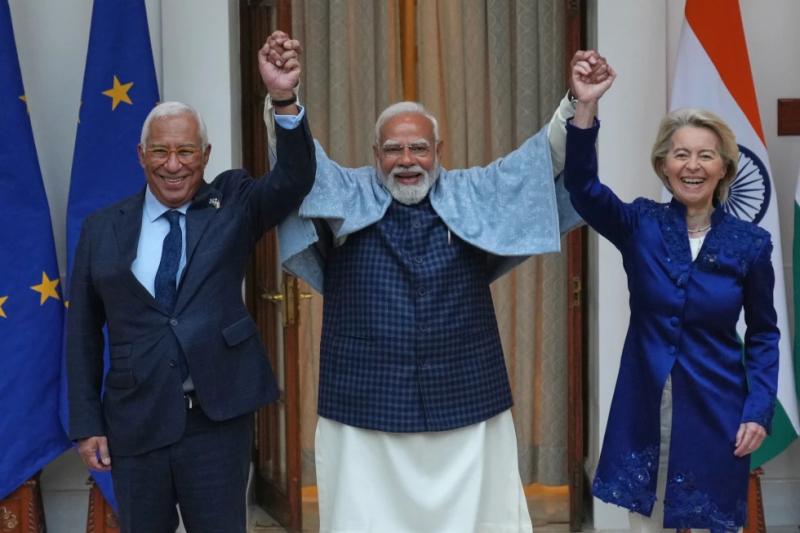
NEW DELHI (AP) — India and the European Union reached a free trade agreement to deepen economic and strategic ties, officials said Tuesday, after nearly two decades of negotiations.
The accord, which the head of the EU's executive branch described as the "mother of all deals," could affect as many as 2 billion people. It will likely take several months before the agreement takes effect.
The deal between two of the world's biggest markets comes as Washington targets both the Asian powerhouse and the EU bloc with steep import tariffs, disrupting established trade flows and pushing major economies to seek alternate partnerships.
"This agreement will bring major opportunities for the people of India and Europe," Indian Prime Minister Narendra Modi said in a virtual address to an energy conference. "It represents 25% of the global GDP and one-third of global trade."
The accord will see free trade on almost all goods between the EU's 27 members and India, covering everything from textiles to medicines, and bringing down high import taxes for European wine and cars.
India and the EU also agreed on a framework for deeper defense and security cooperation, and a separate pact aimed at easing mobility for skilled workers and students, signaling that their partnership extends beyond commerce.
U.S. pressure propels deal
The negotiations for the India-EU deal got a new impetus after U.S. President Donald Trump's strong-arm trade tactics, including threatening his European allies with punitive tariffs over their objections to Trump's threats to take control of Greenland.
Modi, speaking at a joint news conference in New Delhi with European Commission President Ursula von der Leyen and European Council President Antonio Costa, said that the partnership with the EU "will strengthen stability in the international system" at a time of "turmoil in the global order."
"Europe and India are making history today. We have concluded the mother of all deals," von der Leyen posted on X.
In a speech later, she said that the accord was a tale of "two giants" who chose partnership "in a true win-win fashion." She also said that it sends "a strong message that cooperation is the best answer to global challenges."
The deal is expected to further integrate supply chains and strengthen joint manufacturing power between the two economies. It will also cut up to 4 billion euros ($4.7 billion) in annual tariffs for exporters and create jobs for millions of workers in India and Europe.
Easing regulation
A formal signing of the deal could come later this year after officials go through the legal details of the text and the European Parliament ratifies it. India's trade minister, Piyush Goyal, said that he expected the deal to take effect by the end of the year.
India is expected to reduce or eliminate tariffs for 96.6% of EU exports, while Brussels will reciprocate with similar reductions in phases that eventually cover nearly 99% of India's shipments by trade value, according to statements from both sides.
India's sectors poised to gain from the deal include textiles, apparel, engineering goods, and leather, handicraft, footwear and marine products, while the EU's gains will be in wine, automobiles, chemicals and pharmaceuticals, among others.
A quota system for automobiles, wines and whisky has been agreed upon, bringing down steep duties.
The European Commission said that tariffs charged by India on EU-made cars will gradually go down from 110% to as low as 10%, while they will be fully abolished for car parts after five to 10 years. Tariffs ranging up to 44% on machinery, 22% on chemicals and 11% on pharmaceuticals will also be mostly eliminated.
On European wine, the tariffs in India would come down from 150% to 20% for premium wines.
New Delhi has excluded dairy products such as milk and cheese from the deal, along with cereals, citing "domestic sensitivities" about those products. For its part, the EU won't allow concessional tariffs on imports of Indian sugar, meat, poultry and beef products, Indian Trade Ministry officials said.
Offsetting U.S. tariffs impact
India is looking to diversify its export destinations as part of a strategy to offset the impact of higher U.S. tariffs, including an extra 25% levy on Indian goods for its unabated purchases of discounted Russian oil, bringing the combined tariffs imposed by the United States on its Asian ally to 50%.
For the EU, the deal offers the bloc expanded access to one of the world's fastest-growing major economies, and helps European exporters and investors reduce their reliance on more volatile markets.
"This is the most comprehensive trade deal India has ever signed, which gives European companies a first mover advantage into this market and gives them a strategic upper hand that other players do not," said Garima Mohan, a senior fellow at the German Marshall Fund.
Trade between India and EU stood at $136.5 billion in 2024 to 2025. The two sides hope to increase that to about $200 billion by 2030, Indian officials said.
"Ultimately, the agreement is about creating a stable commercial corridor between two major markets at a time the global trading system is fragmenting," Indian trade analyst Ajay Srivastava said.
The EU is still reeling from the aggressive approach of its once-stalwart ally across the Atlantic. There's a widespread sense of betrayal across the bloc from Trump's onslaught of higher tariffs, embrace of far-right parties and belligerence over Greenland, a semiautonomous territory of EU member Denmark.
Brussels has accelerated its outreach to markets around the world. Over the past year, von der Leyen has signed deals with Japan, Indonesia, Mexico and South America under the catchphrase "strategic autonomy," which in practice is akin to decoupling from a U.S. seen by most European leaders as erratic.
Sam McNeil reported from Brussels.
RAJESH ROY brings over two decades of journalistic experience in covering a spectrum of big stories spanned across defense, geopolitics, business and local politics. Mostly found in the corridors of power: talking, scooping and writing. SAM McNEIL McNeil covers Europe and beyond with a focus on conflict and the environment.
Be a good human. Grossly derogatory comments, blatantly inflammatory comments, excessive trolling, mean-spirited taunting and insults, scamming, spamming, and off topic comments may be removed in compliance with the site's Terms of Service and the Code of Conduct. The moderators have the final word.

Tags
Who is online
230 visitors
The value of the US dollar has declined 10% in international exchange. That may be a forewarning that the dollar is losing its standing as a global reserve currency. Especially in light of the 'Sell America' trend in international trade and financial investments. The phenomena of selling American equities, bonds, and dollars (divesting of America) is unusual and troubling.
We also know the dollar is being debased by Trump's inflationary trade and fiscal policies. Unfortunately we don't know how much since the Federal government's economic data has been politicized.
It has become difficult to walk back from Trump's policies. Trump's attempts to expand access to feedstock commodities won't be a winning strategy. The US must either revitalize it's ability to export or risk becoming another Japan trapped in a downward spiral of recurring monetary crises.
This is what it looks like when the trusted world leader starts alienating old friends.
What were the lessons learned during the COVID pandemic? Those trusted world leaders turned into parasites and entitled antagonists.
Phony politics will blame Trump while completely ignoring that the height of the pandemic and the most friction between the US and allies occurred on Joe Biden's watch. We learned more about those trusted world leaders after Biden assumed office and allies dropped any pretense of being partners.
The lessons that should have been learned from Joe Biden's 4 years is that the United States needs to become more self sufficient, more resilient, and less compliant with untrustworthy world leaders.
What the hell? You seed a story on current events. You sensibly post your own comment on the current president, but your only response to me is that you suddenly turn into Trump yourself and blame everything on Biden. And it’s still an empty comment that has nothing to do with the seed or what I wrote. You attack our allies, but only in the vaguest terms. It’s like talking to Dr. Jekyll. You never know who is going to answer.
That is ahistorical and completely counterfactual. Trump has been the greatest disruptor of America's relations with our allies ever. Nothing like that occurred during Biden's presidency.
Hell has it's origin in the COVID pandemic when those trusted allies were not so friendly. Biden presided over the height of the COVID pandemic and was forced to rebuff the demands of our allies for relaxed border restrictions to allow health migration, for the US to sacrifice necessary 2nd doses vaccines and give them to other countries, for the US to give up the intellectual property rights for mRNA vaccines (not just the COVID vaccine). Our allies during the COVID pandemic proved themselves to be Jekyll and Hyde.
The world expected the US to sacrifice itself for everyone else's benefit. The politicians spoke in glowing terms of sacrifice and service while dumping the burden onto the people of the United States. That's been the history of globalization, the international world order, and our alliances.
Everything really did begin falling apart six years ago, on Biden's watch. The COVID pandemic demonstrated that alliances and partnerships were only creating burdens for the US without any benefit. 2021 was what it looks like when old friends begin sponging off the trusted world leader.
The COVID pandemic was the greatest disruptor of American's relations with our allies. And disengagement from those allies began in 2021 when Joe Biden was forced to rebuff the demands of allies.
Why do you think Biden drug his heals every time Europe wanted to escalate the war in Ukraine? It was not Biden's idea to supply Ukraine with advanced weapons. Biden was trying to hold back but buckled under pressure from our allies. Biden wanted to defend and strengthen NATO, not Ukraine. Europe was not seriously taking steps to defend itself and supply Ukraine; they were expecting the United States to carry those burdens.
He is conflicted.
How is it possible that Donald Trump could break those alliances in only four months? Trump imposed tariffs to protect the US markets and alliances and partnerships crumbled overnight. Trump reduced the gravy on the gravy train and our friends became decidedly unfriendly.
Globalization has allowed the political ruling class to become richer and more insulated from the real world. But the burdens have been falling onto the American people. The world expects the people of the United States to open our borders, open our treasury, open our institutions, open our military to them for their benefit. What have the people of the United States gotten out of these partnerships? A debased dollar? Fewer jobs? Perpetual inflation? More national debt? Disposable goods and mountains of trash? Foreign investors sucking profits and wealth out of the American people?
Our allies revealed who and what they were during the COVID pandemic. If people are going to appeal to history then they need to get the history correct.