
CNN poll: A third of Democrats now identify as Democratic Socialists

By: Edward Wu (CNN via MSN)
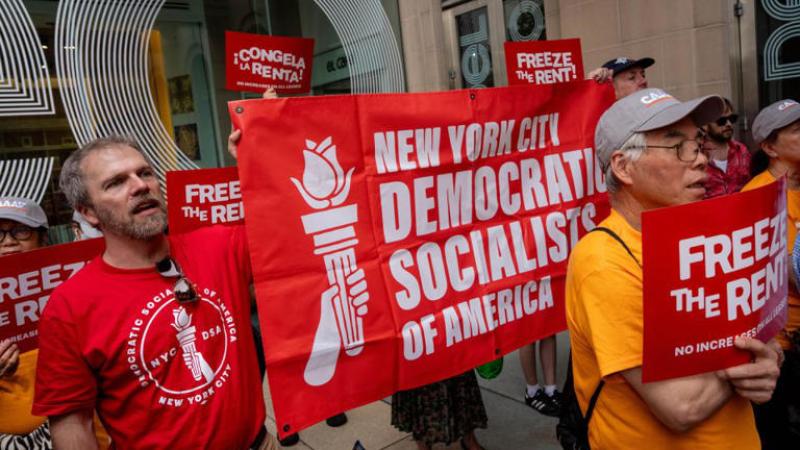

Democratic Socialism is incompatible with Federalism and the checks & balances of our constitution. The United States is too large and heterogeneous to avoid Democratic Socialism becoming totalitarian. This is why the Democratic Party is considered by many to have become un-American.
 S E E D E D C O N T E N T

July 30, 2026 -- About a third of Democrats and Democratic-leaning adults identify as democratic socialists, according to a new CNN poll conducted by SSRS.
They’re some of the party’s staunchest supporters, but many are also raring for a party overhaul at a time when democratic socialists are seeing new momentum at the polls.
Building on New York City Mayor Zohran Mamdani’s victory over Andrew Cuomo last year, candidates describing themselves as democratic socialists have secured the Democratic nomination in several US House races around the country, including defeats of incumbent Reps. Adriano Espaillat in New York and Diana DeGette in Colorado.
Primaries over the next few weeks will test whether the trend can expand beyond Democratic strongholds – with recent polling on the Democratic gubernatorial primary in Wisconsin finding democratic socialist Francesca Hong leading the field in that critical battleground state.
Who makes up the democratic socialist wing of the Democratic Party’s base? According to CNN’s poll, Democratic-aligned Americans who identify as democratic socialists:
- Tend to be younger (59% are younger than 45, compared to 46% of non-democratic socialists aligned with the Democratic Party) and are more likely to be White (57% to 49%)
- Are less likely to have a college degree (66% to 54%) and more likely to earn less than $100,000 a year (76% to 65%)
- Are more likely to say they are extremely motivated to vote this year (66% of those who are registered voters say so, compared to 57% for non-democratic socialists), though both groups overwhelmingly support Democratic congressional candidates (99% of democratic socialists and 94% of non-democratic socialists)
- Are more positive toward the Democratic Party. They are more likely to hold favorable views of the Democratic Party (68% to 60%) and its congressional leaders, and more likely to have negative views of the Republican Party and its congressional leaders
Although democratic socialists are just as likely as other Democratic-leaning Americans to say the Democratic Party needs to be completely reformed or needs major changes, they are more likely to see as positive changing the current leadership of the party and nominating younger candidates. Notably, they are nearly twice as likely to support the party moving to the left on policy issues.
Democratic socialists also split from the rest of the party on US aid to Israel – 48% say they’d be enthusiastic about a candidate who believes the US should cut support to Israel, compared to 20% for non-democratic socialists. Three years into the war in Gaza, the issue has animated many Democratic primaries this cycle.
Democratic socialists overwhelmingly tend to hold favorable views of the Democratic Socialists of America as well as of democratic socialist officeholders: among those expressing an opinion, nearly all have favorable views of Mamdani and of New York Rep. Alexandria Ocasio-Cortez.
Democratic-aligned adults are generally comfortable with the possibility of their party nominating a candidate who identifies as a democratic socialist.
While enthusiasm is considerably higher among democratic socialists, 64% of Democratic-aligned adults who do not identify as democratic socialists would be at least OK with such a candidate, while 36% would be upset or uneasy.
The CNN poll was conducted by SSRS from July 23-27 among a random national sample of 1,225 US adults drawn from a probability-based panel. Surveys were either conducted online or by telephone with a live interviewer. Results for the full sample have a margin of sampling error of plus or minus 3.2 percentage points.
CNN’s Jennifer Agiesta and Ariel Edwards-Levy contributed to this report.
Be a good human. Grossly derogatory comments, blatantly inflammatory comments, excessive trolling, mean-spirited taunting and insults, scamming, spamming, and off topic comments may be removed in compliance with the site's Terms of Service and the Code of Conduct. The moderators have the final word.

Tags
Who is online
150 visitors
Does any doubt remain that our education system has been undermining the founding ideas of America? These so-called Democrats are not debating in the political arena to seek reforms. They are seeking the autocratic power to impose philosophies and ideologies onto the country.
The United States may continue as a nation. But America is in danger of being replaced by autocratic expediency.
Nope. Been saying that for years. And the undermining has been intentional.
Yes, and that's spelled out plainly in the platform of the DSA. They want to
Basically, no checks or balances on their power. Constitution becomes toilet paper.
Totally agree. And the corruption will put the current state of affairs to shame.
There about as many Democrats who understand the DSA platform as there are MAGAs who understand the constitution. In other words there isnt much cause for worry.
LOL. You dont seem to be ashamed of Trump so whats the difference.
I am against abolishing the US Senate.
I am for abolishing the electoral college. Specifically, I am in favor of keeping the electoral tallies, but with modification. Each congressional district's popular vote immediately translates into an electoral vote for the winning candidate. The two electoral votes per state go to the popular winner of the state. No human electors, the electoral tally is just basic arithmetic.
I am against Congress choosing the President. (However, voters do not currently directly elect the PotUS.)
I am against replacing the SCotUS with that chosen by Congress. However, I am in favor of term limits for justices.
These bullets (except the second one) by the DSA are ridiculous to propose. This tarnishes the DSA with ideals that are almost certainly not going to happen in anyone's lifetime. It is stupid to propose such nonsense today. Maybe in 100 years or so.
I tend not to feel shame for things I'm not responsible for. What you can't seem to understand about me is that I think nearly the entirety of our government at every level and both parties is a clown show. You think Trump is the biggest threat to our country while ignoring what Democrats in various positions around our country are doing that are as bad or worse, in an immediate sense.
That is exactly the reason to worry, JR. You don't seem to get that. CNN came out with a poll that says one third of Democrats identify as Democratic Socialists, if one believes anything CNN puts out. If they don't understand what they are supporting, don't you think that is a cause for worry? That means most of them are identifying as such most likely because they think its trending more than anything else. It's "anti-establishment," which is good enough for them, whatever it is.
Agreed. Get rid of the "winner takes all" approach. Leaves too many unrepresented and gives too much power to metropolitan areas.
What Trump has done to this country is far worse than having a handful of "socialists" in Congress.
First it was critical race theory, then it was wokeism, and now its the DSA. Trump apologists are not happy unless they are inventing existential scenarios emanating from the left. Meanwhile the 2 by 4 in their own eye goes unnoticed.
Wow, there is a difference between inventing and calling out. It is the dems that are creating the scenarios. And now we have the DSA picking up steam. At least they are being honest about what they want. And the dem establishment is welcoming them to the big tent.
Actually, it was just critical theory at first, created by the Frankfurt school of Marxism and later adapted for race theory. The thing about the theory, regardless of the ideological subject (Trans, LGTBQ, Feminism, whatever) it is dealing with, is that the assumption that inequality and injustice already exist, even if it doesn't. In other words, it's not a theory; it's a method intended to describe any subject in terms of injustice or inequality for political purposes.
Wokeism is too broad a term to bother with. I'll just say it's basically believing what is mostly nonsense produced by whatever critical theory is being applied to and trying to make others believe it, too.
And yes, now it's the DSA. But you say this as if the left isn't or hasn't been going more and more to the extreme left for years now. As if we didn't have college students everywhere protesting for Hamas. If our young people have so much sympathy for thugs like that, what makes you dismiss DSA and their goals so easily?
Right. You're consistent, I'll give you that. Dismiss the argument as simply as Trump apologetics and it all goes away.
critical race theory is a topic in academia. It is not something that 1 in 20 people could intelligently discuss.
Wokeism is a categorizing from the right of things they dont agree with. What wrong with DEI? Thats another subject very few right wingers understand.
I think they were protesting the over reaction by Israel for committing war crimes on a scale unseen since WWII.
Oct 7 ; hamas killed roughly 1200 Israelis and 50 homes.
in response to that and the 240 hostages taken, both sides agree that over 73,000 Palestinians were killed and at least 436,000 homes demolished.
Where I was raised, even the rabbis are embarrassed by the over kill of the IDF.
and American students will claim that they have a God given right to express themselves from the Founding Fathers.
Right back at you.
Institutionalized Slavery from 1619 to 1865, followed by Jim Crow for what, until 1964?
and white conservative Dems and GOPs alike think there is no longer any racism or prejudice in their lives.
They just claim it's all gone away magically in the last 62 years.
I think they had little idea about what they were doing. In my opinion, they reduced the whole thing to oppressor/oppressed, which is what critical theory trains them to do, along with a bogus history of the conflict.
A limited view, in my opinion. Throwing out a number like 73,000, as if that is the only relevant thing concerning the matter, is disingenuous. So is the idea of proportionality, in this case. More than 3,000 Hamas terrorists, terrorists from other outfits and Palestinian civilians crossed the border that day and did monstrous things. The idea that Israel is just supposed to go only so far, something proportional, is insane. There is literally nothing Israel could do other than exterminate Hamas and the rest of the terrorists because Hamas and the Palestinians just don't care. And the Palestinians are as responsible for their own deaths as anyone. Hamas is made up of Palestinians. Palestinians supported them. Their religion thinks martyrdom is the height of piousness and guarantees a place in their heaven. Hamas used their own people as human shields and, somehow, it's Israel's fault.
So, tell me. If you had the power to make the decision, would you have had the allies stop when the Nazis were pushed back into Germany and go no farther?
Yes, they can do exactly that and be just as stupid as the White Supremacists and Neo-Nazis that do the same thing. In other words, no one is arguing against using one's rights. Using them doesn't make one right, though.
I wonder if, 500 years from now, people will still be saying America is just as racist as it is claimed it is today because we had institutionalized slavery 700 years ago and Jim Crow laws 560 years ago.
Probably.
Only the stupid people.
I think you sell them short.
I think you don't understand CT or CRT and you don't appreciate the Old Testament.
The Allies did stop, but the Russian's not so much. As the spearhead went past the Rhine and deeper into Germany, the West had to arrange for 1.5 million Germans who surrendered on the Western front in April 1945 alone. Another 120,000 surrendered to the Western Allies in Italy.
Prior to the final push in 1945 the Russians had about 200,000 prisoners; by the time Berlin fell, they had 3.6 million German prisoners who were forced into hard labor camps to replace the 8 million Russian lives lost during the war. More than a million died during their incarceration throughout Russia and Siberia. the rest were slowly repatriated by 1956.
Neither does having an opinion make it fact.
Have you read the old testament?
So it we aren't supposed to take the Bible literally where the Israelites apparently started much of the genocidal "mischief" with their God's blessing
why should we take the Koran literally as well
Doubtful as families continue to mix ethnically and religiously, probably within 200 years this America will be predominately brownish like Brail and Argentina
where the only prejudice will be like my extended Mexican family on my bride's side who value lighter skin but fluent English and Spanish. Darker tones and English only speakers like me are somewhat pitied and tolerated.
I guarantee that 500 years from now they will still be embroiled in politics and religion.
Give yourself some credit, if you were alive 500 years in the future we would expect more of you.
Of course we don't understand it, the evidence for which is that we reject it. Because if we understood it, we couldn't possibly object, right?
Not at all. People can understand it and still choose to be complete self-absorbed assholes. You can fix racist ignorance with education, but you just can't fix stupid bigots.
I think we should revisit that Bonhoffer article again.
The "aspirations" and ambitions of the DSA are just as 'buck wild' as MAGA supporters. How many cycles of stupid and damn near impossibilities do we have to wade through at a time like this?! It seems that with our two parties we are in parallel circling of 'ying-yanging.' The matching of stupid political moves and activities.
It is so damn tiresome to have to think about. . . significant distractions. . . while striving for and with all we are worth to 'right' this Titanic!
One would think any grouping of supportive people can see that is is precisely what Trump and MAGA were hoping for. . . a leverage point to go to the 'rooftops' and start shouting about the 'doom' coming and fearmongering.
You can't make this sh-t up. You simply can't. Life can be cruel with its truths. Just basically cruel.
If the shoe fits. . .then yes. What I wonder is this? Will there be a world worthy of people like me in 500 years. You should too, since you believe in the advent of Christ's return and pretty much can not wait for the 'End.'
We can all take hope that intentionally bigoted, evil, and reprobate racists will die out. . . in say another 100 years 'tops.' (Now, that is a 'death wish' I can make.) Die evil bigots and destroyers of dreams, limbs, and lives! Die, everywhere you exist!
We desire, need, a true colorblind world! Not simple rhetoric about colorblindness!
(I could not let this comment go by, though I really have little hope for 'us.')
So, the collective you reject what you do not understand wholesale. Worse the collective you act against what you do not understand wholesale. There is a word for that: Narrow-mindedness. Happens to a collection of people that foolishly dedicate themselves to not change in an ever-changing, dynamic, world.
Nah, that’s ok. Giving oneself credit for realizing something so simple and common sense must be like accepting a participation trophy
In the long history of civilization not having slaves is a new concept
Thank God for that.... and I am an atheist
So what are you 'saying'?
Just what I said, not having slaves is a new concept.
By itself, the statement is hallow. Make it 'solid.'
Here is an interesting article about a slave who was freed but kept slaves. Article appeared in Northern Virginia Daily newspaper this week.
Belle Grove Plantation in southern Frederick County is preparing a new exhibit detailing the life of Monday Robinson, a former slave who became a slave owner.
Robinson, who spent the final years of his life in Middletown, was the subject of a Shenandoah University forum on March 20 that featured Belle Grove Executive Director Kristen Laise, Winchester historian Brenda Nelson and Alexandria-based genealogist and journalist Char McCargo Bah. Afterward, Laise announced that Belle Grove would create an exhibit called "Monday Robinson: A Life of Thorn and Roses," which is scheduled to open on Sept. 26 at Belle Grove, located south of Middletown.
Laise, Bah and Nelson, along with Robinson descendant Frances Norton Burton and exhibit designer Jess Pritchard-Ritter, recently met in a video conference to discuss the upcoming exhibit and Robinson's life.
A cemetery lost and found
Research into Robinson originated in Alexandria, a city in Northern Virginia that was occupied by Union soldiers during the Civil War. Slaves who ran away from their enslavers in the South frequently ended up in Alexandria, Burton said, "because once they got behind Union lines, they were free."
But that was perhaps the only positive thing. At the start of the Civil War in 1861, Burton said many of the former slaves lived in encampments and were exposed to diseases including smallpox. Those who died were buried in a new cemetery created and operated by the Union Army.
After the Civil War ended in 1865, the slave cemetery was seldom used. The last recorded burial there was in January 1869, just a few months after the federal Freedman's Bureau, which helped former slaves transition to freedom, scaled back its services. As a result, the cemetery and its more than 1,700 graves were abandoned and eventually forgotten.
"In modern times, it looked like just a piece of land," Burton said.
In the 1990s, a $2.4 billion project to replace the nearby Woodrow Wilson Bridge from Alexandria to Prince George's County, Maryland, got underway. During excavations for the project, Burton said workers in Alexandria began digging up pieces of metal. When the metal pieces became numerous, archaeologists were called in and determined that workers were digging up coffin hinges from an old cemetery.
Recognizing the property's importance, the city of Alexandria purchased the land to create a memorial park. The newly designated Contrabands and Freedmen Cemetery was preserved and dedicated in 2014. It includes artist Mario Chiodo's sculpture "The Path of Thorns and Roses," which is representative of the former slaves' struggle for freedom.
Using a record of burials that was maintained in the 1860s by the Rev. Albert Gladwin, cemetery officials wanted to see if any descendants of the former slaves could be located. They asked Bah to use her genealogy skills to find anyone she could, and her investigation eventually led her to Burton's door in Alexandria.
"One of the first people that she found [in the burial records] was the child of my great-great-aunt, who was Lucy Robinson," Burton said about Bah. "Lucy Robinson came to Alexandria after she was freed through the [last ]will [and testament] of Monday Robinson."
Lucy was one of Monday's estimated 12 children.
Born into slavery
Monday Robinson was born in 1778 in Westmoreland County as a slave owned by a man with property holdings throughout Virginia. When the owner died, Monday was willed to the owner's wife. When she died, he was inherited by one of the owner's children. When he died, Monday became the property of one of the owner's grandchildren.
During his enslavement, Monday married a fellow slave named Polly who was about 20 years younger than him. The exact date of their wedding is unknown because in the early 1800s, marriage documents for slaves were frequently not recorded.
Since Polly was a slave when all 12 of their children were born, the sons and daughters were slaves as well.
"Children [who were Black] got their lineage from their mother," Burton said. "She (Polly) was a slave, therefore all of her children were slaves."
In 1813, Monday was granted his freedom in Loudoun County.
"The law during that time stated that if you were a free person, you basically had to leave the county because they didn't want you to give the enslaved any ideas," said Bah, who has spent 16 years researching Monday and his family.
Bah said Monday was exempt from the leave-the-county rule because he held the deed for Polly and three of their children, making him a slave owner. He later moved to Shenandoah County before settling in Middletown in Frederick County.
Being a skilled shoemaker, Monday earned a decent living. Records show that he and his family owned horses and real estate, and he paid taxes just like every other entrepreneur.
When Monday died in late 1856 or early 1857 — the exact date is unknown — his will did not contain provisions to free his family. It fell upon his brother, Henry, to settle Monday's estate and file a deed of manumission in Frederick County that released Polly and her offspring from slavery.
(Manumission is a word for the voluntary freeing of slaves by their owners via verbal consent, written documents or wills.)
When the family was lifted out of slavery, the leave-the-county rule kicked in. Bah said the Robinson children ended up in various places including Alexandria, Washington, D.C., and Pittsburgh, Pennsylvania.
As for Monday, no one knows where he is buried. It's assumed he was laid to rest somewhere in or near Middletown, but there was no record of his burial.
Why?
So why did Monday keep his wife and children enslaved?
Bah said there could have been several reasons for this, such as a desire to keep the family together or protect them from the harsh realities of freedom for Black people in the racially troubled 19th century.
On the other hand, Bah learned that Monday profited from his enslaved children by occasionally hiring them out to other property owners. Also, in 1824, he used his wife and three of their children — Elliott, Louisa and William — as collateral to obtain a $490 loan from a man named William L. Clark.
Bah said Monday could not read or sign any documents presented to him, so he may not have been fully aware of what the paperwork said. Burton added that it's possible he wasn't aware that an 1856 inventory of his estate assigned a monetary value to each of his family members. The children were worth anywhere from $100 to $1,000, while Polly's value was listed as $0.
Those values became moot once Monday's brother, Henry, became executor of Monday's estate and secured the freedom of Polly and her children.
Whatever his reason for keeping his family enslaved, Burton was devastated to learn that one of her ancestors was a slave owner.
"I wanted to be done with it," Burton said. "It broke my heart."
In the ensuing years, though, as she learned more about Monday and the possible explanations behind his rationale, Burton eventually came to terms with the situation.
Telling Monday's story
In May 2025, Bah contacted Laise to tell her about Monday Robinson.
Laise said she had actually heard about Monday and his connection to Middletown and Belle Grove a few years earlier, when she spoke with Burton as part of Belle Grove's research into the slaves who worked at the plantation. Approximately 270 people were enslaved there by the Hite family from 1738 to 1851. They have been honored in two recently completed memorial quilts on permanent exhibit at Belle Grove.
"We realized that Monday Robinson had come onto the Belle Grove property as a free Black man and purchased some things when Ann Hite, the second wife [of Maj. Isaac Hite Jr.] at Belle Grove, passed away in 1851," Laise said. "They had an estate sale."
Among the items Monday bought, Laise said, were shoemaking tools.
Laise entered into a collaboration with Bah, Burton, Nelson and Pritchard-Ritter to come up with ideas to share the story of how a former slave became a slave owner himself.
"We thought it would be a great example of how we can work with descendant communities, so we put our heads together to do this research and have a traveling exhibit," Laise said.
The exhibit will open at 10 a.m. Sept. 26 at Belle Grove in a ceremony that will include Burton and other descendants of Monday. Afterward, it will travel to museums and libraries in 14 Virginia localities, including Winchester, that have ties to Monday and his family.
"The hope is that by getting some of the research out there, maybe other information, other stories and data points might come up," Laise said.
Monday's story, Laise said, will be representative of the complicated Black experience in America.
Assembling the exhibit on Monday and his family will be Pritchard-Ritter, who said she wants to include not only the research, but also "the passion and the feeling" that Burton, Bah and Nelson experienced as they learned about Monday's conflicted life.
"It's complicated. There are a lot of twists and turns," Pritchard-Ritter said. "I'm trying to capture their research and evoke emotion but not tip our hand to make people feel one way or another."
No one will ever know why Monday kept his family enslaved, but Pritchard-Ritter said the exhibit will show how other events happening in Virginia during the 19th century — including Nat Turner's Rebellion in 1831, which was a three-day slave revolt in Southampton County that left nearly 200 Blacks and whites dead — may have influenced his decisions and actions.
"We all have our thoughts [about Monday]," Burton said before sharing her personal theory. "I believe that part of his thinking was subterfuge (i.e. deceit used to obtain a goal) as a way to keep his family together. ... I think that he was playing a game."
To learn more about the upcoming Monday Robinson exhibit and Belle Grove's ongoing research into the Middletown plantation's slaves and their descendants, visit bellegrove.org .
I hear the "It was accepted in their time" bullshit a lot but the fact is that there were abolitionists and many religious groups that condemned slavery and fought to uproot it for centuries. In 1688 Germantown Quakers were organizing anti-slavery protests. The Society for the Relief of Free Negroes Unlawfully Held in Bondage was founded in Philadelphia in April 1775. Slavery was NOT "just accepted", it was being fought for hundreds of years before the patriotic abolitionist Americans kicked the white supremacist Souths asses.
So, let's start being honest. Slavery was NOT "just accepted" when this nation was founded. It was an uneasy compromise made with narcissistic white supremacist Christians in the South who wouldn't join us to fight for our independence if they weren't told they could keep owning black humans like cattle.
As the Vice President of the Confederacy said "The prevailing ideas entertained by (Jefferson) and most of the leading statesmen at the time of the formation of the old Constitution were, that the enslavement of the African was in violation of the laws of nature; that it was wrong in principle, socially, morally and politically. It was an evil they knew not well how to deal with; but the general opinion of the men of that day was, that, somehow or other, in the order of Providence, the institution would be evanescent and pass away."
So perhaps the idea of "not having slaves" was a "new concept" 300 years ago, but I think we can say the ideas been around a lot longer than many weak sniveling dipshit white supremacists want to admit.
You mean an irrelevant anecdotal example of something that doesn't, in any fucking way, justify owning humans.
Why did you have me read this? What is the point you wish to make? Have you read it?
Look at history. Slaves recorded in Bible and many old texts. Africans were selling slaves to traders into at least mid 1800s. Many places had slaves until then and some later. Slavery or something like it probably continues in some places.
as I said not having slaves is a new concept in the long history of civilization.
yes I read it. Point is obvious, it puts a big hole in some attitudes.
Now you are just winging it. Make a point and stand by it. Then we can discuss the point!
Okay, since you wish to discuss the bible and slavery. . . was biblical slavery the same as slavery in the colonies?
I already made the point, proved it and stand by the point.
Look at history
The point is until a short time ago in history many places had and used slave labor, that is just how it was.
I just used that to prove it was common for a longer time than since Civil War. Most of history compared to about 160 years. Count the time
Forced labor and forced marriages still exist in the world. We know this already. So what is YOUR point for dropping slavery into this? Tell me, do you approve of modern slavery or a return to 'old school' colonial slavery? Let's be clear when we discuss.
Was biblical slavery the same as slavery in the colonies, Charger?
I was not the one who dropped slavery into this, look several posts above. Again, I just pointed out not having slaves is a relativity new concept in history
Civil war ended slavery, so it is over in USA
Times were different between the two and I really don't know or care much . Biblical slavery was a very long time ago, reports are not that detailed, and does not seem to worry some as much
The relevant ANSWER is biblical slavery was not RACIAL, colonial American slavery was RACIAL (blacks alone were permanent slaves in the colonies). Which directly drives 'home' the intent and cruelty of the "ancestors" towards a(nother) people.
Actually, state and federal governments do have one 'system' of forced labor existing: Prison (labor).
and, blacks owned black slaves and blacks in Africa captured and sold other blacks for slaves. But there haven't been any slaves for a while
Charger, black people can do stupid, racist, stuff too. . . hell, Africans use machetes to hack themselves to pieces somewhere on the planet right now. . . it is not something any one of us should model or put up as suitable. The fact is, the colonies, held themselves through leaving the King of England. . as being BETTER than the King. . . aspiring for freedom, liberty, prosperity, and yes. . . justice for ALL people (see our lofty written declaration of independence and constitution). Thus, what occurred after liberation from the King of England was truly tragic and weak. Turns out this country went back on its words, plural, and cast freed people in this country wholesale RACIALLY into slavery, using the CHURCH to support its power to do so.
There is no DEFENSE for what was done. . . no matter how stupid AFRICANS were to themselves, that this country did what it did. . . can not be simply explained away. What the founding fathers did was ignore its own 'will' for the country and themselves. . . and decided GREED was worth 'dogging' and 'chattling' its potential citizens by DENYING THEM right to be citizens like themselves!
If you want to say that Africans were fools to own slaves. . . okay. However, that does not excuse the colonies for making slavery in this land, and doing so the same and worse than many other places at the time.
Well for Africans that is one thing (then and now) as they did not then and probably do not now claim to hold to U.S. concepts of freedom, liberty, and justice. Our nation espoused some lofty rhetoric as a means to becoming a nation (set apart from England). Note the distinction. This nation set its own high(er) standards. . . and then failed miserably to enact equality, liberty, and prosperity for one of its own (groups entirely).
The scenes from Spain today are what the dsa has in store should democrats regain the presidency. They controlled the Biden presidency and have only grown stronger since.
That kind of explains it, doesn't it?
We now have young people graduating college with heavy student dept and no longer finding those positions that a college degree once guaranteed. Imagine for a minute a someone with a college degree having to settle for a $60,000 a year job. I can just hear them: "Look at that plumber! He makes more than me! It's not fair .... sniff sniff."
Yup, Socialism must seem very attractive to the miserable.
Constantly locked in political fundraising with dark money funding will be the death of this country... not socialism.
Give Socialism a chance, after all we are the last holdout.
Your posts have proven repeatedly that you label that which you dislike as 'socialism'.
Using the word 'socialism' rather than listing the defining characteristics of what you mean renders your comments meaningless.
WTF are you talking about? You have produced yet another caricature — a social mockery based on cynical assumptions.
Provide a factual basis that young people who support socialism do so because they are miserable or resentful.
What is generally true is that people seek change if they view the status quo as worse than a viable alternative. It is reasonable to presume that those supporting 'socialism' defined as 'social programs with regulated capitalism' do so because they believe that universal healthcare, regulation of huge C capitalism, etc. are good things. I would be quite surprised if they would support what you envision as 'socialism': authoritarian rule, command economy, etc.
The people who survived the Great Depression never turned to Socialism or Communism.
We have devolved
Of course not. Socialism/Communism as defined by the former USSR is a terrible system.
But those who survived the Great Depression absolutely embraced social democracy (what most people refer to as 'socialism' today).
So none of them, not one person took a handout from the US Government? You sure about that?
And neither did they support robber baronism. (Hyper-aggressive capitalism.) -MAGA does to the loss of society as a whole.
Oh, it's like Socialism, in that we just haven't had it done right yet.
You are talking about the building of the world's great economic engine. China envies those "robber barons!"
Marxian socialism has never been fully realized by any nation. Although there have been partial experiments (e.g. the Mondragon corporation), no country has established a durable system in which the people democratically control workplaces, productive resources, economic priorities, etc. The Soviet Union and similar regimes replaced private ownership with centralized party-state control. They moved from one master to another; that is NOT what Marx called for. They then added elements that are the polar opposite of Marxism — a brutal authoritarian rule that exploited the people (the many) for the benefit of the party (the few).
This is historical fact. It has been provided to you many times. You can verify this yourself instead of clinging to misguided, partisan hyperbole.
It won't stop. They can't stop. Misinformation and disinformation is how the GOP wins elections. Facts are optional! Spin is 'everything.'
The world's greatest economy engine will not survive robber barons. And all I have to do to prove that point is ask you if you would support democrats' hyper-aggressive capitalism. (I will inform you of the obvious: You would not and you do not!)
Furthermore, if you think a moniker like "robber baron" is a positive. . . then, it is a failure of comprehension.
Really?
Tell us what happened after the railroads were built connecting the country, and electric power generated the nation that people had cars and oil and light?
Why don't you tell us all about it—first! (Do the work for a change in your MO.) Convince the room that robber barons made this country great! Please proceed. . . .
US history should be elementary. Shall I start with the building of the railroads?
The Vital Role of Railroads in Building the United States
Railroads were absolutely vital to the United States’ development, serving as the backbone of its economic, social, and political growth for nearly two centuries.
Economic Transformation
Before railroads, moving goods inland was slow, expensive, and unreliable. Railroads cut travel times from weeks to days, lowered costs, and enabled year-round, long-distance commerce. This connected isolated communities to national and international markets, turning the Midwest into the “American breadbasket” and opening the West for agriculture, mining, and manufacturing The Association of American Railroads (AAR) +1 . By the late 1800s, railroads accounted for about 40% of all U.S. investment , more than any other industry CompleteEra .
National Unity and Expansion
The completion of the First Transcontinental Railroad in 1869 linked the East and West for the first time, creating a unified national economy and enabling mass migration westward CompleteEra . This integration allowed goods, people, and ideas to flow freely, fostering a cohesive national identity.
Industrial and Agricultural Growth
Railroads powered industrialization by moving raw materials and finished goods efficiently. They enabled farmers to ship crops nationwide, factories to access resources, and mines to transport products to markets The Association of American Railroads (AAR) +1 . Innovations like refrigerated cars and express shipping were pioneered to meet the demands of rail-based commerce.
Social and Cultural Impact
Railroads built towns along their routes, spurred urban growth, and standardized time zones to coordinate schedules WTOP News . They also facilitated communication via telegraph lines strung along tracks, accelerating information flow.
Legacy
Even after the rise of highways, trucks, and airplanes, railroads remain essential for moving bulk goods, energy, and consumer products The Association of American Railroads (AAR) . Their influence on logistics, timekeeping, and national integration is still evident today.
In short, railroads were not just transportation—they were the engine of America’s transformation into a connected, industrialized nation . Without them, the U.S. might still be a collection of isolated regions rather than a unified superpower CompleteEra +1 .
A Special thanks goes to those who were called "Robber Barons."
Entrepreneurs Who Built the U.S. Railroads
The construction of the United States’ vast railroad network was driven by a mix of visionary entrepreneurs, industrialists, and immigrant laborers who combined capital, engineering, and determination to connect the nation.
Key Entrepreneurs and Industrialists
Cornelius Vanderbilt (“The Commodore”) began in the steamboat business and entered railroads in 1863 with the New York & Harlem Railroad. He expanded into the New York Central & Hudson River, Lake Shore & Michigan Southern, and eventually linked to Chicago, creating a dominant Northeastern system American-Rails.com +1 .
Collis P. Huntington was part of the “Big Four” who financed and built the Central Pacific Railroad, the western leg of the Transcontinental Railroad American-Rails.com .
Jay Gould and George M. Pullman were other prominent figures who expanded and consolidated rail lines, often through aggressive business tactics American-Rails.com .
James J. Hill built the Great Northern Railway, linking the Midwest to the Pacific Northwest American-Rails.com .
Edward Harriman expanded the New York Central and other lines, shaping the Northeast’s rail network American-Rails.com .
American Rails
Railroad Tycoons List (USA): Men Of The Gilded Age (1800s)
Last revised: February 22, 2025
By: Adam Burns
Railroad tycoons were the early industrial pioneers amassing or overseeing construction of many large railroads through the early 20th century.
These men, names like James Hill, Jay and George Gould, Cornelius Vanderbilt, Edward Harriman, and Collis P. Huntington are largely responsible for building much of the country's network.
Their power and influence brought about classic systems like the New York Central, Union Pacific, Chesapeake & Ohio, Missouri Pacific, Wabash, and Great Northern.
Despite their visionary leadership these barons came under intense scrutiny for their [at least perceived] ruthless nature and wanton disregard for public safety, all in the name of greater profits.
This perception led to the industry's considerable regulation following passage of three notable bills; the Elkins Act of 1903, Hepburn Act of 1906, and Mann-Elkins Act of 1910.
Each, in different ways, considerably expanded the Interstate Commerce Commission's (ICC) power over the railroads, which ultimately led to many failures through the 1970's.
That is from your own link! For the record 'nobody' has said that entrepreneurs can't do big things. . . and those big things an entrepreneur/s do is not why they were called "robber barons." (The verbiage is not 'nice' or praiseworthy.)
See the red-lettering above. It was the negativity (which you give a pass on) and evil that such men did in the making of their successes that got them in trouble with the public and with officials over the country and thus, they had to be reigned in.
You should read history—holistically. Do not just pick out of history the 'parts you like'!
Those man ran railroads better than the current Precision Scheduled Railroad operating model of today. Precision Scheduled Railroading is 3 lies in one. No precision, mesed up Scheduling and not real railroading.
James J Hill was the best of that bunch.
What is a "robber baron" and were these men (including James J. Hill) labeled as robber barons?
The robber barons tried to take over the government and steer money into their pockets.
robber baron
robber baron , pejorative term for one of the powerful 19th-century American industrialists and financiers who made fortunes by monopolizing huge industries through the formation of trusts, engaging in unethical business practices, exploiting workers, and paying little heed to their customers or competition. Alternatively, those who credit the explosive growth of American capitalism during this period to the indefatigable pursuit of success and material wealth are likely to celebrate these entrepreneurial tycoons as “captains of industry.” Among the sectors in which they compiled their great wealth were the oil, steel, liquor, cotton, textile, and tobacco industries, railroads, and banks.
It has been argued that these capitalist pioneers were the “antecedents” of the organized crime that emerged in the United States during the Prohibition era (1920–33). The robber barons transformed the wealth of the American frontier into vast financial empires, amassing their fortunes by monopolizing essential industries. In turn, these monopolies were built upon the liberal use of tactics that are today the hallmark of organized crime: intimidation, violence, corruption, conspiracies, and fraud.
John Jacob Astor
Among the earliest of the robber barons was John Jacob Astor , a fur magnate who amassed his fortune through the monopoly held by his American Fur Company over the trade in the central and western United States during the first 30 years of the 19th century. This monopoly was achieved in part by crushing rivals and systematically cheating Native Americans of fur pelts. When his competitors complained to the government, Astor’s agents resorted to violence. With his riches, Astor routinely paid off politicians to protect his business interests. At the time of his death, Astor was considered the wealthiest person in the country.
James Fisk
James Fisk , one Wall Street ’s first great financiers, accumulated much of his fortune by fraudulent stock market practices. Fisk took much of the considerable money he made from smuggling Southern cotton to Northern mills during the American Civil War and invested it in Confederate bonds. He then swindled European investors by selling short when the defeat of the Confederate army was imminent but before Europe learned that the Confederate currency had collapsed.
In 1866, he formed the brokerage firm Fisk and Belden, and later he and his colleagues protected their control over the Erie Railroad Company by issuing fraudulent stock. Along with his associates, Fisk attempted to corner the gold market by inflating the price, which was accomplished by bribing public officials to keep government gold off the market. The venture brought them vast sums but led to a securities market panic that began on September 24, 1869, a day that was long remembered as Black Friday . At the time, the negative repercussions of the gold hoarding shook the economy and the scandal-plagued administration of Pres. Ulysses S. Grant .
Leland Stanford
Leland Stanford became involved in Republican politics in California and was elected governor in 1861. While governor, Stanford approved millions of dollars in state grants for the construction of a transcontinental railroad line during a period when he was also president of the Central Pacific Railroad . With three colleagues, he formed the Pacific Association and used their combined assets to bribe congressmen and others with political influence in the country’s capital. In return, the association was provided 9 million acres (3.6 million hectares) and a $24 million loan financed by federal bonds.
In addition, Stanford and his associates intimidated local governments into providing millions of dollars in subsidies by threatening to have the rail line bypass their communities. In 1885, Stanford was elected to the U.S. Senate by the legislature and re-elected in 1891. In 1885 also, he established what would later become Stanford University . Stanford died in 1893 worth more than $18 billion in 2004 dollars.
John D. Rockefeller
John D. Rockefeller made his immense riches from monopolizing America’s oil industry. Conspiring with refinery owners, he helped found what became known as the Standard Oil monopoly. The consortium colluded with the railroads to monopolize oil delivery, prompting competitors to allow themselves to be bought by Standard Oil or be forced to pay outrageous shipping costs that would drive them out of business. These who stubbornly resisted were confronted with price wars. By 1890, the Rockefeller trust controlled approximately 90 percent of the petroleum production in the United States, a situation that led to the passage of the Sherman Antitrust Act that same year.
Other robber barons
Among the others who are often counted among the robber barons are financier J.P. Morgan , who organized a number of major railroads and consolidated the United States Steel , International Harvester , and General Electric corporations; Andrew Carnegie , who led the enormous expansion of the American steel industry in the late 19th century; shipping and railroad magnate Cornelius Vanderbilt; industrialist George Pullman , the inventor of the Pullman sleeping car; and Henry Clay Frick , who helped build the world’s largest coke and steel operations. Perhaps ironically, many of the robber barons were also among the most prominent and generous philanthropists in U.S. history.
My favorite railroad builders are Henry H Rogers, built Virginian Railroad with his own money, Billy Malone, put together Norfolk & Western and James Hill of Great Northern. I would not call them robber barons like some of the others of the time.
The needs of people were met and things got more efficient. And yes it all happened out of the pursuit of profit.
Marx's idea of to each his needs never works.
How is any of that a refutation of:
Go back and read your history book. The robber Barons were not greatly admired by the population at large.
There is nothing wrong with profit. There is something wrong with the accumulation of insane amounts of wealth.
Okay. Look, let's not pick this apart individual by individual (the "Trumpian way"). These men (including the two you mention in 3.2.18) were called "robber barons" - even though they were entrepreneurs, you can LOOK IT UP - I did.
I already knew it. Hill, Malone and Rogers ran their railroads better than any current railroad is run.
They were labeled, "robber barons," by their contemporaries for some of the ruthless and monopolistic business practices they executed and/or attempted to carry out.
Now let's move forward: Are you taking the position that robber barons were good for this country? Or, is it your position that these men were never labeled as robber barons?
Which?
They are not much different than many contemporary rich people, they caused some needed rules to be made. Compare them to Musk, Waltons, Stan Kroenke, Gates, Jobs, Buffet ect ect
Where would the country be without them?
Many of them were big time philanthropists
I did not say their entrepreneurships and philanthropy is not properly appreciated. I simply made a point: Robber barons, which each of these mentioned men were labeled, were brought considerable problems to industrialism in their time. Enough so that rules had to be made to balance what they could become if left 'unbridled.'
That is, industrialism could bring growth and at the same time—abominations! (There could be smoke, soot, grime, waterways pollution, forest upheavals, waste of natural resources (abuses of the same), fraudulence, monopolies, workers at the mercy of their employers (the "Iron Law of Wages"), and so forth and so on.
These. . . things. . .occurred while the rich and wealthy would hold fancy balls in their very own private ballrooms!
Something made up does not merit attention.
Maybe ignorance should not merit attention either.
It would be fair to say that they sped up the process of efficiency and of course a rising tide, lifts all boats, if one can afford the boat.
And we still see it today, many of the old rules kept in place by the politicians, usually Republicans, in Congress.
A POTUS who is worth Billions and paid $750.00 in many recent years.
Tesla as a corporation has usually paid zero taxes, while Musk personally tries to avoid paying more than zero (2018) his stock manipulations to buy Twitter cost him 11 billion in Federal taxes. but he can afford it.
Most of your shit is made up of half-truths and non-logical and magical thinking. Does that mean I am supposed to remain silent to your abuses of fact and logic?
I said: The robber barons tried to take over the government and steer money into their pockets.
This statement is demonstrably true. While the Gilded Age did produce many advancements in transportation, energy, manufacturing, etc., the same era produced many types of vile capitalist behaviors, which, like many of Trumps actions were not illegal when they did them, but had pernicious outcomes, some of which were eventually addressed in the Interstate Commerce Act, the Sherman Antitrust Act, et al. So yes, it was all in the answer to capitalisms call, but it was bad and ugly in addition to the "good" that you seem to think makes it all better. There was a fuck-load of bad interspersed with the good. The Robber Barons of today, the people who make their fortunes from the emergent technology before there is chance or will to regulate and control their actions, are the same as the Robber Barons of the old school: Corrupt people with enough money to bend the political will (aka, politicians) to their own ends.
I will throw no more pearls, they get mixed in with the pig shit to the benefit of no-one.
They know this. They can read. They can think. Knowing and understanding this, what this tells us is the Trump/GOP/Conservatives want what they want, to keep liberals oppressed and second-rate in this community/society. . . that they judge to be beneath them. That is what (and all) this is about! And no, liberals do not wish to keep conservatives under our thumb, we wish them to stay in their lane and share the country with Others (sanely and equally).
We've known about this attitude for quite some time...
and here is the studio version
Dang, that was interesting as 'hell'! The drummer (left side) keeping that cymbal action going and going and going. . .and the lead guitarist shredding. . . gotta love it! (I did!)
Exactly. It is no longer work hard and get ahead. It is now getting what you "deserve" because your college degree in gender studies does not get you a six figure salary out of college.
The basic dynamic has not changed. One's salary is still a function of the employment market. The more marketable one's skills, the better the compensation. For example, those skilled in developing websites are far less in demand than they were in the 1990s but those skilled in managing teams using AI technology are in high demand.
You bet!
Remember when people would calculate what their kids would earn based upon what kind of degree they came out of college with?
Those days are over.
Times change. Always have, always will. Change is inevitable. Rational minds deal with the cards we are dealt and seek to maximize benefit.
That dynamic is over. I remember parents, kids and guidance counselors picking majors largely in part for earning potential. Now it seems kids pick majors based on what makes them feel good and are surprised when reality kicks them in the face when they find out there are no jobs for people with a puppet arts degree (from Uconn) and a job for someone with a degree in fiber, textile and weaving arts (Rhode Island School of Design) will not pay you six figures even if you can find a job.
That is when they listen to the socialists and communists that tell them they deserve more and the source of all their problems are the billionaires hogging all the money that is rightfully theirs because they are so "special".
Right. They should deal with whatever major they decided to take and try to maximize the benefit of the choice they made without expecting the billionaires (or anyone else) to pay for their decisions.
Not even remotely close to the point I made.
It rarely is.
On the other hand
When we start out with comment 3's delusions, meaningful dialogue is tough to establish.
the statistics don't lie.
78% of Associate degrees are employed year after year, often in their field of study
74% of masters degrees are employed, almost always in their field of study.
70% of BA's and BS's are employed year in and year out but in their field, starts out at 30% and increases to 40% in the second year.
You go to college to learn how to process information and or problem solve.
The last plumber I had to the house had a degree in aeronautical electrical engineering, hated it but admitted it helped his problem solving skills 100%.
He loved plumbing, fixing things, meeting different people everyday instead of being a bee in the hive at Boeing surrounded by hundreds of smarter bees who all depended on the next government contract.
Less than 1.5 million people have a pilots license to fly; there are fewer than 3 billion airline passengers but there are 143 million homes and 33 million businesses with plumbing, guaranteed to break, clog, leak or fall out of code. His livelihood is better guaranteed than his co-workers at Boeng.
When I went to college I heard the same shit I hear now, basket weaving, South American languages, religions of the world etc waste of time and money.
These were electives, not majors. They were often cheaper and not worth three credit hours but filled a 2 or 3 hour hole in your schedule and had women in those classes.
Remember colleges are filled with testosterone just waiting start trouble.
By the time most men graduate they are pretty close to that magic point of maturity where they can just get married once.
60% of all women married before age 20 are divorced within 10 years.
I just love it when people who have never served gripe about the military.
They have never been to California but can list hundreds of reasons for why it's a shithole in their opinion.
Ditto, people how did not go to college but are experts on what is wrong with the whole realm of education in America today.
No.
On the other hand they might be the same sort of people who gamble on the ponies. I do not.
The USA has always been a bit socialist and it always will be.
The same can be said about some degrees of socailism.