
Blackout hits Northeast United States | August 14, 2003

By: HISTORY

 S E E D E D C O N T E N T

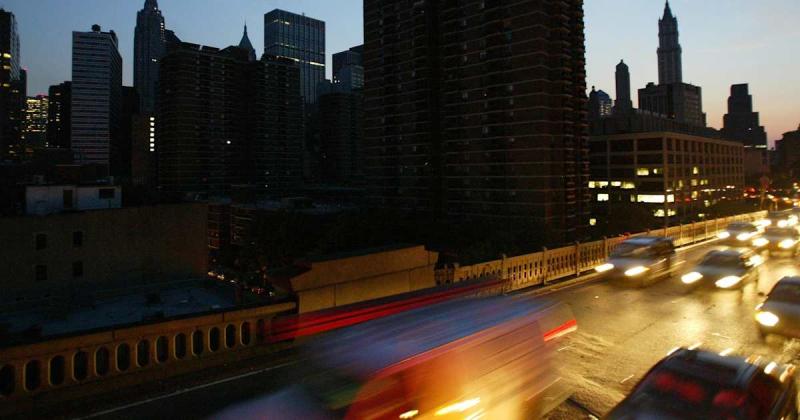
On August 14, 2003, a major outage knocks out power across the eastern United States and parts of Canada. Beginning at 4:10 p.m. ET, 21 power plants shut down in just three minutes. Fifty million people were affected, including residents of New York, Cleveland and Detroit, as well as Toronto and Ottawa, Canada.
Although power companies were able to resume some service in as little as two hours, power remained off in other places for more than a day. The outage stopped trains and elevators, and disrupted everything from cellular telephone service to operations at hospitals to traffic at airports. In New York City, it took more than two hours for passengers to be evacuated from stalled subway trains. Small business owners were affected when they lost expensive refrigerated stock. The loss of use of electric water pumps interrupted water service in many areas. There were even some reports of people being stranded mid-ride on amusement park roller coasters. At the New York Stock Exchange and bond market, though, trading was able to continue thanks to backup generators.
New York City
It's densely populated and filled with the world's most iconic landmarks. Learn some facts and figures behind "the city that never sleeps."
1:37m watch
Authorities soon calmed the fears of jittery Americans that terrorists may have been responsible for the blackout, but they were initially unable to determine the cause of the massive outage. American and Canadian representatives pointed fingers at each other, while politicians took the opportunity to point out major flaws in the region's outdated power grid. Finally, an investigation by a joint U.S.-Canada task force traced the problem back to an Ohio company, FirstEnergy Corporation. When the company's EastLake plant shut down unexpectedly after overgrown trees came into contact with a power line, it triggered a series of problems that led to a chain reaction of outages. FirstEnergy was criticized for poor line maintenance, and more importantly, for failing to notice and address the problem in a timely manner—before it affected other areas.
Despite concerns, there were very few reports of looting or other blackout-inspired crime. In New York City, the police department, out in full force, actually recorded about 100 fewer arrests than average. In some places, citizens even took it upon themselves to mitigate the effects of the outage, by assisting elderly neighbors or helping to direct traffic in the absence of working traffic lights.
In New York City alone, the estimated cost of the blackout was more than $500 million.
With few options to access information about the major power outage, a crowd of people gathered around a battery-powered radio to listen to the news. Amber D'Hooge/Redux

Batteries were in high demand across the city, and sold out quickly. This crowd, on the Upper West Side of Manhattan, lined up at the local hardware store for batteries to power fans, flashlights and radios. Diane Bondareff/AP Photo

Transit was crippled during the blackout—just as many people started to make their way home for the day. Subway cars that had been operating during the blackout slowed to a half and were left stranded underground. Crowded train cars across all five boroughs had to be evacuated. Diane Bondareff/AP Photo

With no access to the subway, the streets filled with people looking for a way to get home. Some pedestrians got creative by hitching a ride on the back of a New York City bus. Christie Johnston/AP Photo

Not everyone was able to use the limited NYC transit options available. David Eisenberg, who had commuted in on the Long Island Railroad, stood in Time Square with a sign looking to get a ride home. Jose Jimenez/Primera Hora/Getty Images

It was only two years since the city had endured the September 11 attacks and many New Yorkers feared the blackout had also been caused by terrorists. On the night of August 14th, thousands of people started to make their way home on foot over bridges, crowding the streets and creating total gridlock. Dan Callister/Camera Press/Redux

I conic views around the city became unrecognizable in the dark. Times Square, known for its bright lights at all hours fell dark just like the rest of the East Coast. Robert Rosamilio/NY Daily News Archive/Getty Images

As the blackout carried on to the following day, many New Yorkers tried to carry on as usual. Here, Peachy Garcis soaps up near a fire hydrant for a quick shower in Manhattan's Chelsea neighborhood. Corey Sipkin/NY Daily News Archive/Getty Images

The power outage affected many businesses, including those with perishable items that needed refrigeration. Here, Natalie Matos looks over a limited supply of meat at the supermarket. (AP Photo/Diane Bondareff) Diane Bondareff/AP Photo

Many tourists who had had booked air-conditioned hotel rooms resorted to sleeping outside on the sidewalk when the power went out, rather than staying inside their stuffy rooms. Mike Albans/NY Daily News Archive/Getty Images

Commuters waited for their trains at Grand Central Station on day two of the blackout as the city remained without electricity. Jose Jimenez/Primera Hora/Getty Images

Buses and ferries were the only mass transportation options for stranded commuters who rely on subways and rail. Hordes of people were forced to squeeze into the limited buses that continued operating. Andy Levin/Redux

A stranded traveler sleeps in the baggage claim area at John F. Kennedy International Airport. Flight delays at airports in New York City stranded travelers for up to 48 hours or more. Julie Jacobson/AP PhotoTimeline

Also on This Day in History
Discover more of the major events, famous births, notable deaths and everything else history-making that happened on August 14th
1751 -- A daughter poisons her father
Francis Blandy falls into a coma and dies in his home outside London, England. Later that night, Blandy's daughter Mary offered one of the family's servants a large sum of money to help her get to France immediately. Mary was forced to flee on her own when he refused, but she was chased down and […]
1795 -- George Washington signs Jay Treaty with Britain
On August 14, 1795, President George Washington signs the Jay (or "Jay's") Treaty with Great Britain. This treaty, known officially as the "Treaty of Amity Commerce and Navigation, between His Britannic Majesty; and The United States of America" attempted to diffuse the tensions between England and the United States that had risen to renewed heights […]
1917 -- China declares war on Germany
On August 14, 1917, as World War I enters its fourth year, China abandons its neutrality and declares war on Germany. From its inception, the Great War was by no means confined to the European continent; in the Far East, two rival nations, Japan and China, sought to find their own role in the great […]
1935 -- FDR signs Social Security Act
President Franklin D. Roosevelt signs into law the Social Security Act on August 14, 1935. Press photographers snapped pictures as FDR, flanked by ranking members of Congress, signed into law the historic act, which guaranteed an income for the unemployed and retirees. FDR commended Congress for what he considered to be a "patriotic" act. Roosevelt had […]
1945 -- Japan's surrender made public on V-J Day
In what later became known as V-J Day, an official announcement of Japan's unconditional surrender to the Allies during World War II is made public to the world on August 14, 1945.
1971 -- Pitching ace Bob Gibson throws first no-hitter
On August 14, 1971, St. Louis Cardinals ace Bob Gibson throws the first no-hitter of his storied career. Gibson's heroics helped his team sail to an 11-0 victory over the Pittsburgh Pirates. Gibson overcame numerous childhood ailments—including rickets, asthma and a heart murmur—to earn a basketball scholarship to Creighton University after high school. His basketball […]
1985 -- Michael Jackson takes control of the Beatles' publishing rights
On August 14, 1985, King of Pop Michael Jackson purchases the publishing rights to the vast majority of the Beatles' catalog for $47 million. It was while collaborating on 1983's "Say Say Say" that former Beatle Paul McCartney is said to have advised Jackson to invest some of his enormous wealth in music publishing. It […]
1994 -- The terrorist known as Carlos the Jackal is captured
On August 14, 1994, French intelligence agents capture terrorist Illich Ramirez Sanchez, long known as Carlos the Jackal, in Khartoum, Sudan. Since there was no extradition treaty with Sudan, the French agents sedated and kidnapped Carlos. The Sudanese government, claiming that it had assisted in the arrest, requested that the United States remove their country […]
Remember the Golden Rule, be a good human. We're here to relax and chat, so let's keep it civil and fun. Please, remember to quote the person(s) you are replying to as a courtesy so everyone can follow the conversation. Grossly derogatory comments, blatantly inflammatory comments, excessive trolling, mean-spirited taunting and insults, scamming, spamming, and off topic comments may be removed in compliance with the site's Terms of Service and the Code of Conduct. The moderators have the final word and may remove comments at their judgement (or lack thereof).
Past performance does not guarantee future results. Comment at your own discretion. The owners of the site, the owner of this group, and the moderators are not responsible or liable for any stupid thing you do. You break it, you buy it. No shirt, no shoes, no service. Don't poke the bear. Mind the gap.

Tags
Who is online
93 visitors
Where were you when the lights went out?
In a very dark place.
I see. Or maybe not ...
I remember that blackout well. I was still living in Toronto and I didn't first notice it because I was at homw using my laptop at the time, which of course was battery-powered.