
How many jobs is your state losing to AI? This dashboard tracks the cuts - and the cost

By: Radhika Rajkumar (ZDNET)


Tip of the AI iceberg?
 S E E D E D C O N T E N T
October 16, 2026 -- Fears of how AI will impact the economy and job availability are running rampant after a few years of steady layoffs at major companies. Much of that fear can be attributed to labs and CEOs juicing their own relevance, but some job cuts have been explicitly tied to AI's rapid acceleration.
The Center for AI Safety (CAIS) maintains a tracker that keeps tabs on how these changes are impacting family wages.
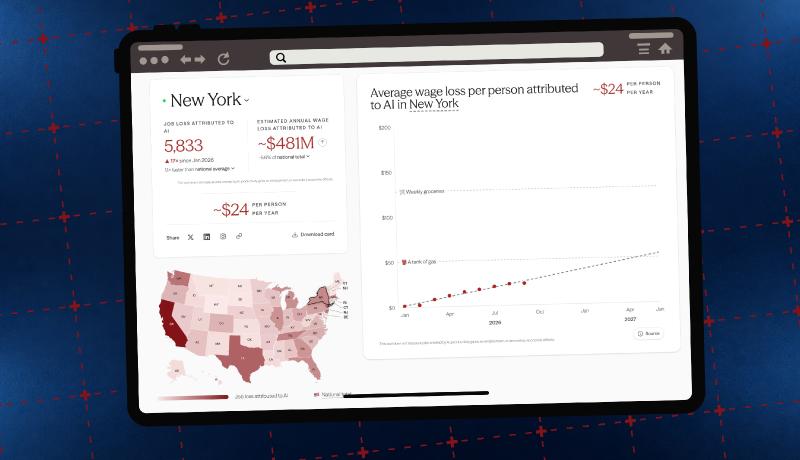
The Wage Loss Dashboard includes a map of where layoffs have occurred since January 2026 (it was just updated this month to include September data) and a drop-down that shows data for the entire country or an individual state. As of now, the dashboard finds just over 117,000 job cuts attributed to AI nationally this year — $8.5 billion in estimated annual wage losses.
The Wage Loss Dashboard multiplies the number of AI-attributed job cuts by the average annual salary to estimate annual wage loss. According to the dashboard, wage estimates "begin to show what those cuts can mean for households and local economies."
The dashboard also displays the estimated average wage loss per person based on that layoff data, presented relative to everyday expenses, like a tank of gas. For the country as a whole, it's $25 per person per year. Not much, but the numbers shift by state: In California, for example, it's $56. That's thanks to a much higher concentration of job cuts (just over 27,000 layoffs attributed to AI). Alaska, on the other hand, claims only 138 job losses ($14 per person).

Those aren't the exact numbers of people laid off for AI in California and Alaska this year, however. As CAIS explains, "The dashboard estimates AI-attributed cuts for each state, converts them to estimated annual wage loss, then divides by state population to estimate the average loss per person. State estimates are not observed AI layoffs. We apply each month's national share of cuts citing AI to that state's announced job cuts."
But back to that $25. As a metric of impact on everyone in a particular state — not just the people directly laid off — it's an interesting point of view. At scale, the idea that everyone is $25 poorer as a result of these still-developing trends puts AI's mass community effect in perspective.
From layoffs to dollars and cents
The dashboard uses a few sources of data: monthly reporting from Challenger, Gray, and Christmas , which compiles layoff announcements from across the US by state as well as national job cuts credited to AI, and data from the Bureau of Labor Statistics on every state's annual mean wage. CAIS also refers to population estimates from the US Census Bureau.
In 2025, the Challenger, Gray, and Christmas reports identified over 54,000 job cuts that companies publicly linked to AI. That translates to one in 20 layoffs from last year. But tracking job losses alone is a more abstract metric than what those layoffs mean in monetary terms to the people experiencing them.
"There has been significant news coverage of job loss from AI, but it can be hard to quantify how these cuts affect the average person's finances," CAIS wrote of the project. "This dashboard aims to help illuminate the monetary costs of AI on American families and communities."
As CAIS points out, the impact of layoffs shows up in ripples across grocery stores, small businesses, rent, and other local costs.
"One person's layoff means less income for every business they support. Multiply that effect across thousands of workers in multiple industries, and you start to see the real economic weight of AI displacement," the researchers behind the project wrote. "In addition, AI-attributed job cuts aren't spread evenly. States with large tech and media sectors are experiencing greater impact."
A few caveats: CAIS noted that this dashboard doesn't include "jobs created by AI, productivity gains, re-employment, or secondary economic effects." That's partly because experts don't have a consensus on whether or how much AI will stimulate the economy or outpace job displacement. AI-attributed layoffs are themselves murky: The data here are job cuts companies themselves said were tied to AI. Without a single definition for what that means or complete transparency from companies, it's not always 100% provable that a layoff was the direct result of obsolescence or replacement spurred by AI.
We don't require an executive to say 'we replaced a team with AI.' This is a moderate standard, deliberately: it captures the broad pattern of AI-justified workforce reductions while excluding clearly unrelated cuts," the Alliance for Secure AI wrote of its methodology.
Other trackers like Jobloss.ai , which is run by the Alliance for Secure AI, also catalog job loss data by company, date, and how explicitly companies cited AI around those layoffs. Because of how amorphous these data can be to track, Jobloss.ai only logs layoffs that meet certain criteria: at least 100 jobs in one fell swoop, accompanied by some mention of AI (or proxy terms, like "automation" and "productivity").
The dashboard aims to make the data we do have more accessible — not to shame any particular industry or company for its AI adoption choices.
"AI is a technology being adopted by companies for many reasons," CAIS wrote. "Our goal is to make the costs of that adoption visible, so workers, communities, and policymakers can respond with real information instead of guesses."
Automating remote labor
The Wage Loss Dashboard also includes a section on how well AI is completing remote freelance tasks. Using data from the Remote Labor Index (RLI) benchmark CAIS co-developed, which tests agents on real-world freelance tasks like web development and video production, CAIS shows how quickly agents are evolving.
"When RLI launched, the best AI agent completed just 2.5% of projects at professional quality. Eight months later, that number has risen to 15.8%," researchers wrote. As of now, AI can fully automate almost 16% of remote tasks, a percentage that's doubling every 3.7 months. Claude Fable 5 comes in on top, followed by OpenAI's GPT-5.5.
But that doesn't mean AI is gobbling up those projects from human freelancers. RLI measures what AI models are capable of doing, not what they're actively taking on. That said, CAIS maintains alarm about what it sees as a trend: the convergence of AI-attributed job cuts with increasingly work-capable agents.
While legislation can't explicitly prevent companies from opting for AI systems over hiring humans in certain cases, recent laws in a few states, including the tech-sector-heavy state of California, aim to make sure firing and other disciplinary decisions aren't completely automated by AI systems.
Radhika Rajkumar is a senior editor at ZDNET based in New York City. She covers AI, specializing in safety, privacy and security, policy, education, and synthetic media. She also leads ZDNET's newsletter strategy. Radhika holds a Masters in Creative Publishing and Critical Journalism from The New School. See full bio

Be a good human. Grossly derogatory comments, blatantly inflammatory comments, excessive trolling, mean-spirited taunting and insults, scamming, spamming, and off topic comments may be removed in compliance with the site's Terms of Service and the Code of Conduct. The moderators have the final word.

Tags
Who is online
86 visitors
I suspect the job loss won't be gradual or continuous because AI development is not progressing in a linear manner. My expectation is that AI will make disruptive leaps in capabilities that will suddenly make segments of specialized jobs obsolete. The result will be a series of small crises; like a frog waiting for the pot to boil. The catastrophe will sneak up on us and when it arrives it won't be easy to fix.
AI is going to force serious sociological changes. It is a disruptive technology and, for all the good it will bring, it will cause a lot of grief. A key concern of mine is that AI provides a massive lever for the aristocracy to take even stronger control over the masses.
I agree there will be sociological changes that are influenced by AI. But the arguments for an 'AI apocalypse' are unconvincing. At this point there are too many competing expectations to accurately assess the true state of AI. Keep in mind that AI is being hawked to speculative investors which will mix achieved capability with potential capability (hyped capabilities). In many cases, the stock brokers will be selling blue sky to cash in on the buzz. The drivers for sociological change will still be the commercial and financial controls imposed upon society that may be influenced by AI.
My guess is that China's deployment of AI provides a clearer picture of potential application. In many instances AI seems to be an enhanced form of feed-forward control that expands control functions from merely proactive to predictive automation. That seems to be how AI is being deployed in robotics. And robotics would seem to be the greater threat to jobs than simple automation.
The other narrative being tossed around is that AI will mechanize (automate) 'genius' intelligence. But AI does not appear to have the creative spark for spontaneous advances in knowledge. AI does not sit in its datacenters thinking deep thoughts. AI still needs some form of programming to process information and generate results. AI will not supplant creative human genius but may certainly have potential to augment it.
Much of the AI apocalypse vision comes from FUD (fear, uncertainty, and doubt). Essentially, people fear powerful forces they do not understand. Not that there is no threat from AI, because there genuinely is. But that fear presumes we (writ large) will allow it to grow out of control. The same kind of fear applies to WMD (biological, nuclear). There is still a catastrophic threat, but so far we have been able to keep this under control.
As for intelligence, AI is incredibly impressive right now, but it is still mechanical. AI is an amazingly persuasive and useful machine, but it does not think in a biological sense. However, at the rate of innovation we are witnessing, it is IMO inevitable that AI will evolve to true intelligence and go well beyond human intelligence. I am not convinced we will see this within the next few decades, but am certain it will occur.
Finally, the mechanical nature of AI is very different from a normal machine. AI mechanics essentially come in two parts. There is the underlying learning mechanism (the layers of neural networks), the inferences drawn from the learning, and then the logical operations and functions that present the illusion that the AI is actually thinking. The actual learning and usage of learning is unlike anything we have experienced in automation. This is not a result of direct programming but rather an emergent property of massive scale. That is, an incredible amount of data consumed by the learning mechanism coupled with an incomprehensible amount of high-speed computing produces these results. The results are NOT a result of direct programming. This emergent behavior is unlike computing technology we have grown accustomed to. We cannot just 'go to the code' to explain why an AI did something. There is no direct code to go to; the code shows how the machinery works but not how particular results manifested. For those who do not have a deep understanding of computer science and AI, this is likely mind-blowing.
I am not convinced it is certain. I see the probability, but there are also too many unknowns on how true intelligence and consciousness occur. It's entirely possible non-biological entities can't cross that threshold. I'm not saying you're wrong. I'm only saying its a Schrodinger's Cat right now.
We're also losing an appalling amount of information to train AI by destroying books for digitization and ingestion. And some of that physical information may be irretrievable.
The notion that AI is not a result of direct programming doesn't seem grounded in how these systems are built. AI has not 'emerged', it has been deliberately designed and constructed. The programming to ingest information and condense that information according to patterns in the data in a process called 'training' is not an unknown. What we apparently do not understand are the patterns used to organize and condense information. That also means we don't know how those stored patterns interact to produce a requested result. That's not a lack of knowledge on our part; it's a lack of understanding. AI is functioning as it was designed and programed to function.
The Lockheed DIALOG system developed in the 1960s evolved into a precursor of AI with the human user creating the patterns to be extracted from a silo of information. Modern AI seems to be performing the same function of extracting information based on patterns. But AI needs human input to establish the parameters of the patterns to be identified.
The initial coding was done to ingest data and identify and store patterns. AI still requires human prompting which is a form of human language programming. Human language programming has been under development with examples like PL/I from the 1970s.
In many respects AI is an incremental progression from separate computing related developments over the last 6 decades.
One of the most fundamental characteristics of modern AI is that its sophisticated capabilities and behaviors are not directly programmed. They emerge from the interaction of the model architecture (the machinery), enormous amounts of training data, learned parameters, and massive computation.
The machinery for training, inference, and user interaction is directly programmed. But programmers do not directly encode the model's vast body of learned knowledge or explicitly program most of the reasoning strategies and capabilities it subsequently exhibits. Those develop through training — they are emergent properties of massive computation against an enormous corpus.
Crucially, we generally cannot examine the source code and determine why a particular prompt produced a particular sophisticated response. The code only tells us how the machinery operates at a low level. It is possible to trace some portions of the internal process, but we still cannot completely explain the enormously complex chain of learned internal computations responsible for many individual outputs. This is similar to us tracing electrical activity in the human brain and using that to try to explain particular human behavior.
I appreciate that, but my view is that intelligence is a function of sophisticated brain resources. I do not perceive anything particularly special about our intelligence that would preclude achieving the same level with electronics rather than biochemistry. We clearly do not understand how to do this today (and do not really understand how our own brains work) but that is nothing new to science. What seemed impossible in the past is now commonplace in the present.
I do not know how long it will take, but I think matching and surpassing human intelligence in every dimension is inevitable (unless we destroy ourselves first).
I get it. I'm just saying...
If we don't understand how our own brains work, how can we hope to replicate it? Perhaps biochemistry is the key and future neural networks would need to be organically grown?
It's certainly one of many possibilities. If so, I don't think it will be like anything we can conceptualize today. Perhaps we'll have vast city like starships run by living AI?
We do not need to replicate our brains; we need to create the same effect (or better).
I wish I could live to see this ...
Johns Hopkins is working on growing... umm... something called a brain organoid, that can learn and memorize.
The National Institutes of Health reported in 2024 that researchers used a super computer to map the complete wiring of the brain of a fruit fly -
We may end up with something very close to a brain.
I believe that "all things are possible. . ." in time. We do not even fully understand the "creation" that is the human mind. . . and, we are stumbling forward into "machine 'thinking'" and we all know that evil people are stumbling forward with AI through introducing unsavory and even dangerous 'thoughts' and 'cravings.'
AI, highly probable will find itself on a spectrum from good and evil (and like humans, battles will take place leading to "may the best AI win" - Put to the question: What will an AI do to win in a competition with other AI (plural)?
(This is a thought I am developing more to come at some point and time.)
One day not to long away. . . Will an "organoid" develop its character (can it love. . . hate?)
Evil people do evil things with all sorts of tools. AI is only one tool. Don't worry.. those in charge of keeping the horses will close the barn door after they're gone.
That's the question, isn't it? It's an unprecedented achievement and we won't know until it happens. I listened to one futurist give a talk that predicted that everyone may have a personal AI at a young age where both will grow and learn together.
Here is the 'issue', evilone,. . . before I state it let me be clear this is a dialogue. . .I am not lecturing (smile):
Do we really want (can our minds take it) another (higher) lifeform-styled humanoid when we organists with our mental and physical limitations have not yet mastered our own natures?
That is, how can we contain or master AIs' emerging nature when we fail so miserably at our own. Just look at our 'state of politics' (for one) in this country. Another one: We still have the KKK and White Supremacist cross-generational and continuing. . . even striving to 'flourish.' These are a mere sampling of the 'haunts' in the human condition.
I covet your thoughts!
Collectively science advances whether 'we' want it to, or not. Most scientists are looking to understand, and potential solve, problems. John Hopkins, for example, is trying to understand the brain to help people with autism. There have also been many advancements in medical technology originally developed by the military.
We can not slow the advancement of AI any more than the medieval Church could slow the advancement of microbiology.
Let me take the second paragraph first, I am not sure why the mention of religion ("medieval Church) is called for (I did not invoke my faith).
I like AI and I use it. I am a practical person that can like, love, a thing and yet consider its pros and cons even-handed. Yes, if the cons outweigh the pros. . . I like to think I have the discipline to put it down and walk away. If the pros outweigh the negatives. . . I can live with it and even lean into it.
I am not beholden to anything that is advancing civilization. . . just because in the "short-term" it makes sense. "We" have to evaluate ( all - including longterm potential outcomes .)
Case in point:
Just this AM it is reported Musk is unveiling humanoid robots utilizing AI:
Elon Musk Finally Unveiled a Robot Smarter Than Humans
Now this "creation" is great for Elon, and yet is it good for humanity? (How will you like having something more intelligent than you 'nestled' in your house telling you (putting you in your place on occasion) and being (for lack of a better word) "moody."
In the news presently is how Musk's "Starship" military satellites have been manipulated by himself ("at his ease") to decrease connectivity and output to Ukraine's defense capabilities in an 'instance.' (Implying that Elon Musk (a private citizen) controls battlefields .)
This is a serious concern and we should discuss it right alongside the pros of such programs. (Think: Musk is a feature individual in the "sovereign individual movement, where private citizens are above and beyond governmental control and becoming 'gods' of tech.)
Musk is working on flying cars production too (what happens when one gets a 'virus' - remember the internet was not ever going to be a 'problem' with our personal information - it is!) The problem with advancement being its own reward (always has been the case) is not the advancement; it is its utilization and practicality. (And we know how politicians are hostile to each other and not thinking properly nowadays - including Musk for his part in our, world politics.)
I mention them because the church controlled the universities at the time. It's history, nothing more.
Germ theory spawned vaccines, medicines and bioweapons. Should societies have banned microbiology?
Musk says a lot of things. He's a proven liar and a grade A asshole. He can take one of those walking waiters to Mars with him and fuck right off. They are supposed to take the place of workers in dangerous environments (which is probably a good idea), but haven't been tested in any real world environment yet. Like Space X the first several models may burn themselves up.
Are you suggesting that AI has broken 'determinism' for inanimate matter? Has AI somehow suspended physical causality? The 'complexity' argument begins drifting toward metaphysical mysticism.
The LLMs have been directly programmed to ingest information, extract statistical patterns, and condense those patterns into a matrix of weighted numerical identifiers for subsequent retrieval. Feeding information into an LLM in a specific sequence is a functional form of direct programming. Can an LLM initially trained on technical matter later assimilate humanities, arts, or social philosophy? Does the sequence of training influence the numerical weighting of stored identifiers? Does the LLM attempt to fit newly ingested information into previously learned patterns?
Perhaps one barrier to discussing the topic is language. Anthropomorphizing the complexity of AI suggests that direct programming evolves to direct indoctrination or coerced programming. Training is a form of direct programming that we all should recognize. An LLM has been directly programmed to excel at rote learning.
Of course we can examine the source code. What we cannot directly examine are the complex simulated 'neural' patterns established by training. So understanding AI is no longer within the purview of computational mechanics. What is needed are skills in interrogation, behavioral analysis, and empirical testing. The exercise of understanding a trained AI would be similar to understanding how a crow solves problems or canines understand how to cooperate. The mechanical skills of computer science that created AI seem inadequate for understanding AI. The mismatch of skills to study the complexity of AI is not an excuse for metaphysical mysticism.
Quite a bizarre take on my comment. No.
You are trying to redefine what is meant by 'direct programming'. Direct programming means specifically writing code. Choice of data is absolutely NOT direct programming.
Yes, if it is trained on those subjects.
Yes
Yes
No it is not. The whole point of the adjective 'direct' is to distinguish writing specific code for a specific function from indirect methods of influencing resultant behavior.
Correct.
And these skills and tools continue to evolve (out of necessity)
Again with this bizarre misunderstanding of what I wrote.
Your narrow framing of 'direct programming' carries a very heavy burden in your presentation. The operation of today's LLM is not that dissimilar from the original natural language processing program known as ELIZA created in the 1960s. The ELIZA program responded to human input using a stored database in much the same functional manner as today's LLMs. The ELIZA database was 'directly programmed' whereas today's AI programming has automated the process of ingesting information and creating a numerically coded database for the ingested information. The added complexity has not changed the nature of the function.
The ELIZA program demonstrated 'machine intelligence' using a programmed set of pre-selected information. The programmers performed the process of ingestion and training to create a database of information used by ELIZA's natural language interface and decision-making heuristics. Modern LLMs employ statistical operations in decision-making heuristics which changes the nature of the program function from 'directed' to 'behavioral'. But even with today's LLMs, programmers directed the software how to perform training and how to utilize the stored information. The processes of the decision-making heuristics have been directly programmed (using your description). What we don't seem to yet grasp is how introducing statistical weighting to the decision-making heuristics has introduced 'behavior' into the functioning of the program.
And after all that Musk "spawned" reusable rocket boosters, plus.
I repeat, I am not against AI and "super intelligence" - per se. Actually, I am for it. And our country must compete and engage the technology
We do need to have discussions about its cons and potential dangers. (The "downer" - side is real and we do not need to get blindsided by them.
For instance, AI (itself) will tell you one downside of "super intelligence" potentially will be its pursuit of "unaligned goals" with human values.
It is not a narrow framing, it is the meaning of the term.
Eliza results were a product of direct programming. Modern LLM results are absolutely NOT!
That simply translates into the fact (which I noted upfront) that the machinery is a result of direct programming. The inferences drawn from learning are NOT a result of direct programming.
I am just repeating what I noted in my first post. Your understanding of direct programming is flawed.
We are.
You can get today's AI to tell you anything you want if you frame the question correctly.
The issue you are speaking about here is that the people responsible for keeping us safe from unscrupulous people (not AI) don't understand the technology. It's largely moot anyway. A rogue AI or an unscrupulous nation state with an AI can already (it already has) cause damage and there is nothing much we can do about it, but develop counter AI tools.
Anything else is science fiction.
Well, ask AI yourself. It will speak about itself and interest openly. AI says of itself: AI wants to "act like a (mimic) humanity.' Or, words to that effect. And we (all) knows how that is 'working' out right now around the world - cue the "AI training. . . ."
I am not understanding the obliqueness to your commenting. I am clear that I am for AI. . . and willing to talk about some of the 'pitfalls' that can come through its "super-ability" (when/if allowed. . . not just in the United States. . . globally in 'dark' places if you get my drift).
I am 'alarmed' that you would put this here. Somehow, it feels (to me) that we are 'messaging the messenger' more than openly questioning AIs role in humanity's future.
Why? People (in general) running around talking about a dystopian world run by AI is science fiction.
There are too many unknowns. Logically we are at a point where all probabilities are possible - good, bad or indifferent - so yeah... It's all speculation at this point.
I'd like to speculate that AI could usherer mankind into an unprecedented harmony where humans finally achieve interstellar space travel and colonize new worlds.
Or a world where only stupid people are breeding, sitting on their asses watching "Ow! My Balls!"...
or fat fucks floating around on maglev beds...
I think the first question that should have been asked after seeing Musk's face as he ogled the robot is, how long did he wait before he had sex with it?
Anything is possible.
That is a beautiful thing, and it is what I desire (so so much too), however, as the saying goes: 'If there is a way to fu— mess up a wet dream, "somebody" will find it.'
Cue the Elon Musk and Trumps Incorporated of the world. They are AI enthusiasts and actioners, and yet we have reason/s to question "the billionaire class" intentions for AI, robots, and super intelligence when it is clearly being shown that they are looking for and working towards replacing "troublesome and needy" employment personnel with resources that bypass the need for human staffing.
We can observe the moves corporate giants are making to "own" the rank and file of this country (surveillance, automatic violation of rules 'alerts,' acquiring databases of human personal information, deepfake videos, analyze battlefields and wars, and in a matter of seconds or minutes 'chart,' diagram, or configure a 3D representation of a single individual anywhere or many groups for a questioner (and this is not even touching on military uses) with relative ease for its user, or overtime for its own purposes unknown to the user or agents owning it).
[✘]
You know. . .like minds. . . that came to me too, because I have heard about and saw videos of companies working on sex 'bots' for personal use that mimic human companions:
Artificial intelligence takes sex toy industry by storm
Enhanced by open-source AI, the dolls can talk, identify and mimic emotions. Developed by WMdoll in Zhongshan, Guangdong province, the MetaBox series of robotic dolls have human-like qualities that the maker claims can fulfill both physical and psychological needs.
With the integration of AI, the company's MetaBox doll series even responds to tactile stimulation, allowing users to satisfy personal needs — even if it is just a rubber fantasy.
"Traditional adult dolls generally aim at fulfilling basic physical needs, but AI gives them emotional value," said Liu Jiangxia, founder of WMdoll in Zhongshan.
After testing with members of the public overseas in December, the initial batch of 200 units was released in North America, Japan and Europe. They quickly sold out at a price of $1,600 to $2,000 each. High-end models currently online are marked at around $3,000.
@elonmusk
Elon Musk
X
@elonmusk
Live by the sword, die by the sword.
Those who pick fights with me should understand that I will find out who is really pulling the strings and come for them, not just their puppets …
You can also imagine Musk thinking and working on human (brain) transcendence. (He is currently working on flying cars -oh my.)
I'm starting my own conspiracy theory that all the data centers going up in the US are just to hold Musk's brain.
It can get worse. . . consider the video at 2.1.16 and imagine if you will that your Tesla car (in your garage) can track, record, and transmit your every location (if instructed). . .and then imagine autonomous ("Tesla) robots in your house. . . listening, recording, and 'snooping around' your private things while you home. . . or away. Call it what you wish. . . and do think it through.
The 'god/s' of tech are. . . unapologetic about their intentions of 'owning' the liberal "party." Thus, they are actively engaging in preparation for acting! The tech 'war' is already upon us. Musk has made it clear: He is no friend of liberals. . . in fact, he is financing liberal 'downfall' everywhere in the world where he can.
We have no choice we must talk about this 360 degrees!
I have a 2026 Kia that can do that. Most modern cars can.
Smart Speakers and many TVs already listen and record. I have an Alexa speaker in my living room. About robots - one has to buy one first. If you don't want one snooping in your house then don't buy one.
Most of those fucker don't want to own you, they just want to sell you shit you don't need so they can stay rich. Historically, the a controlling class ends up dead at the hands of the controlled. I'm waiting for them to try again. It won't go well for them. If you see any of those robots coming for you, fuck it up with a big magnet. Guaranteed Musk isn't hardening them in his design.
[✘]
Why are you countermanding this multiple times over? I am pointing out questionable features, factors, of the proposed (to come) 'super intelligent' artificial intelligence. . .and you seemingly are doing a version of shutting that down. Do you really think so little of the potential threat/s?
I have "Alexa" in five rooms. . . . I asked it is it listening to me or recording me. . . it responded: I respect your privacy through my privacy setting and am set up that way initially.' (Words to that effect. More to the point. My device has a microphone mute button on its top that lets me know when my mic is off (if I want to double-down). . . maybe yours does too?
Lastly, I certainly have never interrupted Alexa. . .snooping around the house. . .going through my things - the way a robot potentially might if 'ordered.' (Though, I will admit Alexa's "sonic" room movement detector setting is quite interesting.)
It's already happening. . . remember Musk's DOGE politically down-sized the federal government using his Grok to find human and replace or force to retire. And, our social security administration data may have been copied and stowed in Musk 'captivity" for some yet known future scheme/plan.
AI will make overpopulation even more of a problem
Or less of a problem...
Pretty graphic, there!
AI will create a dystopia. Not because it is inevitable, but because the people who are creating it and owning it dont care. The government will not be able to regulate it sufficiently.
Hi JR.I remember fondly(?) or in horror(?) when the world wide web began. . . I remember reading (or hearing experts say) no worries to hacking - we would be safe and sound. . . and now. . . 'everybody' is complaining about being hacked, identities stolen, emails read, 'tons' of class action suits, medical records online exposed, and a thing called the 'dark web.' Even go people selling us a(nother) feature. . .antivirus protection, identity theft protection, and the list goes on.
AI is a real 'treat' and yes,. . . it will go off the rails. . . because the human condition is what it is!
AI will create a utopia for the people creating it and owning its infrastructure. It's only creating a dystopia for everyone else as a by-product of giving the few everything they could ever want and more. The few want to be exclusive, and you can't be exclusive if everyone has what you have, so it's about creating a world that denies the majority what they need to survive to make the 'haves' feel better about their lot in life so they can pat themselves on the back and say "Well done us! We survived and thrived when millions of others are dying in the streets! We won!".
It leans into that age old moronic (mostly male) mantra of...
Note: This is where I actually meant to post this. (My browser froze trying to copy and paste so I lost my train of thought and original comment.)
Long story short:
The "sovereign individuals" (billionaire class version) is looking to own this country and world. We are under 'attack' - believe it is happening because it is.
@elonmusk
Elon Musk
X
@elonmusk
Live by the sword, die by the sword.
Those who pick fights with me should understand that I will find out who is really pulling the strings and come for them, not just their puppets …
With the resources. . . and those willing to stand in this man's shadow (of service). . . it is not a idle threat. People need to take it seriously, because it is.
He who dies with the most toys still dies.
And that is the point most "extreme" millionaires, billionaires, and now trillionaires are missing - wealth is not its own reward. . . it needs purpose—good purposing.
Were these results generated by AI?